The Evidentiary Value of Six Ownership Notes Dated 1518-1563 and Signed by Muḥammad al-Qūṣūnī

Nomenclature has proved a difficult problem, for two reasons.  First, the style of both subjects changed three times during the course of their lives, from plain Lindsay, to Lord Lindsay, and finally Earl of Crawford. […] The second difficulty is the shortage of Christian names in the Lindsay family, James, Hugh, Alexander, Charles (and recently David) are recurrent names, born by several Lindsays in the period 1812-1913.

Nicolas Barker, Bibliotheca Lindesiana: The Lives and Collections of Alexander William, 25th Earl of Crawford and 8th Earl of Balcarres, and James Ludovic, 26th Earl of Crawford and 9th Earl of Balcarres, 1978.

[T]he respect for early books which is now taken for granted is a fairly recent development. Vast numbers of books have perished utterly and books which are described in old lists and catalogues may no longer exist. Many collections of the past are no longer reconstructable.  A separate kind of problem […] centres round the extent to which owners have marked their books. […] Although many owners have marked their books, for reasons of security, vanity, or both, many more have not, and countless books have passed through various hands without being marked in any way. This applies not only to people who owned only one or two books, but also to substantial collectors. […] This problem generates two obvious consequences. Firstly, there must be book owners of the past, and possibly quite major collectors, whose identity will never be known because their libraries were dispersed without a surviving record and the books were unmarked. Secondly, we may be able to identify people who are likely to have had appreciable libraries, but be unable to confirm one way or the other the influence which personal book ownership had on their activities, as their books cannot be identified even if they still exist.

David Pearson, Provenance Research in Book History, 1st ed., 1994.

Serendipity is always a factor in research, as is a scholar’s ability to recognize and seize an opportunity.  In 1958, a few years after the Egyptian Revolution of 1952, the government of communist Czechoslovakia appointed the Arabist Rudolf Veselý (1931-2020) to teach Czech at the Higher School of Languages in Cairo.  Until 1964, when he had to return to Prague for good, Veselý managed to research late Mamluk, early Ottoman history in the Egyptian archives, since he enjoyed, as an employee of the new Egyptian government, very generous access.  Immersed into these mostly unexplored riches, Veselý became an expert of Arabic chancery and legal documents, while writing his dissertation about a waqf from sixteenth-century Cairo (Dr. phil. Charles University, Prague 1966).  In the 1970s and 80s, Veselý’s academic career stalled in communist Czechoslovakia; nevertheless, he continued with his research about medieval Islamic archives.  After the Velvet Revolution of 1989, Veselý was eventually appointed professor of Middle Eastern history and culture at his alma mater.

In the 1970s and 80s, Veselý’s German colleague Rudolf Sellheim (1928-2013), professor of oriental studies at the University of Frankfurt (1958-1994), was working with uncatalogued holdings of the State Library in West Berlin (Staatsbibliothek zu Berlin SBB).  Sellheim noticed on the title page of a fragment of Rāzī’s commentary on the first volume of Ibn Sīnā’s Qānūn fī al-ṭibb the name Muḥammad b. Muḥammad b. al-Qūṣūnī in an ownership note, dated to the beginning of 947 [ began 8 May 1540 ].

SBB Ms. or. oct. 1466, fol. 1a
Fakhr al-Dīn Rāzī (1149-1210), Sharḥ kulliyyāt al-qānūn fī al-ṭibb
h = 21 cm, incomplete, colophon dated mid Shaʿban 627 [ end of June 1230 ]
purchased from Isaac Benjamin Yahuda (1863-1941) in 1913 (SBB acc. no. 1913.128)
digital surrogate: http://resolver.staatsbibliothek-berlin.de/SBB0001FA7300000000
Public Domain Mark 1.0
Qalamos entry: https://www.qalamos.net/receive/DE1Book_manuscript_00017885

There were three well-known physicians with the name Muḥammad al-Qūṣūnī, also al-Qawṣūnī: father, son, and grandson.  The al-Qūṣūnī family had come to prominence in fifteenth-century Cairo.  From the early sixteenth century until the early seventeenth century, several of their men served as physicians at the Ottoman court, and at least two died in Istanbul.  In Ottoman sources the family became known as Qayṣūnī-zāda, though it is not clear whether there ever was an Istanbul branch.  In contrast, the family’s Cairo branch is documented until the second half of the seventeenth century.  Between the fifteenth and the seventeenth century, other men of the al-Qūṣūnī family were also named Muḥammad.  While the al-Qūṣūnī family included distinguished physicians, members of this family were active in other professions as well.

The father’s full name was Shams al-Dīn Muḥammad b. ʿAbd al-Wahhāb al-Qūṣūnī (1430-1511).  He served at the time of his death as a personal physician of al-Ashraf Qānsūh al-Gūrī (r. 1501-1516) at the Mamluk court.

The son’s full name was Shams al-Dīn Muḥammad b. Muḥammad al-Qūṣūnī al-Nāṣirī (d. 1524).  He had worked, like his father, as a physician at the court of Qānsūh.  After the Ottoman victory over the Mamluk army near Aleppo, the Ottoman troops took Shams al-Dīn prisoner.  In early 1517, he joined the entourage of Selim I (r. 1512-1520), and worked around 1520 at the Ottoman court in Istanbul.  He died in Egypt, in Rosetta. However, his brother Sayyidī ʿAlāʿ al-Dīn ʿĀlī b. Muḥammad al-Qūṣūnī became the physician-in-chief at the Ottoman court, and died in Istanbul in 1548.

The grandson’s full name was Badr al-Dīn Muḥammad b. Muḥammad b. Muḥammad al-Qūṣūnī al-Ḥānafī; also known as Ibn al-Qūṣūnī and Qīṣūnī -zāda (1514-1568).  Due to a mix-up of proper names (Arabic sing. ism), in some Ottoman sources he is called Maḥmūd al-Qūṣūnī (Sellheim, Materialien zur Literaturgeschichte, 1: 205).  He was educated in Cairo.  In 1547, Badr al-Dīn successfully treated Beyazid, the governor of Anatolia and a son of Suleyman (r. 1520-1566), and the following year, the sultan appointed him as his personal physician.  Badr al-Dīn joined Suleyman’s Safavid campaign, and in 1549 he became a member of the Ottoman court in Istanbul.  Badr al-Dīn eventually served, from 1562 until his death in Istanbul, as the court’s highest ranking physician, first to Suleyman and then to his successor Selim II (r. 1566-1574).  Badr al-Dīn had a son named Muḥammad, though nothing further is known of him.

As these three physicians are easily mixed up (e.g., the references to Muḥammad al-Qūṣūnī III in Shefer-Mossensohn, Ottoman Medicine, 2010, index), Sellheim added to his catalogue entry (VOHD 17, A, 1, 55 = Materialien zur Literaturgeschichte, 1: 201-203 s.v. no. 55 and pl. 16, fig. 17) an excursus, for which he compiled biographical details scattered across a wide range of literary sources: “Zur Familie al-Qūṣūnī” (Materialien zur Literaturgeschichte, 1: 203-213).  To clearly distinguish the three men from each other, Sellheim numbered them Muḥammad al-Qūṣūnī I (d. 1511), Muḥammad al-Qūṣūnī II (d. 1524), and Muḥammad al-Qūṣūnī III (d. 1568).  Sellheim’s original essay was published in 1976.  His investigation had become feasible, since by the 1970s, new scholarship about the history of medicine in Muslim societies had facilitated access to both medical literature and physicians’ biographies.  Details for the life and work of Muḥammad al-Qūṣūnī III – a high-ranking court physician serving not just one, but two sultans in Istanbul – could now be gleaned from sixteenth-century Ottoman sources.  In 1987 Sellheim’s subsequent discoveries about the al-Qūṣūnī family were published in the “Nachträge und Berichtigungen” of his 1976 catalogue of SBB manuscripts (Materialien zur Literaturgeschichte, 2: 111-112 = VOHD 17, A, 2, pp. 111-112).

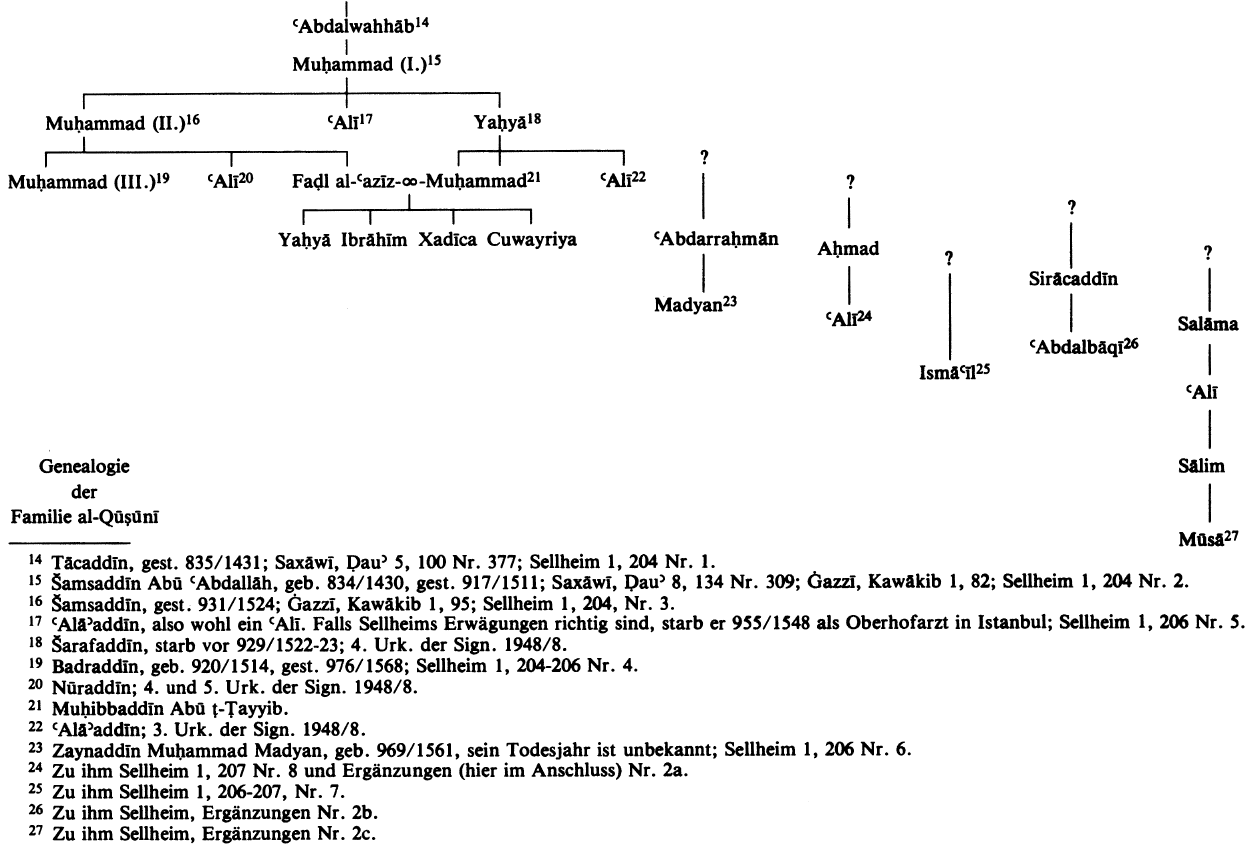
In 1992, an updated version of the excursus was published in Oriens (33: 441-444) – as the journal was still edited by Sellheim in Frankfurt.  It was presented as an appendix (“Ergänzungen”) to an article by Veselý about “Neues zur Familie al-Qūṣūnī: Ein Beitrag zur Genealogie einer ägyptischen Ärzte- und Gelehrtenfamilie” (33: 437-440).  During his 1960s dissertation research in Cairo, Veselý had discovered a waqfiyya (dated 1528) and five slightly earlier rental contracts.  Taken together, these six archival documents yielded new details about the al-Qūṣūnī family in the early sixteenth century.  Notwithstanding the synergy between their sources, Veselý and Sellheim stressed the fragmentary state of their knowledge, as the genealogy of the al-Qūṣūnī family continued to be constructed from biographical “membra disiecta” (p. 437) which could not always be linked to each other (p. 441: “Leider reicht der Name seines verstorbenen Vaters Aḥmad nicht aus, um den Anschluss an andere, uns bekannte Mitglieder der Qūṣūni-Familie herzustellen”).  Although the archival documents filled some gaps in the family tree, which was first constructed by Sellheim in 1976 (Materialien zur Literaturgeschichte, 1: 203, diagram 13), missing connections remained in Veselý’s revised and annotated family tree (p. 440):

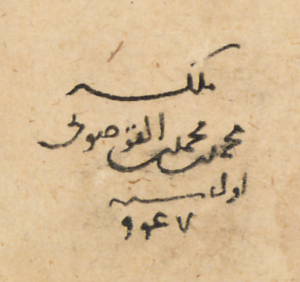
There is, however, a subtle difference with regard to how Veselý and Sellheim approached the ownership note in the Rāzī fragment (SBB Ms. or. oct. 1466), which had prompted Sellheim’s interest in the al-Qūṣūnī family.  The owner just stated name and date:

malaka-hū
Muḥammad b. Muḥammad b. al-Qūṣūnī
awwal sanat
947

Muḥammad b. Muḥammad b. al-Qūṣūnī
acquired it [i.e., the manuscript ]
at the beginning of the year
947

The bare-bones inscription is unremarkable, as no additional, identifying elements – be it a place name, be it a laqab, shuhra, or kunya – are required whenever an owner bothers – for their own private reasons – to write their name into a book.  It is after all just a book.  It might have been considered valuable, but really, so what?  How much care did people take, somewhere in the Eastern Mediterranean in 1540, when they scribbled their names into 300 year old literary fragments?  In the end, ownership notes are individual expressions, they are not legal documents.  For Veselý the ownership note proved that in 1540 the Rāzī fragment had been property of the al-Qūṣūnī family (p. 436: “die Familie al-Qūṣūnī, in deren Besitz sich die Handschrift i.J. 947/1540 befand”), and there he stopped.  Because of his research in the Egyptian archives, Veselý (“Hauptprobleme der Diplomatik:” 340) was familiar with the naming conventions according to which people identified themselves in contemporary legal documents.  In contrast, Sellheim (Materialien zur Literaturgeschichte, 1: 202) read the name in the ownership note as ending with Ibn al-Qūṣūnī, and thus identified Muḥammad al-Qūṣūnī III as the person who wrote his name into the Rāzī fragment in 1540.

At this point – without a thorough investigation of all references collected by Sellheim and Veselý – I am aware of two more manuscripts with ownership notes signed by an Ibn al-Qūṣūnī: an early twelfth-century copy of al-Ḥarīrī’s al-Maqāmāt in the Istanbul University Library (İstanbul Üniversitesi Kütüphanesi İÜK) and a fifteenth-century excerpt from Ibn Taghrībirdī’s Mawrid al-laṭāfa in the Gotha Research Library (Forschungsbibliothek Gotha FBG) of the University of Erfurt.

İÜK Ms. A 4566, fol. 1a
al-Ḥarīrī (1054-1122), al-Maqāmāt
h =  21 cm, complete, no date
contested authorial ijāza dated Muḥarram 514 [ began 2 April 1120 ]
first published by Ritter, ”Autographs:” 68-69 and pl. IV
description in MacKay, “Certificates of Transmission:” 28 and 72 fig. 23
for the authenticity of the ijāza, see Keegan, “Commentators,” 295 note 2
for the ownership note, see Sellheim, Materialien zur Literaturgeschichte, 2: 111
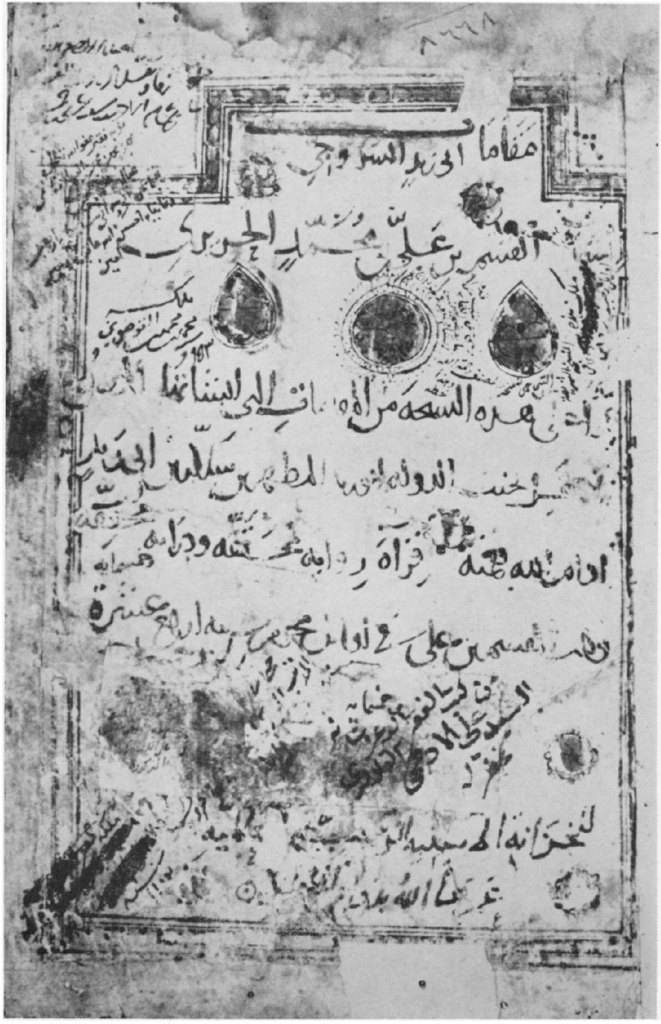
This ownership note is dated 953 [ began 4 March 1546 ]:
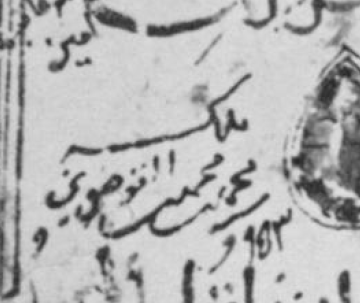
FBG Ms. orient. A 1626, fol. 1a
Ibn Taghrībirdī (1411-1469), Mawrid al-laṭāfa
h = 22 cm, excerpt, no date
purchased by Ulrich Jasper Seetzen (1767-1811)
image courtesy of the Gotha Research Library of the University of Erfurt
Public Domain Mark 1.0
I am much indebted to the generous help of Feras Krimsti, the FBG’s Curator of the Oriental Manuscript Collection
description in Pertsch, Die arabischen Handschriften, III, 3, 1881, pp. 242-243
Qalamos entry: https://www.qalamos.net/receive/DE39Book_manuscript_00001632
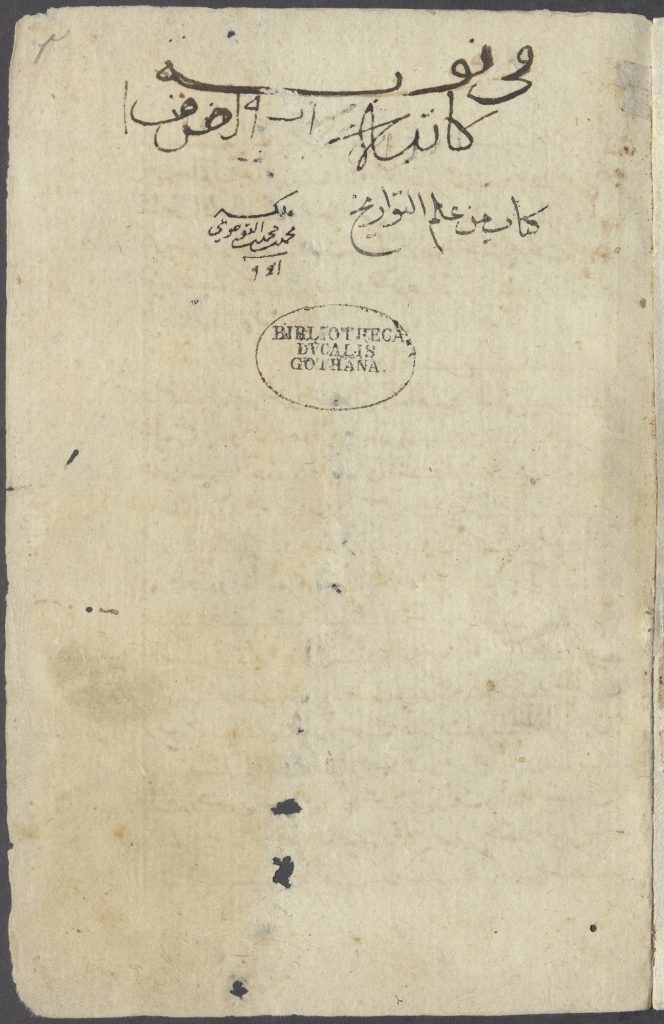
The ownership note has a Qalamos entry: https://www.qalamos.net/receive/DE39SecEntry_secentry_00001065
which reads the name as Muḥammad b. Muḥammad al-Qūṣūnī – without the second “ibn” – and identifies Muḥammad al-Qūṣūnī III as the owner.
The ownership note is dated 941 [ began 13 July 1534 ]:
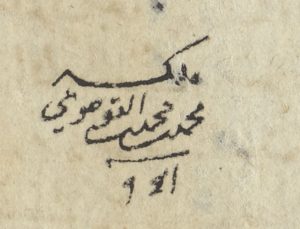
The most surprising aspect of these three ownership notes, which otherwise appear as almost uncannily uniform, is the variant spelling of the numeral 4 in the dates 947/1540 (SBB Ms. or. oct. 1466) and 941/1534 (FBG Ms. orient. A 1628).  As they are informal short writing samples, they do not allow for any sustained paleographical argument about the evolution of a person’s handwriting.  Regrettably, the manuscript in Istanbul is of no help, as it is dated 953/1547.

The fundamental challenge for the interpretation of ownership notes is the tension between consistency and variance.  Without unchanging characteristics it is impossible to identify hands.  Conversely, the possibility of seemingly random changes is always a convenient argument, whenever ownership notes could be assigned to already identified book owners.

Thanks to the continuing digitization of manuscripts in Arabic script, it is possible to compare Sellheim’s reading of the two ownership notes in SBB Ms. or. oct. 1466 and İstanbul Üniversitesi Kütüphanesi MS. A 4566 with an ownership note signed by a Muḥammad b. Muḥammad al-Qūṣūnī which has survived in a much damaged Dioscorides fragment in the Bologna University Library (Biblioteca Universitaria di Bologna BUB).  The fragment’s origins are obscure, and almost nothing is known about its circulation in the Eastern Mediterranean and southeastern Europe until 1702, when its presence in the Habsburg empire is suddenly documented.  Drawing on the dated colophon and an art-historical analysis of its illustrations, Anna Contadini has suggested that the manuscript was produced by an Ayyubid court workshop in Syria around 1240.

BUB Ms. 2954, fol. 274b
Kitāb Dīyusqūrīdis al-ḥakīm
h = 35 cm, incomplete, scribal note dated 17 Dhū al-ḥijja 642 [ 16 May 1245 ], with botanical illustrations and a portrait of Dioscorides with Luqmān and Aristotle
description published in 1702 in the library catalogue of Luigi Fernando Marsili FRS (1658-1730): Talman, Elenchus, 4: 14-16 s.v. no. 4
digital surrogate: http://hdl.handle.net/20.500.14008/78130
Creative Commons license BY-NC-ND 4.0
art-historical discussion in Contadini, “Ayyubid Illustrated Manuscripts,” 186-187 with pls. 9.8-9.9
description in Machaeva, Catalogo, 206–210 s.v. no. 80; she reads al-Mawṣūlī, and not al-Qūṣūnī

Since the ownership note is dated 924 [ began 13 January 1518 ], it could not have been written by Muḥammad al-Qūṣūnī III, who was born in 1514.  Applying Occam’s razor, the ownership note would be associated with Muḥammad al-Qūṣūnī II.  His full name was Muḥammad b. Muḥammad al-Qūṣūnī, and in 1518, shortly after the collapse of the Mamluk sultanate, he was a prominent physician who had managed to move from an official position at the Mamluk court to one at the Ottoman court.
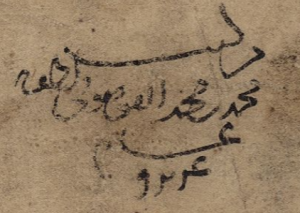
In the second line, the name “Muḥammad” was separated, by lifting the pen, from the following “ibn”, abbreviated to a single stroke.  The ownership note is furthermore distinguished by its vocabulary and its placement within the codex.  As regards its language, this ownership note is literally an ex libris:

min kutub
Muḥammad b. Muḥammad al-Qūṣūnī < laṭafa bi-hī ? >
ʿām
924

from the books of
Muḥammad b. Muḥammad al-Qūṣūnī < may [ God’s ] kindness be with him ? >
the year
924

Whereas the other five ownership notes are placed at the beginning of the work, in the Bologna Dioscorides the ownership note was written next to the colophon, at the end of the work (fol. 274b).  Unfortunately, in its current state, the manuscript lacks the opening leaves.  As it is impossible to determine whether in 1518, the volume still included a title page, this observation – though noteworthy as a codicological detail – is a dead end.

The Bologna Dioscorides reveals the limits of an ownership note’s evidentiary value in other ways as well.  Once it has been successfully argued that an identified person could have owned a certain manuscript at a particular point in time, this detail needs to be contextualized in order to become meaningful for research about the transmission of knowledge in Muslim societies.  It feels of course good – as it is intellectually plausible and emotionally satisfying – to have determined that in the early sixteenth century a thirteenth-century Dioscorides fragment was probably owned by the prominent physician Muḥammad al-Qūṣūnī II.  Setting aside the inconvenient fact that the ownership of manuscripts with medical and pharmaceutical literature has never been restricted to physicians or pharmacists, the successful identification of a historical person who could have owned a manuscript without any documentation of its origins and provenance, becomes an open invitation to further speculation in the hope of uncovering additional possibilities about this manuscript’s circulation.  In the case of the Bologna Dioscorides, the manuscript’s plausible association with Muḥammad al-Qūṣūnī II allows for many scenarios to be imagined, as very few details about his life are reliably documented – there is not even an estimated year of his birth.  Yet none of these scenarios, however lovingly they are supported with reasonable assumptions, changes the reality that for the time being it is impossible to know as to where – Egypt, Syria, Turkey, or Fertile Crescent? – and how – loot, purchase, gift, or giveaway? – Muḥammad al-Qūṣūnī II might have gotten his hands on this volume, and what he subsequently did with it.  The ownership note only proves that in 1518 a Muḥammad b. Muḥammad al-Qūṣūnī wrote his name into this Dioscorides fragment.  Historians, following Veselý’s model of careful close reading, may eschew all speculations by limiting themselves to this fact: in 1518 the al-Qūṣūnī family owned the Bologna Dioscorides.

Two further examples illustrate different interpretative approaches to two dated ownership notes which are even more ambiguous, because the owners identified themselves as Muḥammad al-Qūṣūnī.  Since their notes were left in undated manuscripts, there is an even stronger incentive to identify the men whose notes establish a terminus ante quem for these codices.  One is a fragment of a Mamluk biographical dictionary, also kept in Gotha, and the other is a short commentary on al-Jaghmīnī’s widely used introduction to astronomy, held in the Cadbury Research Library (CRL) of the University of Birmingham.  The author of the commentary has yet to be identified.

FBG Ms. orient. A 1758, fol. 1a
Ibn Rāfiʿ al-Sallāmī (1305-1372), Kitāb al-wafayāt
h = 18 cm, complete, no date
purchased by Ulrich Jasper Seetzen (1767-1811) in Cairo in 1808
digital surrogate: https://dhb.thulb.uni-jena.de/receive/ufb_cbu_00005177
Public Domain Mark 1.0
I am much indebted to the generous help of Feras Krimsti, the FBG’s Curator of the Oriental Manuscript Collection
description in Pertsch, Die arabischen Handschriften, III, 3, 1881, pp. 338-339
Qalamos entry: https://www.qalamos.net/receive/DE39Book_manuscript_00001764
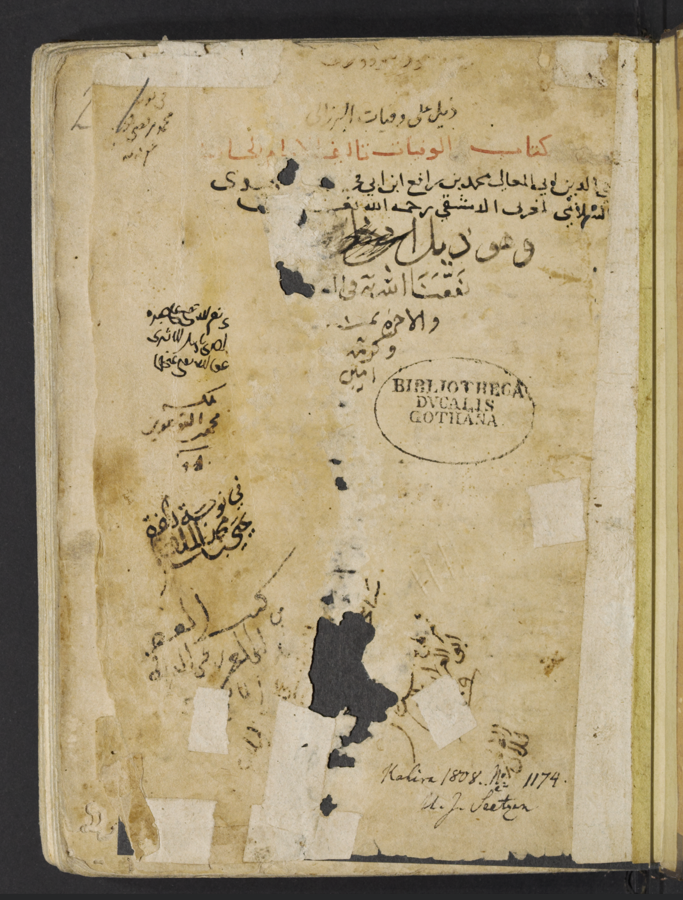
The ownership note has a Qalamos entry: https://www.qalamos.net/receive/DE39SecEntry_secentry_00001065
which reads the name as Muḥammad al-Qūṣūnī and identifies Muḥammad al-Qūṣūnī III as the owner.
The ownership note is dated 940 [ began 23 July 1533 ]:
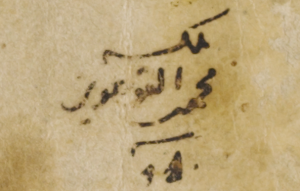
malaka-hū
Muḥammad al-Qūṣūnī
sanat
940

Muḥammad al-Qūṣūnī
acquired it [i.e., the manuscript ]
the year
940

CRL Mingana Collection, Ms. Islamic Arabic 259, fol. 1a
Jalāl al-Dīn Faḍl Allāh al-ʿUbaydī [unidentified], Khāshiyya ʿalā al-Jaghmīnī
h = 18 cm, no date [c.1350?], with astronomical diagrams
previously owned by Alphonse Mingana (1881-1937)
I am much indebted to the generous help of Mark Williams, the CRL’s Assistant Public Service Manager
description in the Catalogue of the Mingana Collection of Manuscripts, 4, 1985, no. 943
Fihrist entry: https://www.fihrist.org.uk/catalog/manuscript_3814

The ownership note – regrettably I do not have a publishable image – has a Fihrist entry: https://www.fihrist.org.uk/catalog/person_f2613
which does not attempt any identification of this Muḥammad al-Qūṣūnī.
The ownership note was added to fol. 1a, which in this codex is a cover page, and not a title page.
The note is dated 971 [ began 21 August 1563 ]:

malaka-hū
Muḥammad al-Qūṣūnī
laṭafa Allāh bi-hī wa-bi-al- < muslimīn ? >
fī sanat
971

Muḥammad al-Qūṣūnī
acquired it [i.e., the manuscript ]
may God’s kindness be with him and the  < Muslims ? >
in the year
971

These two ownership notes were written about 30 years apart: the one in FBG Ms. orient. A 1758 is dated 940/1533, and the other in CRL Mingana Ms. Islamic Arabic 259 is dated 971/1563.  Because of this time gap it is more difficult to confidently conclude that they were written by the same man, even though both were written by a Muḥammad al-Qūṣūnī, and both use the “malaka-hū” phrase.  According to the available cataloguing, the CRL’s collections do not include another manuscript with a Muḥammad al-Qūṣūnī ownership note.  As methodologically a hapax legomenon is a freak incident that cannot be contextualized, his identification was not attempted.  In contrast, Gotha has two Muḥammad al-Qūṣūnī ownership notes, and in this case, the men signed with different names, but the “malaka-hū” phrase is identical, and these notes were written about the same time, around 940-941/1533-1535.  (As I have not seen the original manuscripts, I am following the cataloguers who read the middle numeral in both dates as a 4.)  Moreover, both manuscripts contain works of Mamluk historiography.
     FBG Ms. orient. A 1626, fol. 1a detail
    FBG Ms. orient. A 1758, fol. 1a detail

The cataloguer assigned these two notes to the same person: Muḥammad al-Qūṣūnī III, who was born in 1514 and therefore could have written these notes as a young man in Cairo.  It is an elegant solution.  Applying again Occam’s razor, what would be the probability that around 1534, two different men with the same ism and the same nisba wrote their versions of their names into manuscripts with works about the pre-Ottoman history of Egypt?  Unfortunately, the geographer Ulrich Jasper Seetzen (1767-1811) did not note down the acquisition details of both volumes: he purchased FBG Ms. orient. A 1758 in Cairo in 1808; neither date nor place of purchase was recorded for FBG Ms. orient. A 1628.  Between 1803 and his death in Yemen in 1811, Seetzen had travelled widely in the Arab lands, with extended stays in Aleppo, Damascus, and Cairo, and thus it is impossible to confirm whether Seetzen might have bought both manuscripts in Cairo.  Considering the research of Sellheim and Veselý about the al-Qūṣūnī family, while accounting for the popularity of the ism Muḥammad, I would be more comfortable with limiting myself to the only knowable fact: members of the al-Qūṣūnī family owned these codices around 1534.  I hasten to add that I do understand how unsatisfactory such a parsimonious inference feels.

As it is impossible to identify with a modicum of reliability the individual men who used, with variations, the name Muḥammad al-Qūṣūnī in six ownership notes, which other insights can be gleaned – while keeping in mind that six is too small a number for any momentous conclusions – from these notes and their manuscripts?  Thinking about these manuscripts as books associated with different members of a family of scholars and physicians made me curious about their contents: Which texts did they own and, perhaps, even read?  The first four are canonical works of pharmacology, medicine, astronomy, and Arabic adab literature, whereas the last two belong to the historiographical literature of the Mamluk era.  None of the six manuscripts contains a contemporary work, written in the sixteenth century.

    • anonymous Arabic adaptation of Dioscorides’ materia medica (colophon dated 1240), incomplete
    • Fakhr al-Dīn Rāzī’s commentary on Ibn Sīnā’s Qānūn fī al-ṭibb (colophon dated 1230), fragment
    • unidentified commentary on Jaghmīnī’s introduction to astronomy (no date), complete
    • al-Ḥarīrī’s al-Maqāmāt (no date, ijāza dated 1120), complete
    • Ibn Rāfiʿ al-Sallāmī’s biographical dictionary regarding Hadith scholarship in fourteenth-century Egypt (no date), complete
    • one of Ibn Taghrībirdī’s Mamluk chronicles (no date), excerpt

The present state of research does not allow for assessing the value of these manuscripts in the used-book trade and among collectors in sixteenth-century Cairo or Istanbul.  However, approaching them as intergenerational family property reveals two elements which are conspicuously absent: none carries a second ownership note written by another member of the al-Qūṣūnī family, and none preserved any traces of ever having been part of a library funded by a waqf, be it an endowment of the al-Qūṣūnī family or of someone else.  While it remains of course impossible to base any argument on that which is not there, identifying absences illuminates areas of ignorance.  The manuscripts’ silence about passing on books within the al-Qūṣūnī family feels particularly salient with regard to the Dioscorides fragment (BUB Ms. 2954), since it belongs to the corpus of highly valued late Abbasid, early Ilkhanid large-format manuscripts with illustrations, which for lack of a better label are still occasionally called “Arab painting”.
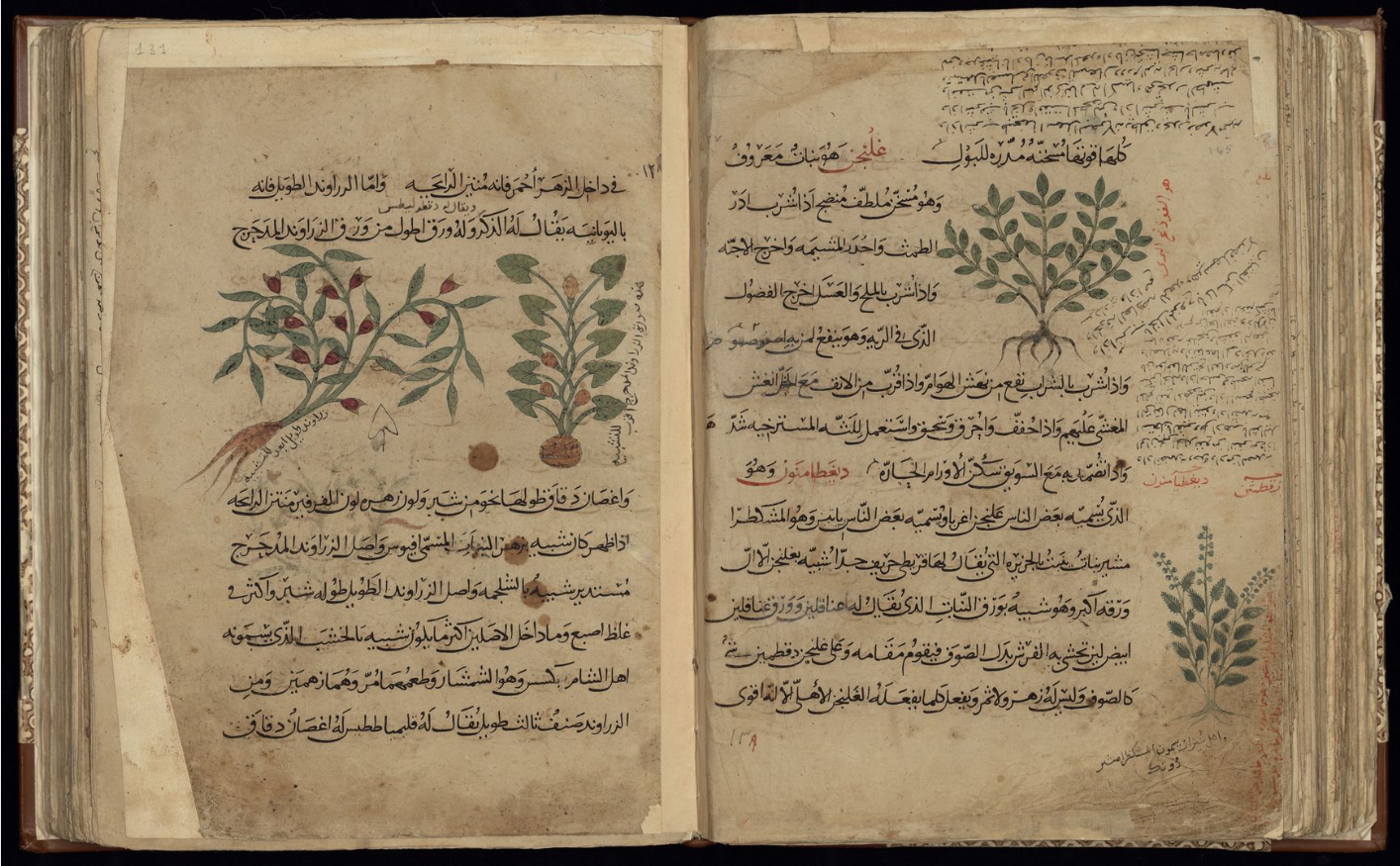
BUB Ms. 2954, fols. 130b-131a

The Dioscorides fragment is not the oldest of the six manuscripts, but it preserves the oldest ownership note.  As mentioned above, it is practically impossible that this note, dated 924/1518, was written by Muḥammad al-Qūṣūnī III, as he was born in 1514.  It would have made for a nice family anecdote if Muḥammad al-Qūṣūnī II, a well-known physician who died six years later, in 1524, had bequeathed an almost three-hundred year old illustrated fragment of a famous materia medica handbook to his young son, Muḥammad al-Qūṣūnī III, who in turn would become an even more successful physician.

In her 2018 study of Teaching and Learning the Sciences in Islamicate Societies: 800-1700, Sonja Brentjes emphasized the diversity of formal and informal educational opportunities in premodern Muslim societies vis-à-vis the limited evidence explored in contemporary research.  She observed that the Islamic sources do not seem to support the received wisdom that medical training was primarily passed on within families (pp. 131-134).  In Mamluk Egypt, for example, physicians’ biographies seem to regularly list teachers and mentors who were not family members.  With regard to the continuous circulation of canonical textbooks, she warned of projecting our own historical interests unto the early modern era, as large numbers of extant science manuscripts document how teachers routinely designed customized textbooks for their students (pp. 225-226, cf. pp. 247-254 for medical literature).

Brentjes wrote this study in the 2010s, drawing on biographical dictionaries, catalogues, and manuscripts, when Middle Eastern studies at large began to vigorously embrace codicology and book history.  Although in fields such as the history of science, scholars have always heavily depended on manuscripts as many of their source are not available in printed versions, the materiality of the manuscripts themselves has usually remained invisible as they were perceived as mere media – that is: transparent containers – for the transmission of knowledge.  In contrast, Brentjes’ study includes reproductions of manuscript pages – though no list of illustrations or figures – and references to specific manuscripts (for call numbers, see p. 289).  Even more importantly, she acknowledged the practical difficulties of understanding how a certain manuscript was employed for the transmission of knowledge (p. 252).

Among professionals like the educated members of the al-Qūṣūnī family, books must have been everywhere – like air – because Islam – like Judaism and Christianity – had emerged in the literate societies of Late Antiquity as a civilization that depended on the written transmission of knowledge.  In literate societies, book ownership appears to be self-explanatory, even though ownership notes often reveal very little about a book’s meaning, value, or provenance despite the tantalizing specificity of individual names and precise dates.  For book historians, the methodological challenge of investigating book ownership concerns the question of how to establish meaningful differences between the access to books for work, leisure, or religious practice; the individual or institutional ownership of books on purpose or by chance; and the intentional collecting of books for a particular goal.  As Meredith Quinn observed in her dissertation (Harvard University 2016) about the book culture of seventeenth-century Istanbul: “people from every segment of society came into contact with books and the texts they contained” (p. iv).  And yet, very few people actually owned any books, and not every person or institution that owned a few books thought of their books as a clearly defined collection or even a formal library.

I will conclude this reflection on the evidentiary value of ownership notes with a discussion of a medical manuscript that in its current state is associated with two physicians of the al-Qūṣūnī family, though not through straightforward ownership notes.  The dual connection was discovered by Cécile Bonmariage, professor of Islamic philosophy at the Université catholique de Louvain.  In the late 2000s, when she worked for Princeton University Library (PUL) as a cataloguer of Don Skemer’s Islamic Manuscripts Cataloging and Digitization Project (https://dpul.princeton.edu/islamicmss/about/islamic-manuscript-collections), Bonmariage noticed that a formal copy of a popular commentary about al-Lamḥa al-ʿafīfiyya fī al-ṭibb by Ibn Amīn al-Dawla (active 15th century) mentioned Muḥammad al-Qūṣūnī I (1430-1511) on the undated title page and ended with a reading note by the physician Zayn al-Dīn Abū al-Ṣalāḥ Muḥammad Madyan b. ʿAbd al-Raḥmān al-Qūṣūnī (b. 1561, d. after 1634).  His precise position within the genealogy of the al-Qūṣūnī family cannot be determined, because the name of his paternal grandfather has not been transmitted (Sellheim, Materialien zur Literaturgeschichte, 1: 206 s.v. 6).  The loss of this detail about Madyan’s immediate male ancestors is baffling, as he included an entry about himself into his biographical dictionary of physicians.  Unlike his relatives with the very popular ism Muḥammad, he did not use the nisba al-Qūṣūnī in his ownership notes and instead identified himself as Madyan al-ṭabīb (e.g., PUL Isl. Mss. Garrett 567 H and Garrett 2315 Y).  In 2009 Bonmariage published an article about “Un nouvel élément à propos des Qūsūnī” in Arabica (56: 269-273), continuing the research of Sellheim and Veselý about the al-Qūsūnī family.  Like the publications of Sellheim and Veselý, Bonmariage’s article followed a serendipitous encounter with a manuscript.

PUL Islamic Mss. Garrett 570 H
Maḥmūd b. Aḥmad al-ʿAyntābī, also known as Ibn al-Amshāṭī (1409-1496), Kitāb taʾsīs al-ṣiḥḥa bi-sharḥ al-Lamḥa
h =  27 cm (cropped as there are cut off marginal comments), composite codex
Martijn Theodoor Houtsma (1851-1943) bought the manuscript from Amīn b. Ḥasan al-Ḥulwānī al-Madanī (d. 1898) in the early 1880s
Robert S. Garrett (1875-1961) purchased the codex in 1900 as part of a collection which Brill was selling on Houtsma’s behalf
Gift of Robert Garrett, Class of 1897, to Princeton University in 1942
digital surrogate with description: http://arks.princeton.edu/ark:/88435/6108vb32x
this description is also available as OCLC record no. 82518882
published by Bonmariage, “Nouvel élément à propos des Qūsūnī”
all images are courtesy of Princeton University Library
for a list of the commentary’s known manuscripts, see Csorba, Late Mamluk Medical Regimen for Travellers, 77-78

On the top of fol. 1a, the book’s title – Kitāb taʾsīs al-ṣiḥḥa bi-sharḥ al-Lamḥa – is written on gold ground in a rectangular panel.  The name of the book’s author – Maḥmūd b Aḥmad al-ʿAyntābī – in the central medallion is framed by a two-part bi-rasm statement.
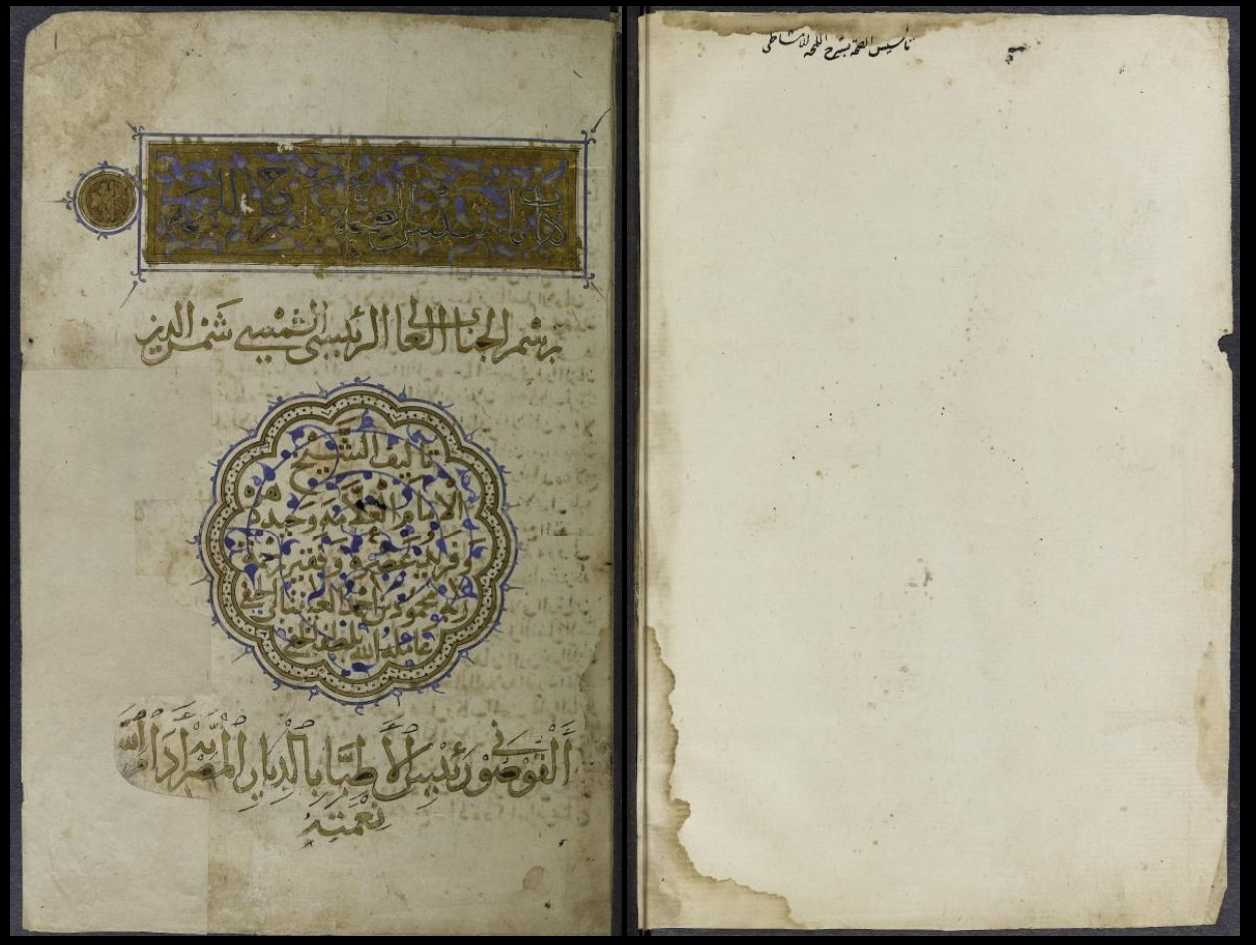
Muḥammad al-Qūṣūnī I (1430-1511) is named in this bi-rasm statement, though without his ism Muḥammad.  His laqab Shams al-Dīn (lit. sun of the faith) is highlighted through punning, as he is praised as “al-raʾīs al-shamsī” (lit. the sunny chief).

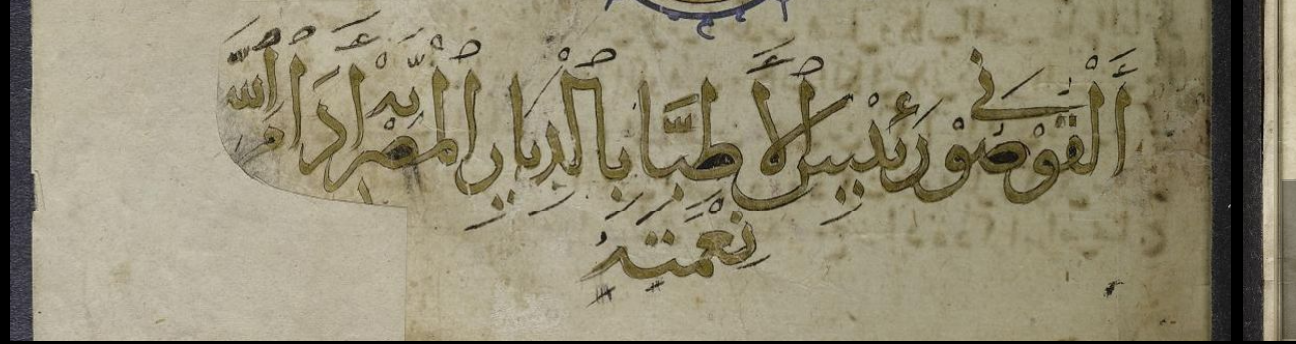
bi-rasm al-janāb al-ʿālī al-raʾīs al-shamsī Shams al-Dīn
al-Qūṣūnī raʾīs al-aṭibbāʾ bi‘l-diyār al-miṣriyya adāma Allāh
niʿmata-hū

on the order of his excellency the brilliant chief Shams al-Dīn 
al-Qūṣūnī, the chief of the physicians of Egypt – may God make
his blessing everlasting

The online cataloguing entry mentions about the first quire (fols. 1-9) that the incomplete quinion misses its first leaf, but no further details about the quire structure are given.  Unfortunately, images of the three edges and the endbands were not included into the digital surrogate so that they cannot be checked for traces of disturbed or replaced leaves or quires.  Because the codex was scanned as single pages, and not as double-page openings, the stub of a singleton is just about visible between the inner margins of flyleaf and fol. 1a.
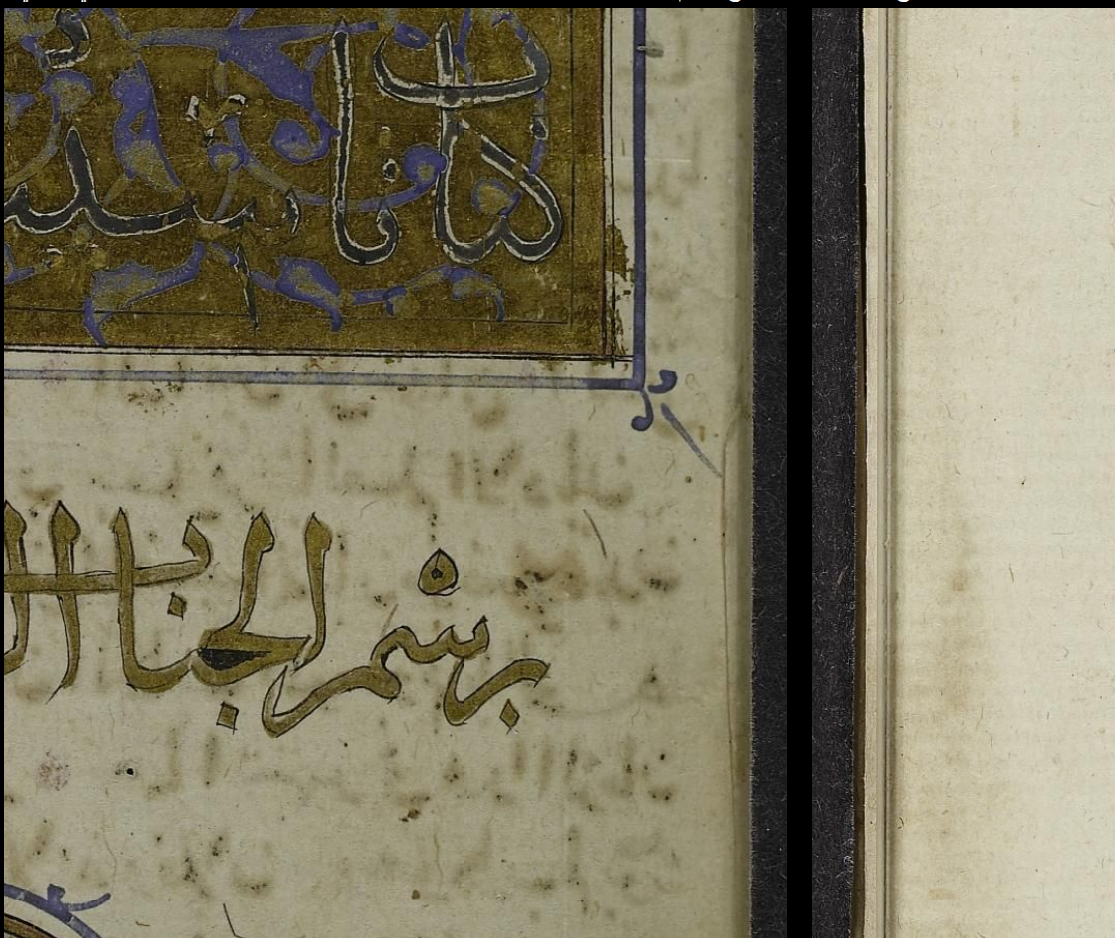
The description of the mise-en-page of fols. 1b-2a highlights the text area’s gold-and-black borders and gold-painted floral spray in the top margin of fol. 1b, yet the description does not comment whether this illumination is connected to to the preceding title page or the following leaves.
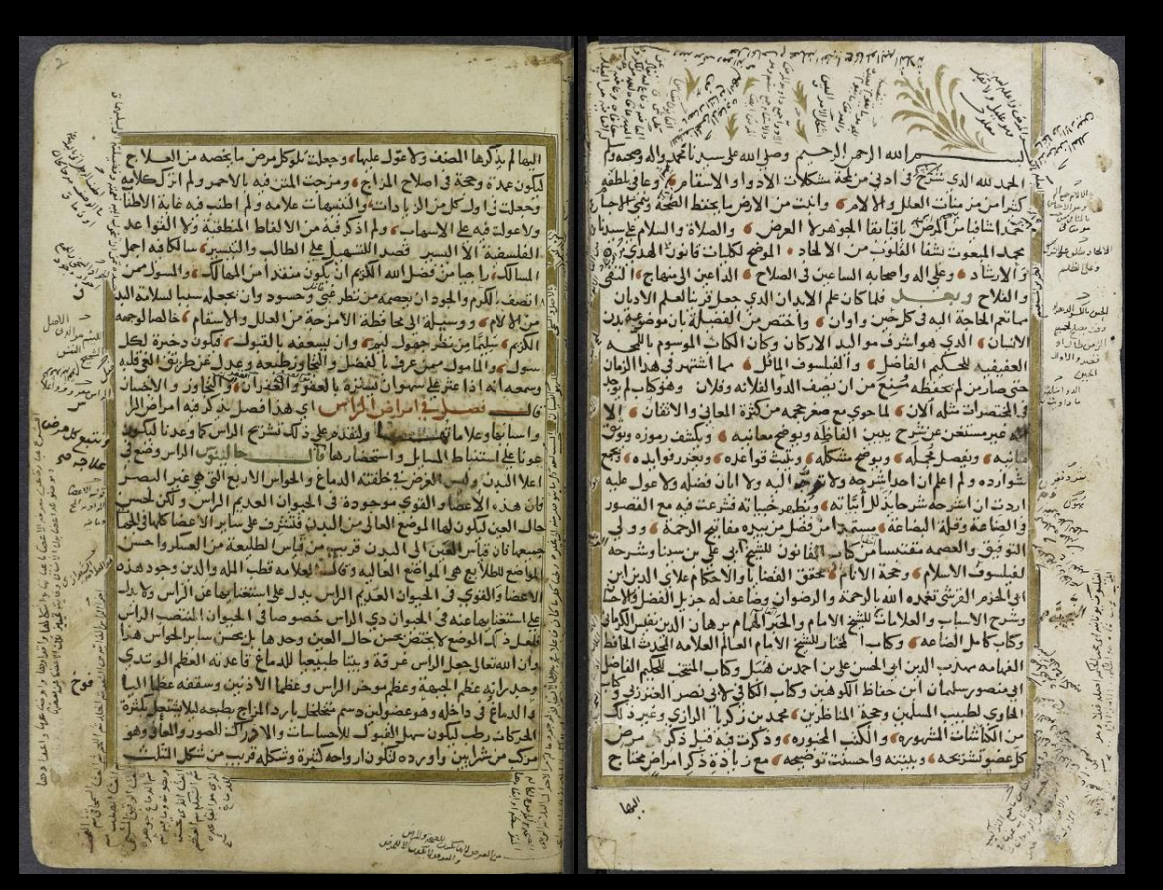
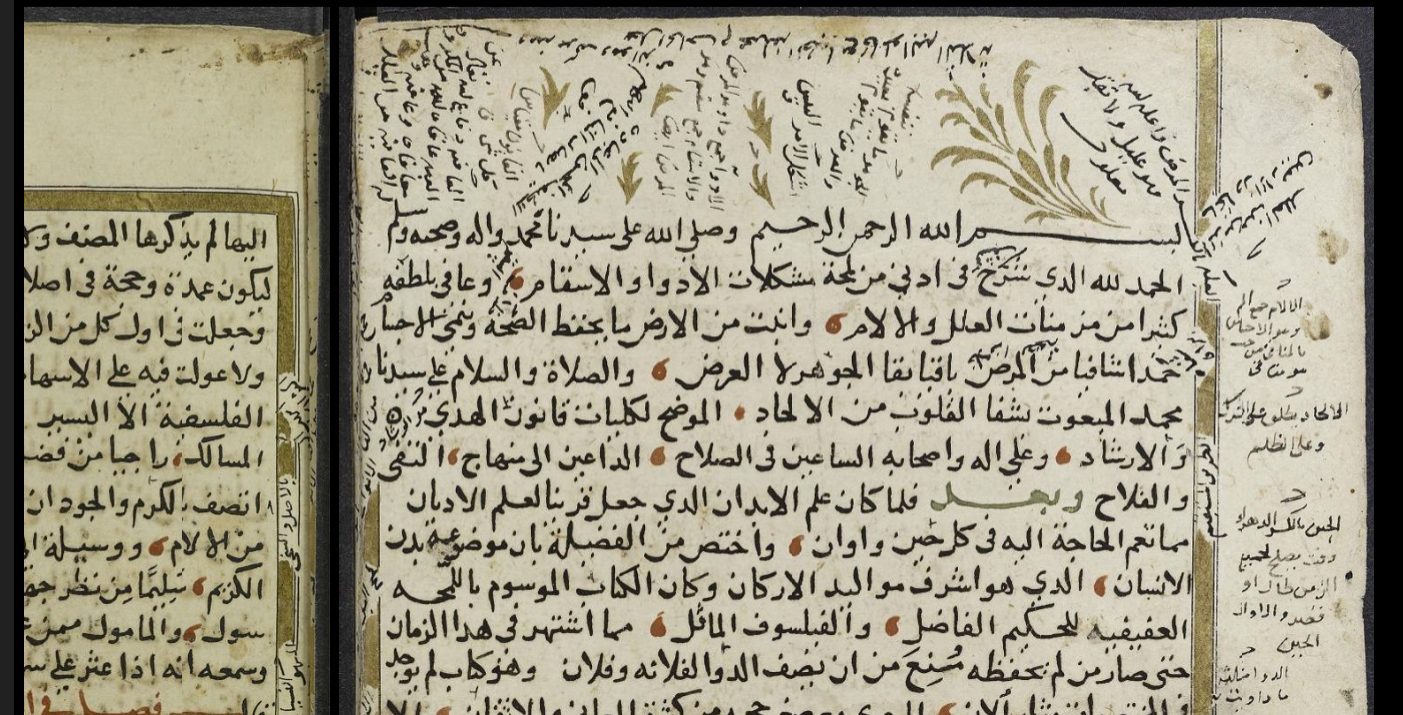
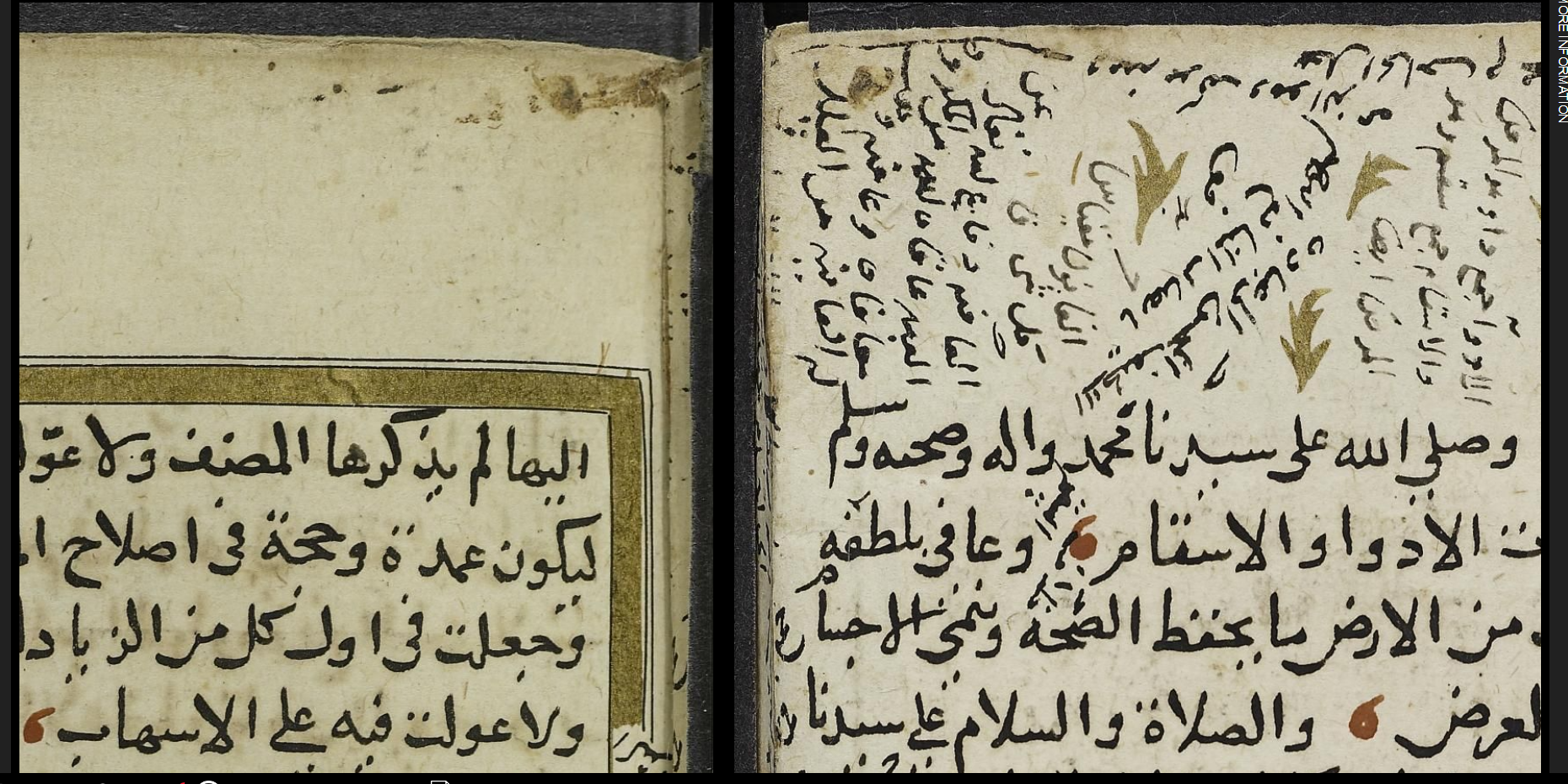
PUL Islamic Mss. Garrett 570 H, fols. 2b-3a

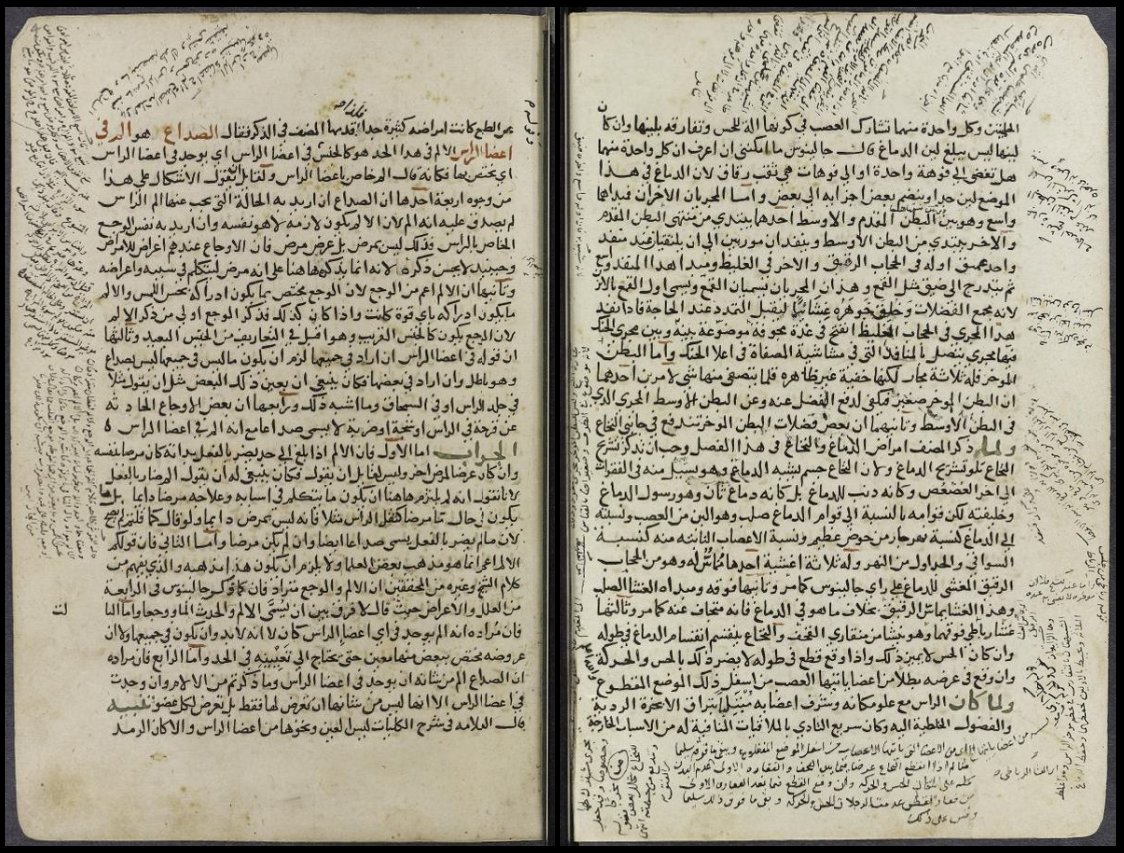
The commentary concludes with a colophon (fol. 292b), dated 18 Rabīʿ II 870 [ 8 December 1465 ].  About 150 years later, in the 1610s, a note about the reading of the complete commentary– “qirāʾat jamīʿ hādhā al-sharḥ” in well-attended meetings and at recurring times – “fī majālisa mutaʿaddidatin wa-awqātin mutajaddidatin” was added on a leaf facing the colophon (fols. 293a-293b).
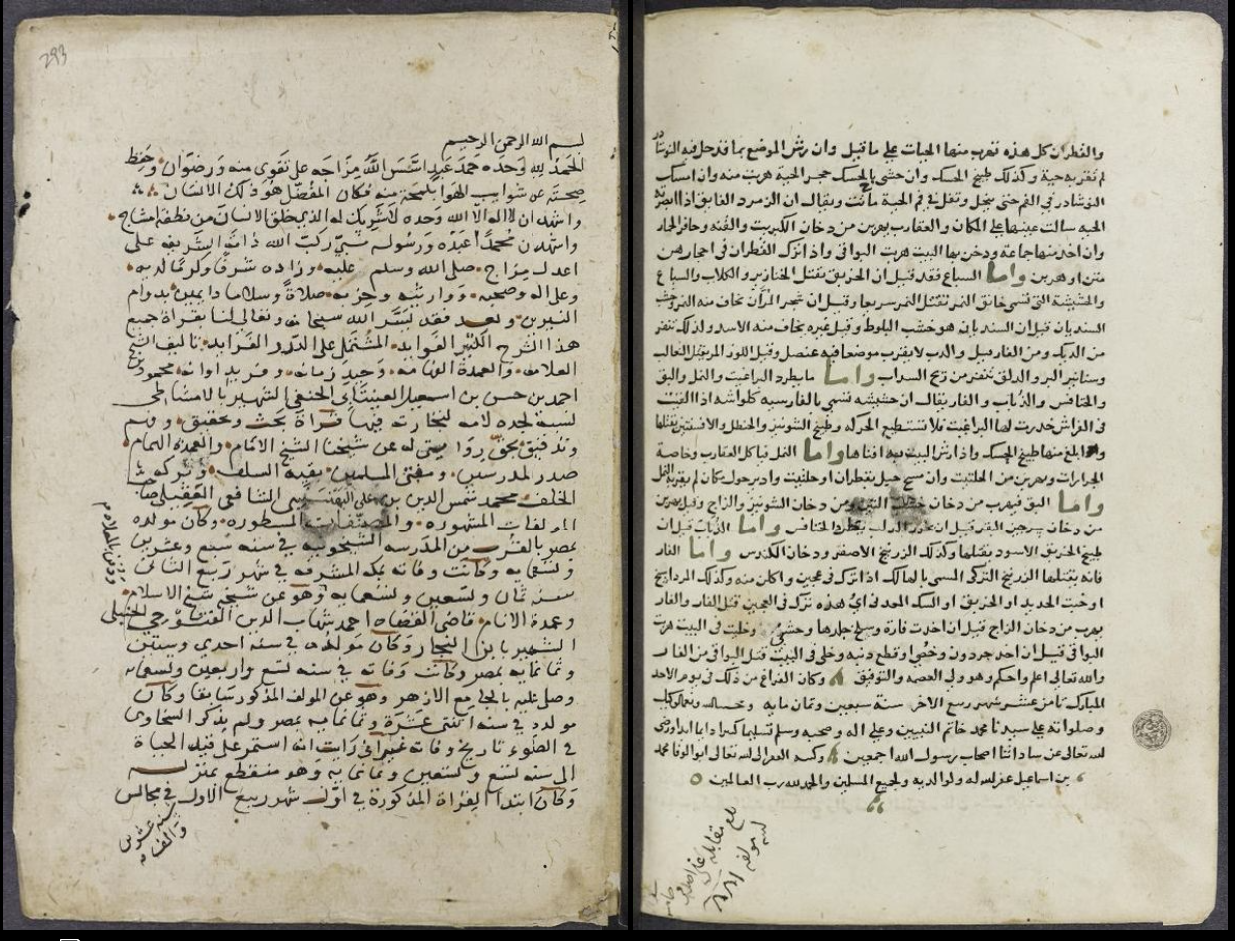
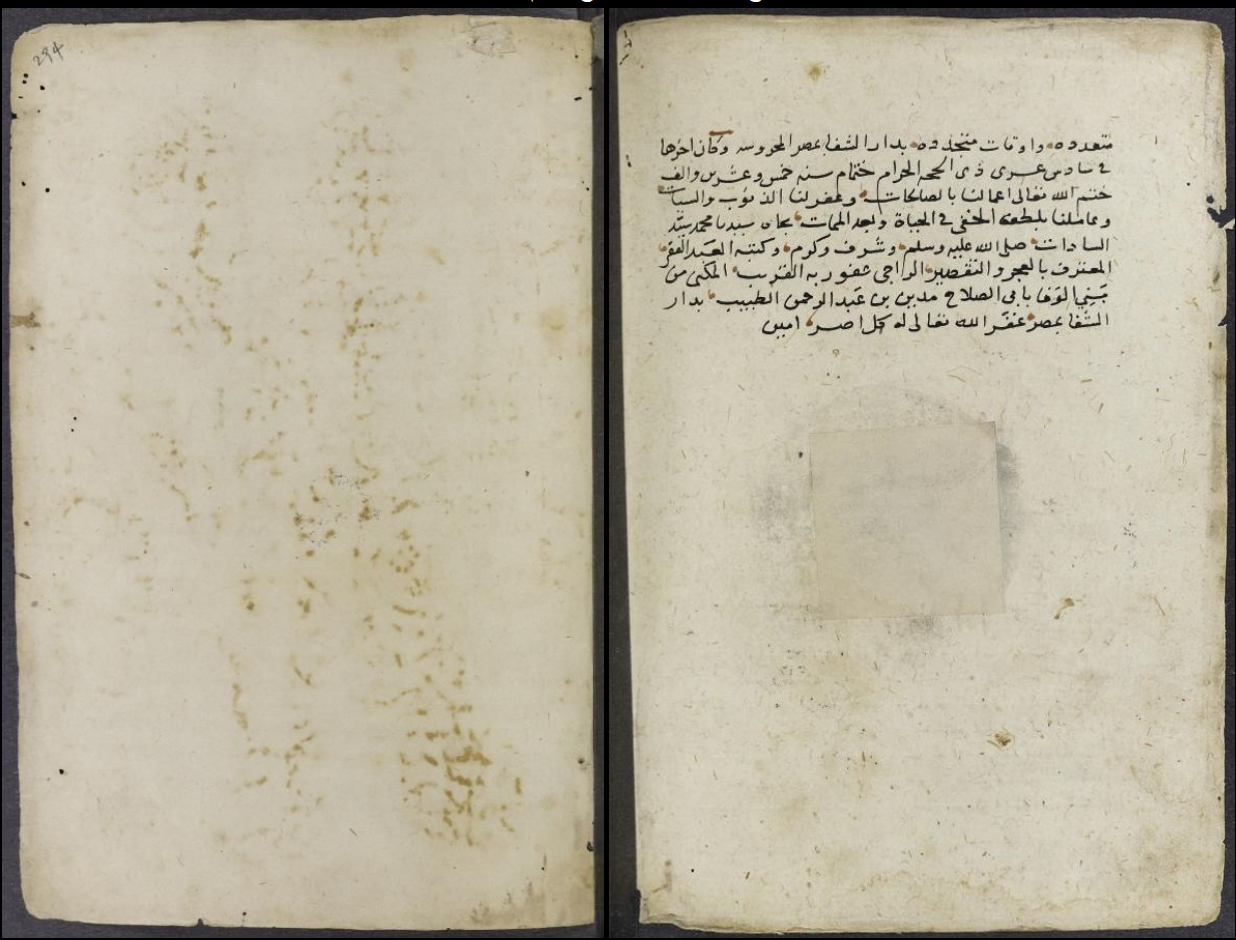
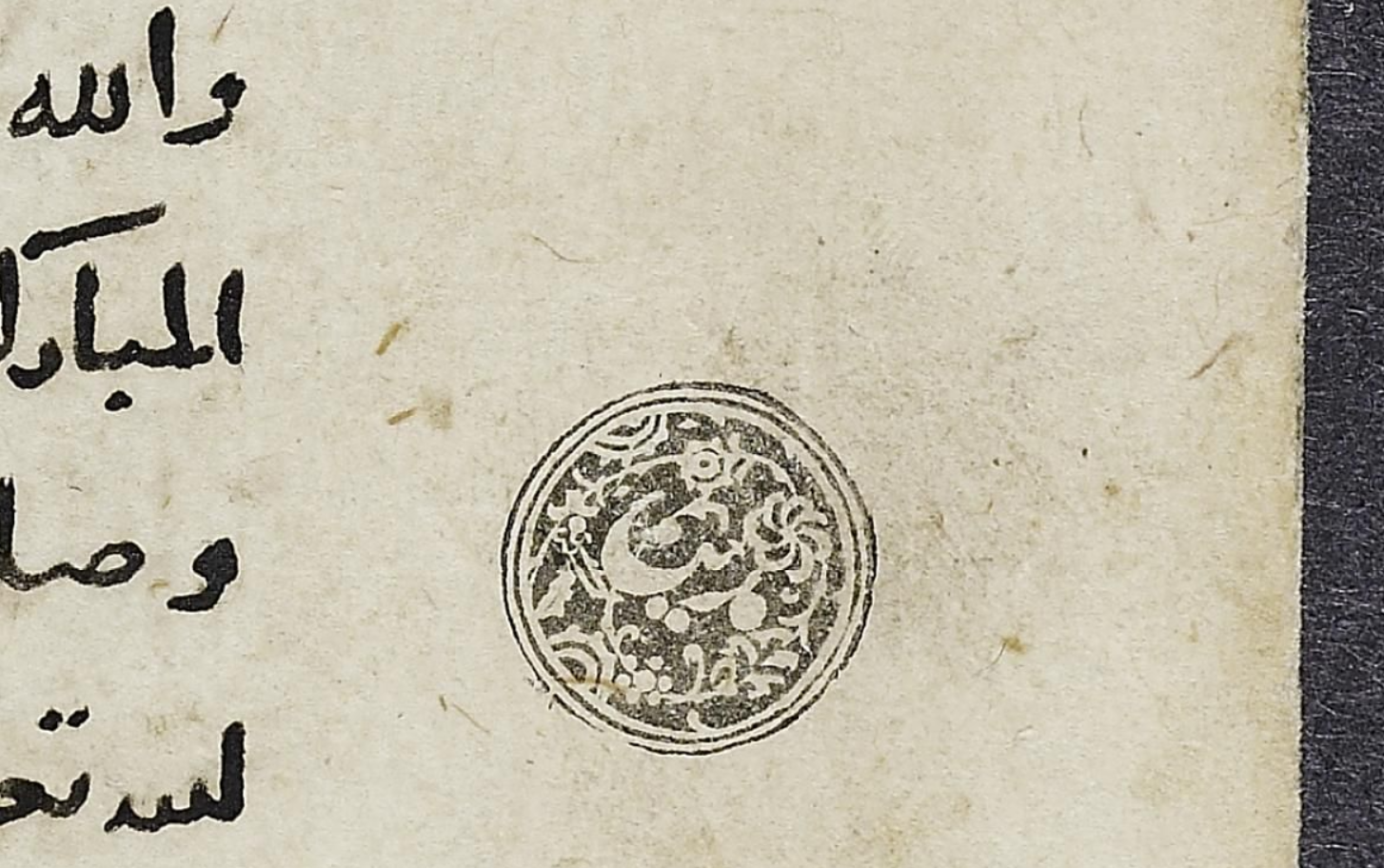
The colophon was written by Abū al-Wafāʾ Muḥammad b. Ismāʿīl.  Next to it, in the lower portion of the right margin, Madyan left the impression of a circular seal (diameter = 1.2 cm), inscribed only with his ism Madyan.  An undated collation note in a different hand, partially cut off, was written unto the bottom margin.
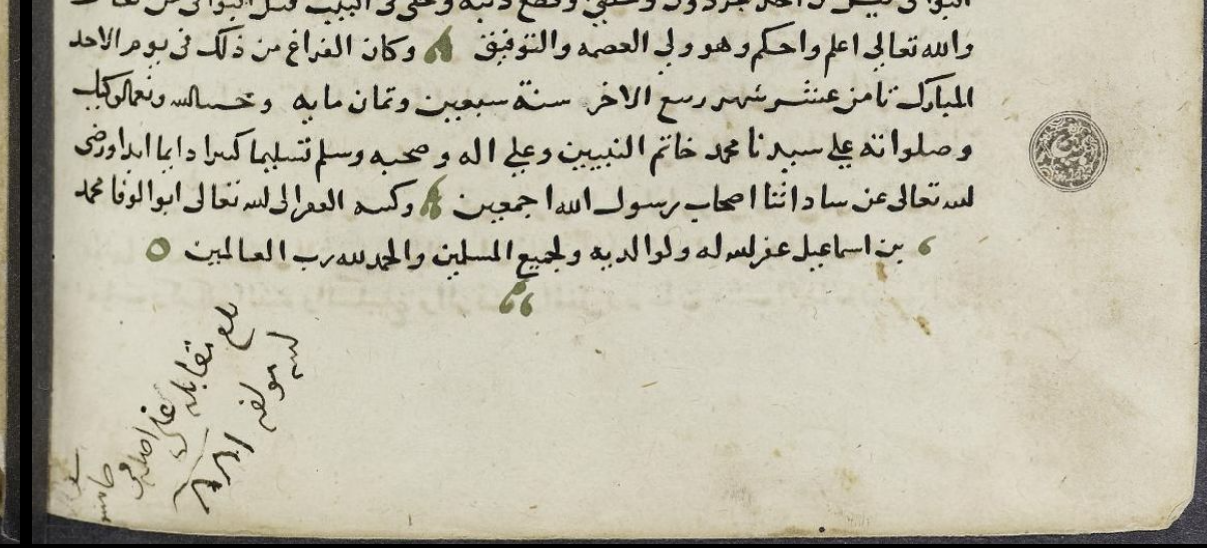
In the reading statement Madyan first identified the author and the two men through whom the commentary had been transmitted, and then he certified as “Abū al-Ṣalāḥ Madyan b. ʿAbd al-Raḥmān al-ṭabīb bi-Dār al-Shifāʾ bi-Miṣr” (Abū al-Ṣalāḥ Madyan b. ʿAbd al-Raḥmān, physician in the Dār al-Shifāʾ hospital in Cairo) that the reading had began on 1 Rabīʿ I 1020 [ 13 June 1611 ] and was completed on 26 Dhū’l-Ḥijja 1026 [ 4 January 1617 ].  In contrast to reading certificates from the Mamluk era, those who attended these study session with Madyan were not individually listed (for a French summary with a transcription that skipped the shahāda and the ṣālwa at the beginning, see Bonmariage, “Nouvel élément à propos des Qūsūnī:” 271-272).
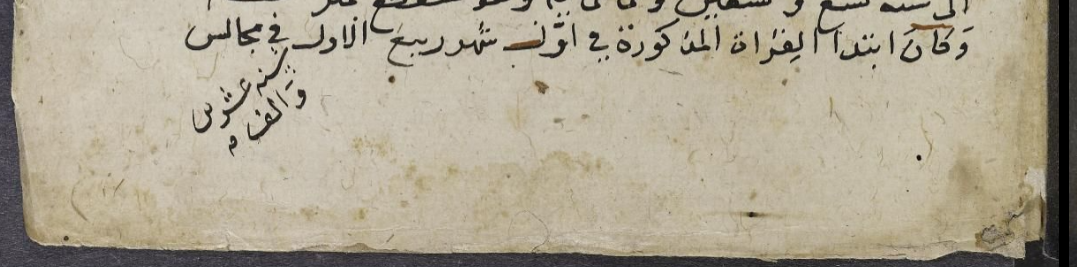
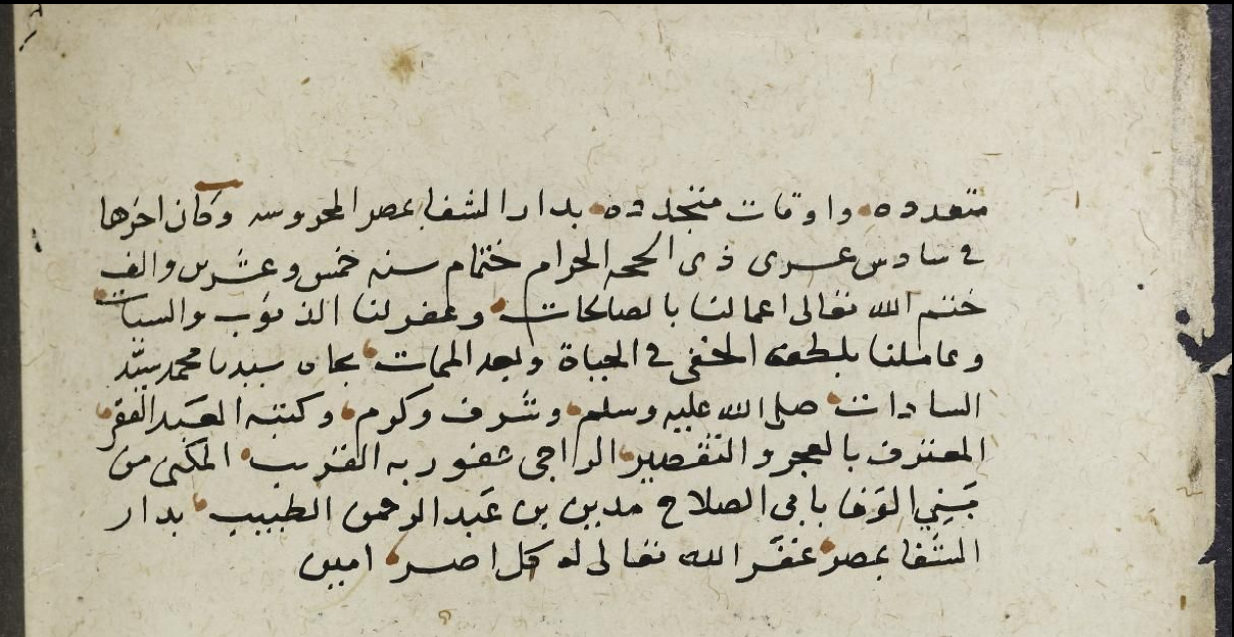
Writing her 2009 article while working as a cataloguer, Bonmariage took the volume in its current state at face value, since it has no obvious lacunae, replacement leaves, or later additions.  She connected the colophon with the bi-rasm statement and concluded that in 1465, when Muḥammad al-Qūṣūnī I commissioned this copy for himself, he was in his 30s and served as a high-ranking physician in Mamluk Egypt.  As many owners never write anything into their books, the absence of any other traces possibly left by Muḥammad al-Qūṣūnī I only attracts attention, because Madyan documented in writing and through a seal impression how he used this book – which in its current state does not carry his ownership note – for several years.  The exceptional fact that two physicians of the al-Qūṣūnī family, about 150 years apart, seem to be associated with this volume motivated Bonmariage to write about her discovery.  At the same time, she was careful not to speculate about this fact.

The comparison of PUL Isl. Mss. Garrett 570 H with the six manuscripts that carry a Muḥammad al-Qūṣūnī ownership note yields the surprising insight that too much information is even more confounding than zero information.  The identification of the two physicians is absolutely sound, when evaluated on their own.  And yet the volume’s dual connection with the al-Qūṣūnī family seems too good to be true.  For me, it is a red flag.  Although I am only familiar with the digital surrogate, I suspect, applying Occam’s razor one more time, that fol. 1a with the bi-rasm statement concerning Muḥammad al-Qūṣūnī I is a later addition to a 1465 codex which had been used by Madyan in the 1610s for his reading sessions.  Since this manuscript is a formal working copy of a popular commentary, replacing just the first two leaves – as noted earlier, in its current state the first quinion lacks its first leaf – would have been feasible (for the common practice of exchanging title pages, see Carter and Barker, ABC for Book Collectors, 207).  Without the illuminated title page, the manuscript can be understood as a formal working copy of a medical textbook, written when its author Ibn al-Amshāṭī (1409-1496) was in his 50s.  Approaching this as a historical textbook which despite its popularity stood outside the medical teaching curriculum of the 1610s might explain why Madyan and his colleagues needed more than five years for working through the entire commentary.  At the same time, none of these considerations addresses the question whether Madyan ever owned this manuscript.

Acknowledgements

I would like to thank Feras Krimsti and Kaveh Niazi for their help with the reading of the ownership notes.

Bibliography

“Amīn b. Ḥasan al- al-Ḥalawānī al-Madanī.” In Encyclopaedia of Islam, 1t ed., 1: 327.

ʿĀmir, Hanāʾ Fawzī. al-Aṭṭibāʾ al-Qūṣūniyyūn: Dirāsa wa-taḥqīq. Abu Dhabi: al-Majmaʿ al-Thaqāfī, 2002.

Behrens-Abouseif, Doris. Practising Diplomacy in the Mamluk Sultanate: Gifts and Material Culture in the Medieval Islamic world. London: I.B. Tauris, 2014.

Behrens-Abouseif, Doris. The Book in Mamluk Egypt and Syria (1250-1517): Scribes, Libraries and Market. Leiden: Brill, 2019.

Bonmariage, Cécile. “Un nouvel élément à propos des Qūsūnī.” Arabica 56.2-3 (2009): 269-273.

Brentjes, Sonja. Teaching and Learning the Sciences in Islamicate Societies (800-1700). Turnhout, Belgium: Brepols, 2018.

Carter, John, and Nicolas Barker. ABC for Book Collectors. 8th ed. with corrections. New Castle, Del.: Oak Knoll Press, 2006.

Contadini, Anna. “Ayyubid Illustrated Manuscripts and their North Jaziran Neighbours.” In Ayyubid Jerusalem: The Holy City in Context, 1187-1250, edited by Robert Hillenbrand and Sylvia Auld, 179-194.  London: Altajir Trust, 2009.

Contadini, Anna. Conoscenza e libertà: Arte islamica al Museo Civico Medievale di Bologna. Genoa: SAGEP, 2024.  Italian-English exhibition catalogue.

Csorba, Zsuzsanna. A Late Mamluk Medical Regimen for Travellers: Ibn al-Amshāṭī’s al-Isfār ʿan ḥikam al-asfār. Critical edition, translation, and commentary. Leiden: Brill, 2024.

D’hulster, Kristof. Browsing through the Sultan’s Bookshelves: Towards a Reconstruction of the Library of the Mamluk Sultan Qāniṣawh al-Ghawrī (r. 906-922/1501-1516). Bonn: Bonn University Press, 2021.  A changed version (lit. “geänderte Ausgabe”) is available at: https://hdl.handle.net/20.500.11811/11485  New manuscript discoveries have been posted on D’hulster’s acdemia.edu website since 2024: https://uni-m.academia.edu/KristofDhulster/Browsing%20through%20the%20Sultan’s%20Bookshelves:%20Addenda

D’hulster, Kristof. “A Preliminary Handlist of Manuscripts from the Library of al-Ashraf Qāytbāy.” Journal of Islamic Manuscripts 15 (2024): 353-376.

Gottschalk, Hans Ludwig. Islamic Arabic Manuscripts. Edited by Derek Hopwood. Catalogue of the Mingana Collection of Manuscripts, now in the Possession of the Trustees of the Woodbrooke Settlement, Selly Oak, Birmingham 4. Zug, Switzerland: Inter Documentation, 1985.

Grabar, Oleg. “What Does ‘Arab Painting’ Mean?” In Arab Painting: Text and Image in Illustrated Arabic Manuscripts, edited by Anna Contadini, 17-22.  Handbuch der Orientalistik. Leiden: Brill, 2007.

Heyd, Uriel. “Moses Hamon, Chief Jewish Physician to Sultan Süleymān the Magnificent.” Oriens 16 (1963): 152-170.

Keegan, Matthew L. “Commentators, Collators, and Copyists: Interpreting Manuscript Variation in the Exordium of Al-Ḥarīrī’s Maqāmāt.” In Arabic Humanities, Islamic Thought: Essays in Honor of Everett K. Rowson, edited by Joseph E. Lowry and Shawkat M. Toorawa, 296-316.  Leiden: Brill, 2017.

Machaeva, Orazgozel. Catalogo dei manoscritti islamici conservati nella Biblioteca universitaria di Bologna. Bologna: Paolo Emilio Persiani, 2017.

MacKay, Pierre A. “Certificates of Transmission on a Manuscript of the Maqāmāt of Ḥarīrī (MS. Cairo, Adab 105).” Transactions of the American Philosophical Society 61.4 (1971): 1-81.

Muhanna, Elias I. “The Sultan’s New Clothes: Ottoman-Mamluk Gift Exchange in the Fifteenth Century.” Muqarnas 27 (2010): 189-207.

Quinn, Meredith Moss. “Books and their Readers in Seventeenth-Century Istanbul.” PhD diss. Harvard University, 2016; http://nrs.harvard.edu/urn-3:HUL.InstRepos:33493319.

al-Qūṣūnī, Madyan b. ʿAbd al-Raḥmān. Qāmūs al-aṭibbāʾ wa-nāmūs al-alibbāʾ. 2 vols. Damascus: Majmaʿ al-lugha al-ʿarabiyya, 1979.

Pertsch, Wilhelm. Die arabischen Handschriften der Herzoglichen Bibliothek zu Gotha. Die orientalischen Handschriften zu Gotha III, 3. Gotha: Perthes, 1881.

Ritter, Hellmut. “Autographs in Turkish Libraries.“ Oriens 6.1 (1953):  63-90.

Schäbler, Birgit. “Seetzen, Ulrich Jasper.“ In Neue Deutsche Biographie 24 (2010): 155–156; https://www.deutsche-biographie.de/pnd119328593.html

Sellheim, Rudolf. Materialien zur arabischen Literaturgeschichte. Verzeichnis der Orientalischen Handschriften in Deutschland 17, A. 2 vols. Wiesbaden: Steiner, 1976-1987.

Shefer-Mossensohn, Miri. Ottoman Medicine: Healing and Medical Institutions, 1500-1700. Albany, NY: SUNY Press, 2010.

Talman, Michael. Elenchus librorum Orientalium manuscriptorum, videlicet Græcorum, Arabicorum, Persicorum, Turcicorum, et deinde Hebraicorum, ac antiquorum Latinorum, tam manuscriptorum, tum impressorum a domino comite Aloysio Ferdinando Marsigli […] collectorum, coëmptorúmque. 6 vols. Vienna: Susanna Cristina Cosmerovius, 1702.

Ullmann, Manfred. Die Medizin im Islam. Handbuch der Orientalistik. Leiden: Brill, 1970.

Ullmann, Manfred. Die Geheim- und Naturwissenschaften im Islam. Handbuch der Orientalistik. Leiden: Brill, 1972.

Veselý, Rudolf. An Arabic Diplomatic Document from Egypt: The Endowment Deed of Maḥmūd Pasha dated 974/1567. Prague: Charles University, 1971.  The original three-volume doctoral dissertation, written in Czech, was accepted by the Charles University Prague in 1965, and successfully defended in 1966.

Veselý, Rudolf. “Die Hauptprobleme der Diplomatik arabischer Privaturkunden aus dem spätmittelalterlichen Ägypten.” Archiv Orientální 40 (1972): 312-343.

Veselý, Rudolf. “Neues zur Familie al-Qūṣūnī: Ein Beitrag zur Genealogie einer ägyptischen Ärzte- und Gelehrtenfamilie – Mit ‘Ergänzungen‘ von Rudolf Sellheim.” Oriens 33 (1992): 437-444.

Biographical information about Rudolf Sellheim and Rudolf Veselý

Endress, Gerhard. “Rudolf Sellheim.“ Oriens 42.1-2 (2014): 1-19.

Neumann, Christoph K., and Petr Štěpánek. “In memoriam Zdenka Veselá.“ Wiener Zeitschrift für die Kunde des Morgenlandes 88 (1998): 9-13.

Ženka, Josef. “Rudolf Veselý, 1931-2020.” Mamluk Studies Review 23 (2020): 1-21.


corrected and enlarged 2d version, 23 February 2026
Early British Collectors and the Manuscript Trade in India and Iran before the 1820s: The Persian Collections of the Ouseley Brothers

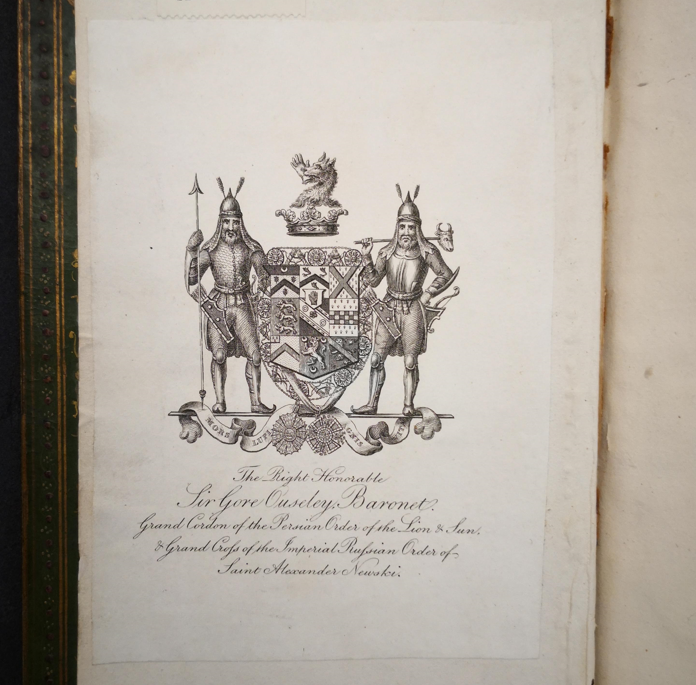
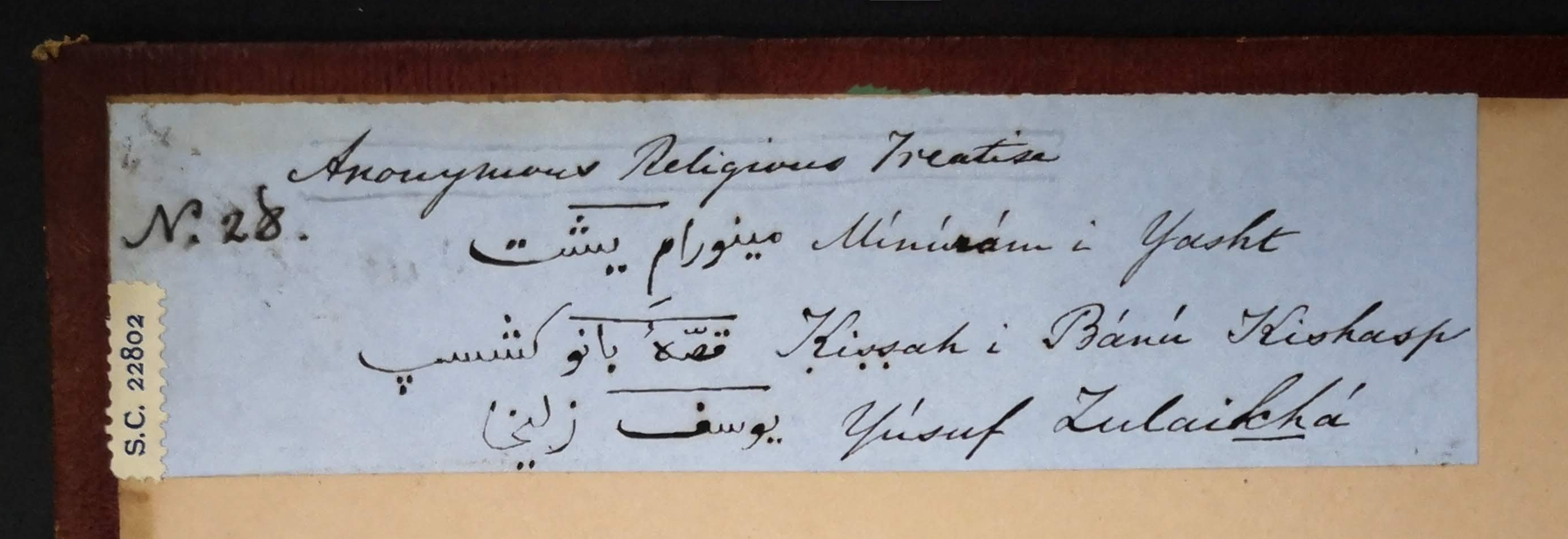
William Ouseley’s label for an undated miscellany, pasted unto the front board’s inside of MS pers. Bodl. Ouseley 28, h = 20.5 cm

Gore Ouseley’s undated exlibris, from a fly leaf in one of his copies of Saʿdī’s Kullīyāt, MS pers. Bodl. Ouseley Add. 39, dated 856 H./ 1452, h = 21 cm

In March 2022 I was awarded a Bahari Visiting Fellowship in the Persian Arts of the Book at the Bodleian Libraries, which I will hold from 2 May to 1 August 2023.  In support of my Bahari fellowship project I received a minor grant from the Oxford Bibliographical Society (OBS) and a grant form the Persian Heritage Foundation (PHF  ), as well as a non-stipendary Visiting Fellowship at St. Edmund Hall for Michaelmas Term 2022.  I owe many thanks to Jake Benson, Susan Boynton, Richard Bulliet, Manuela Ceballos, Elizabeth Evenden-Kenyon, Lalla Rookh Grimes, Henrike Lähnemann, and Marina Rustow for their support of this project.  Here follows the report which on 27 February 2023 I submitted to the OBS.

My Bahari fellowship project draws on the Bodleian’s Persian manuscripts of the Anglo-Irish orientalists Sir William Ouseley (1767-1842) and his brother Sir Gore Ouseley, bt (1770-1844).  William pursued between 1788 and 1794 a military career with the Royal Dragoons, and then focused on Persian studies.  In contrast, Gore lived from 1787 until 1805 as an independent business man in India.  He led from 1810 until 1815 – with William as his private secretary – a British diplomatic mission to Tehran and St. Petersburg to assist with the Golestan Treaty negotiations between Iran and Russia.  Although the brothers today are celebrated for their bibliophilic codices (e.g., Shāhnāma MSS Bodl. Ouseley Add. 176 and Ouseley 369), most Ouseley manuscripts are devoid of any illumination or figurative painting.  The brothers bought Persian texts to study Persian literature, and this lifelong passion is reflected in their publications: William’s Persian Miscellanies (1795, ESTC T154204) is the first English language essay about Persian paleography, and Gore’s Biographical Notices of Persian Poets (Oriental Translation Fund, 1846) is a literary history, compiled from translated Persian sources.  When between 1843 and 1859 the Bodleian acquired, through different channels, about 1,000 Ouseley manuscripts, they became an influential resource for Persian studies in Britain.  The perhaps most famous example is William’s copy (Bodl. Ouseley 140, dated 865 H./1460) of the divan of ʿUmar Khayyām (1048-1131), which served as a source text for Edward FitzGerald’s Rubáiyát (1st ed. 1859), thereby making the Saljuq mathematician one of the best-known Persian poets in English translation.

The Bodleian’s Ouseley collection is a representative sample for the international trade with Persian books during the Georgian era.  After the 1757 battle of Palashi (Plassey) in West Bengal, the expansion of the East India Company’s economic influence was accompanied by an increasing British demand for Persian literature, as well as for Arabic, Urdu, Hindi, or Sanskrit literature.  In the book trade in India and Iran this British demand created a secondary, antiquarian market which catered to foreigners.  As local and foreign buyers possessed different levels of both familiarity with the canons of oriental literature and expertise in the oriental arts of the book, damaged books which sophisticated local patrons would reject could still be sold to inexperienced foreign customers.  These British purchases were manuscripts, since commercial Muslim workshops only transitioned from manuscript copying to printing from the 1820s onwards.

Against this backdrop I argue that the materiality of the Ouseley manuscripts, in particular codicological evidence of repairs and recycling, reflects a stratified book trade in India and Iran.  Books are three-dimensional mobile objects with a limited lifespan, because wear-and-tear will eventually destroy every book, however precious.  But a damaged book may be preserved, if its presumed market value justifies repairs or recycling as economically sensible interventions.  The damaged book’s intended reuse will, in a second step, determine the application of repair or recycling strategies.  While these interventions may, or may not, alter a book’s written content, they often destroy copy-specific evidence, such as paratexts which could have allowed for a historical contextualization of its written content’s diffusion.

The overarching goal of my Bahari fellowship project is to highlight the agency of Indian and Iranian dealers at the intersection between book production and the international antiquarian manuscript trade by demonstrating the impact of their material interventions on the textual transmission of Persian literary sources.  The codicological analysis reveals fragmentation and reconstruction as complementary strategies with crucial significance to editorial criticism: e.g., Bodl. Ouseley 131 and Ouseley 141, as well as Ouseley 140 with ʿUmar Khayyām’s divan, are fragments of a lost poetic anthology from Turkmen Shiraz, while Bodl. Elliot 5 is a ghost as the composite codex, built up from recycled Akbarnāma fragments, offers an incomplete unique text.

Corrected, 13 March 2023

Limited Storage

As a historian of pre-modern Muslim societies, I am reading not only the written sources of the Islamic civilization but also the materiality of the media through which these written sources were preserved. Their materiality comprises the writing surface itself – marble, slate, clay, papyrus, textiles, palm leaf, paper, bits and pixels – and its “packaging” (e.g., binding), as well as the visual arrangement of the text (i.e., mise-en-page) and its illumination and illustration. 

In the eastern Mediterranean, parchment and papyrus were commonly used writing surfaces in late antiquity, when the codex had replaced the scroll as the dominant format of books.  Islam emerged in the early seventh century on the Arabian Peninsula, and the earliest extant Islamic manuscripts in Arabic script are parchment codices and documents written on papyrus.  Since the ninth century, paper has been the most important writing surface in Muslim-ruled societies  

Paper-making technology entered the Islamic civilization as a Chinese invention.  In Central Asia, around 700, Muslim governors were the first to use paper documents in their written administration of recently conquered territories.  In the 750s the first paper mill was established in Abbasid Baghdad in Mesopotamia, the new capital of the Sunni caliphate which was going to dominate the Islamic East until the Mongol conquests of the thirteenth century.  The Islamic adaptation of paper-making technology is considered an important factor for the intellectual and creative flourishing of the Arab-Islamic civilization between the late eighth and the eleventh century, since as a writing surface, paper was more durable than papyrus and less costly than parchment.  These practical advantages of paper, taken together with its low-complexity manufacture and relative affordability, spurred the increased uses of literacy and writing in all aspects of life in Muslim-ruled communities in Eurasia and Africa.

It is against this backdrop that the topos of the abundance of books in medieval Muslim-ruled societies emerged.  The wealth of premodern Islamic book cultures across Eurasia and Africa is usually contrasted with the scarcity of books in Christian Europe during the Middle Ages, on the one hand, and on the other hand, with the absence of printing technology from the commercial manufacture of books by Muslim workshops before the nineteenth century.  Since the late 1970s, the topos of the abundance of books has given way to the celebration, if not fetishization, of Islamic manuscript culture as one of the most important achievements of the Islamic civilization.

In my lecture, I will investigate this topos of abundance, which is both triumphalist and defensive.  The historical record of the premodern Islamic civilization is much more fragmentary than commonly acknowledged, because our own obsession with wealth and ownership loses sight of absences and gaps, loss and destruction.  Despite our own daily experience of limited storage capacities so that we need to regularly discard old things in order to have space for new things (see “fast fashion”), we are reluctant to acknowledge that each book is also a utilitarian, commercial commodity.  Nonetheless, I will argue that the practical advantages of paper make it feasible to replace damaged books with new copies.  In the twenty-first century, paper, as the formerly dominant writing surface, competes with the bits and pixels of computer screens, because books, as media for written contents, are not defined by the materiality of their writing surface.

Madrid, Calle Albasanz 26-28 – 4 April 2017


Madrid, Calle Mayor/Plaza de la Villa – 15 April 2017

 * Précis of my contribution to Paper Trails: Post-Industrial Histories, Technical Memories and Art Practices, a trans-disciplinary online seminar, organized by the Ecole de Design et Haute Ecole d’Art (EDHEA, Valais, Switzerland) and the Instituto Politécnico de Tomar (IPT, Tomar, Portugal), Fall 2021.

Literary History and the History of the Book in Arabic Script

Sabine Schmidtke of the Freie Universität Berlin and Sarah Stroumsa of the Hebrew University of Jerusalem observe in their prospectus of a special volume of the journal Intellectual History of the Islamicate World that “[D]espite the constantly growing research regarding the literary history of the Islamicate World, our knowledge about what was available/popular/read in different periods and regions is still dismally patchy.”  While I share their dissatisfaction about the state of research on manuscripts and printed books in Arabic script, I do not see a contradiction between the flowering of scholarship on the literary history of the Islamicate world and the lack of interest in the material and social history of the book in Arabic script.  Research on literary history has benefited from the improved access to extant written sources thanks to the continually growing number of digital surrogates.  As there is little interest in Middle Eastern and Islamic Studies in integrating manuscripts and printed books in Arabic script into the research programs of Critical Bibliography and Book History, there is less competition for funding and significant resources can be invested into the digitization of manuscripts and printed books in Arabic script.

The dramatically increased availability of digital surrogates of Islamic books is not only a consequence of the wide range of digitization initiatives in Europe and North America.  Since the Islamic tradition combines the reverence for written texts, which originated with the revelation of the Quran to the Prophet, with strong oral traditions, the digitization of manuscripts and printed books in Arabic script has been smoothly integrated into the pragmatic traditions of Islamic bookmaking that for centuries focused on facilitating the access to written texts by whatever means necessary.  The adaptation of digitization to bookmaking was not hampered by theoretical concerns for the ontological differences between nineteenth-century manuscript copies of much older manuscripts, lithographs, typeset books, microfilms, or digital surrogates: they are all texts.  Historicist awareness for the authentic material artefact and its facsimile or forgery is as irrelevant as legal concerns about copyright law and best practices within the Digital Humanities: as long as the text itself seemingly does not change, it does not matter in which medium a text is reproduced so that it can be studied.  Against this backdrop it is only sensible that source criticism in Middle Eastern and Islamic Studies does usually not consider codicological and bibliographical evidence, and is, with the qualified exception of Quranic Studies, mostly practiced as an ahistorical evaluation of content.  Recent publications about editorial practice focus on matters such as transcription, while carefully sidestepping a critical examination of any underlying tacit editorial theory.

At the same time, research on the Islamicate world continues to be defined by the conceptual predicament that follows from placing Middle Eastern and Islamic Studies into a geography-based curriculum that was derived from the nineteenth-century division of subject matter into western and non-western topics.  Almost forty years after the publication of Edward Said’s seminal Orientalism, specialists of Middle Eastern and Islamic Studies do not easily relate themselves to Classicists, Medievalists, or Renaissance scholars.  Regional expertise is more highly valued than interdisciplinary and transnational collaboration to conduct research on a particular historical period.  Middle Eastern and Islamic Studies at large are committed to overcoming the Cold War Area Studies paradigm according to which “the West” generated knowledge about “the East” in order to perpetuate its global economic and political power.  Undergraduate and graduate training is focused on providing students with language skills and critical methodologies that allow for research on, and in, Muslim societies, but Critical Bibliography and Textual Studies in fields such as Classics or Medieval and Renaissance Studies seem too closely associated with philology and are thus rejected as Orientalist approaches to the literary heritage of the Islamicate world.  Moreover, it seems insensitive to study printed books and manuscripts in Arabic script as mere material objects and quotidian commercial commodities, since scholars of Muslim societies take enormous pride in the Islamic manuscript tradition as a major cultural achievement of the Islamicate world.

The Digitization of Books in Arabic Script and the Digital Divide in Muslim Societies

How could future initiatives for the digitization of manuscripts and printed books in Arabic script respond to the practical and ethical challenges posed by the digital divide between rich and poor in Muslim societies in Eurasia and Africa?  Despite the naturalization of e-texts in Arabic script among those who have managed to cross over, the current uses of digitization in Muslim societies do not address this digital divide.

It is well publicized in the mainstream media in Europe and North America that poverty and underdevelopment in many Muslim societies continue to be exacerbated by bad governance as well as political instability, religious and ethnic violence, civil wars, and occupations by foreign powers.  While the importance of digital literacy beyond the sophisticated uses of smart phones is increasingly stressed in Europe and North America, the digital divide in Muslim societies is rarely noticed.  Its invisibility to outsiders seems to follow from the fact that the western perception of Muslim societies is dominated by the actions of either westernized elites or Islamist terrorists, and both groups are committed Internet users.  Since 2009 the news about democratic protest movements in Iran, Tunisia, Egypt, or Turkey have been associated with their savvy employment of social media, in particular FaceBook, YouTube, and Twitter.  At the same time, the broad surveillance of all forms of digital communication by organizations such as the NSA is still justified by the observation that al-Qaeda and other Islamist movements too rely on the Internet to organize their followers.  But across the Middle East, South Asia and North Africa the engagement with social media and the Digital Humanities is limited to small and highly privileged segments of the population.  Only a minority of students does manage to gain access to prestigious institutions of higher learning such as the American University of Beirut (AUB) where earlier this year the Faculty of Arts and Sciences organized a first Digital Humanities workshop.  Unfortunately, this workshop was hosted by AUB’s Department of English, and not by its Department of Arabic and Near Eastern Languages.

Independent of the uses of digital media and the Internet in the political discourse, in the second decade of the twenty-first century, the digitization of manuscripts and printed books in Arabic script has been smoothly integrated into the pragmatic traditions of Islamic bookmaking that for centuries focused on facilitating the access to written texts by whatever means necessary.  For Islamic civilization combines the reverence for written texts, which originated with the revelation of the Quran to the Prophet Muhammad in the early seventh century CE, with strong oral traditions.  Consequently, the adaptation of digitization to bookmaking was not hampered by theoretical concerns for the ontological differences between books such as the nineteenth-century manuscript copies of thirteenth-century manuscript originals, lithographs, typeset books, microfilms, or digital surrogates: they are all texts.  Historicist awareness for the authentic material artefact and its facsimile or forgery is as irrelevant as legal concerns about copyright law and best practices within the Digital Humanities: as long as the text itself seemingly does not change, it does not matter in which medium a book is reproduced and can be read (see the report of David Hirsch (UCLA) about his 2012 workshop for Iraqi librarians in the TARII Newsletter 8/1 (2013): 22-23).  Nor is there any debate about the carbon footprint of digital hardware and software and about the technical problems of the secure long-term preservation of e-texts in societies where many citizens are struggling with access to electricity.

Since the late 1990s the number of websites that offer free access to Arabic, Persian, Ottoman, or Urdu literatures – delivered in a range of formats, though with a slight preference for downloadable pdf-files – has been steadily increasing (see the list of Textual Databases on the resource website of the Digital Islamic Humanities Project at Brown University).  In addition, foundations such as the Imam Zayd Cultural Foundation and the Iran Heritage Foundation (IHF), as well as philanthropists like Yousef Jameel are underwriting the digitization of illustrated manuscripts in Arabic script, together with the digitization of other Islamic or Middle Eastern artefacts, in public and private collections in Europe and North America, thereby reclaiming these material objects as their cultural heritage.  It depends on the mission of the respective private sponsor to which degree these digital surrogates are also intended as means to the end of giving a boost to particular religious or national goals through pretty pictures on computer screens (see for example the Persian Manuscript Digitization Project at the British Library).

The extent to which the reading of e-texts has become the new normal among those with access to small personal computers or smart phones can be gauged by the lavish indices that have become a distinctive feature of academic books published in print in Muslim societies.  Considering the amazing power of relatively straightforward full-text search engines for text files, it is now customary to find in scholarly books specialized indices for personal names, tribal names, place names, Quran verses, first lines of classical poetry, and so forth.

It seems to me that as long as scholars who specialize in Middle Eastern, North African or South Asian Studies remain on the sidelines as the happy consumers of digital surrogates – which are, admittedly, great time-savers – digitization will not receive the critical attention which is urgently needed to address the practical question whether digitization is really the best and most responsible use of limited financial resources in order to improve access to the written texts of the Islamic civilization within the Muslim societies themselves.

PS.  On June 4, 2013, Sarah Zakzouk published an announcement on the blog Muftah about the Media and Digital Literacy Academy of Beirut (MDLAB) at the AUB.  The MDLAB is an extension of AUB’s Media and Digital Literacy University, and will focus on digital media literacy in Arabic.  In August 2013 it will hold its first session for fifty media scholars and students from Iraq, Jordan, Lebanon, Palestine, and Syria.  The working language of the MDLAB is Arabic, but for the August session the MDLAB has also invited communications scholars from Europe and North America, and they will teach in English.

Updated, 28 July 2013

PPS.  In early July 2013, a slightly different version of this essay was submitted to The First University of Lethbridge, Global Outlook::Digital Humanities, Digital Studies/Le champ numérique Global Digital Humanities Essay Prize.  The results were announced on 1 December 2013: 53 essays or abstracts in seven languages were entered into the competition, and the jury awarded four first and five second prizes; the essay’s older version was among the 16 submissions which received a honourable mention.

Updated, 1 December 2013

Prosopography and Social Networks in the Digital Age

On 17-18 May 2013, Will Hanley of Florida State University (FSU) led the First Workshop for PROSOP, which was held at Brown University.  The workshop was supported by a start-up grant from the National Endowment of the Humanities (NEH) and by Brown’s Middle East Studies program.  Will is a Middle East historian, and his research has, for example, explored Egyptian legal records from the late nineteenth and early twentieth century CE.   As the administrator of the ArchivesWiki of the American Historical Association (AHA), his hands-on experiences with this crowdsourced Wiki are informing his plans for this new Digital Humanities project.

I had applied to the PROSOP workshop because research on manuscripts and printed books in Arabic can yield significant prosopographic knowledge that is not limited to the names of authors.  Many books preserve paratexts such as ownership notes, statements about endowments (Arabic sing. waqf), certificates of transmission (Arabic sing. ijāzah), marginal notes (Arabic sing. ḥāshiya), or study and reading notes.  The paratexts reveal the names of people related to one specific copy of a written text, such as
•       author of a commentary on a specific work
•       author of an abridgement or epitome of a specific work
•       person who rewrites, revises or edits a specific work
•       scribe of a specific copy
•       illuminator of a specific copy
•       binder of a specific copy
•       publisher of a specific copy
•       owner of a specific copy (e.g., institution, dealer, private person)
•       reader of a specific copy
These names can be examined as concrete historical evidence for the production, circulation, and uses of manuscripts and printed books in Arabic script, providing insight into book production and the book trade as one aspect of the transmission of knowledge in Muslim societies.  Considering the overall scarcity of archival sources for the history of premodern Muslim societies, the systematic study of paratexts has the potential to dramatically increase our understanding of the social, intellectual and economic history of Muslim societies.  But two formidable obstacles continue to impede the study of paratexts, since few Middle East historians and literary critics are trained in the quantitative research methods commonly applied in the Social Sciences.  The first obstacle is the methodological evaluation of an assembled corpus of manuscripts and printed book as a statistically valid sample for both quantitative and qualitative analyses.  The second obstacle is the technical skill needed for a meaningful organization of the raw prosopographic data gleaned from paratexts.  Consequently, Stefan Leder’s collection of ijāzah from medieval Damascus (Les certificats d’audition à Damas 550 –750 h./1155–1349, 2 vols. Damascus: Institut français d’Etudes arabes & Deutsches Archäologisches Institut, 1996-2000), did not initiate further publications of paratexts from manuscripts and printed books in Arabic script, even though in Middle Eastern and Islamic Studies it has been long recognized that paratexts are unique sources of historical evidence.  (For more about Islamic books as sources of prosopography, see the notes of my workshop presentation.)

For the PROSOP workshop Will had brought together scholars with very different approaches to prosopography and a wide range of experiences with computer based research and the Digital Humanities.  The goal of PROSOP is the aggregation of datasets generated by microhistorical research so that the aggregated datasets can be subjected to macrohistorical analysis (see this 2010 poster illustrating Will’s vision for PROSOP).  The need for aggregation reflects the insight that every local event has international and transnational dimensions because all human beings are affected by violent conflicts and trade, whether this impact is consciously recognized (e.g., military engagements, commodity prices, climate change, epidemics) or not.  Will himself is right now working with computer scientists on a PROSOP prototype that will provide a website with a template which contributors can adapt to the needs of their specific prosopographic datasets.  The site’s search engine will execute global searches across all uploaded datasets.  In order to allow for flexibility in such a globally conceived data collection it will be necessary to avoid fixed category requirements, and Will expects that PROSOP will employ the Linked Data framework provided by the Semantic Web.

Will had structured the workshop as a series of presentations about different types of prosopographic datasets.  Most of our discussion therefore focused on how the website design and the technical requirements of the database template and its variable fields could be organized in order to accommodate our own idiosyncratic datasets and research needs.  With the hope that the debate will continue and that PROSOP will flourish, here are some reflections about PROSOP’s organizational challenges – just my two cents.

PROSOP’s Mode of Operation

Our own reasons for contributing prosopographic datasets to PROSOP indicated that we were interested in submitting datasets to a website that would serve two different purposes: the first is the safe depository for prosopographic research data which are no longer needed for our current work, and the second is an aggregated database whose big data collection promises synergy and serendipity.  Accordingly, the PROSOP website should have concise how-to pages for submitting and extracting datasets (cf. the Wiki “Contributing to Wikipedia“), as well as for searching PROSOP and for citing from its datasets and search results.

Will is passionate about his commitment that PROSOP be open to all, with no professional barriers to the submission of prosopographic datasets.  PROSOP will accommodate the research of bone fida historians and social scientists, as well as the work of genealogists who conduct their historical research as autodidacts and amateurs.  This debate was oddly self-referential, as we were discussing the social structure of digital data sharing in order to build a digital repository for social network research data.  Will distinguished between data sharing as collaboration among academic peers (e.g., Prosopography of the Byzantine World) and general-audience crowdsourcing, favoring non-commercial general-audience crowdsourcing over strictly academic data sharing (e.g., Open Context).  But in fields such as Anglo-Saxon literature and cuneiform studies, the interpretation of relatively scarce and arcane documents demands a high degree of scholarly expertise which in turn exerts a tyranny of quality over any collaborative project.  Nonetheless, a site open to all is bound to raise considerable anxiety, not only among contributing academics but also among those individuals and organizations whose funding will keep the project running, about the reliability of the submitted datasets.  During our discussion the Americanists were most eager to keep PROSOP accessible to researchers outside academia, as for them the painstaking genealogical research of autodidacts and amateurs is an enormously valuable resource (see Gordon S. Wood, “In Quest of Blood Lines: Review of François Weil’s Family Trees: A History of Genealogy in America,” New York Review of Books, 23 May 2013), even if much of this extramural research primarily generates fuzzy data (see Peter Hajek, “Fuzzy Logic,” in Stanford Encyclopedia of Philosophy, 2002, rev. 2010).

The two crucial issues for PROSOP’s mode of operation are the recruitment of collaborators and the site’s concrete uses, while the functional questions of how datasets be entered, stored, and extracted can be treated separately as a technical challenge.  Throughout the workshop we did not worry much about how to win active participants from all walks of life; after all, we ourselves were willing to give PROSOP a chance.  Will, however, had thought hard about the issue, which he addressed by highlighting the concrete scholarly benefits of data sharing.  My own sense of the situation is that the acceptance of and engagement with the project will depend not only on the site’s research utility but also on PROSOP’s association with professional organizations and its institutional ties, since both will directly impact the project’s social prestige in the academic community.  (For more thoughts about the social history of knowledge production, see my 2010 conference paper about the Encyclopaedia Iranica).

Will envisions PROSOP as a project without any top-down quality control so that possible contributors without formal credentials would not be scared off or censored.  But even a bottom-up project such as Wikipedia has a rating system for entries, and Will therefore insisted that all datasets in PROSOP will receive a “confidence score.”  The group accepted as practical and efficient the device of a straightforward questionnaire with control questions which would allow for a modicum of critical evaluation.  The questionnaire would ensure that contributors describe and evaluate datasets prior to their submission to PROSOP.  I found salient that among a group of Humanities scholars there was a clear preference for a computer’s judgment calls.  Most of us had no problem with surrendering the final judgment of their datasets to an algorithm that would calculate the results of the questionnaire as a dataset’s numerical confidence score.  While I am still surprised by this trust in an algorithm, the preference may reflect the perception that a computer is less fallible and more transparent in its decisions than a (human) editor.

PROSOP’s Professional Associations

In order to provide Will’s vision of a continually growing international website with additional support, it seems to me that PROSOP would benefit from being already in this early stage more closely linked to professional associations, even if these associations would come at the prize of an additional layer of administrative duties.  As a project that Will single-handedly started in the USA it would seem logical to approach the professional organizations of American historians, archivists, and librarians, while reaching out to the Library of Congress (LoC) and the National Archives and Records Administrations (NARA).  The conversation opener could be the fact that Will has received the blessings of a NEH start-up grant for PROSOP, while the concrete matter at hand would be the formal establishment of an advisory board, or something similar (cf. the division of labor among the collaborators of the Social Network and Archival Context Project).  The AHA may be of particular importance to PROSOP since the AHA does not limit its membership to academics.  How many of the workshop participants were, for example, AHA members in good standing?  In addition, the AHA has been actively engaged in fostering Digital History for more than a decade, and among its members are historians from other countries and continents.

PROSOP’s Institutional Ties

At the moment, PROSOP has a freestanding website at http://www.prosop.org.  In order to guarantee the secure storage of datasets contributed to PROSOP it seems necessary to plan already during the development phase for secure and regular backups of the site’s continually growing contents as well as for mechanisms that will allow for the uploading of datasets, the downloading of the template, and the extraction of individual datasets.  The secure storage of the uploaded datasets will be one of the incentives for contributing to PROSOP, but the secure storage presents a technical challenge because PROSOP will not merely aggregate a huge collection of individual files saved as text, PDF, or spreadsheet.  Since successful collaborative Digital Humanities projects such as the Stanford Encyclopedia of Philosophy (http://plato.stanford.edu/) or the Social Network and Archival Context Project (http://socialarchive.iath.virginia.edu/) are hosted on university servers, the question arises whether PROSOP would also benefit from an explicit institutional link with FSU where Will is a professor in the History Department.

PROSOP’s Model of Financing

PROSOP’s future depends on its financial viability.  Irrespective of where the website be hosted on the Internet, the maintenance of an actively growing website, which is designed as a digitally-born resource, is cost- and labor-intensive.  Columbia University Libraries, for example, only accepts active, web-based research projects, if a project has its own endowment dedicated to covering all costs associated with hosting the associated websites.  Aside from the daily maintenance costs which range from electricity to salaries for technicians, money will be needed for a separate research and development (R&D) team so that there will be regular updates to PROSOP’s underlying technology and visible web interface.  While the NEH stipulates that its projects are available as Open Access resources since they have received financial support from the US government, it may be worthwhile to explore not only the options of fundraising for a dedicated endowment and of an institutional sponsorship program (cf. the Stanford Encyclopedia of Philosophy International Association) but also the possibility of cost-recovery for nonprofit institutions (e.g., the secure storage of prosopographic research data; cf. that in the US the libraries of nonprofit colleges and universities rely on cost-recovery to give students and faculty affordable access to very expensive services such as InterLibraryLoan).

PROSOP’s Copyright and Licensing

The current version of the PROSOP website does not have any statement about the site’s copyright and licenses.  Considering the importance of copyright laws for education and research in the US, it may help with the further development of PROSOP if at least the most basic copyright and license issues are addressed, while the first PROSOP prototype is still under development.  It is my understanding that Will’s contract with FSU as well as the stipulations of his NEH grant are relevant for determining the copyright of the website and the database design.  But I would otherwise expect that Creative Commons licenses should be able to solve most of the copyright issues related to the prosopographic datasets.  It may provide an additional incentive for the collaboration with PROSOP if the website has a section which explains, for example, the intellectual property rights of a researcher’s own datasets, or the legal status of prosopographic research based on archival documents and artifacts that are not in the public domain.  Since the goal of PROSOP is the aggregation of of the greatest number of available prosopographic datasets, it may not be possible, though, that collaborators can freely chose a particular Creative Commons license for their individual datasets.  In any case, the section about PROSOP’s section about copyright and licensing should be clearly linked to the how-to page about citing from PROSOP’s search results and datasets.

PROSOP’s Design

The debates about the design of PROSOP’ interface and database template were particularly fascinating because they revealed the extent to which knowledge production and knowledge transmission is culturally determined.  Some favored a user-friendly simple interface design, while others asked for truth in advertising, insisting that no glossy layout be used to hide the nitty-gritty complexity of a serious dataset template.  There was, however, agreement that it be important that there be as few clicks as possible between the homepage and the search form or a particular dataset.

Within the group there were still some proponents for developing PROSOP as a relational database, even though Will and his computer science collaborators have already rejected this option.  Another recurrent theme in the discussion was the question whether a person’s name or a person’s association with a specific place and time would be the primary categories for organizing the prosopographic datasets.  This question strikes me as particularly important, since Will expects that PROSOP will allow for the spatial mapping of search results.

Since I myself I have no practical experience with the setting up of databases, I have no specific wishlist for PROSOP’s database design.  But I am very much looking forward to the first PROSOP prototype going live so that I can start using its database template for my research on the production and trade of manuscripts and printed books in Arabic script.

PROSOP and the Ethics of Humanities Research in the Digital Age

Most of our discussion was taken up with very concrete questions about the quantitative and qualitative analysis of prosopographic research data.  Conversely, we had little time and energy left for a more general reflection on PROSOP within the concrete political and social realities of the second decade of the twenty-first century.  Of course, Will’s decision that PROSOP will not rely on relational database design is based on his philosophical rejection of essentialist categories in historical research.  My most general expectation is that PROSOP will manage to remain as transparent as possible about its organization, its funding, and its collaborators.  In addition to an active outreach to genealogists and scholars outside North America and Europe, I would find particularly important that the future development of PROSOP will take into account its carbon footprint and the digital divide inside and outside the US.

The Anxiety of Influence: Framing the Blue Quran

Folio of the Blue Quran, Metropolitan Museum of ArtQuran.  MS arab., parchment, 30.5 x 40.3 cm.  North Africa, late 9th-early 10th century.
MMA 2004.88 – Purchase, Lila Acheson Wallace Gift, 2004.

In the spring and summer of 2012, three leaves of the famous Blue Quran were shown in New York City, in two unrelated exhibitions in the Metropolitan Museum of Art and the Rubin Museum of Art.  The unusual Quran manuscript was first brought to the attention of Western scholars by the Swedish diplomat and Orientalist Fredrik Robert Martin (1868-1933), who had purchased a few of its leaves in Istanbul before 1912.  Today the largest part of this luxury manuscript from the ninth or tenth century CE is preserved in the National Library, Tunis, while about a hundred detached leaves and bifolia are held in private and public collections, such as the Chester Beatty Library Dublin, the Agha Khan Museum (AKM248), the Nasser D. Khalili Collection of Islamic Art (2 fols. Acc. no. KFQ 53; cf. F. Déroche, The Abbasid Tradition, Oxford: Azimuth, 1992, pp. 92-95), the Seattle Art Museum (69.37 – Purchased from Mark Lansburgh, Colorado College, 30 January 1969), or Los Angeles County Museum of Art.  Two leaves are owned by New Yorker institutions: the Metropolitan Museum of Art (MMA 2004.88 – Purchase, Lila Acheson Wallace Gift, 2004) and the Brooklyn Museum of Art (BMA 1995.51a-b – Gift by Beatrice Riese).  During the last decades, leaves were repeatedly sold in auction, for example, by Quaritch (catalog 1213, items 13-14), Sotheby’s London (24 Sept. 2007, lot 7; 5 October 2010, lot 7; 4 October 2011, lot 2), and Christie’s (26 April 2012, lot 39); for an almost complete list of published leaves in public and private collections until 2008, see Alain George, “Calligraphy, Colour and Light in the Blue Qurʾan,” Journal of Qurʾanic Studies 11/1, 2009, pp. 110-111.

The Blue Quran has attracted considerable attention, and the manuscript’s authenticity has been doubted.  One reason is the technical challenge of dyeing deeply saturated parchment leaves, even though there are Quran fragments written on parchment leaves dyed yellow, safran, pink or violet (see F. Déroche, The Abbasid Tradition, Oxford: Azimuth, 1992, pp. 58 and 93).  The use of a dyed writing surface continued in later times, and the Bibliothèque nationale de France owns an incomplete set of a late fourteenth-century Quran from North Africa, written in silver on purple paper (BNF MSS arabe 389-392).  Another reason for the doubt’s persistence is the choice of color for its writing surface.  There is not any other known example of an Islamic book, written on parchment or paper, whose leaves were dyed in such an intensive blue, and so historians of Islamic art have searched for the Blue Quran’s precedents in other book cultures.  Since the largest part of this manuscript is nowadays dispersed among North African collections, it seems plausible that the Blue Quran reflects the impact of Byzantine luxury manuscripts of the Bible, written in silver and gold on parchment dyed purple, and was produced in the early tenth century CE for a Fatimid patron in Egypt or North Africa.  But luxury manuscripts were always a widely circulating commodity, and a manuscript’s current location does not necessarily provide any clue to its date and place of production.  Alain George (“Calligraphy, Colour and Light,” op. cit. ) has recently speculated that the manuscript was produced for a high ranking patron at the Abbasid court in Baghdad in the early ninth century.  As there is indirect evidence for the production of canonical Buddhist scriptures in gold script on a dark blue surface in the eighth century CE, George raises the question, though merely as an afterthought in the first appendix (ibid., p. 109), whether Chinese artisans in the Abbasid capital Baghdad might have acquainted their Abbasid patrons with the Chinese taste for chrysography on a dark opaque surface.  After all, the impact of Chinese artisanship on the Islamic ceramics industry is well documented.

In the MMA two leaves of the Blue Quran were featured in the large Byzantium and Islam exhibition, while in the Rubin Museum the third leaf was included into in a small exhibition of illuminated sacred books.  In neither exhibition, the audience was given any information about the scholarly controversies triggered by the hermeneutic impossibility of making sense of a unique object.  Experiencing these three leaves in two different contexts elicited mixed emotions. It was frustrating and stimulating, since a book is always also defined by its material characteristics and its appearance.  Although the arguments about the place and time of the Blue Quran’s production cannot be settled with a visual argument, showing leaves of the Blue Quran together with other books creates a paratactic narrative in the course of which possibilities of causation are implied through sequence and context.  It is of course a logical fallacy to argue “post hoc ergo propter hoc,” and yet, the power of sequential narratives in all pictorial art is derived from this logical fallacy.

fol. 3

Gospel.  MS greek, parchment, 32 x 26.5 cm.  Syria or Constantinople, 500-600 CE.
Codex Cottonianus fragment of the Codex Petropolitanus Purpureus (N, Uncial 022).
British Library, MS Greek Cotton Titus C. XV, fol. 4.

Folio of a Quran, Metropolitan Museum of ArtQuran.  MS arab., parchment, central Islamic lands, probably 9th century.
MMA 40.164.1b – Rogers Fund, 1940.

Leaf from the Blue Quran, Brooklyn Museum of Art

Quran.  MS arab., parchment, 28.4 x 38.1 cm.
Egypt, North Africa, Sicily,  or Spain,, 9th-10th century.
BMA 1995.51a-b – Gift of Beatrice Riese.

The Noble Mahayana Sutra Named Boundless Life and Knowledge

Amitayus Sutra.
MS tibetan, silver on dark blue paper, ca. 7 x 25 cm.
No place and no date; probably 18th or 19th century CE.
Library of Congress, Asian Division, William Rockhill Tibetan Collection, uncataloged.

In the MMA, the two leaves of the Blue Quran were shown in the last room, surrounded by other fragments of large-format Quran codices. The curators obtained these two leaves as loans from the BMA and LACMA, and decided not to add the example of a Quran also written on parchment though dyed in another color, such as the leaf shown above (MMA 40.164.1b).  Consequently, the Blue Quran appeared as an exceptional object, following the traditional narrative of Islamic art while reinforcing the mission of the MMA as an institution dedicated to art of the highest order.  But in this very well received exhibition (e.g., Peter Brown, “The Great Transition,” NYRB, 10 May 2012), the different religious denominations were kept in splendid isolation.  Even though the exhibition explored how artistic traditions of the Byzantine Empire were transformed during the emergence of Islamic civilization from the seventh century onwards, there was no mingling, mixing, or matching of the artifacts of Greek-Orthodox Christians, Nestorians, Copts, Jews, or Muslims.  This segregationist approach created the maddening situation that the curators united in one exhibition two leaves of the Blue Quran with two leaves of the Codex Petropolitanus Purpureus, a Greek Gospel from the sixth century CE written in gold and silver on purple parchment, and yet they did not use the opportunity to examine the possible influence of Byzantine luxury manuscripts on the Blue Quran.  Not only were the leaves of the Byzantine Gospel and the Blue Quran shown in different rooms, far away from each other, the viewer was not even encouraged to compare these two manuscripts, since the labels remained silent about the possible connection between them.

In contrast, the curators of the Rubin Museum focused on the material aspects of sacred books.  The leaf of the Blue Quran, which was a loan from the Rose Trust, Dubai, appeared quite comfortably in the company of Buddhist and Hindu examples of religious texts written in gold or silver on dark blue or black writing surfaces.  The result of this curatorial decision was surprising, as well as sensible and beautiful.  In Asia Muslims have lived among non-Muslims since the eighth century CE, and despite the complex history of violent conflicts between Hindus, Buddhists, and Muslims, Islamic books, like all other sacred books, are a commodity made by humans.  The example of the Blue Quran revealed that the religious segregation of books is as detrimental to the understanding of intellectual and cultural history, as the segregation of humans according to ethnicity, race, religion, or wealth is pernicious to all humans.

Corrected, 29 May 2013

PS – On 9 October 2014, Christie’s sold a seventeenth-century Quran written on blue paper (Sale 1557, Lot 6).

Quran in private collection

Quran in private collection

Quran.
MS arab., gold and silver on dark blue paper, ca. 24 x 14.4 cm and 19 x 9.4 cm.
328 folios and 4 fly leaves.
Later added envelope binding.
No place is given in the colophon, which is dated 1099/1687-1688
and signed by Muḥammad Afḍal b. Muḥammad ʿAlī.
On one of the fly leaves, a seal impression is dated 1272/1855-1856 and bears the name of Nawāb Malikah Zamaniyyah Begum, the second wife of Nāṣir al-Dīn Ḥaydar Shāh of Lucknow, the builder of the Imāmbārah-i Gūlah-ganj (r. 1827-1837).
Unidentified private collection.

Updated, 9 October 2014

Not a Good Fit: Islam and Book History

In February 2013 I submitted, within the deadline, a proposal for a conference about the scientific author and cultures of scientific publishing, organized by the Program about the History of the Book at Harvard University.  But my proposal for a presentation about scholarly authority in the Ottoman Empire after 1517 was neither reviewed nor rejected.  Harvard’s spam filter flagged my email, and that was that.  The conference program is now posted on the internet, and I am left with the question of what I will do next with the sequestered proposal about the Muslim reception of Euclid’s Elements between the tenth and the seventeenth centuries.  Even though in this instance it was Harvard’s spam filter that decided against a presentation about the changing perception of scholarly authority in the Ottoman Empire, similar proposals of mine have not fared any better.  Irrespective of the merits of my work, it seems that these rejections are not just about me.  Rather they also suggest that in North America and Europe fitting Islam into Book History remains a challenge.  Research on books in Arabic script is difficult to classify for scholars outside and inside Islamic and Middle Eastern Studies, as well as well for scholars outside and inside Book History.

One reason for this challenge is practical.  Scholars, librarians, and curators without any prior background in Islamic and Middle Eastern Studies have little opportunity to obtain additional training for manuscripts, printed books, archival documents, or ephemera in Arabic script.  At Princeton University and UCLA, where strong Near Eastern Studies departments have access to rich library collections of more than 10,000 manuscripts in Arabic script, there is no tradition whatsoever for using these Islamic holdings for teaching.  In North America only Adam Gacek of the Institute for Islamic Studies at McGill University does regularly teach an introduction to Islamic codicology, such as this 2013 course at Stanford University.  In 2006, Marianna Shreve Simpson offered an introduction to Islamic manuscripts at the Rare Book School, but this course has not been offered since.

Another reason for this challenge is conceptual.  In Europe and North America the study of Islam continues to be located in a geography-based curriculum that was derived from the nineteenth-century division into western and non-western subject matters.  The study of Islam remains strongly associated with research on the Middle East, Africa, and Asia, even though many Islamic and Middle Eastern Studies scholars are strongly opposed to the Cold War Area Studies paradigm according to which “the West” generated knowledge about “the East “in order to perpetuate its global economic and political power.  Undergraduate and graduate education concentrates on providing students with language skills and critical methodologies that allow for research on, and in, Muslim societies (see, for example, the mission statement of Columbia University’s Department of Middle East, South Asian, and African Studies).  Specialists of Islamic and Middle Eastern Studies usually have a methodological foundation in disciplines such as Anthropology, History, Linguistics, Literary Criticism, Political Science, or Religious Studies, so that source criticism is generally practiced as the historical evaluation of written texts.  Since regional expertise has remained more important than the focus on a particular period, specialists of Islamic and Middle Eastern Studies do not relate themselves to Medievalists or Renaissance scholars, and so are not exposed to their expertise in codicology, paleography, and bibliography.  Conversely, the contemporary western discourse on Islam and Muslim societies has remained anchored to the premise that the intellectual decline of Islamic civilization from the thirteenth century onwards is one of the root causes for the undeniable socio-economic and political problems of twenty-first century Muslim societies in Africa, the Middle East, and Asia.  This negative view of Islamic civilization between the thirteenth and nineteenth centuries has ensured that this middling period attracts fewer scholars and much less is known about it.

The most twisted reason for the seeming incompatibility of Book History and Islam is the comparatively late acceptance of printing technology in Muslim societies in the nineteenth century.  In its Anglo-American tradition, Book History is so closely linked to research on Gutenberg’s invention of letterpress printing that a contemporaneous book culture without the printing press is hard to stomach.  This hands-off attitude is further compounded by the fact that many Islamic and Middle Eastern Studies scholars shy away from research on the academic study of Islam in early modern Europe.  Since the history of Oriental Studies  appears as merely supplementary to the insights of Edward Said’s Orientalism, it is rarely noticed how little is known about the printing of books in Arabic script in early modern Europe.  Nor do we have a comprehensive history of the European and North American collections of Islamic manuscripts and printed books.  Despite the new Center for the History of Arabic Studies in Europe at the Warburg Institute, Islamic and Middle Eastern Studies scholars who focus on Oriental Studies in early modern Europe tend to keep a low profile, often by adopting an antiquarian attitude.

Against this backdrop it is understandable, though nonetheless annoying, that the 1517 defeat of the Mamluk sultans is not yet perceived as a crucial event of the book history of the Ottoman Empire and its neighbors.  The loss of political independence condemned Syria, Palestine, Egypt, and Iraq to becoming a backwater of the Ottoman Empire, and the rich libraries of the central Arab lands provided the Ottoman elites in Istanbul with a hitherto inaccessible wealth of manuscript books.  In the course of the sixteenth century, the Ottoman armies pushed into Eastern Europe.  At the same time, Jewish and Muslim refugees from the Spanish Peninsula were settling in the Ottoman Empire, and West European powers―in particular the Italian city states, France, and Britain―began to establish diplomatic contacts with the High Porte in Istanbul in order to obtain trading privileges and to explore political alliances against their Christian rivals.  The mobility of people around and across the Mediterranean was accompanied by the circulation of printed books into the Ottoman Empire, as well as the diffusion of letterpress printing technology to Jewish and Christian communities within Muslim societies.  In 1493, Samuel and David Ibn Nahmias printed the Arba’ah Turim in Istanbul.  But when the first complete Arabic Quran was printed in Venice between 1537 and 1538, the intended export into the Ottoman Empire could not be realized, and the venture became an abject commercial failure.  In 1647, the Armenians in New Julfa, a suburb of Isfahan, printed the first typeset book in Safavid Iran when they published an almanac for their congregation.

In the proposal that was eaten by Harvard’s spam filter I had suggested an analysis of how the Arabic bibliographies of Taşköprüzade (Aḥmad b. Muṣṭafā Ṭāshkubrāzādah, 901-968/1495-1560) and Katip Ҫelebi (Muṣṭafā b. ʿAbd Allāh Ḥājjī Khalīfah, 1016-1067/1609-1657) classify Euclid’s Elements.  Although both bibliographies are still widely used as bio-bibliographical reference works, neither Taşköprüzade’s Kitāb miftāḥ al-saʿādah wa-miṣbāḥ al-siyādah fī mawḍūʿāt al-ʿulūm (The key of happiness and the light of command over the matters of knowledge) which is a comprehensive prospectus of an Islamic curriculum, nor Katip Ҫelebi’s alphabetical title catalog Kashf al-ẓunūn ʿan asāmī al-kutub wa’l-funūn (The disclosure of opinions about book titles and the branches of knowledge) has been studied as evidence for new strategies for information management.  I believe that these comprehensive bibliographies illustrate a seminal break in the intellectual history of Muslim societies, since their authors surveyed the known, though not necessarily accessible, literature in Arabic script, focusing on the classification of the contents and the titles of books.  But since the study of bibliographies falls into the purview of Book History, I will probably peddle this presentation to another Book History conference, curious as to whether at another institution the spam filter will have an equally voracious appetite for a proposal about the transformation of the concept of authorship in Muslim societies.

Revised because of broken hyperlink, 17 July 2014.

How Digitization Has Changed the Cataloging of Islamic Books

Once the [micro-] films are made, there is seldom any need for the scholar to go back to the books and documents themselves.

Richard D. Altick, The Scholar Adventurers, 1950, chap. VII

The Major had told him one day that in five years’ time no one would read any more.  Later, archaeologists would ponder on, argue about, what books had been for.  ‘It’ll all be telly; visual aids.’  ‘Then why are more books published every year?’ Ludo had asked, annoyed with him as usual. ‘Show me the figures, laddie.  Show me the figures.’

Elizabeth Taylor, Mrs Palfrey at the Claremont, 1971, chap. 9

The total number of all extant and accessible manuscripts in Arabic script is not known (Adam Gacek, Arabic Manuscripts: A Vademecum for Readers, Leiden: Brill, 2009, p. x).  Scholars whose research focuses on the history of the book in Muslim societies are of course aware of this fact, and there are at least two rough estimates on the table.  Geoffrey Roper (“The History of the Book in the Muslim World,” in The Oxford Companion to the Book, eds. Michael F. Suarez and H. R. Woudhuysen, 2 vols., Oxford: Oxford University Press, 2010, vol. 1, p. 323) has recently suggested that “more than 3 million MS texts in Arabic script” have been preserved in accessible collections worldwide, while the number of inaccessible manuscripts in private collections is anybody’s guess.  Roper pulled this number out of his hat, providing no explanation whatsoever as to how he derived at it: What (catalogs and internal shelf-lists?) did who (staff or outside researchers?) analyze to determine the holdings of manuscripts in Arabic script all around the world?  What was counted (parchment and paper? fragments and complete codices?) and what was excluded (papyri and archival documents on paper?).  But Roper’s number is important, because he was the general editor of the World Survey of Islamic Manuscripts (5 vols., London: Furqan, 1991-1994).  Moreover, his number is comparable to François Déroche’s estimate of about 4 million extant manuscripts in Arabic script (oral communication, Christoph Rauch, 5 January 2010), though I do not know in which context Deroche has suggested this number.  Since an estimate in the millions has an accordingly wide margin of error―for example, 1 percent of 1,000,000 is 10,000―the numbers put forward by Roper and Déroche serve, depending on one’s point of view, as rhetorical sleights of hand or effective didactic devices by adding a fleeting sense of fact-based mastery to the much more low-key observation that there are lots and lots of manuscripts in Arabic script dispersed in public and private collections worldwide.  I find remarkable, though, that the estimates by Roper and Déroche leave room for optimism.  In the times of big data, collecting cataloging metadata for manuscript holdings in the low single-digit millions should be manageable.  Indeed, these holdings in Arabic script seem rather modest if compared to the estimate of more than 30 million Indian manuscripts, written in Sanskrit or vernacular Indic languages and preserved in India alone (Sheldon Pollock, “Literary Culture and Manuscript Culture in Precolonial India,” in Literary Cultures and the Material Book, eds. Simon Eliot et al., London: British Library, 2007, p. 87; for a discussion of the empirical data in incunable research, see Joseph A. Dane, The Myth of Print Culture: Essays on Evidence, Textuality, and Bibliographic Method, Toronto: University of Toronto Press, 2003, in particular chapter 2 on “Twenty Million Incunables Can’t Be Wrong,” pp. 32-56).

Specialists of Middle Eastern and Islamic Studies rarely discuss this situation and its impact on all aspects of their research.  We take immense pride in the riches of the Islamic manuscript tradition, and yet, we lament about the primary sources actually available for research (R. Stephen Humphreys, Islamic History: A Framework for Inquiry, rev. ed., Princeton: Princeton University Press, 1991, p. 25).  Although autograph manuscripts are very rare in Middle Eastern and Islamic Studies, there is no agreed upon process of ratiocination―comparable, for example, to the distinctions between Folio, Good Quarto, and Bad Quarto in Shakespeare Studies―for the compilation of a manuscript corpus that will allow for the preparation of a scholarly edition, whenever a complete census of all known and extant manuscript copies is neither feasible nor possible.  In subfields, such as Graeco-Arabic Studies and Papyrology, scholars draw on the editorial theory and practice as developed by Classical Philology.  But, in general, research based on manuscripts and printed books in Arabic script remains curiously disconnected from fundamental questions about the material evidence yielded by paleographical, codicological, and bibliographical analysis.

At the beginning of the twenty-first century, the number of Islamic manuscripts seems as uncountable as the number of Muslims, be it in the US or all around the world, as there is no central organization which can claim authority over the preservation of Islam’s cultural heritage.  The international diffusion of manuscripts and printed books in Arabic script reflects the ethnic, linguistic, and denominational diversity of the worldwide Muslim community, and explains why it is so difficult to track Islamic holdings in public and private collections.  Muslims, in contrast, for example, to members of the Roman-Catholic Church, do not belong to a faith tradition that unites its believers within a strictly top-down and binding hierarchy.  Since the Eurasian, African, and Asian nation states which are ruled by Muslim elites or have a Muslim majority population are currently confronted with much more pressing political and economic problems, it is rather unlikely that an Islamic counterpart to the UNESCO will be established any time soon.  The preservation of books and their cataloging must take a backseat when people live in dire poverty and their lives are threatened by sectarian and ethnic violence.

The current state of cataloging manuscripts in Arabic script mirrors this complex political situation.  There is a tacit agreement, especially among western scholars of Middle Eastern and Islamic Studies, to bravely soldier on with individual research projects without sounding a clarion call for concerted action, as such a call will inevitably raise the specter of Orientalism.  Professional academic organizations, in particular MELCom International, MELA and TIMA, have made the cataloging of Islamic books, whether manuscripts or printed books, a focus of their work, even though they are fighting an uphill battle.  Decades of political pressure on the Humanities in Europe and North America have severely reduced government funding for basic research which does not promise immediate benefits to taxpayers outside the enchanted reading rooms of academia.  It is nice to know which books are in the library.  But a library catalog does not carry the prestige of original research; nor does it help with paying for new acquisitions, salaries, and building maintenance.

The severe funding shortages faced by private and public institutions have created an opening for wealthy individuals who have made the preservation and accessibility of this or that part of Islam’s cultural heritage their responsibility.  The non-profit foundations of their choice exert significant influence over the cataloging of manuscripts and printed books in Arabic script.  Since private and public institutions have to make strategic decisions about acceptable funding, sometimes, pecunia olet.  The strategic necessity to design feasible projects that can successfully compete for as much acceptable outside funding as possible does not ensure that the most deserving holdings receive the funding needed for their cataloging, as well as for preservation and digitization.  As long as the fierce competition for limited funding pits institutions against each other, the absolute merit of an Islamic book collection is less important than an institution’s ability to offer acceptable donors and grant-making agencies the best match for their funding priorities.

In theory, institutions with Islamic manuscripts and printed books have access to experts who determine the merit of uncataloged holdings in Arabic script and select items for cataloging, as well as for preservation and digitization.  Even though it seems logical to catalog all known and extant manuscripts and rare printed books before making decisions on those which should, and still can, be digitized, the creation of digital surrogates that are instantaneously made available on the internet irrespective of the quality of their cataloging is often considered a much better investment of limited financial resources.  There are obvious benefits to facilitating the digital access to the texts of manuscripts and rare printed books.  Digital surrogates are so readily accepted by scholars, because their primary function is that of any other book in any other format or medium: to preserve and display written language.  In addition, pretty digital surrogates offer an immediate esthetic gratification on computer screens that is out of reach for highly technical cataloging in a digital database.  No one gets excited about access to correct and detailed metadata for manuscripts and printed books, even though poorly cataloged holdings are effectively lost to scholarship.  I was told by a Columbia University librarian that it would be impossible to obtain funding for the descriptive cataloging of Columbia’s rare Persian lithographs since these printed books already have records, however faulty and incomplete, in Columbia’s online catalog CLIO and are therefore considered cataloged.

The popular perception of digitization is all about convenience in the service of increased scholarly productivity, since fewer library trips mean less time needed for drudgery and legwork which in turn should increase the time available for working on publications.  We happily delegate to our colleagues in Information Science and the Digital Humanities all worries about the long-term preservation of digital surrogates and their long-term interoperability with future electronic databases, portals, or platforms.  It is not uncommon on Middle East and Islamic Studies listservices that scholars look for e-books of works in Arabic script, specifying that they would prefer e-books with full-text search.  Yet I have never noticed any discussion of TEI and other mark-up languages on these listservices, even though full-text search demands a fully encoded text.  After all it would be ungrateful to complain about the steadily growing number of digitized Islamic manuscripts and printed books available for free on the internet.

Appearances, however, can be deceptive.  The easy one-click access to previously rare texts in Arabic script on our computer screens is not cost-neutral.  On the contrary.  It is accompanied by three serious disadvantages.  The first is that digital surrogates seem to diminish the intellectual merit of the original artifacts’ descriptive cataloging, since the texts themselves can now be read on the internet.  A digital text’s direct accessibility makes the material artifact that allowed for its transmission and preservation invisible, as there is no longer any physical obstacle between the reader and the text.  The immediacy of digital surrogates effectively puts an end to the hands-on experience of material books as historical evidence of intellectual practice (David McKitterick, Print, Manuscript and the Search for Order: 1450–1830, Cambridge: Cambridge University Press, 2003, pp. 18-19).  The Hathi Trust Digital Library, for example, allows its members to download pdf-files of digitized works in the public domain.  But the pdf-file itself will only preserve information about the holding library, without revealing the actual call number (see, for example, the nineteenth-century MS pers. of Vāmiq va ʿAẕrā, University of Michigan Library, Isl. Ms. 1043, cf. the record at Hathi Trust Digital Library at: http://hdl.handle.net/2027/mdp.39015079131705 and the most recent record with comments on the Islamic Manuscripts at Michigan website).  The fact that the creators of this academic digital library consider call numbers dispensable suggests that the digital surrogate is seen as a complete replacement of the original book, making any further interaction with the material artifact itself unnecessary.  For I do not know of any library where it be possible to request a book without knowing its call number.

The second disadvantage of the easy one-click access to previously rare texts on the internet is the haphazard approach to the cataloging and the digitization of Islam’s cultural heritage.  The funding priorities of acceptable donors and grant-making agencies determine feasibility, while the competition for outside funding pits institutions against each other.  North American and European depositories favor institutional independence, when courting donors and applying to grant-making agencies, and focus, very sensibly, on clearly circumscribed projects.  For small-scale projects with their own dedicated Islamic manuscript portals―examples are the digitization initiatives at the Walters Art Museum Baltimore, Harvard University Library, or the Universitätsbibliothek Leipzig―are more likely to be successfully completed within their grant periods.  In contrast, large libraries, such as the Bibliothèque nationale de France in Paris (for single pages, see its Banques d’Images), the Bodleian Libraries (for single pages, see their Masterpieces of the non-Western book), or the Bayerische Staatsbibliothek in Munich (for complete books, see its Münchener Digitalisierungszentrum), include manuscripts and printed books in Arabic scripts while they are digitizing their most important rare holdings.  Whenever Islamic holdings are included into such comprehensive and long-term digitization projects, the quality and the accessibility of their metadata will determine whether in these vast online collections of digital surrogates search engines can retrieve the Islamic holdings.

Occasionally, the initiative of a private donor seems to force a decision which database will receive the digital surrogates of Islamic manuscripts.  In May 2012, the Museum für Islamische Kunst in Berlin announced that it will digitize and catalog its collection within an Islamic Art Online portal because Yousef Jameel has provided the funding.  This digitization project will include the museum’s manuscripts in Arabic script, and the earlier plan of digitizing the museum’s Islamic books in cooperation with the digitization project Orient-Digital of the Orientabteilung der Staatsbibliothek zu Berlin has been abandoned (email, Julia Gonnella, 13 June 2012).  The situation in Berlin is quite curious since both the Museum für Islamische Kunst and the Staatsbibliothek belong to the Stiftung Preussischer Kulturbesitz.

The haphazard approach to the cataloging and the digitization of Islam’s cultural heritage also reflects that for private donors it is now almost impossible to envision the digital cataloging of artifacts not available as digital surrogates.  Since so many manuscripts and printed books have already been digitized, there is enormous pressure on institutions to forge ahead with the digitization of their holdings, as completely as possible.  The example of the Collaboration in Cataloging Project of University of Michigan Library documents that it is possible to obtain funding for the digitization of uncataloged manuscripts in Arabic script.  Indeed, the undigitized book has become a problem, if not as a serious offense.  It is therefore only logical that in the British Library digitization and cataloging are going hand in hand, when private foundations contribute funding to particular projects.  In 2011 the British Library embarked on the creation of digital archive for its Persian manuscripts, and this summer the Iran-centered project was supplemented with a digital archive for the British Library holdings concerning the Gulf region.  This development is noteworthy because in a parallel move British academic libraries have bandied together to establish Fihrist, a digital union catalog for manuscripts in Arabic script in British libraries.  It remains to be seen whether other Western countries will follow suit and emulate the Fihrist model.  I suspect that the development of financing models of academic publishing will determine how Islamic manuscript catalogs will be published in the future.  In Germany, for example, the project of the Katalogisierung der orientalischen Handschriften in Deutschland (KOHD), which is now envisioned to be completed in 2015, continues to receive funding for issuing the Verzeichnis der orientalischen Handschriften in Deutschland (VOHD), as printed hardcovers (email, Tilman Seidensticker, 17 May 2012).  Who are the intended audiences of these very expensive German books?  For decades German has been losing ground as an academic lingua franca, and only research libraries with generous acquisition budgets can afford standing subscriptions to the VOHD.  But be this is as it may, the KOHD sticks to publishing the results of their research in print, as there is no comparable funding available for the creation of digital metadata records, derived from the detailed German descriptions of undigitized Oriental manuscripts.

The pragmatic preference for clearly circumscribed independent cataloging and digitization projects explains why so few specialists bother with keeping track of all the independent databases that contain digital surrogates of manuscripts and printed books in Arabic script.  The fierce competition for outside funding provides little incentive for institutional cooperation, and may be a contributing factor as to why there are not yet widely accepted best practices for how to make the digital surrogates of Islamic manuscripts and printed books, as well as their cataloging records, available on the internet.  In December 2010, Klaus Graf wondered on his blog Archivalia why he could not find a list of databases with digitized Islamic manuscripts anywhere on the internet; Peter Magierski is now keeping such a regularly updated list of open access databases on his blog AMIR.  It remains to be seen whether the decision of grant-making agencies, such as the Humboldt Foundation, NEH, DFG, the Carnegie Corporation of New York, or the Doris Duke Foundation, to prioritize projects that necessitate domestic and international cooperation between institutions will provide an incentive to scholars in Middle Eastern and Islamic Studies to invent new models for how to coordinate the cataloging of and access to Islamic holdings in the Digital Age.

The third disadvantage of easy one-click access to previously rare texts on the internet is that the competition for funding favors holdings which can be presented as exceptional to donors and grant-making agencies.  It is of course unfair to accuse any institution for drawing on the importance or artistic value of its holdings in order to attract outside funding.  The digitization of Zaydī manuscripts in private collections in Yemen, in connection with the digitization of Zaydī manuscripts in Princeton University Library and the Staatsbibliothek zu Berlin, is the example of a successful international project that received funding from several sources, as there is a compelling need to preserve cultural heritage threatened by political conflict.  But significance, like beauty, rests always in the eye of the beholder.  The focus on a particularly endangered group of manuscripts in Arabic script makes it harder to contextualize those holdings, which are now distinguished by having received a substantial grant.  Every book refers to other books, and not even the most exceptional book was produced in a vacuum.  What will happen to those Yemini manuscripts that cannot be classified as Zaydī?  Since every book is a commodity within a society’s system of book production, how is that which has been preserved related to that which was originally produced?  In every literate society there are many more cheap books than livres d’artiste in circulation, and yet, expensive books and other collectibles are much more likely to survive.

At this point my considerations have come full circle.  As long as specialists of Middle Eastern and Islamic Studies have only very rough estimates for the total number of all extant and accessible manuscripts in Arabic script, it is impossible to gain a better understanding of how the bias of survival has shaped, as well as distorted, the available sources of Islamic history.  The international dispersion of Islamic manuscripts and rare printed books makes it very difficult to keep track of these holdings and to organize their cataloging.  Unfortunately the great attraction of pretty digital surrogates further complicates all efforts to raise money for the little valued, but much more urgently needed cataloging of all known books in Arabic script.

PS.  The Iran Heritage Foundation (IHF) has just posted a You Tube fundraising video, providing some figures for its digitization project in the British Library.  Its collection of more than 11,000 Persian manuscripts is the largest collection in the Western World, and about 1,370 of these manuscripts are currently cataloged in the British online catalog Fihrist.  In the course of the IHF project, the British Library expects to completely digitize another 40 to 50 Persian manuscripts, while adding as many metadata records as possible to Fihrist.

Updated, 13 January 2013.

A French Haggadah in Muslim Garb: Whose Book is it?

Braginsky Collection 315 (Photograph by Ardon Bar-Hama)

Well, the legal part of my question is easily answered: This Haggadah manuscript is owned by René Braginsky, a Swiss collector, and belongs to his outstanding collection of Hebrew manuscripts and printed books.  All pages can be seen on the website which accompanies A Journey through Jewish Worlds, an exhibition of his treasures that between 2009 and 2012 traveled from Amsterdam to New York City, Jerusalem, and Zurich.

Unfortunately I missed the exhibition when it was on view in the Yeshiva University Museum in the spring of 2010.  But on April 19, 2012, Emile Schrijver, the curator of the Bibliotheca Rosenthaliana at the University of Amsterdam (Netherlands), showed a picture of the Bouton Haggadah during his talk at the Book History Colloquium at Columbia University.  Dr. Schrijver also serves as the curator of the Braginsky collection, and was one of the exhibition curators.

On the website of the Braginsky collection, one finds the following details about the Passover Haggadah:
The undated parchment manuscript of 33 leaves (35.5 x 23.5 cm) was written and decorated by Victor M. Bouton (b. 1819).  It is dated to the second half of the 19th century (ca. 1870?), and includes ritual instructions in French.  The textblock is protected by a burgundy-red velvet binding with metal clasps on leather straps.  The manuscript was sold by Sotheby’s New York in 2007, lot 197.

After his talk on “Defining a Field: Jewish Books in the Age of Print,” I emailed Dr. Schrijver whether it be possible that the lavishly illuminated margins, whose design changes every few pages, were chromolithographed and then finished by hand.  The idea presented itself since Dr. Schrijver had quite forcefully questioned the strict separation between manuscripts and printed books by showing eighteenth-century examples of prayer books that combined printed frames with hand-written texts.  In his catalog note (as available on the internet), Schrijver mentioned that Bouton was mostly known as a heraldic painter.  Bouton’s achievements as a scribe and illustrator of Hebrew manuscripts had been overlooked until Sharon Mintz linked his Haggadah to a similarly decorated, though a bit smaller Seder Hatefilot (parchment, 26.8 x 17.5 cm) from 1876, inscribed by Edmond James de Rothschild (1845-1934) to his mother Bronita (1805-1886) and today owned by the  Musée d’art et d’histoire du Judaïsme (MAHJ inv. D.99.04.001.CP) in Paris.  A search in OCLC/WorldCat revealed that more information about Bouton’s work may be gleaned from the files of the publishing house Firmin-Didot (OCLC/WorldCat 32257680) which are nowadays owned by by the Newberry Library in Chicago.  I find the possible but not yet confirmed connection with Firmin-Didot noteworthy as the company is famous for its production of deluxe editions of prints and books.

In his talk Dr. Schrijver had argued that in Europe the production of Jewish books since the early modern period need be contextualized as Jews lived cheek by jowl with non-Jews.  For me, as a historian of Islamic books, the Haggadah shows that in the second half of the nineteenth century Jewish patrons, wherever they lived in Europe, shared the taste of mainstream society for artifacts with Islamic design.  Like other wealthy families, the Rothschilds collected Islamic art, and in 1922 the Louvre’s Islamic holdings were significantly increased by a large bequest from the Rothschild family.  Luxury objects with an Islamic design such as rugs, textiles, ceramics, metalwork or illustrated manuscripts have circulated in Christian Europe since the Middle Ages, while scholars were searching for Middle Eastern books to learn about the Quran, Islam, and Middle Eastern history.  In the course of the nineteenth century the increased interest in all matter Muslim and Oriental preceded the emergence of art history as an academic discipline and the acknowledgment of non-Western art as an art in its own right.  But despite the sustained interest in the study of European Orientalism since the early 1980s, European books with an Islamic design have not yet received any sustained attention; at least I am not aware of any published research on Islamic books printed in Europe.  Most of the printed books with a chromolithographed Islamic design that I have found during the last years are works of Islamic literature in Arabic script, often accompanied by translations or commentaries in French, German or Latin, and the printers were primarily working in Paris or Vienna.  At this point of my research it seems that from the 1840s onward publishing houses that had taken up chromolithography experimented with books whose decoration drew on elements of Islamic design.

In 2012 when Jewish-Muslim and Israeli-Palestinian relations are so fraught and difficult, I find it inspiring that the Bouton Haggadah presents a Hebrew-French guide to the celebration of Passover in the style of an illustrated Islamic manuscript.  It is so much easier to acknowledge complexity and depth in beautiful objects, and this Hebrew-French-Islamic Haggadah demonstrates that something as seemingly simple as the classification of objects can be as intricate as the identities of the men and women who made and used them.

Corrected, 17 May 2012

PS – In March 2015 a digital surrogate of the Bouton Haggadah was made available Open-Access via e-codices at: http://dx.doi.org/10.5076/e-codices-bc-b-0315

Updated, 28 March 2016