In Defense of Dante

Paolo and Francesca, Anselm Feuerbach.
Photo Credit: Schack-Galerie

Students of Literature Humanities will encounter a speech in the fifth canto of Dante’s Inferno. The speaker is a woman named Francesca. She is telling Dante about how she fell in love with the man next to her, resulting in an adulterous affair and eternal damnation for them both in the circle of lust.

Her speech contains some of the most famous verses in all of the Divine Comedy:

“Amor, ch’al cor gentil ratto s’apprende,
prese costui de la bella persona
che mi fu tolta; e ‘l modo ancor m’offende.

Amor, ch’a nullo amato amar perdona,
mi prese del costui piacer sì forte,
che, come vedi, ancor non m’abbandona.

Amor condusse noi ad una morte.
Caina attende chi a vita ci spense.”

“Love, which quickly seizes the gentle heart,
took hold of him with the fair body
taken from me, for which I still grieve.

Love, which pardons no beloved from loving,
took hold of me so strongly,
that, as you see, it still has not left me.

Love led us both to a single death.
Deeper hell awaits the one who took our life.”

There’s a lot to unpack in these eight verses, but one element stands out: love. As the subject and starting point of three stanzas, “Amor” is the most important framing element in Francesca’s speech. It’s the primary referent in her explanation for her sin: she was taken control of by forces she was not able to resist.

Continue reading

Posted in courses, major research, The Core, The Humanities | Comments Off on In Defense of Dante

FLI @ Columbia: Navigating “Underrepresentation” in the Academy 

Book Culture, where you can easily spend hundreds on required reading for class. Photo Credit: Book Culture LinkedIn

At Columbia, it quickly becomes clear that “underrepresented” doesn’t always mean “poor.” While addressing the issue of “underrepresentation” is often framed as a moral imperative for diversity programs aimed at recruiting the next generation of scholars of color, those who use the term frequently overlook the specific challenges faced by first-generation and/or low-income (FLI) students. Moreover, the reasons behind these “underrepresentations” are often left unexamined without further inquiry or attention to class. Even the term “FLI” can be a misnomer: at Columbia, students can be first-generation, but some are certainly not low-income. 

As a senior at Columbia, I have witnessed firsthand how these terms mislead students and faculty alike. Some students and faculty, while sensitive to the challenges faced by underrepresented students of color, fail to take meaningful action to address the complex needs of their underrepresented FLI students. From experience, a one-size-fits-all approach to helping the underrepresented does not work: the needs of one individual student are different from another, even if they share the same identity or experience. 

Continue reading

Posted in Uncategorized | Comments Off on FLI @ Columbia: Navigating “Underrepresentation” in the Academy 

Researching in Small Archives: Tips and Advice

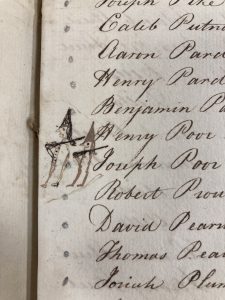
A Doodle. Newburyport Public Library, City Hall Documents, box 68, folder 2, 1814 [Newburyport Tax Assessors’ Directory], 6v. Photo Credit: Janus Yuen

Today I’m here to talk about my experiences with small archives, which have been not only invaluable to my research but also some of my fondest research memories. I will first introduce these archives, explain some aspects of how they come about, and how to access them. Then, I’ll discuss some of the boons of working in these places, as well as basic etiquette. (In a forthcoming blog, I will provide a checklist I use for cold-emailing these organizations, as well as a collection of my own attempts, not all of which have been successful.)

Archives are a nebulous concept to be sure, but in my own usage, I tend to mean an institution that holds collections of rare books, manuscripts, and other unpublished material. To access said material, one usually has to make a journey to the place, appointment in hand, inspect the unique material, and then continue on with one’s research life. Many know of the big archives, like the manuscript division of the New York Public Library, the Historical Society of Pennsylvania, the Rockefeller Archive Center, the Beinecke at Yale, or our very own Rare Book and Manuscript Library, on the 6th floor of Butler. These institutions have collections measured in the thousands of feet of material (i.e. if you stacked their papers in a single stack, it’d be thousands of feet high), are hubs of academic research, and have, in the 21st century, developed robust online resources, such as appointment systems, online finding aids, etc., which smooth out the process of finding out what materials are available, scheduling a time to visit, and getting the job done. Continue reading

Posted in Archives, Historic Sites, Libraries, major research, New York City, Senior Thesis, The Humanities, Uncategorized | Comments Off on Researching in Small Archives: Tips and Advice

FLI @ Columbia: Losing Your Mind In Seminar? Some Tips & Tricks

Fayerweather Hall, circa 1900-1906. Photo Credit: The Library of Congress.

As the sixth week of the fall semester wraps up, I return to a feeling of frustration with my History seminars I know all too well. Despite enrolling in at least one History seminar every semester since my sophomore spring, I still find the experience disheartening and, frankly, infuriating. I’m a senior at Columbia College majoring in History who hopes to enter a Ph.D. program in the discipline after graduating, and who ultimately aspires to become a professor one day. Seminars should be my bread and butter: a fundamental aspect of the major that I’m more than competent in. What gives? 

After spending some time reflecting, and joining my professors for several of their office hours, I’ve come to a better understanding about my performance in History seminars. 

These History seminars are just that: a performance. 

Continue reading

Posted in Archives, courses, Faculty Mentors, major research, postgraduation plans, Senior Thesis, Uncategorized | Comments Off on FLI @ Columbia: Losing Your Mind In Seminar? Some Tips & Tricks

So You Don’t Love Your Class(es)…

One of the first photos I took during my sophomore year. I returned to campus determined to make the most of my time at Columbia—and what a year ahead! Photo credit: Alan Chen.

The time has come—and maybe even passed. You registered for a course during shopping week that leaves you disappointed every M/W, that makes you grind your teeth, or that fills you with deep regret over your course selection. And unfortunately, you are now stuck in the course, with little recourse. But look, we’ve all been there—and even if it seems like you have little to learn in the class, you might still have a few things to learn from the class. In the following blog post, I want to detail a few reflections on the classes that I haven’t been too fond of and the classes that I have fawned over.

  1. When scouting out new departments, don’t feel obligated to begin with intro-level classes.

When I first began my time at Columbia, I only knew to start with introductory classes. Fearful that I might have neither the foundation nor the correct intuition to succeed in more advanced classes, I restricted myself to the domain of 1000-level coursework in political science, economics, and math. 

Continue reading

Posted in Uncategorized | Comments Off on So You Don’t Love Your Class(es)…

A Beginner’s Guide to Grant Proposals

Setting up for a Critical Cartography Project workshop with the Sixth Street Community Center, made possible by the Center for Science & Society Seed Grant. Photo credit: Madeleine Cesaretti

A grant can provide the foundational financial support needed to launch a new initiative or revitalize an existing one. Grants range in terms of funding packages large and small and stem from a variety of sources, including state governments, city agencies, and private foundations among other organizations. They are typically awarded through a competitive bidding process, with application requirements differing between each one. With so many specifications, the process of writing a grant proposal can feel overwhelming, but it certainly does not have to be. Think of the application as telling a story—your story—about a project that is true to you. Securing a grant allows you to access the resources to bring your vision to life.

Continue reading

Posted in Archives, Funding, major research, STEM research, Summer Research, The Humanities | Comments Off on A Beginner’s Guide to Grant Proposals

The Core Is For You

Meditation, Josef Israëls. Photo credit: Rijksmuseum

I often play one song on loop, over and over again—there’s something about a little instrumental detail that can hook me. Same goes for other media. Certain paragraphs in books, photographs in my camera roll or pasted on my wall, and scenes or lines from movies make me pause whenever I experience them. This is a kind of organic distraction: aesthetic things take me out of the stream of my continuous life and let me sit in some different place for a moment.

It’s a nice reprieve from the noise of the city and college. But it can sometimes be a bit too distracting. Ruminating over single pieces of art can take me away from the day and make my tasks a little more difficult to focus on.

Continue reading

Posted in Coursework, The Core | Comments Off on The Core Is For You

Exploring Paris through Its Archives

One of the first documents that I reviewed at the Bibliothèque nationale de France – François Mitterand. Originally published by le Journal des réformes sociales in 1879, this edition detailed the publication’s utopian socialist program. Photo Credit: Alan Chen.

Archival research is already demanding enough as is, so the challenge can only mount when researching in a foreign language in a foreign archive. If you find yourself in this situation, however, fret not! In the blog post that follows, I want to reflect on my time in one of France’s most imposing archives this past summer: la Bibliothèque nationale de France – François Mitterrand (BnF). In doing so, I hope to distill my first two weeks in the archives down into a brief guide on how to navigate a foreign archive in a foreign language. 

Accessing the Archival Materials
As you begin your adventure into the archives, let’s assume that you have a working list of materials that you’d like to consult. Before you can cross the bridge into all that lovely literature, you must first come face-to-face with the ugly troll of the introductory archival appointment. Luckily, the archival representative is not there to give you a hard time—but there may be cultural barriers that render these appointments difficult. For one, make sure to come to your consultation prepared with some knowledge of the local higher education system. The BnF requires that prospective researchers be at least undergraduate-level students. Simple as this may sound, France’s higher education system functions differently than that of the U.S.: whereas a traditional undergraduate degree in the U.S. will conventionally last you four years, a traditional undergraduate degree in France will only occupy three years (often leaving time for students to pursue Masters degrees). Equally confusing is that the thèse—or thesis—of the French higher education system belongs to doctoral candidates, and not to undergraduates. Therefore, in order to smoothly complete the archival registration process at the archival appointment, it is extremely helpful to know the foreign counterparts of your educational level and your research project.

Continue reading

Posted in Archives, Faculty Mentors, Funding, Libraries, major research, Summer Research, The Humanities | Comments Off on Exploring Paris through Its Archives

Visual Arts and Academics: Bringing Both Together

Photo credit: Maddie Cesaretti

Deep in the tall grasses and dry underbrush of the prairies of eastern Kansas, I crouch, my grandfather’s old film camera slung over my shoulder. Trees sway with the wind blowing over the lake ahead of me, and my sister waves from the water’s edge. It is spring break of 2024, and I am working on photographs for my Introduction to Darkroom Photography course—the first Visual Arts class I have taken in college. Up to this point, I understood my artistic practice as separate from my work in other classes. I had not yet learned to see how the subjects I was drawn to with my camera connected to the narrative threads I was pulled towards in the historical archives or to the visual and political dynamics I identified in the built environment of New York and other cities. By taking a class that centered on creative ways of thinking and being, I came to realize that my interests in the relationship between person, place, and the past flow throughout my life, beyond my previously self-imposed separation between my academic work and my artistic practice.

Continue reading

Posted in Art, major research, Summer Research, The Humanities | Comments Off on Visual Arts and Academics: Bringing Both Together

My HRSP (Humanities Research Scholars Program) Journey: The Fruits of a Failed Project

One of my favorite primary sources, found in my exploration: an advertisement letter by the New York Edison Company for lights (presumably electronic lightbulbs), addressed to Congregation Ansche Chesed president Meyer Goodfriend, April 5th, 1915. Source: Jewish Theological Seminary Library, Congregation Ansche Chesed Records, Box 1, Folder 5. Photo Credit: Janus Yuen.

Okay, I might be exaggerating a little when I say that I “failed” in my research, but bear with me, and I’ll explain why I think the failure of my project was more fruitful than if it had “succeeded.”

In the summer after my sophomore year, I was unbelievably fortunate to receive the opportunity to participate in the Humanities Research Scholars Program with five of my classmates from across the humanities. I say unbelievably because, for me, the trade was unbelievable. In exchange for an ambitious and locally actionable research project and a promise to dive headfirst into the archives, I was given housing, a stipend, and the most invaluable commodity for Columbia undergraduates: a couple weeks of (mostly) unstructured time. Rather than expecting us to produce some final research paper, we were expected to go to the primary sources in the spirit of exploration and play—the way any research project would ideally begin, rather than procrastinated until around three weeks before a final paper deadline.

Continue reading

Posted in Archives, Faculty Mentors, Funding, Historic Sites, major research, Summer Research, The Humanities | Comments Off on My HRSP (Humanities Research Scholars Program) Journey: The Fruits of a Failed Project