
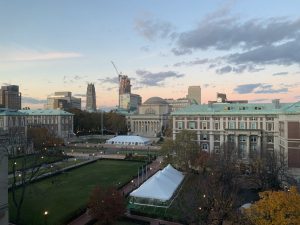
Alan and Janus were neighbors on John Jay floor 10 for the 2021-22 academic year. This was their view when they first came to Columbia! Photo Credit: Alan Chen.
As the Class of 2025 prepares to take on its last semester of college this spring, Rose Research Fellows Alan Chen and Janus Yuen (CC‘25) discuss how they first found their way to their programs of study and areas of focus. This is part of an ongoing series between Alan and Janus on how Columbia has uniquely shaped their journeys over the past four years.
Tell us about yourselves.
Alan Chen (AC): I’m currently a senior in Columbia College studying history and philosophy. In the history department, I focus on modern France and on the history of the family. In the philosophy department, I largely study political philosophy and ethics.
Janus Yuen (JY): I’m a senior in Columbia College, also majoring in history. I am specializing in 19th century U.S. History out of convenience, since we have so many amazing classes in that area in our department. But the heart of my intellectual interests is in early American history within the intellectual, religious, and economic context of the early modern Atlantic world.
What major(s) did you come into college with, and why?
JY: So I came into college as a classics major, since I studied Latin beginning in middle school. I kind of wanted to continue what I had already developed skills for and still cared deeply for as a discipline.
AC: I came into college wanting to study French and Francophone studies. I was a huge French nerd in high school, and, transitioning into college, I wanted to ground myself in the francophone world while dipping my toes in new disciplines like political science or economics. Plus, I figured that the major might open up further opportunities for me in either diplomacy or linguistics—both fields that interested me substantially at the time.
How did you choose your first classes in college?
JY: Even though I came in as a classics major, I was already considering possibly doing history, so I looked through the catalogues of both departments. The core took up three of my five classes, so I was looking for two classes. For both of my classes, I was looking for something between familiar and unfamiliar, and so in classics, I chose Professor Carmela Franklin’s Medieval Latin Literature, since it was Latin, but outside the classical canon, and for history, I chose Hannah Farber’s Early American Republic, since it was American history, which I knew from APUSH, but focusing on a specific less-studied period. While I really enjoyed both classes, it was that latter class which set me on the path to where I am today.
AC: The first class that I chose to take was FREN UN3421: Introduction to French and Francophone Studies II. It was a very small class, about eight or so people; everyone had great proficiency with the language; and most were upperclassmen, if not graduate students. The class, which focused on the literature and philosophy of the francophone world outside of the metropole, exposed me to the works of Aimé Césaire, Léopold Senghor, Léon Damas, and several other different Negritude writers.
I chose my second non-Core class on a whim, really. After shopping a few classes in political science that didn’t do it for me, I wandered over to the sociology department and ended up in SOCI UN1000: The Social World. Between its method and scope, the class didn’t turn out to be my cup of tea, and I left craving historical substance. More on that later.
What majors did you consider before declaring history? Why did you leave them behind?
JY: So, since the core occupied so much of our curriculum our first two years, and I still wasn’t decided on what I wanted to major in, I tried to break into a different department by taking one of its classes each semester: In freshman fall, that was history; in freshman spring, that was anthropology; in sophomore fall, that was comparative literature.
I think the most impactful department for me was Anthropology, since I had to wilfully decide against declaring it during sophomore spring. I was introduced to Anthro by a lecture called “The Ethnographic Imagination,” which I took out of sheer curiosity. It was a required class for the socio-cultural anthropology track and explored ethnographic writing as a genre with a really thorny ethical and epistemological history whose recent practitioners—and we read mostly contemporary ethnographies—have been tugging at the wider conventions and assumptions of humanistic scholarship and nonfiction writing as a whole.
One of the questions anthropologists have been asking themselves more fervently than historians or other disciplines have is the basic question of “what good does a book do?” Like, can a written ethnographic inquiry “represent” an Other culture in a faithful, truthful, and respectful way? That question led me to comparative literature as my next department to explore, but what it did not leave me with was a passion for working out anthropological theory, like working out those general, complex things (I can’t think of a better word for them) of human culture like the fetish, the gift, or the sacred—stuff that I came to recognize after taking more classes was at the heart of anthropology as a discipline.
So, ultimately, even though I remain fascinated by the frameworks anthropologists have built up for the study of culture, as well as the really wonderful theoretical work done by scholars of comparative literature, I kinda decided that among all these baggy monster disciplines, history fit me best as a form of work.
AC: What was the nature of this work in the history department that brought you so much satisfaction?
JY: Going back to first semester, I’m just gonna say point blank, I did not do all the assignments of my Latin class. At first I thought, okay, I’ve done Latin for so long, I can handle this. But my first semester ended up being a lot of afternoons and evenings in the library, sitting with my Medieval Latin reader trying to translate the two paragraphs assigned for that night. And I was just like, oh my goodness, so many minutes of work, and I only got two lines. To which I’d say to myself, “well, skill issue”—I’m just not that great at Latin, especially in its medieval form. But at the same time, I thought of the amount of ground that we were covering each week in my history class, and felt as if—pardon the strange analogy here—compared to history, which felt like squeezing juice out of an orange with my hands, Latin was like making carrot juice, which requires carrots to be thrown in a blender, which even then produces relatively little juice.
In other words, I didn’t feel like I could be a philologist for four years. I felt too plebeian for that—my attention span is too scattershot. Strangely, I found that I much more enjoyed reading a massive amount of material and then digesting it into arguments, so I turned toward historical work.
How about you, Alan?
AC: I left my first semester feeling a bit unsatisfied. I felt that my French class had been interesting, but I didn’t feel profoundly touched by the literature (and quite possibly by literature at large), and I felt similarly toward sociology. (For what it’s worth, I think I failed to realize that this dissatisfaction stemmed from the course’s introductory level.) So I wrote French and sociology off as viable fields of study for myself.
The next semester, I ended up switching gears because I deeply missed that quantitative part of my education that I had had in high school. So I ended up taking Principles of Economics, Calculus III, and International Politics.
Again, I found these subjects to be interesting in their own right—especially economics, which I think I would have stuck with were it not for the problem sets and exam format. So, throughout my first two semesters in college, I remember constantly vacillating between the thought of studying French and Francophone studies, sociology, economics, political science, and so on.
I left my freshman year certain that I needed to find some happy academic medium: that I wanted to study language without only studying literature; that I wanted the social scientific aspects of economics and political science without schematizing people into different theories of behavior; that I wanted to study something that could offer me substance and content. In other words, I wanted access to a richer repository of examples so that I could better substantiate claims that I might issue in the future. At this time, I suppose I didn’t even think about the synthetic training that history provides; I was far more interested in history as evidence.
Why did you decide on history?
JY: I decided from my experience with college-level Latin that I couldn’t be a philologist. On the other hand, I also didn’t feel like I wanted to be a theorist. Why? Because I realized I was more interested in world-building than philosophically true statements about humanity. After being exposed to theory through comparative literature and anthropology, I realized—through the core, frankly, more than anything else—that I wanted to study historical worlds undergoing social and cultural change, as opposed to any particular theory. The difference is between means and ends. In anthropology, for example, a lot of the time the heart of your project is a concept or institution, like fetish or kinship structure, and every society you study is an instantiation and evidence of that, as opposed to history, where all the theories, ideas, concepts, etc. available to you are put in service of understanding a particular society that existed at a specific point in time.
The reason why the Core helped me realize this was because I found that when reading books for Lit Hum and CC, I was less interested in reading them as part of traditions or instances of some higher civilizational spirit, or systems of logical propositions, as much as I was interested in reading each text like a window into the strange world that it was written in and for. And I realized that that’s how one reads documents for history.
AC: Yeah, something I’ve really come to love in history is its openness to contradiction in its propositions, and then that continual process of revision until reaching a satisfactory account.
JY: Yeah. Analogy that I really like to use now, which I came up with in recent months, is that political scientists, economists, sociologists, anthropologists and literature scholars are people who make tools. They’re coming with these really brilliant ideas where they use diverse kinds of evidence to come up with systematic claims within their branches of philosophy about how things work. These are theories. And we history people need their theories, because those theories are a big part of what we have to help us make sense of our really puzzling evidence. The whole point is for us to use the tools they craft to plow this vast field of human experience across time and space. Now we don’t really use them the way they intend them to be used. Like we jerry-rig a cast-iron two-furrow plough (classical rhetoric) to a John Deere tractor (postcolonial theory) to do some oddly specific task (say, studying colonial New England Indian missionary activity)—to the consternation of other disciplines—and when they break, as all tools and all analogies inevitably do, we just set them aside and start using other tools. In other words, we’re the peasants of the humanities, and I’m proud to be one.
Alan Chen and Janus Yuen (CC‘25)