To Color the Void: Remembering Why We Read

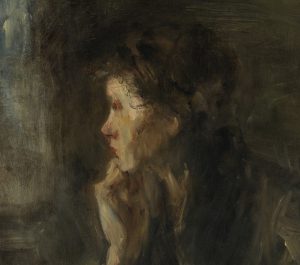
The Death of Socrates (cropped), Jacques Louis-David.
Photo Credit: Metropolitan Museum of Art

For a recent philosophy class, I read a Socratic dialogue called the Phaedo, which relates the hours leading up to Socrates’s death. It’s a powerful text: after being sentenced by his fellow Athenians, Socrates tries to distract his students from his demise by offering them proofs of the afterlife, as well as arguments for why dying is not as bad of a thing as people assume it to be. In the end, he reaches for his cup of poisonous hemlock and lays down to die.

I found Socrates’s courage inspiring. But as I was about to wedge the Phaedo away between other old books, I was struck by the memory of another text. I opened my big, red edition of the Bible—the one we all read for Lit Hum and CC—and flipped to the New Testament. Before long, I was at Matthew 14.

Continue reading

Posted in major research, The Core | Comments Off on To Color the Void: Remembering Why We Read

Thank you to Chile, and Thank you to Columbia: Logistics for Successful Research Abroad

Photo Credit: Harrison Gerson

My summer research abroad as a rising junior (2023) provided me with the confidence to pursue international research within the social sciences. As a Laidlaw Scholar, I worked with the Tourism Federation of Chile to develop their sustainability guidelines. Here’s the process that made my research successful:


Feeling ‘Comfortably Uncomfortable’ Abroad
Comfort is vital to the success and learning of you and your partners. On the other hand, many see entering a new, different space as an incredible learning opportunity. With this in mind, my experience was ‘comfortably uncomfortable;’ I was physically safe and intellectually able to contribute while being outside of my comfort zone in a way that places the least additional burdens on the community. 

Continue reading

Posted in Senior Thesis, STEM research, Study Abroad, Summer Research, Uncategorized | Comments Off on Thank you to Chile, and Thank you to Columbia: Logistics for Successful Research Abroad

Lost in “Translation”: Reflections on Language and Research

An example of a gloss for a Quechua-language catechism. Credit: Symbolo catholico indiano, Fray Luis Jerónimo de Oré y Rojas, fol. 66r, 1598.

As my six weeks with the Humanities Research Scholars Program (HRSP) began, I felt enthusiastic optimism. I knew my project was ambitious, and that it would challenge me in unexpected ways (my biceps, sore after carrying a pile of dictionaries back to my dorm, were early evidence of this). Still, I trusted my planning, and was excited to learn more about colonial-era translation in Mexico and Peru. Moreover, I was confident in my ability to carry out the translations which would be the crux of my research; with linguistics coursework, previous translation experience, and ample resources by my side, how difficult could it really be to work with these texts? 

The answer to this question came quickly: very. Almost as soon as I opened the primary sources I had painstakingly lugged from Butler, I became concerned about the irony inherent in my project. While I tried to study translative choices between Spanish, Quechua, and Maya, I was adding an additional layer of mediation with my English-language analysis. In just the first week of research, I found myself facing a significant methodological problem. I needed to capture subtle grammatical differences between texts, but with minimal Anglophonic interference. 

Continue reading

Posted in Archives, major research, New York City, Summer Research, The Humanities | Comments Off on Lost in “Translation”: Reflections on Language and Research

Diary of a Wimpy Biochemistry Intern Who Asks Too Many Questions

Photo Credit: Maurice Chakour

My first day interning at a biochemistry lab, I messed up a protein assay. 

The array of instruments on the bench were new to me. Most menacing of them was the micropipette, and I didn’t know how to tell my boss I was quite clueless (he was the PI, who was already gracious enough to have accepted me—a freshman without research experience). So, I sucked it up and tried my best. 

What was supposed to be a beautiful gradient of purple (as shown) ended up looking like a tray of water. I didn’t pipette most of the ingredients needed, wasting an hour of my time and half the protein sample. I braced myself as I confessed to my PI that the plate was a colorless failure. Fortunately, I wasn’t yelled at as expected. In fact, my boss was more than understanding and gave me step-by-step instructions for the procedure. 

Continue reading

Posted in Uncategorized | Comments Off on Diary of a Wimpy Biochemistry Intern Who Asks Too Many Questions

A Walk in the Park: Urban Lyme Disease Mitigation

Photo Credit: Noah Edelman

Do ticks tick you off? Does the thought of Lyme leave a sour taste in your mouth? I don’t mean to frighten you, but, if you live in New York City, tick bites might be closer than you think. In the urban parks of New York, ticks lurk in unexpected places— something I learned early on in my summer job as a Research Assistant in the Columbia Eco-Epidemiology Lab. 

My job is simple: I hunt ticks. Perhaps that doesn’t quite capture the image, though. It’s an average Tuesday morning. I’m walking through Clark Botanical Gardens, one of the more manicured sites we check for ticks. I’m in a white painter’s suit and blue Columbia hat, lugging a roll of thick corduroy fabric, which is attached to a dowel rod and rope setup that allows it to be dragged over the ground in maximal contact with foliage and leaf litter.

Continue reading

Posted in major research, New York City, STEM research, Summer Research, Uncategorized | Comments Off on A Walk in the Park: Urban Lyme Disease Mitigation

One Year In: Reflections on Research

Photo Credit: Rachel Smith

My LinkedIn recently reminded me that I have hit the one-year mark since starting my laboratory research here at Columbia. So I asked myself: over the past year, what have I learned? Not only about translation in prokaryotes (which I knew very little about one year ago), but also about research itself. What advice would I offer to prospective or new researchers? Two things come to mind: (1) ask questions, and (2) reflect. 

Continue reading

Posted in major research, STEM research, Summer Research | Comments Off on One Year In: Reflections on Research

One Email and Few Fruit Flies

Photo credit: Wisestamp

You never know where one email might take you. One email landed me a spot in a lab, a scholarship, a work study job, then another few scholarships, a research class, a few publications, and so much more. To say the least, one email changed the course of my undergraduate education. I started college 4 years ago thinking that I would be on a path towards medical school. I thought I would take the sciences, do clinical hours, and then dabble in a lab. Well, after sending one email to Dr. Erin Barnhart my freshman year, the reminder of that year, and every semester following became a pursuit of basic science knowledge. No longer am I planning to go to medical school. Now, as I face graduation in the coming weeks, I look forward to my job in Dr. Barnhart’s lab next year and, PhD programs in the biological sciences after that.

To take a few steps back, as a first-year student on zoom, I took a course that introduced me to the research happening on Columbia’s campus. After one of our sessions where Dr. Barnhart presented, I reached out to say thank you for presenting and that I miss cell biology (as I was taking general chemistry). After trading a few emails, we set up a meeting. After what became the most intense interview of my life, I was introduced to a graduate student in the lab who taught me image analysis. From my bedroom 2,000 miles from campus, I learned the ropes of what became the pillar of research. 

My image analysis work became the basis of my Laidlaw Scholarship application. My work that summer then became the basis for a work-study job, which led to a publication, which led to a Columbia Career education grant and continued to open up doors. Through all of this, I gained experience in image analysis, microscopy, a suite of wet lab techniques (Drosophila husbandry, dissections, genetics, etc.), computational analyses and coding. When I look back at my years at Columbia, I cannot imagine the semesters or summers without these skills, without the lab, and, indeed, without the fruit flies. The later became central not just to my research but all too often to my persona.

This is not to say that one email can cause an avalanche. Rather, it can set in motion a rolling stone that must be continuously pushed and monitored. One email can open a door, that may lead to another that then again may reveal a different path. Between each door is, as always, hard work and determination. Yet when I look back at my trajectory, I realize how fortuitous this entire path was. How much of it was happenstance and how much one email really did make a difference. This all to say, I await with poise and anticipation to see where one email might take me next.

Posted in Faculty Mentors, Funding, major research, STEM research, Summer Research | Comments Off on One Email and Few Fruit Flies

Through the Looking Glass: Representation and Authenticity in Media

An antique ‘looking glass.’
Photo credit:
https://wildschut-antiques.com/products/majestic-antique-french-golden-mantel-mirror.

During my senior year in high school, two prominent films helmed by Asian American casts and crews was released in theaters: Crazy Rich Asians directed by Jon M. Chu and The Farewell directed by Lulu wang. There was a significant amount of excitement from the AAPI community from the long-awaited opportunity to see their stories on the big screen. These movies, as they claimed, would constitute meaningful representation of Asian stories in America. 

After watching both of these films, however, I was disappointed in many ways. They both did not reflect what I perceived to be my experience of growing up as a Chinese immigrant in North America. There was similar criticism from other members of the AAPI community who claimed that these films were far from representative of the diverse cultures encompassed within the label of being ‘Asian American’; rather, they focused solely on the experiences of East Asians and particularly the Chinese. 

Continue reading

Posted in Uncategorized | Comments Off on Through the Looking Glass: Representation and Authenticity in Media

Some Parting Advice

A picture from the Met Cloisters, which the author wishes he had visited before senior spring. A bonus piece of advice: take more advantage of free student admission to museums. Photo credit: Ardaschir Arguelles, 2024.

Since this is my last post on this blog, I thought it would make sense to talk about some
of the principles that guided me to this point in my college career. I am graduating with a double major in Classics and East Asian Studies, having completed a thesis for each major. Amongst Rose Research fellows, a double-major in the humanities is nothing unusual – but since my last few posts have often addressed questions of discipline, creativity, motivation, and so forth in the abstract, I want to take some time to discuss practical principles that have been personally helpful for me in navigating two intensive reading- and writing-heavy majors. My hope is that the three principles I discuss below will be of value to anyone considering a similar track.

Continue reading

Posted in major research, New York City, postgraduation plans, Senior Thesis, Summer Research, The Humanities, Writing | Comments Off on Some Parting Advice

My Time as a Mellon Mays Undergraduate Fellow

Photo Credit: The Andrew W. Mellon Foundation

The semester is ending soon, and with it, my time as an undergraduate is also coming to a close. As I reflect on my college career—four years fraught with rising climate catastrophes, a global pandemic, and escalating international conflicts—I owe my sanity to one particular community: the Mellon Mays Undergraduate Fellowship (MMUF). Designed to foster diversity within academia and cultivate future professors, MMUF provides hefty guidance and financial support for undergraduates pursuing research in the humanities. The fellowship brings together an often overlooked field—the humanities—and an often marginalized demographic—minority, first-generation students, and low-income (FLI) students—to shape the future of academia.

Continue reading

Posted in Adversity, COVID-19, Funding, Libraries, Life, major research, postgraduation plans, The Canon, The Humanities | Comments Off on My Time as a Mellon Mays Undergraduate Fellow