
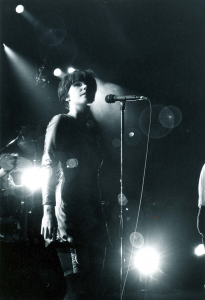
Björk performing with The Sugarcubes Photo Credit: Wikimedia Commons
As part of my Music Humanities course in the Fall, I was asked to write about an object of musical significance. The idea of the assignment is to allow students to summon what they have learned in the class to analyze something of their own choice. Now, I must mention that I am not musical at all. I play zero instruments and know next to nothing about music theory. On top of that, I am surrounded by musically talented people in my East Campus suite and in my friend groups. This has amounted to perhaps the most serious case of impostor syndrome I’ve felt in college… Needless to say, I had a hard time figuring out a musical object to analyze.
I decided to do some research about musical artists I knew I liked. I relistened to some of my favorite albums and tried to find anything unique about them that distinguished them as objects of singular musical significance. It wasn’t quite enough. I started to search on YouTube for my favorite singers, covers of my favorite songs, footage of performances I hadn’t seen—anything that yielded a possible thesis.
I got lucky when I found a grainy video of a 2001 concert by my favorite artist, Björk. By chance, the Icelandic singer-songwriter had gone on tour to promote her album, Vespertine, and ended up performing at our very own Riverside Church in the Morningside Heights. Lots of details about this concert drew me in. The contrast between the Catholic “vespers” and the album title, the black dress Björk wore which recalled her infamous “swan dress” episode at the Academy Awards, and the laptop on the altar that rendered new sound in a traditional setting—these details made the video a suitable musical object for me to explore.
Watching the thirty-minute artifact, I was impressed by the acoustics of the church and the singer’s stage presence. But the very end is what made me pause. After performing some of her recent songs, Björk halts the choir, the harp, and the computer. Silent, she walks down the altar steps and begins to sing one of her earliest songs, titled “The Anchor Song”:
I live by the ocean
And during the night
I dive into it
Underneath all currents
Down to the bottom
And drop my anchor
This is where I’m staying
This is my home
It’s a pretty song, but it wasn’t one I expected to hear as Björk was trying to capitalize on her newest hits. But then I did some research and found that in almost all of her live performances of her albums, she chose “Anchor Song” to finish off her setlist. And even more interesting is that in each of her performances, she chose different instruments to accompany her—saxophone, strings, organ, or piano.
It was obvious that she was saying something about her music by including the song in so many of her performances with a variety of instrumentation. But what it actually meant, I wasn’t sure. I thought about other cases of repetition in art in order to piece together the message she might be sending. An example that came to mind was from one of my favorite authors, Dante Alighieri. I could distinctly remember that he finished each of his three long poems with the same word: “stars.”
Inferno: “And we emerged again to see the stars.”
Purgatory: “Made pure and ready to rise up to the stars.”
Paradise: “The love that moves the sun and the other stars.”
In the Divine Comedy, stars are the central image of hope and ascendence. Each time Dante writes the word, he is putting his eyes up towards the better things he is yearning for. As he is being pushed away from the real world—from his city that exiled him—he repeatedly tells himself: remember where you’re going. And by the end of the poem, he’s there.
Knowing how that poet used repetition to send a message about hope and the future, I thought about how Björk’s musical repetition might be trying to say something similar. “Anchor Song” is a bit like a poetic refrain, taking slightly modified form in each iteration but always resting on the same sentiment.
Listening to the track again, I felt that it was about Björk’s personal connection to her home country, a feeling of bittersweet homesickness put into song. Literally dropping her “anchor,” she is saying that she will always consider Iceland where she belongs. Performing the song at the end of her performances is like a reminder to herself that, no matter how far you might be going and how successful you become with your art: remember your home.
This might seem like a trivial little thing to look for in a song, but for me, it was pretty significant that I could feel a deeper grasp of what a musician was getting at with one of her pieces of art by thinking about it in the same way I think about literature. It gives me a bit more faith in at least attempting to engage with a medium that I don’t feel much understanding of by looking at it through a medium I am much more familiar with. And now, as I enter my last semester of college, I’m thinking about what my anchor is—and where my stars should be.
Josh Martin CC’25