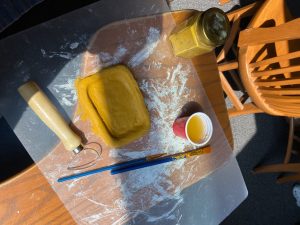
Sculpting with clay and painting with natural pigments at the Core Studio.
Photo Credit: Madeleine Cesaretti
On a warm Friday afternoon in September, I wandered into my first ever session of the Core Studio, an initiative spearheaded by Professor Jennifer Rhodes. Upon entry, Rhodes introduced the focus of the workshop: Clay vessels inspired by Enheduanna, the focus of the first week of Literature Humanities. Rhodes showed students the different activities available, including making air-dry clay objects and painting with natural pigments, and then left the space open for individual and group experimentation and material exploration. In November, I sat down with Professor Rhodes to talk about her work founding the project and her experience as a Literature Humanities instructor these past years. We spoke about her inspiration for the initiative, its mission and current structure, and future directions for the Core Studio.
Rhodes, a graduate of Columbia College herself, has been teaching Literature Humanities for over 5 years. One of her favorite parts of the course is connecting the texts to other media, including works on the Art and Music Humanities syllabi. Her research on the interchange between literature and the visual and performing arts in Europe and the Americas together relate to the structure of the Core Studio, which allows students to access arts-based projects inspired by the texts on the Lit Hum syllabus. “Getting the opportunity to connect students to the material resources to explore” academically and artistically has been one of the most meaningful parts of the Studio for Rhodes.
From her early days of teaching Lit Hum, Rhodes was thinking about how to build deeper relationships between students and the texts on the syllabus. Drawn to “the ways in which memories are connected often through different types of artistic engagement,” Rhodes knew there was potential within the Core Curriculum to highlight the ways in which pedagogical and artistic practices had the potential to influence and strengthen each other. Yet incorporating further creative engagement was difficult given the fast pace and extensive number of works covered each semester. These interdisciplinary commitments stem from Rhodes’ time living in New Mexico and observing the rich pigments of the land in relation to its visual representations in works such as Georgia O’Keeffe’s paintings. Forays into pigment-making for her own watercolor paintings expanded how Rhodes understood the material and its evolution over time, enriching the way in which she imagined pigments described in written works.
Rhodes initially launched the Core Studio in her own Lit Hum sections, structuring the activities as part of an optional weekly session for students. Students not only engage with the text’s ideas but also “become part of the conversation” by creating their own works. Each week’s activity relates in some way to the text being covered that week in Lit Hum. For example, the week I attended earlier this semester highlighted clay vessel-making, inspired by Enheduana and ancient tablets. In November, the Studio hosted a trip to Columbia University Libraries Conservation Lab with conservator Morgan Adams to learn about parchment and paper-making practices.
The Core Studio helps bridge the gap between the Lit Hum syllabus and its diverse historical, linguistic, and geographical contexts. By offering materials and space for students to make their own pigments or tablets, the Core Studio provides a more tangible way for participants to experience these historical artifacts and understand them in a way that more closely aligns with their past. For a course often criticized for its lack of relatability or modern relevance, this hands-on approach helps bridge that disconnect through creative engagement with the materials, both physical and conceptual, suggested by the texts.
This year Rhode’s work with the Core Studio is also being supported by the Center for the Core Curriculum and offered to all CC students on a weekly basis. Rhodes emphasizes the Studio’s importance in making “a space where people could come and just try something out without financial pressure or other types of pressure.” In this form, student engagement can range from dropping in one time to attending on a weekly basis.
Expanding accessibility of the Core Studio is at the heart of its spring initiatives as well. The Studio will be launching a website housing information on its internal curriculum and connections to the Core in general. For example, a user can sort by materials such as lapis and trace references to it across “different places and times, whether it’s used in a text or used as its own material self.” The website will also facilitate a material lending library of the Studio’s resources, allowing students to engage beyond the Studio sessions and instructors to incorporate activities into their own lesson plans.
Whether you have been a long-time enthusiast of the Core Studio or a new convert such as myself, students can look forward to engaging workshops in the spring semester, including book-binding and more. Through its open structure and ethos, the Core Studio facilitates connections between students and texts beyond the traditional classroom, inviting participants to engage across mediums and experiment creatively and academically.
To stay up to date with the Core Studio and Professor Rhodes, join the project’s mailing list here: https://mailchi.mp/3fe20b77ae0e/core-studio.
Madeleine Cesaretti CC’25