Photo Credit: Amanda Elvarsdóttir
This summer I got to see what conducting research is really like, and it wasn’t like in the movies – it was even better. Unlike the movies, there were no bubbling beakers, or lab coats, all I had was a monitor, a mouse and a desk. At first this may sound unimpressive, but I beg to differ when I know all about the ride I took with these tools while at my lab.
Now I’ve never conducted research before. Didn’t know a single thing about how it worked, or what I should research when I arrived at my lab. This was the first dip of my rollercoaster, and dang was my stomach flipping from anxiety because of it. However, as a recipient of a National Science Foundation Research Experience for Undergraduates (NSF REU), I had the amazing honor of being partnered with a professor who mentored me and walked me through how it works to conduct research. I was even luckier to be partnered with a graduate student who really took me under her wings and supported me while we worked on our project together. This was the first up of the rollercoaster.
Yet, once the research actually began, there were some extra dips, corkscrews and loops that I didn’t know I was going to experience. With my research, while we were trying to determine a valid study procedure, we constantly kept running into walls and the unknown. I didn’t know if what I was testing was too simple or too complicated, which meant sometimes I veered into both lanes too many times with my rollercoaster cart. Even when I would believe I found a perfect resolution between the two, I would find an unexpected variable that meant I’d have to loop back to the drawing board, and reconsider some aspect of my research.
Specifically researching how humans may interact with AI in AR, there were so many routes my grad student and I could’ve taken to measure this type of Human-Computer Interaction. At the beginning, when we decided to give our participants a decision making task, we hadn’t known how broad that type of decision could be. It was eventually decided that grocery shopping was the way to measure the interactions of our participants with technology, but then came the battle of figuring exactly how to measure it, what to measure, and what to eliminate or control on our end.
This was what cost us weeks trying to figure out. What grocery items should we pick to test with, what about flavors, brands and colors? Should we include cost? What does our interface look like when overlayed with a grocery shelf, and how many rows should there be on our shelf? So many questions. So many unknown answers, and therefore, so many twists and dips in my rollercoaster.
But, there was a silver lining in all this. I learned to enjoy the ride while going through my research. I would even go as far to say that I started to raise my hands and chirp in glee as a dip would come. Why? Because all of these twists and turns meant that I was learning. I learned so much about human decision making, visual saliency, prior AI interactions, and so much more. Through every up and down of the rollercoaster, I was conducting literature reviews, meeting with my mentors and learning how to apply what I’ve read and what they know to answer my unknowns and direct my rollercoaster to the finish line.
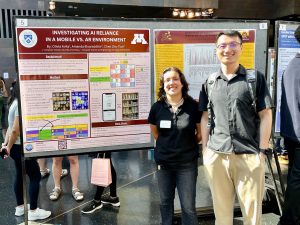
And, believe it or not, I am proud to say that my rollercoaster has not yet finished. Right before my final day of my REU, after working for two and a half months trying to lock down our research questions and our study procedure, we ran a pilot study to see what tweaks needed to be made and what worked for us. It was a long day spent at the lab that had my grad student and I running participants and working till the sun went down. And while I was tired and mentally spent, it was one of the most rewarding and educational experiences I’ve ever had. When we ran this pilot study, I learned so much about the areas and phenomena of human behavior that I had failed to consider earlier. But being able to find these kinks and vulnerabilities in our armor didn’t upset me or make me feel like less of a scientist. If anything it made me feel more like a researcher than ever before. I discovered things. I discovered how humans might treat a study with math involved, how humans might interact with a mobile interface when presented with multiple options but ultimately needing to only choose one. So, I was smiling ear to ear when presenting my poster, one that was printed two days before I ran my pilot study, to the science community while I explained to them how just the night before I walked home knowing that I had to go back to the drawing board and reconsider some of the makings of my now defunct procedure.
And so, to conclude this long and joyous journey that I’ve taken this summer for the last 10 weeks, I only have a few statements to share. I had the time of my life doing research at the University of Minnesota under the mentorship of Professor Zhu-Tian Chen and Master’s student Amanda Elvarsdóttir. I was learning for learning’s sake, and although my research project is not over, I feel very accomplished with my time spent there. I learned much, I discovered a few things, and I made so many valuable connections that I will cherish for the rest of my career and life. My research rollercoaster was a wild one, but the ride was and still will be fun – because I know I’ll be discovering every step of the way.
By Olivia Avila