
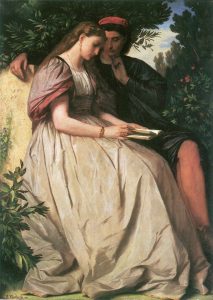
Paolo and Francesca, Anselm Feuerbach.
Photo Credit: Schack-Galerie
Students of Literature Humanities will encounter a speech in the fifth canto of Dante’s Inferno. The speaker is a woman named Francesca. She is telling Dante about how she fell in love with the man next to her, resulting in an adulterous affair and eternal damnation for them both in the circle of lust.
Her speech contains some of the most famous verses in all of the Divine Comedy:
|
“Amor, ch’al cor gentil ratto s’apprende, Amor, ch’a nullo amato amar perdona, Amor condusse noi ad una morte. |
“Love, which quickly seizes the gentle heart, Love, which pardons no beloved from loving, Love led us both to a single death. |
There’s a lot to unpack in these eight verses, but one element stands out: love. As the subject and starting point of three stanzas, “Amor” is the most important framing element in Francesca’s speech. It’s the primary referent in her explanation for her sin: she was taken control of by forces she was not able to resist.
In addition to repeating “Amor,” Francesca invokes language from the poetic tradition that Dante himself was a part of—she appeals to the “gentle heart,” the “fair body” of a woman, and the “pleasure” that love brings. Francesca’s verbal powers cause Dante to faint by the end of her speech (“I fell as a dead body falls,” he writes). You might not go unconscious when you read her pleas, but it would be very natural to feel angry that these beautiful words are being uttered under the condition of the speaker’s permanent suffering. All of the sympathy-sowing elements in her speech are activated when we linger on the fact that she is damned—all that love and pleasure, and to be punished?
The moral implications of Dante’s poetry may scandalize us; he places many types of people in Hell that we would not consider wrongdoers today. But the breaches he makes against our moral sentiments should not prevent us from finding what beauty we can in his imaginative command of language. I want to point out another passage which, placed in juxtaposition to Francesca’s speech, may illuminate the aesthetic value of Dante’s poetry and hopefully demonstrate one reason why he is still on our curriculum.
If you continue reading after the Inferno, you will reach the top of the mountain of Purgatory. It is here that Dante finally meets the person who inspired his love poetry and who, as a character in the Divine Comedy, sent the Roman poet Virgil to guide Dante on his divine journey: Beatrice. But when Beatrice appears, Virgil has already started going back down the mountain to return to his place in Hell. Dante turns from Beatrice to Virgil and finds he has disappeared:
|
… volsimi alla sinistra col respitto Ma Virgilio n’avea lasciati scemi |
… I turned to my left just as But Virgil had left us behind, bereft |
These do not sound like the words of a distant, moralizing author, but of someone fully in tune with the emotions of loss. I am especially moved by how the style of each of these stanzas imitates their content: the first stanza lacks commas, mimicking the anxiety of a child running to his mother in a single held breath, while the commas in the second stanza enforce the pauses that one takes while trying to speak between sobs. Anticipation and excitement give way to a disordered, pathos-ridden expression of turmoil.
Compare this to Francesca’s prepared eloquence: she deftly repeats the word “Love” to keep the locus of her damned status in external forces. It’s a rhetorical choice that demonstrates the character’s ability to persuade, coax, and convince. On the other hand, Dante’s repetition of the name “Virgil” is anything but eloquent, crowding into a single stanza and sapping his poetic impulse as he renders the psychological state he entered when he was left by his guide.
If Francesca’s triple “Amor” is a rhetorical flourish, then Virgil’s triple eruption into the epic flow is a rhetorical collapse under the author’s overriding distress. Dante repeats “Virgil” in the same way we might repeat a loved one’s name after they’ve just passed away—without artfulness, without eloquence, without intention. Just a name, an immediate signifier for the totality of what we feel we’ve lost, over and over again.
Dante is not as immediately accessible to me as someone like Shakespeare. To understand why the Bard deserves to be on our curriculum, all you need to do is read one of Hamlet’s soliloquies. But I think Dante is just as perceptive of the human heart and the power of emotions as any other. It is because of the human in him that, right as he is about to ascend from earth to heaven, he weeps for the person he wishes could ascend with him. And it’s in that kind of moment that words can make someone’s mind, heart, and soul soar over any divide that separates their world from ours.
Josh Martin CC’25