
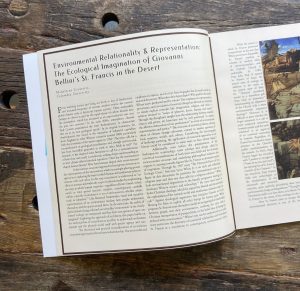
My article published in the 2024 issue of see/saw, the History of Art Journal at U.C. Berkeley.
Photo credit: Madeleine Cesaretti
Have you been working on a research project for a few semesters—or even years—and finding yourself ready and willing to share your work? Are you looking to develop your ideas further and to get connected with others in your field? If these questions resonate with you, you might find it a good time to start investigating ways of sharing your work as an undergraduate researcher. Read on to learn more about avenues of doing so, such as undergraduate research journals, conferences, and more. Each of these paths can be meaningful ways not only to strengthen your writing and presentation skills but also to connect with others and engage with the broader academic community. Today I will primarily focus on journals and publications.
This past spring I published my first academic article in the inaugural issue of see/saw, the History of Art Journal at U.C. Berkeley. My article “Environmental Relationality & Representation: The Ecological Imagination of Giovanni Bellini’s ‘St. Francis in the Desert’” grew from a term paper I had worked on for an earlier class, “Medieval Science, Craft, & Art” with Professor Gregory Bryda. After revising my paper and being accepted into the journal, I worked with the group’s editorial team to further hone my piece for publication. Publishing in this journal allowed me to connect with students across the country at U.C. Berkeley during the peer-review process and at their publication symposium. I have been able to expand on my ideas in the time since by now having work that can be shared with established professionals in related fields. It is exciting to find one’s writing circulating with a broader audience and possibly sparking their interest in turn. (My article is linked here if those reading might be interested as well.)
This process taught me that, while undergraduate research can look different for different fields, students across disciplines can engage with scholarly journals. For example, some students in STEM and social science fields work in research labs and contribute to their Principal Investigator’s (PI) work, perhaps gaining publications through association. For students in the humanities, research might take on a more individual character and develop via one-on-one relationships with professors. In each case, students are able to engage in ongoing discussions in the broader academic world and make research contributions to their fields. Undergraduate journals can help facilitate the circulation of these contributions and nurture students as they grow intellectually and professionally.
What are Undergraduate Journals?
Scholarly journals are important platforms for sharing research and gaining recognition for one’s work. Many of us as students likely have encountered scholarly journals, written and edited by full-time academics, in different classes, referencing their articles to learn and build our own arguments. It might feel intimidating to compare your own work with those of people who have completed decades of research on a subject. Yet, in terms of publishing, many colleges—including Columbia—are home to journals that specifically highlight undergraduate papers across disciplines. The editors for these journals are other students who are trained to help nurture undergraduate works from submission to publication. If you are a visual artist, many journals also accept arts submissions, which can be another valuable way to share your vision and ideas.
Some journals on campus include:
- Journal of Art Criticism
- Columbia Journal of History
- Barnard-Columbia Urban Review
- Columbia Journal of Literary Criticism
- Columbia Journal of Asia
- Columbia Undergraduate Science Journal
Certain journals are affiliated with specific Columbia departments and are promoted on their respective websites. Other journals on campus might be organized as student clubs and can be found on the Activities Board page. National and international undergraduate journals, such as the Journal of Young Investigators, also exist outside of the university.
Call for Submissions
Journals gather articles for publication through their calls for submissions. From important deadlines and word counts to other formatting requirements, these calls outline the guidelines for submission material. It is important to follow these guides so that your submission receives full consideration from the editorial team. The journal might also specify whether or not you can submit multiple articles for possible publication. If they allow multiple submissions, feel free to send multiple works for a higher chance of one catching the attention of their editors.
Additionally, some journals ‘theme’ each of their calls. Typically these themes are designed both to inspire students and to help create internal cohesion for each issue of the journal. Other journals might create themes based on the selection they choose from their calls for submissions. I would strongly recommend adhering to the theme if a journal calls for one.
Calls for submissions are disseminated via a variety of paths, such as through flyers and email newsletters. Some journals have social media accounts and will share their calls there as well. Many departments at Columbia will share calls for submissions from undergraduate journals with their mailing list. Departments will often share calls from off-campus journals as well, so I highly recommend making sure you are on the mailing list for departments of possible interest—whether you have a declared course of study with them or not. Though I am not an Art History major, I learned of see/saw through the Columbia Art History Department’s mailing list. You can join departmental mailing lists by emailing their Administrative Coordinators, found on each department’s website. Research centers at Columbia will also often share the calls for submissions for undergraduate journals, so checking in on their newsletters can also be helpful for finding a journal that matches your interests.
Editorial Process
Once you have submitted your works for possible publication, it is in the hands of the journal’s editorial team to select what pieces they will publish in the issue. The editorial process can differ between journals but likely contains some combination of initial revisions, peer-review, and final edits in order to publish your work.
If your work is selected for publication, congratulations! The journal should contact you about completing the rest of the editorial process and going forth to publication.
If your work is not selected for publication, consider submitting to other journals or again to the same one in the future. Some journals might send feedback on rejected works, highlighting areas for improvement or needed elaboration. Others might not, in which case it might be helpful to reach out to professors for their advice.
Publication
Journals typically publish online or in print—or some combination of the two. Publishing your research allows you to connect with other interested students, professors, and researchers while practicing important professional skills through the editorial process.
In my future blog posts, I will discuss conferences and symposia, which are also engaging opportunities to share your research and work with others.
Maddie Cesaretti CC’25