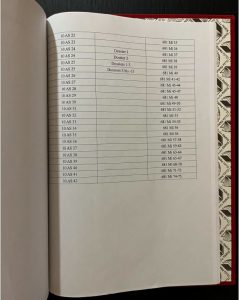
An inventory list from one of my archival collections. Photo Credit: Alan Chen.
In my last blog post, I wrote about the preparation that goes into preparing to write a senior thesis, especially in Columbia’s history department. Since then, I’ve received a few questions on archives: how to locate them; how to plan an itinerary around them; and how a day spent at the archives might look. In the third installment of my de facto series on archives and Columbia’s archival research fellowships, I aim to answer a few of these questions in a Q&A format. As the prospect of writing a senior thesis looms on the horizon for many third-years, I hope this helps clarify a few things—both for those applying to research fellowships and, more broadly, for those generally interested in archival research.
Q: How did you identify and select your archival sites?
A: I approached this in three ways. My first step was to see if there might be a city or town that housed the majority of my archival collections of interest. For me, Paris was the clearest candidate—it not only housed the country’s national archives, but also a host of national libraries and city archives.
In case there’s not a clear hub of sources or in case there are several locations that you’d like to visit, I would highly recommend aggregating a bunch of potential archival sites and narrowing down your list to the one or two cities/towns with the highest concentration of collections. When I first began planning my itinerary, I had intended to visit four to five different cities across France, each containing one or two relevant archival sites. Severely overestimating my reading speed and how much time it would take to sift through and savor each document, I ended up spending all of my allotted six weeks reading through records in Paris.
The second approach began much closer to home—in my case, at Butler Library. After checking out ten or so books on my research topic, I performed a cursory skim of each text (at this stage, it’s sufficient to focus on tables of contents and relevant chapters). On the advice of my professors, I paid special attention to footnotes in relevant chapters and to bibliographies. Both places offer ample primary and secondary sources that might just fit your thesis or research topic.
You can then look these materials up on clio.columbia.edu to see if Columbia owns any copies in our physical or digital collections. If we don’t have them on campus and if we can’t access them through our interlibrary loan system, there’s a chance that they can only be found in collections outside of New York City and even the United States. If you’re applying for one of Columbia’s research fellowships, focus on these documents—the university has less reason to fund your travels if you can access your outlined materials from the comfort of your laptop or from one of our libraries.
Though the two preceding methods are the most reliable, the third approach—if available—is likely the easiest of them all. At the beginning of some academic books, authors will offer a brief list of archives that they draw sources from. When authors provide these lists, they usually do so to offer abbreviations of typically long-winded archive names, but they can just as easily end up to be a great boon for fellow researchers.
Q: Did you discuss your itinerary with an advisor?
A: After I had compiled a list of seven to eight potential archival sites, I visited my second reader (the faculty advisor for my thesis) and a few other trusted professors, who commented on the practicality of my itinerary. Before finalizing your itinerary, it’s a good idea to have a second reader or faculty mentor familiar with your region and/or subject matter so that they can give you leads on where to look (or where not to).
Meanwhile, I also contacted a few librarians and archivists at sites of interest, asking to confirm that they still had the materials that I was searching for. This proved extremely helpful for someone who had not only never stepped foot in a foreign archive, but someone who had never done archival research outside of campus.
Q: What did your daily schedule look like while completing archival research?
A: My daily schedule was largely at the mercy of my archives’ respective hours. At my first archive, the Bibliothèque nationale de France – François Mitterand, I typically sifted through materials from 12:00pm to 7:00pm, although there were certainly days where I went for far less time. At my second archive, the Archives nationales, I was typically on site from 12:00pm to 4:45pm. The schedules of different archives can vary a lot, so while you’re planning out your itinerary, it’s always a good thing to check each collections’ hours in advance.
Another point that slipped my mind while planning was to check the opening schedules for the individual collections that I wanted to consult. At the Archives nationales, the microfilm room—where most of my records were stored—closed earlier than the rest of the archive. There were also some days when the microfilm room would be closed from 1:00pm to 2:00pm for a week at a time. While you likely cannot plan for the latter scenario, it’s always a good idea to allot more time than you might expect for each archival collection.
And that marks the end of my series on archives and fellowships! Stay tuned for an exciting joint piece with a fellow Rose Research Fellow where we discuss how we found our way to our senior thesis topics.
By: Alan Chen (CC‘25)