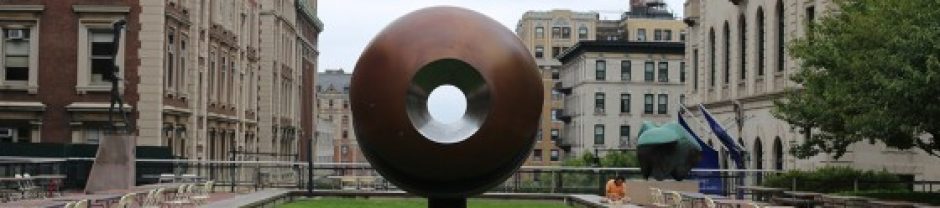
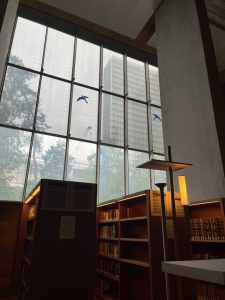
Not an extraordinary photo, but a meaningful one—taken on my first day at the Bibliothèque nationale de France – François Mitterrand. With the support of the history department’s fellowships (as described below), I was able to spend the first half of my summer conducting thesis research in Paris. Photo Credit: Alan Chen.
Officially, the preparation for writing a thesis in the history department begins in the spring prior to the yearlong process of writing a thesis. Every March or so, the department will reach out to declared history majors and call for senior thesis seminar applications, asking for a student’s academic record in the department; a brief explanation of one’s proposed topic; previous research done on one’s topic; a few primary and secondary sources of interest; and potential second readers.
As clear as the application was, there were still several things that I wish I had known before diving into the thesis preparation process. So, with the spring semester right around the corner, I want to use this blog post to break down the preparation that goes into the preparation for writing a thesis.
The Basics
When a student decides to write a thesis in the history department, they will have to register for a yearlong course entitled “HIST UN3838/UN3839. Senior Thesis Seminar” (the numbering differs by semester). Each seminar will be led by a history professor who will guide and supervise the writing process for 12 or so theses. These instructors perform the function of a “first reader.”
It is also up to students to identify and confirm a “second reader” who can offer your project a second pair of eyes. While the overlap between your and your first reader’s interests can be minimal with little detriment to your writing experience, it is highly recommended that your second reader have a working understanding of your topic area, if not expertise. For instance, I am currently writing a thesis on 19th century French cultural and intellectual history, and I am very fortunate to have Professor Emmanuelle Saada as my second reader, who specializes in 19th and 20th century French cultural, legal, and colonial history. Having a second reader who is fluent in your subject area will make all the difference: their background knowledge will help shape the bounds of what you can, should, or might do.
Third Year Coursework: Finding Your Way
To best prepare to prepare to write a thesis, your junior-year course selection offers the perfect place to start. During your junior year, it’s a wonderful idea to take one or more history seminars (3000-level classes and above) with professors who share academic interests with you. I highly recommend this for three reasons.
First, whereas most lectures set out to offer comprehensive surveys of their chosen subject matters, seminars tend to take a more precise approach to studying a narrower topic. Oftentimes, this will require finer primary source analysis accompanied by the relevant historiography—all activities that will serve you well throughout the thesis-writing process.
Second, seminars typically culminate in the writing of an original 10-20 page research paper. Not only does this give you a chance to ease yourself into the process of writing a lengthier, more substantial research paper—this also gives you a chance to do some topic-exploration, often without the constraints of a formal prompt. So, in case you land on a topic that piques your interest, you have the groundwork for a working thesis idea and proposal.
Finally, although lectures certainly offer exposure to course content and to professors alike, seminars allow professors to better understand your interests, your thought process, and your intellectual goals. In the fall of my junior year, for instance, I took Professor Lisa Tiersten’s “Consumer Culture in Modern Europe” and Professor Susan Pedersen’s “Marriage and Morals among the Victorians.” Both courses played such an important role in me finding my way to my thesis topic, and I can’t give enough credit to the countless office hours I spent refining my research interests and skills with Professors Tiersten and Pedersen.
Third Year Coursework: Caveats to Consider
First, make sure to have a healthy spread of potential second readers. Unfortunately, sometimes, though you might have the perfect second reader lined up in your head, they might already be planning to take a leave of absence the following year to pursue their own academic projects, to pursue a visiting professorship, or to focus on their personal lives. Thankfully, Columbia’s history department has an incredible faculty line-up with interests spanning all of space and time (or, very close!)—but this is still something to be mindful of.
Second, if you plan to study abroad in the spring of your junior year, I would highly recommend following all of the above advice during the preceding fall term. This way, you can begin your search for prospective thesis topics and second readers before you head off to wherever your destination may be.
Considering Summer Research
Finally, no thesis-preparation-preparation blog post would be complete without making mention of Columbia’s various thesis research funding opportunities, all of which you can find here. Every year, the history department releases the attached list, detailing several fellowships that go on to fund summer research for various theses. Although some fellowships and funding opportunities do not repeat every year, many, like the Senior Thesis Research Fellowship in European Archives, are long-standing pillars of the department’s offerings. As someone who has completed some of these fellowships, I cannot recommend them enough—they’ve given me access to countless once-in-a-lifetime experiences, both inside and outside of the archives.
Conclusion
I won’t lie to you—preparing to (prepare to) write a thesis is no walk in the park, from brainstorming the perfect thesis topic to identifying second readers who would best suit your project. That being said, the process is entirely manageable and can even be deeply rewarding. So, if you’re thinking about writing a senior thesis, please remember: take it one step at a time; there is no one way to tackle this process; and feel free to speak with our many history major-Rose Research Fellows. You will do wonderfully.
By Alan Chen (CC‘25)