
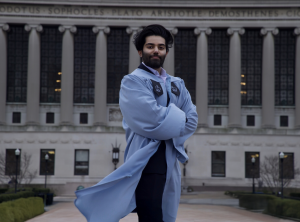
Kumayl Alloo CC’25. Photo credit: Kumayl Alloo.
There is a silence that lives in the brain. It lingers long before disease makes itself visible—before tremors betray the hand, before movement slows into stiffness. In Parkinson’s disease, that silence is often filled with shadows of a different kind: anxiety, depression, the quiet erosion of motivation. These nonmotor symptoms can appear years, even decades, before a diagnosis.
Most of what the world knows about Parkinson’s revolves around its motor features. The shuffling gait, the trembling fingers—these are the images we carry. But beneath them is a deeper story: that the mind changes long before the body falters, and that those early changes are neither well understood nor well treated.
My research lives in this hidden chapter.
We study a genetic mutation called LRRK2-G2019S, the most common inherited cause of Parkinson’s disease. On its own, the mutation is not an inevitable sentence—it is a predisposition, a subtle shift in the brain’s blueprint. But when life introduces stress, something profound happens. The neural networks altered by the mutation early in life seem to interpret stress differently, as though their circuitry had been tuned to another frequency. Under the microscope, activity patterns emerge—specific regions flare where others stay dim. In behavior, the differences become tangible: shifts in mood, in resilience, in how the animal navigates the unfamiliar.
This is not the story most people expect to hear about Parkinson’s. And it is certainly not the kind of story I once thought science allowed me to tell.
Early on, I believed I could write about my research the same way I wrote essays for literature classes: with imagery, with ambiguity, with the intoxicating freedom to let words carry more feeling than fact. I once described our findings as “stress whispering into the brain’s circuitry, reshaping its hidden landscapes.” My first PhD student-mentor read the sentence, looked up, and asked: “What does that mean in data?”
That question lodged in me. What did it mean in data? Could I even explain it without the crutch of metaphor? And why did it feel so much harder to strip the poetry away?
I began to see that science is a different language altogether. In prose, ambiguity can be a gift. A novelist can leave gaps, trusting the reader’s imagination to build the bridge. In science, ambiguity is a failure of duty. Every word must be precise enough to survive replication. If your meaning can be misread, it will be—and the misreading may propagate like a bad gene.
At first, I saw this as a loss. Precision, I thought, was the enemy of beauty. But over time, I learned that there is beauty in precision too. The elegance of a well-crafted methods section, the rhythm of a results paragraph where each sentence delivers a single, irrefutable point—this is a different kind of artistry. It is the art of removing every unnecessary flourish until nothing remains but the signal.
And here, unexpectedly, is where science and prose converge: both are acts of service to the reader. Prose serves by evoking, science by illuminating. Prose invites the reader to feel; science equips them to know. In either case, the writer’s task is to shape the idea so that it survives the journey from one mind to another.
Once I understood this, I began to write differently—not just in science, but everywhere. I stopped asking, “How do I make this sound good?” and started asking, “What does my reader need most from me here?” The answer changes with the context: a grant reviewer needs clarity without ornament; a classmate might need an analogy to make an unfamiliar concept stick; a stranger reading about Parkinson’s might need both, so that the science reaches them before the fear does.
This shift in thinking mirrored something from my research. The LRRK2 mutation alters how the brain reads stress. Writing, I realized, is about altering how a mind reads ideas. The responsibility is similar: if you know the audience’s circuitry—its prior knowledge, its blind spots, its thresholds for overload—you can deliver the message in a form that will not just be received, but remembered.
So here is the lesson I would leave with anyone who writes, in any discipline: before you put down a single word, ask yourself, “What is the job of this piece of writing?” Is it to inspire? Then allow space for wonder. Is it to inform? Then strip away every shadow of ambiguity. Is it to persuade? Then build your argument like an architect, with every beam placed to bear weight.
Writing is not about finding your voice. It is about learning which voice will be heard.
In the lab, our task is to make the invisible visible: to map the changes in the brain that precede the symptoms, to name the networks that fail quietly before they fail loudly. Writing is much the same. You are trying to make someone else see what you have seen, to notice what they would not have noticed without you. And just as in neuroscience, success is not measured by what you send—it is measured by what is received.
The signal is everything. The noise is what you learn, over a lifetime, to strip away.
By Kumayl Alloo