Learning the Core Personally

We’ve all been in that room. Maybe it was your closest class friend. Maybe it was your unspoken class nemesis. Or maybe it was even you. But we’ve all been there when the professor cold calls someone in LitHum or CC to discuss the reading, and instead they launch into a five-minute spiel about their life. Perhaps it was a Marxian reading of Flex Dollars. Perhaps a Vindication on the Rights of Boarding Schools. Maybe even what their Biology class has to say today about Darwin’s theory of evolution and how that makes people in STEM overqualified for the Core.

Chances are, if you’re reading this blog, when you were in that room, you probably rolled your eyes, highlighted a new quote, and mentally prepared to shoot your hand up first with your rehearsed points in tow. For many of us in the humanities who enter a Core classroom, we assume we have it locked down with CC and LitHum analysis. You might have watched your friends struggle over a GenChem problem set, but reading the entire Leviathan in one night was a breeze. And while I do agree it can be quite frustrating to feel like the only one doing the reading or who knows what’s going on in the class, unfortunately, we are not. 

Continue reading

Posted in Uncategorized | Comments Off on Learning the Core Personally

The Art of the Research Interview

St. Luke Drawing the Virgin, by Rogier van der Weyden, mid-15th century (credit: Wikipedia)

Conducting interviews for a research project can be difficult. As an undergraduate, you’ve only just started to learn about your topic—whether industrial-labor relations in the Old West or modern-day separatist movements in Catalonia and Quebec. Your respondents, on the other hand, depending on the project, will either be experts in their fields or people who have experienced first-hand what you’ve only studied from afar. You’re afraid that you might come off as uninformed, insensitive, or banal. You’re afraid that the interview won’t go anywhere, that you’ll waste your time and that of your subject.

These are persistent anxieties that I’ve had to navigate and overcome. Three summers ago, as a Laidlaw Scholar, I spent two months interviewing journalists and academics about the impact of large language models on American and British newsrooms. I had never conducted an interview before (not even for a school newspaper!) and, in retrospect, had very little idea of what I was getting myself into. I made plenty of mistakes, learned on the fly, and came out of the summer with 21 conversations that I then cobbled together into a long-form research paper. It was an arduous but rewarding process. To make your interviewing experience a little less arduous and, hopefully, a little more rewarding, here are some tips and tricks I picked up along the way:

Continue reading

Posted in Uncategorized | Comments Off on The Art of the Research Interview

Starting the Core Paper

Madonna and Child, Simone Martini, MET

When I was assigned my first paper in Literature Humanities three years ago, I felt somewhat overwhelmed. The paper could be about any aspect of the Iliad, a topic that seemed incredibly rich yet also strangely sterile—what new perspective or insight could I bring to this book that had been read and thought about for thousands of years? 

What seemed particularly daunting was achieving a balance between a thesis that was too obvious (for example, that the gods of the Iliad often behave like humans) and one that was too far-fetched (for example, that Homer wanted to trivialize the gods’ divinity and power). Or, to take another example, it seemed intuitive to say that fate played a large role in the Iliad, but to be taking things too far to say that everything that happens in the epic is predestined and the characters have no free will.

Continue reading

Posted in Uncategorized | Comments Off on Starting the Core Paper

Reflections on Taking Research Abroad

The Archivo General de Indias in Seville, Spain, where I spent this summer researching for my senior thesis (credit: Sarah Bryden)

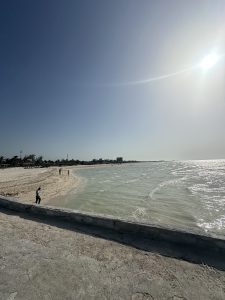
I didn’t come to Columbia with aspirations of traveling abroad– New York City already felt like a foreign country to me, and its museums, languages, and libraries have enough to occupy ten lifetimes’ worth of curiosity. In my sophomore year, however, I spent my summer working on a language documentation project in Mérida, Mexico, through the Laidlaw fellowship. Taking my research abroad proved incredibly rewarding, both academically and personally. I’ve since traveled to Spain for archival research, worked virtually with research teams in Mexico and Germany, and been thoroughly convinced that conducting research abroad is more beneficial and accessible than you might expect. Here, I want to share some of these benefits (which apply to any major or research area), and some of the paths to international research that are open to Columbia students. 

Researchers’ motivations for international travel are often self-evident: archaeologists will travel to digs, linguists to language communities, and historians to archival materials. As undergraduates who have not (yet) specialized academically, these kinds of self-evident travel rationales will not always apply to our projects. This doesn’t mean that traveling for research as an undergraduate is unnecessary– to the contrary, as we develop our academic interests and personal identities, time abroad can be incredibly formative. Moreover, our lack of academic specialization can mean additional opportunities for international travel, and for securing funding. My own experiences abroad have pushed me and my research to grow in two main ways.

Continue reading

Posted in Laidlaw Scholars, Study Abroad | Comments Off on Reflections on Taking Research Abroad

Researching Publics and Public Research

Image overlooking the Adams Morgan Neighborhood in Washington, DC on the Fourth of July, before the fireworks on Capitol Hill (Photo courtesy of Ishaan Barrett)

Imagine for a minute all the spaces that define your life at Columbia: the classrooms where seminars unfold, the lecture halls alive with presentations, the labs buzzing with quiet concentration, and libraries where the daytime hours bleed into the night. Over time, these places stitch themselves together into a web, one familiar and enriched by the places we revisit, but also oddly enclosing. For all its intricacy and complexity, the web of places we might spend our time as students is bounded. Sure, you might venture off campus during the day or throughout the weekend, but when we scrutinize where we spend the academic hours of our days, few extend beyond Morningside or even Columbia’s campus. Intentionally or not, campus builds a physical and invisible boundary that subtly separates how we spend our time and the worlds we come to know. The same can be said for research and the questions, inspired by coursework and mentorship, that we undertake as students. Research conducted within our web of campus spaces is often confined there, but this need not always be the case. 

As you consider beginning or continuing campus research—either in a lab or independently through a fellowship—the question of public research (and even researching public issues) should come to bear. 

Continue reading

Posted in Uncategorized | Comments Off on Researching Publics and Public Research

The Art of the Missing: An Interdisciplinary Retreat

Coverlet from the American Folk Art Museum. credit: Julia Sherman, item located in American Folk Art Museum collections.

Coverlet from the American Folk Art Museum. credit: Julia Sherman, item located in American Folk Art Museum collections.

Last spring, I was scrambling a bit for a summer internship, as many fellow second-semester juniors find themselves. While I was already planning to work at a law firm in New York City, it was only a part-time commitment. Not only did I need to fill the rest of my time, but I needed to find the rest of my rent. After many applications and interviews, I accepted a role at the American Folk Art Museum (AFAM) as a curatorial intern.

I was initially drawn to AFAM because of the artistic connection I learned about in my American Culture Criticism seminar with Professor Blake. As a history major with a specialization in American Intellectual History, I eventually realized art was a pretty critical part of the traditions I was studying. After reading books on Andy Warhol, Clement Greenberg, and John Cage, I thought I would find at least some tenable connection to my studies at AFAM.

Continue reading

Posted in Art, Museums, New York City | Comments Off on The Art of the Missing: An Interdisciplinary Retreat

The Kantian Challenge and How to Overcome It

Frankfurt’s Bankenviertel district, seen from the Bockenheimer Anlage (credit: Joseph Karaganis)

Like most other Columbia undergraduates, I was first introduced to the work of Immanuel Kant halfway through my sophomore year. Kant’s slim-but-dense ethical treatise, the Groundwork of the Metaphysics of Morals, is the second text that students read in Contemporary Civilization’s second half.

At the time, I had just finished a year and a half of philosophy courses, and after much deliberation had decided to declare a philosophy major. My previous coursework in Greek and Roman ethics and metaphysics had served me well during the first semester of CC, and I was expecting that the course would go as smoothly in the spring. But I was less prepared than I thought. Despite being only 70 pages long, the Groundwork is brilliant, bewildering, and infuriating all at once. It encapsulates the stunning depth of thought and impassable esotericism that, for better or worse, characterizes much of the best of German philosophy. By the end of the book’s first section, I was uneasy. By the end of the second, I was quietly panicking, and had started to nervously goggle technical terms that I was unfamiliar with. By the end of the third and final section, I had to admit to myself that I was completely lost.

Continue reading

Posted in Uncategorized | Comments Off on The Kantian Challenge and How to Overcome It

An Undergraduate Research Project, from Idea to Publication

Oscar Wilde and Lord Alfred Douglas, British National Portrait Gallery

When I first learned about the Humanities Research Scholars Program during winter break of my sophomore year, I felt both daunted and excited. I had never done any kind of research before, and I had no idea of what topic I would want to spend a summer studying. But at the same time, the prospect of spending six weeks immersing myself in a particular subject—reading and thinking about it, discussing it with peers, maybe even writing about it—was enormously exciting.

I spent a lot of time over the break thinking about what I might want to research. It was hard, because a lot of my favorite books were translated, and I didn’t think I could properly study them without knowing their original language. Eventually I thought about Oscar Wilde—I had gone through a phase at the end of high school where I read a bunch of his books and a biography of him. But what could I possibly say about Wilde that hadn’t been said already?

Continue reading

Posted in Uncategorized | Comments Off on An Undergraduate Research Project, from Idea to Publication

Learning to Read the Core

My freshman-year copy of The Iliad, complete with my overzealous annotations (credit: Sarah Bryden)

As the fall semester approaches, first-years across campus are engaged– excitedly, nervously, or maybe even frantically– in the hallowed Columbia tradition of reading the first six books of The Iliad. SparkNotes has been consulted, copious amounts of highlighter have been applied, and complaints have been fired off between new friends. Anticipation is high, but so are nerves– a canon experience, if you will.

If your experience with this reading assignment has been anything like mine, you may be worrying this very minute about how little sense The Iliad makes, and how despite your diligent annotations you failed to realize that Chryses and Chryseis are two different people. You may be wondering how you will ever have the time, patience, and stamina to endure two full semesters of readings like this; you may even be despairing of the value of the Core, and wondering how you can outsource future readings. The message of this blog post is: don’t panic! You will survive the Core reading lists, and it will be worth it. 

Continue reading

Posted in courses, The Core, The Humanities | Comments Off on Learning to Read the Core

Just Inquiry: Columbia’s Core, Columbia’s Gates

Afternoon photo of campus gates in front of Earl Hall with security checkpoint to scan IDs (photo credit: Ishaan Barrett)

When I first arrived at Columbia, I did not pay much attention to the gates. They were just there. They stood as symbols of arrival, departure, tradition, and maybe even security. But over time, I started to see them completely differently. They became quiet boundary lines separating two contrasting worlds: those who are included and those left out. The question about these gates as symbols of access arose during a class called “Justice Now,” taught by Professor Larry Jackson. The purpose of the class was to develop critical theories and conceptions of justice rooted in the breadth, depth, and interdisciplinary undertaking of the Core Curriculum. In other words, by expanding on the authors and texts presented in Literature Humanities and Contemporary Civilizations, how can we theorize justice from a variety of vantage points with various communities and social issues in mind? Between that class and my other courses in the Core, we read Plato’s ideas on the just city. We read Locke’s theories on property. We balanced conflicting viewpoints and contemporary ideas across multiple hours of deep discussion. But we never read—or even interpreted—the gates standing just beyond the classroom. After a while, I thought that maybe we should.

Continue reading

Posted in New York City, The Core | Comments Off on Just Inquiry: Columbia’s Core, Columbia’s Gates