
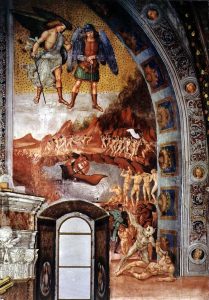
Detail from The Last Judgment, Luca Signorelli, Public domain via Wikimedia Commons
For many freshmen, the most difficult Literature Humanities text to connect with personally is Dante’s Inferno. This was certainly the case for me. Many of the other second-semester readings—To the Lighthouse, Pride and Prejudice, Shakespeare—are easy to feel invested in: we all know Mrs. Ramsays and Mrs. Bennets in our lives, and we all want to know what will happen to Othello or Lear. And even the older and denser books, like Homer’s epics or the Confessions, still deal very much with the world of humans: it is hard not to feel moved by Augustine’s pained descriptions of his conflicting desires, or the moment when Hector says goodbye to Andromache for the last time. But the Inferno is different from all these books—its two protagonists are difficult to connect with personally, and it’s easy to feel somewhat confused by the vast array of characters who they meet in Hell, all being tortured in ways that often seem unfair and cruel.
Many people are quick to point out that much of what makes Dante great is the beauty of his poetry, which is lost in translation. This may be true. But there is also a lot to be obtained from the Inferno in translation. And although the book may take place in another world, it is filled with remarkable insights into this human one that still ring true today. One problem, however, is that the speed with which the book is rushed through in Lit Hum can make it difficult to fully appreciate these insights, and the text can end up seeming like a blurry catalog of thirteenth-century people who Dante disliked.
Take, for instance, Canto 3 of the Inferno, which takes place right outside of Hell and can seem like a relatively unimportant, skimmable part of the book. In this canto we meet a group of people who are often called “the neutrals.” Vergil explains to Dante that these people “lived without disgrace yet without praise,” and so are not wanted by Heaven or Hell (3.36). This may sound like the kind of person who should end up in Purgatory, and indeed there is no Christian precedent for what Dante is saying here—he has come up with it all on his own. Vergil goes on to say that when Satan and his followers rebelled against God, there were some angels who “were not rebellious and not faithful to God, who held themselves apart” (3.38-9). It is an interesting image: a few angels, unsure of where they stood or perhaps just cowardly, standing to the side while hundreds of their peers fought with all their energy for what they believed in, either God or Lucifer. These neutral angels are also Dante’s creation, and they are here too, mingling with the neutrals from Earth.
A classic part of the Inferno is the contrapasso, which means to “suffer the opposite.” In other words, the sinner will be forced to do in Hell what he or she refused to do on Earth, but usually in some ghastly way. The neutrals are given two punishments of this sort. First, they must always be running around carrying a giant banner, a sign of the convictions that they never had on Earth. Second, they are always being bitten “by stinging flies and wasps / that made their faces stream with blood, / which mingled with their tears” (3.66-8). Why do they have to endure this? Because, as Dante explains, these people “were never alive” on Earth. As Dante’s translator Robert Alter writes, “These beings, who lacked all inner stimulation, are stung by noxious insects… Dante’s personal hatred for those who, unlike him, never made their true feelings or opinions known irradiates this canto.”
The idea that people who refuse to have convictions on Earth are dead even while they are alive and so must be made to feel alive when they are dead may seem alarming and cruel, but it is also incredibly original and thought-provoking. It is surely relevant to all of our lives today. And all this in the first half of a canto that takes place before the characters even enter Hell! The more slowly and carefully you read the Inferno, the more clear it becomes that, although its meanings may be beneath the surface, it is one of the most fascinating and perennially relevant of all the Lit Hum books.
Sagar Castleman, CC’26