
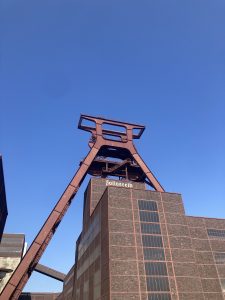
Zollverein, a former industrial complex and center of Germany’s Ruhr Valley, now a UNESCO world heritage site (credit: Joseph Karaganis)
Since it was first taught in the years following World War I, Contemporary Civilization has navigated the tension between debates of the past and challenges of the present. Students read Plato, Aristotle, Aquinas, and Machiavelli before tackling Martin Luther King, Franz Fanon, and Simone De Beauvoir, authors whose central concerns—American racial inequality, the psychology of post-colonial violence, and the existential-cultural morass of gender difference—are as relevant today as they were in the mid-20th century. But CC’s continuum of moral and social thought extends to our own time. No present challenge is as urgent and world-historical as climate change, which will leave our planet a more unstable and unlivable place if it does not destroy it altogether. New additions to the CC syllabus have sought to introduce students to the humanistic discourse that has emerged—and which, in the darkest of times, has even flourished—in response to the crisis of global warming. But this discourse is rapidly evolving and has not yet settled into teachable fault-lines, like Plato against Aristotle, Augustine against Aquinas, or Hobbes against Locke against Rousseau, which students encounter in CC’s first semester.
There is no established climate change canon. And there won’t be one anytime soon. Canonization is a drawn-out process and an unstable one. The fluctuations of the present are a filter through which we understand our collective past. New texts emerge from the ash heap of history and old ones die out. Mary Wollstonecraft, who wrote in the late 18th-century, wasn’t widely read until her work was rediscovered by second-wave feminists in the 1960s and 70s. Karl Marx’s Economic and Philosophic Manuscripts, which form the bulk of students’ engagement with Marx in CC, were not easily available in English and French until the mid-1950s—four decades after the October Revolution and well past the peak of communist popularity in the West.
But in the case of climate change, the question is not when but whether a stable canon will ever emerge. Warming shows no signs of slowing down, and governments around the world have shown themselves entirely incapable or uninterested in reversing course. By the end of the century, 3.5 million deaths a year will be attributable to climate change. Over the next fifty years, if current trends continue, up to three billion people will be displaced. The global population is eight billion.
My point in rehearsing these statistics is not to produce despair and powerlessness in our situation, but to highlight the unavoidable fact that our generation will live through unprecedented political instability and social disruption. The frame through which we look at the past—including the recent past—will change rapidly as conditions evolve and gradually deteriorate. The range of ideas we find useful and take seriously will move to accommodate whatever warming-induced disaster finds itself on our doorstep: massive refugee flows, civil wars, economic atrophy.
With that in mind, the climate change-related texts that have been placed on the CC syllabus provide an interesting first pass at canonization. Japanese philosopher Kohei Saito’s provocative Slow Down: A Degrowth Manifesto, which resuscitates Marx’s neglected later writings to argue in favor of self-inflicted economic deceleration, is opposed both to economist Robert Pollin’s straightforward defense of the Green New Deal as well as the ‘Ecomodernist Manifesto’, a statement co-signed by dozens of researchers and scientists that advocates for a ‘decoupling’ of growth from emissions. (The syllabus also includes an article by Mark Burton and Peter Somerville defending the ‘degrowth’ position.) Saito’s proposed solution to the climate crisis is undoubtedly the more radical and controversial one; ‘de-coupling’, meanwhile, is the stated goal of many governments and corporations, but not one that has amounted to much in recent years.
One interesting and telling feature of the Saito-Pollin debate, if I may call it that, is its focus on emissions reduction over adaptation and resilience. Both Saito and Pollin envision a future where the worst consequences of climate change have been averted and human civilization stretches indefinitely into the future. The goal of Saito’s ‘degrowth communism’, for one, is to prevent climate catastrophe, not to make widespread human settlement, survival, and flourishing compatible with it. The focus on prevention is congenial to our own age—massive warming remains on the horizon and has yet to completely transform our world and way of life. But in the coming decades, as conditions worsen and political inaction continues, we may prefer a more sober assessment of our predicament—one which acknowledges that mitigation efforts are important but radically insufficient. As sea levels rise and cornfields become deserts, the promise of prevention—of sustainable ‘degrowth’ and a catch-all Green New Deal—will reveal themselves as the dreams of a bygone era; and once again, the Core will change.
Joseph Karaganis, CC’26