
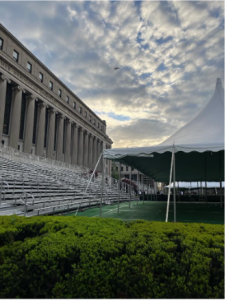
Butler Library with tents and risers set up for graduation (photo courtesy of Ishaan Barrett)
In such an interdisciplinary field as urban studies, it can be hard to determine exactly one place or department in which to house or even propose a research project. In fact, the broad disciplinary foundations of the urban studies program—ranging from economics and anthropology to environmental science and sociology—is one of the many reasons I’ve come to love my major. In a field with so much breadth, proposing a research project or jumping off point can be challenging when the multiple academic apartments and fields of study can plausibly come weigh in on the trajectory of your project. The Urban Studies field not the only academic area where this interdisciplinary aspect of research rings true. Even the “clean cut” academic departments at Columbia house overlaps: economics and mathematics, history and sociology, economics and political science, to name a few. With a bit more work, one can find even more complex overlaps between various academic departments and fields when research is concerned. The binary “Venn diagram” of academic overlaps in research can further complexify as the scope and focus of your project shifts or draws on other methods.
My suggestion to others—especially those with highly interdisciplinary projects—who are trying to find a discrete “field” or department to help steer their research is to embrace plurality. Consult widely with experts, professors, and other students working in these other fields that you think might be relevant to your work. Even if only remotely related, the ideas and perspectives from people across academic fields and departments will add significantly to your work. But even if you are sure about the department at Columbia where your work “belongs,” I still argue that consulting widely in your research—with multiple people across disciplines—can unexpectedly enhance your work.
With research in general, I think there’s a tendency to rely heavily on expertise, literature, and background information from a specific field or department relevant to one’s research. Even in the writing process one must consult with existing literature in a field to assess existing knowledge and schools of thought relevant to a given research topic. Beyond that, journals around the world—even undergraduate journals at Columbia and beyond—rely on a host of peer reviewers with subject matter expertise to assess the validity of a research article as a potential contribution to the field. This element of research is admirable. The notion of peer review and research replicability are essential in ensuring the integrity of research itself but also has the tendency to silo the work. Without wider engagement, even consultation with those outside academic spaces entirely—as I’ve written previously—, it can be hard to produce research that is inclusive of different ways of thinking and that appeals to a wider audience beyond your field of study.
In this regard, the Core offers an interesting way of framing this idea of interdisciplinary research. The unifying feature of the Core requires undergraduates to pursue rigorous studies in foreign languages, the humanities (like Literature Humanities and Contemporary Civilizations), and the sciences. Together, the piecing together of these different learning styles and modes of thinking create a liberal arts experience grounded in a breadth of study areas. It also helps one, as I have found increasingly during my time at Columbia, to see concepts relevant to my major field of study completely differently. The same can be said when applied to undergraduate research. When we draw on more than one field or means of analysis to tackle a research question, the findings we produce can be even more impactful and strengthened by a combined methodological approach. In other words, adding more analytical approaches to your research can help enhance your insights or unveil new, expected ways of viewing your work.
By talking a bit more about interdisciplinary research, I hope you will consider how your work combines various departments and ways of seeing together. Research can, of course, be a way of gaining subject matter expertise, going deeper into an interest or topic that’s relevant to you. But it can also be a way of widening your perspective and bringing new analytical techniques to bear in unexpected ways. Along the way, you may find that your interests, even your entire major or academic passions, change entirely for the better.
Ishaan Barrett, CC’26