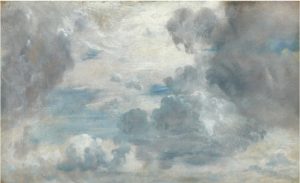
Cloud Study, John Constable, The Frick
At the beginning of my semester abroad at Oxford, my tutor summoned me and the two other visiting students studying English to his office to give us some advice. We were going to be writing papers much more regularly than we were used to, he told us: during our two terms at Oxford, we would basically write one essay each week on what we had read. My tutor said that reading criticism on the books and writers that we studied could be helpful—he himself would give us a list of recommended criticism each week—but that our most effective tool was not criticism, but close reading. Considering our limited time and fast pace, we would never be able to grasp the scholarship on a writer as thoroughly as a specialist could. This made it difficult for us to try to wade into scholarly debates. But at close reading, he said, we could be as good as anyone else.
I found this to not only be quite helpful for the coming term, but also comforting. Since I first took Literature Humanities, I had often wondered how it could be possible to say something new about these very old books. How many books had been written about these books, and how many of them had I read? My tutor’s answer seemed to be that right now we didn’t have to worry about being original. Instead, it was enough to try to understand the intricacies of the text as thoroughly as we could, and to write about what we noticed. A provocative piece of criticism could kickstart this process, but it wasn’t necessary.
Close reading is the backbone of all good literary criticism, not only college papers. When I eventually wrote a research paper through a summer research program at Columbia, I spent hours poring through books and journal articles about the poems I was examining, so as to understand the various scholarly and historical perspectives on them as best as I could. While this was helpful for my research, what bound my final paper together was my own readings of the relevant poems. Looking closely may not produce a scholarly paper by itself, but it can offer something arguably more important—a deep appreciation of something we’ve never thought much about before.
And this applies to things beyond literature and research. I spent a month last summer in London, researching a group of nineteenth-century artists and poets called the Pre-Raphaelites. One of the most striking things that I read while I was there was by John Ruskin, an influential art critic who was the first prominent public supporter of the Pre-Raphaelites. His first book, Modern Painters, which he published when he was twenty-four, includes a chapter about the sky:
“Sometimes gentle, sometimes capricious, sometimes awful, never the same for two moments together; almost human in its passions, almost spiritual in its tenderness, almost divine in its infinity… And yet we never attend to it, we never make it a subject of thought… Who, among the whole chattering crowd, can tell me of the forms and the precipices of the chain of tall white mountains that girded the horizon at noon yesterday? Who saw the narrow sunbeam that came out of the south and smote upon their summits until they melted and mouldered away in a dust of blue rain? Who saw the dance of the dead clouds when the sunlight left them last night, and the west wind blew them before it like withered leaves? All has passed, unregretted as unseen…”
Since reading this chapter, I’ve thought about and looked at the sky differently. Often when I’m outside now, I’m watching the clouds, trying to come up with metaphors for them (a map, a swath of paint, a parade) and ways to describe them precisely, wondering how I never noticed how striking and grand they could be. I’ll never write anything new or important about clouds, or about artistic representations of the sky. But looking closely at them has brought me a meaningful (if small) appreciation for something I had never noticed before, and that feels like more than enough.
Sagar Castleman, CC’26