
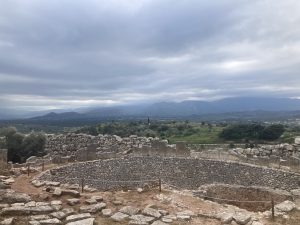
Mycenae, legendary home of Agamemnon (credit: Joseph Karaganis)
Literature Humanities, the centerpiece of Columbia’s Core Curriculum, opens with Homer’s Iliad—an immediately absorbing epic of grand scope, jam-packed with irresistible characters (Patrokles anyone?) and dozens of pages of gripping interpersonal drama. Sure, some students might have their patience tested during the infamous “Catalogue of Ships,” which interrupts the story’s momentum to shout-out the various tribes who contributed to the Achaean war effort (although as a proud Arcadian and Laconian myself, I was glad to hear that my ancestors could muster up sixty ships each). But the point stands: for most students the Iliad is fun to read—and the same can be said for the rest of LitHum’s syllabus. The Odyssey (especially as filtered through Emily Wilson’s spirited translation) is a breezy trek through the sun-kissed Mediterranean; and while the Aeneid isn’t for everyone, I remember finding its tale of dispossession and national rebirth impossible to put down. It goes without saying that the second semester—bookended by Claudia Rankine, St. Augustine, Jane Austen, Virginia Woolf, and Toni Morrison—is no less entertaining than the first. Even if you weren’t required to read these books for class, you would be (or at least should be) doing so anyway.
Contemporary Civilization, the moral and political philosophy course that follows LitHum, is a little different. Without prior training in Classical Greek history or political theory, the first couple of readings can make for a hard slog—Plato’s Republic has its moments (the Allegory of the Cave and Myth of the Metals stand out), but don’t get me started on Aristotle’s Ethics, not to say his Politics. Aristotle was possibly the greatest and certainly the most influential Western philosopher of all time, but his unpolished and only posthumously collected lecture notes do not make a great impression on the average STEM major.
So how do we bridge the gap between the dramatic peaks of LitHum’s narrative prose and the dryly systematic valleys of CC’s philosophical thought? How should those who enjoyed the former approach the latter?
These are big questions—and I don’t have all the answers. Different strategies will work for different students, depending in part on academic background and personal interests. But here’s one suggestion: as you finish LitHum, think about how literature can offer profound philosophical insights. As you begin CC, consider whether the canon of Western philosophy is best understood as a literary one. The boundary between philosophy and literature is porous and always up for debate.
One philosopher who made a serious and compelling effort to probe this boundary is Richard Rorty, who had a background in analytic philosophy but ended his career teaching in a comparative literature department. In a series of lectures, aptly collected as Philosophy as Poetry, Rorty argued that while philosophy and imaginative literature (both poetic and prosaic) have often been treated as opponents, at their best they play the same cognitive and intellectual role: exposing us to “ever-expanding circles” of human experience. In other works, Rorty took this point even further by suggesting that we read the philosophical canon not as a history of scientific progress, in which the resolution of old problematics is followed by the discovery of new ones, but as an unfinished (and unfinishable) intertextual conversation. The goal of philosophy, Rorty argued, is the same as literature: using our conceptual resources to address the insistent problems of the present (to use the famous CC phrase).
The connection runs in the other direction as well. Not only is philosophy literature, but literature philosophy. Philosophers regularly draw on literary examples to illustrate their points. For example, in a celebrated paper titled ‘White Ignorance’, the late Charles Mills, an important contemporary American political philosopher, used Herman Melville’s “Benito Cereno”—a short story about a slave revolt in the Pacific—to illustrate the profound epistemological (i.e. knowledge-based) consequences of racial bias. In Martin Hagglund’s This Life, a wonderful blend of philosophy of religion and Marxist humanism, Karl Ove Knausgård’s My Struggle is given an extended treatment.
Not only are literary works filled with philosophical themes, ripe to be exploited and analyzed by philosophers, but many philosophers have seen fit to engage with the medium of literature itself. Friedrich Nietzsche’s celebrated—but nearly-incomprehensible—Thus Spake Zarathustra is a long philosophical argument in the form of revelatory myth. By the end of his career, German philosopher Martin Heidegger was writing short, imaginative essays that are difficult to distinguish from experimental prose poetry.
These examples provide just a small taste of where these two forms of intellectual and creative expression overlap. They are far from exhaustive. But recognizing the continuity between aesthetics and logical thought can become an important tool and source of reflection as you move from one canon to the next.
Joseph Karaganis, CC’26