
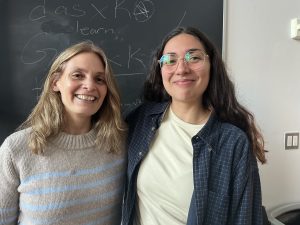
The author, Sarah, with Professor Landman (credit: Eliana Steele)
The benefits of mentorship from a professor are very clear, but the steps to finding a mentor are not always so obvious; Columbia is a large school in an even larger city, and it’s easy to feel lost in the crowd. Compounding this is the fact that Columbia’s professors are experts in their fields with amazing accomplishments– this is both exciting and intimidating, from the student perspective. Even so, I’ve been lucky to find several mentors during my time here, both professors and non-professors: my upperclassman TA showed me the path through “Introduction to Linguistics” as a freshman, my graduate student history TAs have dramatically improved my writing skills, and my faculty mentors in research programs like Laidlaw have given me a rare glimpse at human expertise.
For this blog post, I spoke with one of my own professors and mentors, Meredith Landman, in order to share the “professor perspective” on mentorship at Columbia. Meredith is a linguistics professor, and I’ve been taking her classes since my sophomore year. For myself and many of my peers, Meredith is an invaluable source of guidance on graduate school, career options, summer research, and anything linguistics-related. Most recently, we’ve been working together on the Linguistics Program’s blog, and on documenting the Kalmyk language in our Field Methods class. Here is an abridged version of our conversation:
As a professor, how do you understand the role of a “faculty mentor”? How do these relationships work on a practical level, and what do students gain from building relationships with their professors?
I view my students as equals—collaborators and fellow professionals. This is key. It means working alongside you with respect and trusting that you can achieve a great deal. It’s so exciting to see how much students thrive when given the right opportunities, whether serving as a TA, managing a research project, or helping create and update the Linguistics Program’s blog. I’m continually impressed and inspired by what you all are capable of and how much you step up in these professional roles. As a mentor, my role is to share my experience through ideas, methods, and guidance on common pitfalls. At the same time, I’m listening carefully to your input and suggestions. This creates a mentorship built on teamwork and partnership. I find this is very effective, and it’s the approach that feels most natural to me.
You frequently guide students through research projects, whether through programs like Laidlaw, in your classes, or in the senior thesis seminar. How do professors help students develop their research skills? How do you see students benefiting from research mentorship?
I focus on two things. First, incremental progress. Research projects are daunting, and can be painful if completed as all-nighters! To help make the process more manageable and even enjoyable, I ask students to create a shared Google Drive folder with all of their materials and assign short assignments to be completed about every two weeks. Breaking the project down into more manageable parts can help move students along and avoid the pitfall of getting stuck.
Second, even a small contribution is a great contribution! Find a model piece of work and build from there.
Students can be nervous to speak with their professors, and especially to ask about letters of recommendation, research assistantships, TA roles, etc. What would you say to students who are feeling these nerves, and do you have any advice for them? How can students form relationships with their professors?
Good question! This is a little hard to answer, because I can only speak for myself. But here’s my view. We are here to help you. Ask for what you need. You can think of this as a skill you’re practicing and can get better over time with experience. So it doesn’t have to be perfect the first time. The most important thing is that you are trying to communicate your needs. What you can do, on your side, is to think carefully about a) what it is, exactly, that you need, and b) how best to communicate it. You want to be clear and you want to be respectful. Give your professors plenty of time to write recommendation letters. For recommendation letters, it is a good idea to build a relationship with your professor early, so that they know you well enough to speak to your strengths. Try talking to them outside of class—about your interests, their interests, questions you have, advice you’re seeking, their academic arc, etc. This can be after class, if they are free then. Or attend office hours, if they are free then. Or schedule an individual appointment. Again, we’re here for you. We’re people, too, just like you. But it does help for you to be prepared with what you want to discuss with us, so that you are being respectful of your professor’s time. Write thank-you emails when you get responses. This things can go a long way.
Can you tell me about a mentor you had in college?
I studied music for many years, and I built one-on-one relationships with several of my piano instructors during college. Academically, my focus ended up settling on linguistics, but these mentorships were important to me personally. Within linguistics, some of my most impactful mentors have actually been peers. Especially during my PhD, speaking with fellow students helped me to clarify my own work, and to make progress on the dissertation. My cohort was supportive, and we shared many of the same research questions, methods, and interests. Many students in my cohort were older than me, and they had a pretty diverse set of experiences. Some had worked in the corporate world, some were married with families, and some had spent many years doing linguistic fieldwork. This meant my cohort members were wonderful mentors on an academic and personal level. I think this is an important point to underscore: professors are very willing and wonderful mentors, but students can find mentorship in a range of places! At Columbia, graduate students, TAs, tutors, classmates, etc. can all be great sources of guidance.
Sarah Bryden, CC’26