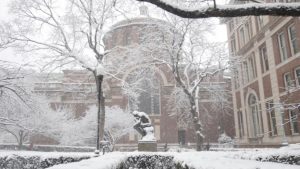
Image of “The Thinker” statue in front of Philosophy Hall and St. Paul’s Chapel during wintertime (image courtesy of Unsplash and Ariel Tang).
For most students, the familiar phrase “the insistent problems of the present” is a common throughline within and beyond classrooms dedicated to the Core Curriculum. It is both a critical tool in positioning the origins of the curriculum itself, and somewhat of a guiding principle to steer the development of the Core today. To give a bit of background though, the notion of “the insistent problems of the present” was rooted in the founding doctrine behind Contemporary Civilizations, the first class that marked the beginning of the Core at Columbia College. The website for the Core argues that this “first college general education program in the United States” came about during a time of “global crisis, social reform, and widespread debates about the aims and methods of higher learning.” Contemporary Civilization was thrust into this world as a “bold experiment” towards John Dewey’s vision of “progressive education.”
All of this might be true. It is hard to position oneself squarely in the mindset of Columbia scholars and teachers from 1919 when the Core was founded, but I think it is reasonable to grasp the general mission behind the Core. However, a lot has changed in the 106 years since the start of the Contemporary Civilizations. Of course, I’m talking about the sweeping global and national changes that have occurred since, but also the way that higher education itself appears to be in the crosshairs of current political scrutiny. The “insistent problems of the present” that were imagined more than a century ago are decidedly different, and it begs the question: what should the Core do for us today? What work—internal to the classroom or beyond it—can (or should) it accomplish right now? I argue that the Core and the larger project of liberal arts education is charged with confronting its own limitations and using that self-critique rethink higher education. Not radically per-se, but the Core must now contemplate more than it ever has before the way knowledge is produced, shared, and applied in a world far more divisive—and unequal—than the one it was born into.
Part of the reasons why higher education is falling into the crosshairs of political scrutiny goes perhaps beyond the project of education itself. Many of the pressures that many institutions now face are not purely academic but deeply political. They are rooted in shifting national priorities and partisan narratives that are questioning who—and what—higher education is meant to serve. Columbia, most notably, was one of the institutions who reached an agreement with the White House restore federal funding. And yet, the conditions that made such intervention necessary and that motivated Columbia’s acquiescence seem detached from the pedagogical work of universities like ours. The issue of funding research for universities, while essential to the academic project of institutions themselves, was mostly relegated to the hard sciences. Most of the grants targeted by the government came from the National Science Foundation (NSF) and the National Institutes of Health (NIH). They went towards graduate and post-doctoral research initiatives and laboratories around the country. Therefore, it would be easy to say that the decidedly undergraduate and liberal arts-focused educational project of the Core is irreconcilable with the type of “insistent problems of the present” facing higher learning right now. But that would be misguided.
The Core itself, oriented towards external challenges beyond our campus, must square a politically divided world with its founding mission. The distrust that exists towards institutions of higher learning is a substantial motivating factor in the hardships universities are facing right now. As such, the “insistent problems of the present” for the Core must now include—surprisingly so—the type of social problems that threaten its existence. It must take on this national challenge, of everyday people losing their trust in academia, as part of its mission. Part of that means confronting an irony that swirls around the Core and its place at Columbia. Once a response to crisis, the Core itself sits within a university navigating one of its own, on a scale even more urgent, perhaps, than ever before. If the “insistent problems of the present” once referred to global conflict or industrialization, they now include the fragility of higher education itself, and the complex world of financial politics embedded within the world of academia. The relevancy of the Core now hinges on its ability to be self-critical and reconcile the sweeping global problems facing us right now with the pressing ones happening right here, on campus.
Historically speaking, this must be the task of the Core in its next 100 years. The curriculum was never about consensus or shying away from the challenge of confronting social disarray. It is about the act of questioning itself. In an age when universities are being measured by political metrics and headlines rather than the value of their ideas, that act of questioning feels radical and transformative. Maybe the Core’s survival and new merits depend less on defending its past than on unearthing its new spirit, rooted in the conviction that thinking deeply about the world—from as many vantage points as possible—is still worth the time and trouble.
Ishaan Barrett, CC’26