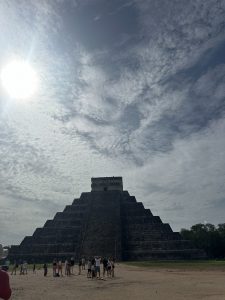
“El Castillo,” the main pyramid at Chichen Itza (credit: Sarah Bryden)
My faith in the value of the Core has wavered on some occasions: during exam periods, while slogging through an exceptionally-dense reading, and in the last half-hour of any seminar discussion on a warm spring afternoon (to name a few instances). More persistently, I’ve often struggled to see the overlap between the Core curriculum and my own academic interests. Much of my research centers on using Indigenous languages, specifically Quechua and Yucatec Maya, to research colonial history in Latin America. Pre-1492, these languages operated in complete separation from the Western canon; as St. Augustine wrote Confessions, the Classic Maya were starting construction on Chichén Itzá. It’s somewhat ironic, then, that I received my strongest proof of the Core’s relevance at a library 45 minutes away from Chichén, in a small Maya-speaking town called Xocén.
I visited the town’s library last summer with a group of fellow Yucatec Maya students. The librarian gave us a thorough tour, but the book that stole the show was actually not on a shelf– instead, it was locked in a safe. To be specific, it was a velvet-wrapped manuscript, which the librarian handled with care and named as a facsimile of the Kuxa’an Áanalte’ (“Living Book”) of Xocén.
He explained the manuscript this way: the original copy was a living, speaking, bleeding document, which contained a history of the world and prophecies about the future. Its provenance is dotted with famous figures, including Jesus and the Maya leaders of the Caste War. But mysteriously, the manuscript disappeared sometime between the Caste War and the 1940s. Although several investigations have been launched, the Living Book’s whereabouts remain unknown. In its place, a handwritten facsimile was drafted by people who had heard, read, and remembered the contents of the original.
Hearing this, I didn’t know what to think. None of the details– that the Living Book records the future, that it can bleed and speak, that it was brought to Xocén by Jesus– fit neatly into my worldview. But the librarian’s somber tone, and the locked safe which housed the facsimile, compelled me to take the story seriously. In trying to understand, I clung to one detail: that the facsimile was created from memory, based on a lifetime of interacting with, hearing, and reading the text.
To me, this sounded similar to the composition history for several Core texts, including the works of Homer, Plato’s Republic, and the Gospels. In fact, these authors were writing in a similar context, mixing oral tradition with written record and their own memory to produce accounts of revered figures like Socrates, Jesus, and Odysseus. I could take the analogy even further; for example, while the Living Book records both history and prophecies, the Core hopes that knowledge of a Western canon might inform students’ futures. And as the Living Book continuously updates itself, the Core aims to adapt to the “persistent problems of the present.” It may sound far-fetched, but this analogy still remains my best way of understanding the Living Book and the legends surrounding it.
In retrospect, I recognize that this ability to analogize and make sense of the unknown is an important lesson of the Core. By tracing the Western canon from (approximately) beginning to end, we learn how ideas are produced, re-produced, and shared, whether through text, music, art, or even some other medium. Since the impulse to share ideas is universal, understanding this process in the Western canon helps to interpret any piece of media, Western or non-Western. In this sense, I think the Core is less about particular ideas, stories, and people than about the varied forms of discussing said ideas, stories, and people.
Ultimately, the Living Book in Xocén probably has very little content in common with the works of Homer, Plato, or the Gospels. It is part of a largely non-Western tradition, written in a non-Indo European language, and housed pretty far from any of the settings that appear in the Core syllabus. But surprisingly, when confronted with a tradition so unfamiliar to me, the Core was my best guide. I would never have expected it, but it was actually because of the Core that I was able to make sense of this story about a bleeding, living book.
Sarah Bryden, CC’26