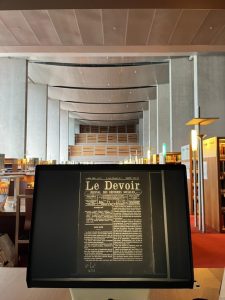
One of the first documents that I reviewed at the Bibliothèque nationale de France – François Mitterand. Originally published by le Journal des réformes sociales in 1879, this edition detailed the publication’s utopian socialist program. Photo Credit: Alan Chen.
Archival research is already demanding enough as is, so the challenge can only mount when researching in a foreign language in a foreign archive. If you find yourself in this situation, however, fret not! In the blog post that follows, I want to reflect on my time in one of France’s most imposing archives this past summer: la Bibliothèque nationale de France – François Mitterrand (BnF). In doing so, I hope to distill my first two weeks in the archives down into a brief guide on how to navigate a foreign archive in a foreign language.
Accessing the Archival Materials
As you begin your adventure into the archives, let’s assume that you have a working list of materials that you’d like to consult. Before you can cross the bridge into all that lovely literature, you must first come face-to-face with the ugly troll of the introductory archival appointment. Luckily, the archival representative is not there to give you a hard time—but there may be cultural barriers that render these appointments difficult. For one, make sure to come to your consultation prepared with some knowledge of the local higher education system. The BnF requires that prospective researchers be at least undergraduate-level students. Simple as this may sound, France’s higher education system functions differently than that of the U.S.: whereas a traditional undergraduate degree in the U.S. will conventionally last you four years, a traditional undergraduate degree in France will only occupy three years (often leaving time for students to pursue Masters degrees). Equally confusing is that the thèse—or thesis—of the French higher education system belongs to doctoral candidates, and not to undergraduates. Therefore, in order to smoothly complete the archival registration process at the archival appointment, it is extremely helpful to know the foreign counterparts of your educational level and your research project.
Conducting Archival Research
Now that you’ve made it through to the research stage of the process, it’s time to switch gears to a different set of preparatory advice. First, try to arrive at the archives with some familiarity of the literary and linguistic norms of the source material that you will be working with, lest you encounter words that look nothing like what is taught in U.S. foreign language courses. On several occasions, I’ve found myself confused by minute yet critical linguistic idiosyncrasies of centuries past, leaving me stuck at the stage of deciphering. Take the French accent circonflexe (the circumflex), apparent in words like être or forêt. Before the French language as we know it came into its current form, letters with the accent circonflexe would have been written with the same letter followed by an -s. This explains the orthographic divergence between the English forest and the French forêt. As simple as this may seem to deduce, it can just as easily land you in deep trouble when you encounter a word that looks similar to a totally unrelated word that you might already know.
There are other linguistic pitfalls into which you might fall which preparation can help you avoid. For one, while reviewing an 1870s French magazine stored at the BnF, I misinterpreted a short op-ed that lamented its author’s déception. I proceeded to read the piece as though someone had tricked the author into some belief or conclusion. However, as I continued on, this dynamic became less and less evident, encouraging me to return to where the conundrum of misunderstanding had first taken root. Cases like these are commonly known as faux amis—“false friends”—where two supposed cognates have been imbued with very different meanings. As I finally returned to the source of the problem (that darn déception!), I soon realized with the support of online resources that déception may translate to “disappointment” and not necessarily “deception.” In this case, I fear it may have been me who was deceived…
This may, of course, be solved by bringing a laptop or phone into the archive to double as a translator for such instances (or consider downloading an offline dictionary in case an archive’s internet access is slow). However, it also evokes a larger lesson to read generously and to not prematurely fix yourself to any one meaning. Otherwise, you might run the risk of misreading a text and operating off of a falsehood. Therefore, read quickly, but remain attentive to the omnipresence of these linguistic traps.
And that’s all for now! At the risk of running over my permitted space, I will end my reflections on my time at the BnF there and hope to author another installment of all of my journey into the ~ foreign archives in a foreign language ~ . À plus ! See you next time!
By Alan Chen (CC‘25)