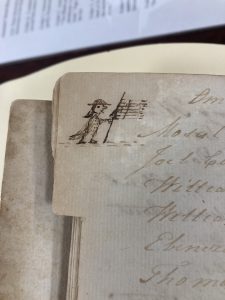
A Doodle. Newburyport Public Library, City Hall Documents, box 68, folder 2, 1814 [Newburyport Tax Assessors’ Directory], 6v. Photo Credit: Janus Yuen
Archives are a nebulous concept to be sure, but in my own usage, I tend to mean an institution that holds collections of rare books, manuscripts, and other unpublished material. To access said material, one usually has to make a journey to the place, appointment in hand, inspect the unique material, and then continue on with one’s research life. Many know of the big archives, like the manuscript division of the New York Public Library, the Historical Society of Pennsylvania, the Rockefeller Archive Center, the Beinecke at Yale, or our very own Rare Book and Manuscript Library, on the 6th floor of Butler. These institutions have collections measured in the thousands of feet of material (i.e. if you stacked their papers in a single stack, it’d be thousands of feet high), are hubs of academic research, and have, in the 21st century, developed robust online resources, such as appointment systems, online finding aids, etc., which smooth out the process of finding out what materials are available, scheduling a time to visit, and getting the job done.
Many archives, however, do not have many of these resources. Why not?For starters, many archives are parts of multi-functional organizations, which maintain archives on the side. For example, Agudath Israel is an Orthodox Jewish advocacy organization in for Orthodox and Hasidic communities which maintains its National Orthodox Jewish Archives in its office in downtown Manhattan, and the Newburyport Public Library is the public library of the town of Newburyport, Massachusetts, which maintains archival collections and a reading room in the basement of their library building. For such organizations which lack the enormous budgets and scholarly focus of research universities like Columbia, there are naturally resource and labor constraints. Many have shelves upon shelves full of material, but only one or two people working to catalogue them. The archivists themselves are usually juggling a plethora of duties, including outward-facing services. Others have much material catalogued, but for one reason or another, not been able to upload the catalogue online. Yet others are literally living, present organizations which may not even recognize themselves as archives, like churches whose employees include pastors, deacons, and charity coordinators, but not archivists, or museums prioritizing curation and presentation of material culture, which handle significantly less traffic in manuscripts.
As such, these archives can be hard to recognize as archives, let alone gauge for importance to one’s own project, or even access. How do I know if a place even has papers or artifacts relevant to my project, if there’s no catalogues or finding aids? How do I arrange an appointment, if there’s no portal?
The short answers are: (1) tips from other organizations; (2) secondary literature; (3) cold emails; (4) in person visits and talking with people; and (5) straight-up (educated) guesses. I found out about Agudath Israel through a synagogue’s website, which said that the synagogue had deposited its old files at the National Orthodox Jewish Archives. Emailing Agudath Israel’s outward-facing email with an inquiry about the synagogue’s files led them to forward my email to their archivist, who confirmed that they had the material mentioned and set up a time for me to visit. In another another case, I only realized the Museum of Old Newbury had relevant manuscripts to my senior thesis project after visiting in person while in Newburyport to see some of the wooden statues they held, which my research subject had commissioned. The docent mentioned to me at the end of my tour that they probably have papers of my subject’s that have neither been digitized nor catalogued, and gave me a name to reach out to about them. As for the Newburyport Public Library, I guessed that since New England political life is historically so town-centered, town organizations are likely to hold on to local material rather than transferring them to the state level. Surely enough, after fiddling with the town public library’s website, I found a useful list of archival collections with descriptions of collections’ contents, as well as a form to request specific boxes of material.
If you manage to visit these places, you’ll find that they tend to be really generous with time and space, and trustful with their materials. This is in small part due to relatively small numbers of people who access their collections, but in large part because these staff really care about making these resources available and useful to researchers. At the Newburyport Public Library, the staff, including the wonderful head reference librarian Dana Echelberger, made available the 30-or-so boxes of Newburyport town hall records I’d requested and told me that I could access them whenever I wanted during my week-long visit, so long as the reading room was open. At Agudath Israel, the rabbi-archivist opened his work computer, pulled up the excel sheet with his catalogue of collections which he hadn’t had time to publish online, and told me to search through his internal catalogue for any more collections I’d be interested in looking at besides the one that I’d found out about from an outside tip. (In other cases, if there is no digital catalogue online, there are usually printed catalogues of collections, finding aids, index cards, or other cataloguing materials available onsite.) Needless to say, these relationships helped to greatly accelerate my research.
I hope I’ve made my point clear about how fruitful and rewarding these experiences can be. Needless to say, one’s success at these locations depends on good relationships with archive staff, and thus it’s obviously important to observe archival etiquette and be polite. As I’ve noted above, archivists at these places are juggling a lot of duties, and many perform the arduous work of collecting and cataloguing manuscripts from a personal sense of the endeavor’s importance. Please not abuse their trust. Please follow their instructions, ask for photography and reproduction policies, and be careful not to harm archival material. Please express thanks for their work. And if they request it, please provide feedback! Tell them how you found out about their collections, what was helpful for locating what you needed, etc. Everything you do along these lines will not only make an archivist’s day, but will likely be helpful to the next researcher who comes along.
Janus Yuen CC’25