
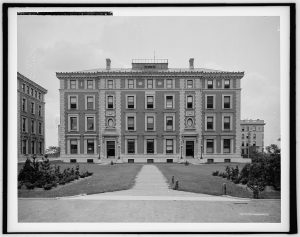
Fayerweather Hall, circa 1900-1906. Photo Credit: The Library of Congress.
As the sixth week of the fall semester wraps up, I return to a feeling of frustration with my History seminars I know all too well. Despite enrolling in at least one History seminar every semester since my sophomore spring, I still find the experience disheartening and, frankly, infuriating. I’m a senior at Columbia College majoring in History who hopes to enter a Ph.D. program in the discipline after graduating, and who ultimately aspires to become a professor one day. Seminars should be my bread and butter: a fundamental aspect of the major that I’m more than competent in. What gives?
After spending some time reflecting, and joining my professors for several of their office hours, I’ve come to a better understanding about my performance in History seminars.
These History seminars are just that: a performance.
They are performances that, without the proper preparation and resources allotted to you, are easy to fall short in, or at least believe you did. The secret to a stellar performance in these seminars? To perform well, you don’t need to be naturally talented (is there even such a thing?); you just need to develop certain skills and fake confidence. It’s hard to do that, however, when you’re a first-generation, low-income (FLI) student with no college-educated family to turn to for guidance.
So if you’re like me, a FLI public school kid who once thought the International Baccalaureate program would be enough to prepare me for my time at Columbia, keep reading. Below, I’ve outlined some tips and tricks I wish I had known when I first started my History major. If they’re helpful, pass them on to your friends who may also be losing their minds in their humanities seminars (or for that matter, their CC and LitHum sections).
Tip #1: DO NOT “internalize” anything about your perceived inability to do well in seminars. You are perfectly capable of contributing to the classroom. In fact, your contribution is often invaluable and worth exploring in detail because of these “incapabilities.” Heyyy Franz Fanon!
As you probably already know, Columbia University is not a place meant for FLI students. The university has little interest in your life once you have accepted your spot, save for the occasional student profile or trustee talking point. With the way Columbia sets up their seminars, with every student sitting in a circle equal to the other, it’s easy to miss that some students are, in fact, not coming to the Fayerweather table with a background equal to yours.
Some come from private preparatory schools that prepare students to read 300+ pages a week through a rigorous required reading list and individual attention from teachers who acquired their Ph.D.s. Others come from specialized public schools that train their students to articulate their arguments first and let their thoughts catch up to them later. Most come from wealth. A fun thought experiment: imagine who in your seminars knows intimately what free and reduced lunch programs are, and what proportion of students were in these programs. That’ll probably tell you something about how prepared your school was to send you to Columbia versus how prepared other schools were to send your classmates. Moral of the story: it’s not your fault if you feel like you aren’t performing as well as your peers. In reality, your experiences will probably inform a fresh reading of an assigned book, or a more sincere articulation of an argument not weighed down by academic jargon.
Tip #2: Form study groups with people who understand your cultural context. Listen to those who don’t.
This is easier said than done. Where do you find FLI History majors who are interested in the same classes you are? How do you know if your peers are FLI? In my experience, I’ve found that Columbia’s academic student associations are not sensitive to the needs of their FLI constituency. Instead, student organizations categorized as “cultural” such as the Chicanx Caucus, and those categorized as “political/activist” such as FLI Net, have netted me the best results. I have also found the community at CSER, or the Center for the Study of Ethnicity and Race, to be full of genuine people who come from similar backgrounds. Either way, it’s up to you to reach out to your peers and form these connections that can prove to be mutually beneficial.
Listening to those you don’t share a common background with can be more than rewarding, too. Growing up in North Carolina the child of immigrants, I was taught to listen first and speak later. I found it strange, then, to come to Columbia University and engage with students who often spoke first and listened to me later. While I found these experiences in seminar to be irritating at first, I found that it was more meaningful to understand how their strategy worked. Now, I ask myself: How do my peers present themselves? What posturing do they take up and why? How does their argument work? What can I take away
from this? Though engaging with people who come from different cultural contexts can seem bothersome in seminar, embracing these differences can enrich your understanding of the material and enhance your ability to engage in other types of discussions.
Tip #3: Schedule office hours with your professors and TAs, and ask them how you could best contribute to the seminar.
Here’s something I wish someone had told me when I was a first-year: you should feel entitled. As a student at Columbia University, you should feel entitled to access office hours, request letters of recommendation, and seek mentorship from your professors. It’s actually part of their job to provide these resources. I know it’s easy to feel unentitled to these resources: for the longest time, I felt as though I was barely supposed to be at Columbia, especially when comparing myself to my peers who were paying thousands for their education while I did not. But in reality, you are entitled to the same opportunities as everyone else; you worked just as hard if not harder than your peers to get here. Engaging with your professors during office hours is not a privilege—it’s an essential part of your education.
Office hours can be intimidating, but they also demonstrate your commitment to learning. Use this time to ask your professors how you can contribute more effectively to class discussions. I was surprised to learn that some of my professors placed significant weight on my writing—through discussion posts, midterms, and final papers—when evaluating my performance in seminars. They understand that seminar dynamics can be unpredictable. If you feel comfortable, even offer constructive feedback in the spirit of scholarly exchange. I, for example, have offered what I appreciated about the seminar styles of other instructors. These comments have been received well. Remember, amidst the prestige of Columbia, you are a student who deserves to learn and grow.
Navigating History seminars as a first-generation, low-income student can be a daunting experience, but it’s important to remember that you are not alone. Embrace your distinct background, and leverage it. By forming connections with peers, engaging with professors, and cultivating confidence, you can transform your seminar experience from a source of frustration into an opportunity to learn. After all, these seminars will not stop being a performance until you stop making it one.
Xavier Amaro CC’25