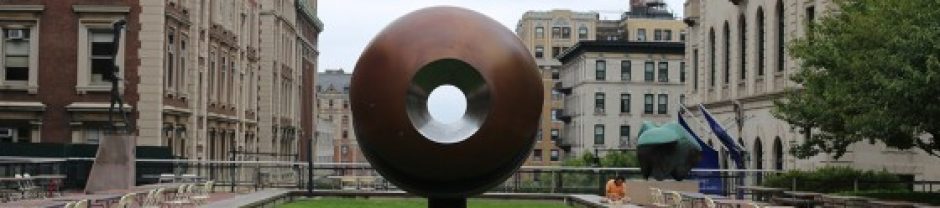
One of the first photos I took during my sophomore year. I returned to campus determined to make the most of my time at Columbia—and what a year ahead! Photo credit: Alan Chen.
The time has come—and maybe even passed. You registered for a course during shopping week that leaves you disappointed every M/W, that makes you grind your teeth, or that fills you with deep regret over your course selection. And unfortunately, you are now stuck in the course, with little recourse. But look, we’ve all been there—and even if it seems like you have little to learn in the class, you might still have a few things to learn from the class. In the following blog post, I want to detail a few reflections on the classes that I haven’t been too fond of and the classes that I have fawned over.
- When scouting out new departments, don’t feel obligated to begin with intro-level classes.
When I first began my time at Columbia, I only knew to start with introductory classes. Fearful that I might have neither the foundation nor the correct intuition to succeed in more advanced classes, I restricted myself to the domain of 1000-level coursework in political science, economics, and math.
Looking back, I don’t dispute that this spread of classes eased me into college and into my new subject areas—but I think this move hampered my ability to envision the best of what these disciplines had to offer. A professor once told me that introductory courses dully profess a field’s foundational premises only for more advanced coursework to pull the rug out from under you to disprove those same premises. In my introductory classes, I felt that I only had a murky view of these disciplines available to me.
From what I could gather, I was largely dissatisfied with my coursework in these subject areas because of their method. Political science equipped me with theories with which to classify and understand events of the present; economics offered me the quantitative skill set to study trends in human behavior and desire. Both are unmistakably crucial, but I nonetheless felt that I lacked the historical grounding on which to stand, to imagine, and to theorize. So for my first year at Columbia, I drudged through school, hoping to complete my degree and to derive fulfillment from the non-academic parts of my life.
2. You can love your classes!
But in the summer after my first year in college, after taking a break from the “grindset” that is common to all Columbia students, I realized the extent of my dissatisfaction with my freshman-year coursework and my prospective majors. So, on a whim, I decided to throw myself into the (semi) deep end and pursue 2000-level coursework in the history and philosophy departments.
Having neither taken classes in history nor philosophy, I felt—and arguably was—deeply unprepared for what laid ahead. I still recall the first week of sophomore year: stepping into “U.S. Lesbian & Gay History” with Professor George Chauncey only to feel confused by how to take notes for his narratively-driven lectures; feeling lost in the jargon of academic philosophy in Professor Dhananjay Jagannathan’s “History of Philosophy I.” In these two classes, both taken in the fall of my sophomore year, I felt horribly unqualified to understand what was going on. But the mix of my brilliant professors, my determined peers, and the interests that they inspired in me lit a fire under me—and that fire has since led me to some of the best coursework that I could have never imagined taking.
I didn’t know that I could enjoy my classes. I thought that coursework meant lectures that I should attend when I was up to it; that I could skim readings without taking them too seriously; that movement toward my degree was the most important incentive in my academic career. But I was so wonderfully wrong.
3. If you’ve taken several unsatisfactory classes in the department, the major might just not be for you.
Conventional wisdom holds that you might bump into a few rough classes on the way to completing your major—that goes without saying. But sometimes, an extended encounter with unsatisfactory classes can serve as an ambiguous, non-self-evident indication that a major isn’t the best fit for you.
After the fall of my sophomore year, I went on to take Professor Lisa Tiersten’s “European History since 1789”; Professor Andrew Lipman’s “Revolutionary America 1763-1815”; and Professor Christina Van Dyke’s “History of Philosophy II.” I realized that I knew so little of the internal continuities and logics of history that materialize in the present—and that this was what I had been searching for in my previous coursework. I figured that if I should derive joy from my classes, then I ought to maintain a similar standard for my major. So, that same semester, I declared history and philosophy as my fields of study—and I have never looked back.
This is certainly not to say that you should jump ship from your, say, political science or economics major if you confront classes that don’t do it for you—merely that you have some room for lateral movement between majors in the humanities and social sciences. As this blog is largely geared toward issues in the humanities and social sciences, I want to emphasize that your work in your major matters more than the name of your major—so try out the classes, departments, and majors that speak (or even whisper) to you. You never know what you might find on the other side of that gamble.
Alan Chen, CC‘25