
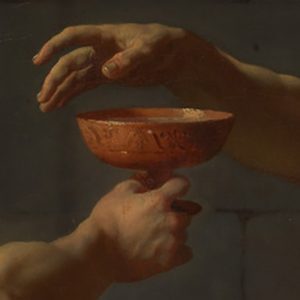
The Death of Socrates (cropped), Jacques Louis-David.
Photo Credit: Metropolitan Museum of Art
For a recent philosophy class, I read a Socratic dialogue called the Phaedo, which relates the hours leading up to Socrates’s death. It’s a powerful text: after being sentenced by his fellow Athenians, Socrates tries to distract his students from his demise by offering them proofs of the afterlife, as well as arguments for why dying is not as bad of a thing as people assume it to be. In the end, he reaches for his cup of poisonous hemlock and lays down to die.
I found Socrates’s courage inspiring. But as I was about to wedge the Phaedo away between other old books, I was struck by the memory of another text. I opened my big, red edition of the Bible—the one we all read for Lit Hum and CC—and flipped to the New Testament. Before long, I was at Matthew 14.
It’s a short scene in which Jesus appears before a boat carrying some of his followers in a storm. He beckons his disciple Peter to exit the boat, and Peter finds himself standing upon the waves. But Peter becomes afraid of the roaring wind and begins to sink into the sea. Jesus grabs his arm and pulls him back up, saying to him, “You of little faith, why did you doubt?”
This image of Jesus is one I have possessed since I was a child. But reading it again made me realize that I had not really felt the words in a long time. For some reason, reaching the end of the Phaedo had rekindled them in my head—why? I think it’s because Plato touched a fundamental fact of life that had entered my head, however stealthily, when I was still running down the halls of Sunday school: death.
Being a student has put me in front of all kinds of ideas about life, hope, and the future. But once in a while, all of those ideas get consumed by something larger, which finds itself expressed in the same confused questions I’ve always asked about it: What is this abyss? What can I hope for if everyone I love, and myself, must fall into it?
In the same way that books can remind me of these doubts and fears, they can also try to address them. In the Phaedo, for example, I saw a man showing his friends how to fall into that abyss. And he does so by using his reason to poke at the intuitions at the heart of their fears. He gives answers, however desperate in their own way, to questions like “Do we really die?” and in doing so provides a new perspective about death—maybe it’s not really an abyss at all. In Matthew, we don’t see Jesus trying to reduce the stakes of what death is in order to pacify his friends. Instead, we see him literally overcoming the waves that signify the end of life. He offers a way over the abyss.
I think many people would prefer the Socratic story to the biblical one. And I sympathize—millenia of artwork and retelling have made stories like Jesus over the water seem clichéd. And in the present day, I can be absolutely sure that if many people raised historical doubts about Plato’s telling of Socrates’s death, then many more would be skeptical about what really happened on the Sea of Galilee. But what makes these stories both classics is that they are early meditations on the same impulse to life. They show that, despite two thousand years of separation, our intuitions haven’t really changed. We still ask the same questions about what it means to be alive, and to know that it won’t be very long until we aren’t.
Books sometimes emerge in my memory years after I’ve read them. And this is one of the experiences, at least in my opinion, of reading the Core: it doesn’t always hit us very hard at first. The words often enter latently and then months, or years later, we start to realize why they matter so much as to be put on a curriculum in the first place. And the reason is this: those writings provide us with some of the earliest, rawest, and most delicate accounts of human loss and joy, journey and return, and, of course, life and death.
That said, you don’t need to look at all classic texts with a specific theme in mind in order to read them correctly. We don’t all take away the same messages from what we read because, as unique readers, we find unique meaning in them. But the Core itself, the literal collection of titles and authors from Lit Hum and CC, is what joins us together into one academic community: we all encounter the same materials, the same stuff of life. When Socrates talks to his friends, he’s talking to us. When Jesus pulls Peter from the depths, it is to us that he offers his arm. And trust me when I say it is not necessary to be religious to get a fuzzy feeling when reading about Jesus’s moment upon the water. Nor must you be a philosopher to grow teary-eyed at a man’s attempt to use his final teaching moment to relieve his closest friends of pain.
It might seem like these two people are so different from most humans that we would be foolish or even arrogant to try to relate to them. But what makes Socrates and Jesus so compelling is how they relate to us. They experience things just as harshly as we do, and even more so, if we consider how both of their stories end. It is how they deal with the difficulties of existence that makes them some of the best guides for human beings—for their followers during their lives, and for all of us who read about them afterwards. What they give us, as do the other books of wisdom that line the shelves in our dorm rooms, is hope. And hope is really nothing other than faith—faith in a God, faith in reason, or faith in something else. Any one of them would be a nice footing to find in this harsh, beautiful world, in which the only certainty is that it’s temporary.
Joshua Martin CC’25