Photo credit: Maddie Cesaretti
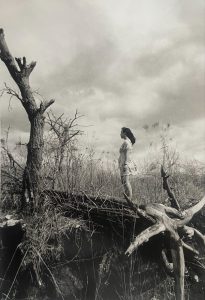
Deep in the tall grasses and dry underbrush of the prairies of eastern Kansas, I crouch, my grandfather’s old film camera slung over my shoulder. Trees sway with the wind blowing over the lake ahead of me, and my sister waves from the water’s edge. It is spring break of 2024, and I am working on photographs for my Introduction to Darkroom Photography course—the first Visual Arts class I have taken in college. Up to this point, I understood my artistic practice as separate from my work in other classes. I had not yet learned to see how the subjects I was drawn to with my camera connected to the narrative threads I was pulled towards in the historical archives or to the visual and political dynamics I identified in the built environment of New York and other cities. By taking a class that centered on creative ways of thinking and being, I came to realize that my interests in the relationship between person, place, and the past flow throughout my life, beyond my previously self-imposed separation between my academic work and my artistic practice.
Through my past experiences as an Urban Studies and History student, I explored themes of interconnection and heritage with an interdisciplinary lens. Yet, by taking a class outside of these areas I gained access to a new way of understanding my work while getting to engage with the work of others with backgrounds different from my own. Visual Arts classes offer a unique opportunity to explore not only one’s own creative vision but also how that vision relates to the self-expression of one’s peers. On the first day of semester, my professor emphasized how, as the class went on, each person’s vision would start to manifest in a distinct way—that we would eventually be able to identify the person by her image. I remembered experiencing this kind of creative recognition in past settings, though with mediums like painting and drawing. Honestly, at the time, I did not quite believe the same might happen with the camera. However, as weeks passed, this prophecy came true, and I found myself reflecting more and more on the stories each person presented in association with the photographs they created. As much as I enjoyed getting to explore my interests through my own photo process, I equally enjoyed getting to interact with the works of other students in this way as we each produced archives of our own.
Traversing the wide and windy fields of Kansas, where members of my family call home, I began to realize how to translate my ‘other’ interests, such as those of heritage and memory, into photography. The photographs from this trip not only became the foundation for my semester portfolio but also helped me clarify my perspective for seminar papers in other subjects as well as my current senior project. As I enter this fall semester, I return to the questions that have driven me in the past with a renewed creative energy: How do the buildings, infrastructure, and monuments created around the world and across time reflect different society’s conceptions of power, beauty, utility, and history? How do the stories, manifest in both physical structures and social hierarchies, shape perception of oneself, other people, and the environment? Who and what is commemorated versus who and what is condemned? In taking Darkroom Photography, a class in which I had little technical background, I learned to communicate in an unfamiliar medium and thus expanded my research interests with a new frame. As we enter the school year and select classes anew, I highly encourage exploring the Visual Arts department—or any other class based around creative expression and communication. One never knows the path these courses might ultimately take one down, and learning a new skill, like photography, especially with how image-saturated our lives can be, can enrich the way one moves through the world and interacts with others.
By the lake, I wave back to my sister, lift my camera, and open the lens.
Madeleine Cesaretti CC’25