


NYPCC’s Virtual Career Fair | Thursday, June 25
A message from our partners at the New York Psychotherapy and Counseling Center (NYPCC). Please contact Kirsten Crawford, Human Resources Coordinator, directly at [email protected] with any questions.
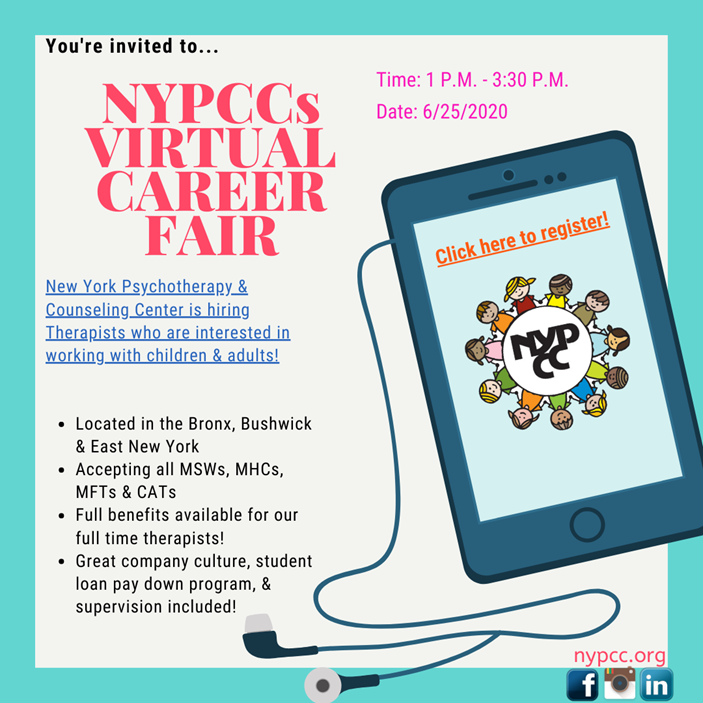
You’re Invited to NYPCC’s Virtual Career Fair for open therapist roles on June 25, 2020 from 1 P.M. until 3:30 P.M. In order to attend this virtual career fair, you must register by either clicking on our flyer (below) or clicking on the following link: https://us02web.zoom.us/meeting/register/tZIpcumsrTIpE9MxhCwV0CY54b5rWOTiSexC
Once registered, kindly email [email protected] with a copy of your resume.
What to Expect:
During our virtual career fair, once candidates connect to the zoom meeting, they will be placed in our waiting room and seen in the order of arrival. Please be patient with us as we are excited to meet with all of you and want to make sure that we are being fair and giving everyone the time that they deserve.
Free Resources for Creating Workplace Inclusivity
 Are you looking for resources on creating more inclusivity and belonging in the workplace?
Check out these LinkedIn courses on diversity, inclusion, and belonging, which are FREE to the general public until August 31. The 7-course learning path includes modules on how to confront unconscious bias, have inclusive conversations, and create diverse and inclusive workplaces.
To Expand Your Job Search, Consider Your Transferable Skills
 If you feel stuck or are having a difficult time finding opportunities in your area of practice, consider expanding your job search to include positions where you can apply your transferable skills.
Transferable skills are adaptable skills that can be used in multiple settings, such as emotional intelligence, problem-solving, communication, and teamwork.
For instance, while you may have experience with policy analysis, your skills such as research and writing may be useful in communications and advocacy work at a nonprofit. Your experience in direct practice or clinical work can transfer over to program development and training, where you can contribute your knowledge of best practices for addressing the needs and interests of specific communities.
To identify your transferable skills, start by taking inventory of the different skills you have used to advance a cause or mission, whether through people, projects, or data; then, brainstorm how you can leverage these skills in other contexts. You can also review skills highlighted in job descriptions and reflect on how you have accomplished similar work. Once you start building your list, you may be surprised by how many transferable skills you have relative to various roles and careers.
Henry Street Settlement: Dispelling the Myth About Clinical Work in Shelters | Tuesday, June 16 @ 1PM
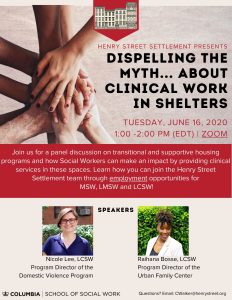 Join us for a panel discussion on transitional and supportive housing programs and how Social Workers can make an impact by providing clinical services in these spaces.
Learn how you can join the Henry Street Settlement team through employment opportunities for MSW, LMSW and LCSW! REGISTER
SPEAKERS’ BIOS
 RAIHANA BOSSE, LCSW
Program Director of the Urban Family Center, Henry Street Settlement
Raihana began her career in social services working for the Administration for Children Services as a child protective specialist. That experience provided her with a glimpse into different family dynamics and the impact of generational traumas in those relationships. During this time she decided to work more intimately with individuals and obtaining an MSW was the key. After completing her degree from Stony Brook University Raihana set out on a journey to make a difference! She broadened her experience by working as an elementary school social worker and as a social worker at an inpatient substance abuse program. Raihana’s professional journey continued in multiple social work avenues such as child welfare, pediatric palliative care with the Visiting Nurse Service of New York, clinical psychotherapy, and discharge planning for the mental health unit on Rikers Island.
“My professional journey helped me realize that I wanted to affect change at a higher level and decided that I wanted to be in more of a leadership role, so I began working within the Henry Street shelter at the management level. This allows me the proximity to keep my finger to the pulse of the clinical needs of the individual and the families we serve, while also being able to influence the way we provide those services. It is the best of both worlds!”
 NICOLE LEE, LCSW
Director of the Domestic Violence Program, Henry Street Settlement
Starting her director’s post in August of 2018, Nicole continues to lead the Transitional and Supportive House division in providing emergency intervention to families at Henry Street Settlement. Her previous roles at Henry Street Settlement include serving as Assistant Director of the School-Based Mental Health Clinic (SBMHC) Program, where she started out as a therapist in 2014 upon joining the organization. Nicole’s experience also includes inpatient and outpatient psychiatric services at Kings County Hospital Center. After earning her bachelor’s degree in anthropology from New York University (NYU), she matriculated into the Silver School of Social Work of NYU. Nicole has earned a post-master’s certificate in Advanced Clinical Practice from NYU, training in Trauma-Focused Cognitive Behavioral Therapy, and is a certified supervisor in-field instruction (SIFI). Nicole is passionate about elevating the profession of social work as a vehicle toward social justice through the core applications of empathy and advocacy. She volunteers her free time at Open House New York and is a junior board member of HeartShare St. Vincent’s Services.
Graham Windham Virtual Job Fair | Tuesday, June 16

Developing Anti-Racist Professional Identities and Practices
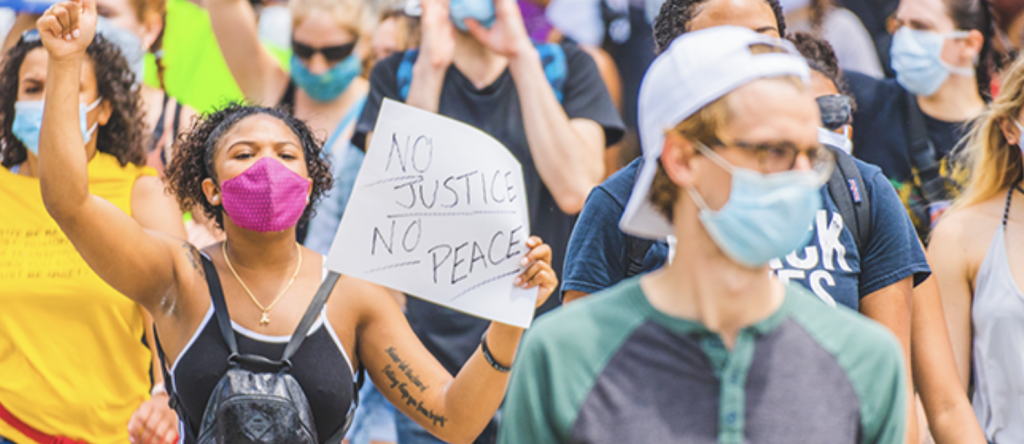
Update (6/9/20): The CSSW Action Lab (previously the CSSW COVID-19 Action Group), which aims to address anti-Black racism and other key social justice issues, has curated resources for engaging in anti-racist action.
Take a look at their website, in particular, their working document of action items, for educational resources, volunteer opportunities, and new advocacy initiatives that you can join.
We’d like to take a moment to acknowledge what a trying time it has been, especially for our Black colleagues, friends, students, and alumni, as we grapple with the continued manifestations of hate and injustice that seep through the fabrics of our society, both overtly and covertly. We too are outraged and heartbroken.
The lives of Ahmaud Arbery, Breonna Taylor, George Floyd, Sean Reed, and Tony McDade, and experiences shared by Christian Cooper and countless others–too many unnamed and unrecorded–remind us of the critical need to proactively engage in anti-racist action, in particular, action against anti-Black racism, both in our personal and professional lives.
Much of this work begins from within, including reflecting on our own knowledge, practices, and values. Below are links to resources that we have personally found useful in engaging in this work.
What tools and resources have been helpful in developing and enhancing your own anti-racist professional identities and practices? We invite you to share them with us by emailing [email protected].
In solidarity,
Tomomi and Rawlisha
Office of Career Services and Leadership Management
NOTE: The Columbia School of Social Work Council of Deans has issued a Call-to-Action to address anti-Black racism. Read their statement and co-sign here.
Applying an Entrepreneurial Spirit to Your Career
With the world of work operating remotely, how do you stand out when the traditional means of making an impression, from networking events to coffee chats, no longer apply? Consider the framework of entrepreneurship.
An article in Forbes describes the entrepreneurial spirit as a mindset: “It’s an attitude and approach to thinking that actively seeks out change, rather than waiting to adapt to change. It’s a mindset that embraces critical questioning, innovation, service, and continuous improvement.”
Here are some ways you can incorporate this framework into your professional identity and brand:
-
- Engage in critical discussions: Attend virtual conferences to meet professionals in the field who are having important discussions about the world of work in the COVID-19 era. Use these as opportunities to connect with others, learn best practices in the field, and become a resource for your field or organization. You can also start your own communities of practice.
- Innovate or influence: Have you been following the latest trends and practices on serving communities particularly impacted by the pandemic? Share relevant thought pieces and articles on LinkedIn so others can benefit from the knowledge. You can also publish your own articles to highlight new ideas or initiatives you have worked on.
- Embrace the value of service: Remember the personal values that brought you to social work: helping others in need. Wherever you are, look out for the call for volunteers in your community. Contributing your time and skills will help you stay connected and engaged in a meaningful way, and at the same time, showcase your value to others.
- Seek continuous improvement: If you’re job hunting, this is a prime time to invest in your professional growth. Whether you choose to learn a new language or further develop your technical or clinical skills, taking time to up-skill will show that you are open and able to adapt to changing needs and priorities–qualities that will make you attractive to any employer.
The world needs social workers now more than ever. Leverage your natural ability to lead the way in problem solving and effecting change! Doing so will not only enhance your chances for employment, it will also make you marketable for future opportunities.
Message for the Class of 2020
 Congratulations, Class of 2020! YOU DID IT!
As you take your next steps in your path as social workers, we’d like to take a moment to applaud you for your hard work, perseverance, and commitment, especially during these last few months.
Through it all, you demonstrated the ability to adapt to changing needs and circumstances, learn new ways of coping with disruption and loss, and prepare for the unknown—critical strengths that are needed as we seek to move forward in our new reality, and which make you, the next generation of social work leaders, invaluable to the larger community.
For those who have shared job updates with us, an additional congratulations to you! (If you recently landed a job opportunity, we would love to hear from you; email us at [email protected].) Your successes provide encouragement and hope for many others embarking on the job search process.
For those who are actively seeking opportunities, please note that career support will remain available to you. You can continue to use your Career Connect account to schedule appointments and access resources.
Thank you, 2020 graduates, for allowing us to be part of your journey! We look forward to staying in touch with you as you continue this journey as alumni.
Warmly,
Tomomi and Rawlisha
Office of Career Services and Leadership Management
Warm Wishes to Pamela Picon ’20
 We are so grateful and fortunate to have had the opportunity to have Pam Picon ’20 work with our team over the last two years in career services!
Pam was instrumental in conducting research on our graduate outcomes, drafting marketing and communications material, updating resources and handouts, and so much more.
Thank you for supporting our office and our initiatives in your time throughout CSSW. We’re so proud of all you that have accomplished, including beyond our office, and will miss your presence. Congratulations, and all the best!