Depressive Symptoms During Adolescence and Young Adulthood, Gender and the Development of Type 2 Diabetes

sfs2150_3_Shakira F SugliaThe American Journal of Epidemiology just published research by Shakira Suglia finding that high depression symptoms in both adolescence and adulthood are associated with onset of Type II diabetes among women. Among men however an opposite effect was noted in that men who experienced high depression symptoms in both adolescence and adulthood had a lower odds of Type II diabetes after accounting for BMI, physical activity, sleep duration, smoking and alcohol use.  This research suggests that the onset of depression early in life conveys sex specific effects for the development of Type II diabetes.

Past work on the link between depression and Type II diabetes has measured both depression and diabetes status in adulthood limiting the ability of most studies to identify the temporality of the association – subclinical Type II diabetes risk factors may simply contribute to both depression and clinical Type II diabetes development later in life.  Since risk factors and health behaviors that impact obesity and diabetes track from childhood to adolescence and into adulthood, Suglia and colleagues took a life course approach to identifying risk factors for Type II diabetes.  Their work used data from the Add Health study which is a nationally representative school-based, longitudinal study of the health-related behaviors of adolescents and health outcomes in adulthood.

The sex specific associations suggest gendered responses, either behavioral or physiological, to symptoms of depression that in turn put women at risk of diabetes but convey a protective risk for men.  However, their analyses of adult patterns of physical activity, body mass index, smoking, alcohol consumption and sleep by sex and depressive symptoms found similar links between depression and behaviors in men and women; suggesting that behavioral differences did not explain the sex specific associations. Suglia and colleagues suggest that future studies should explore whether sex specific responses to depression involve hypothalamic- pituitary-adrenal axis dysregulation or other physiological pathways.

Posted in Depression, Diabetes, Gender | Leave a comment

Unequal depression for equal work?

Current doctoral students Jonathan Platt and Seth Prins, along with Cluster faculty Lisa Bates and Katherine Keyes recently reported that structural workplace discrimination, measured as the presence of a gender wage gap, largely explained higher rates of mood disorders among woman as compared to men. The full paper was published in the January issue of Social Science and Medicine.

reddit_AMAThe authors will be doing a Reddit Ask Me Anything on Friday Jan 29th from 1-2 pm, you can participate HERE and discuss the research.  Social Science and Medicine will also be removing their pay-wall for the article for a week starting on Friday Jan 29th.  So if you don’t have access to a subscription you can read the article HERE.

Below Jonathan describes their work.

There is strong and consistent evidence that women are more likely to suffer from depression and anxiety disorders than men (see below for selected examples). This is true whether depression is indexed as a diagnosed mental disorder or as subclinical symptoms.  For depression these symptoms include depressed mood, decreased interest in usual activities, significant weight change, sleep problems, and loss of energy. For general anxiety disorder symptoms include restlessness, fatigue, difficulty concentrating, irritability, muscle tension, and sleep disturbance. Differences in risk for these mood disorders by gender emerge in adolescence and persist throughout adulthood, causing significant morbidity and increasing risks for numerous other physical and mental health conditions. A variety of explanations have been proposed to explain these gender differences, for example; as the result of greater or more traumatic stressors, differences in coping responses, and even differences in sex hormones during puberty. In addition, others have sought to explain these differences as results of measurement error or construct invalidity, by comparing differences in symptom reporting, illness severity, or in help seeking behavior. These explanations account for a limited portion of overall differences. No one theory has completely explained these gender differences, so it is likely that the reasons are complex and to some extent the result of social experiences.

Selected studies of gender differences in Major Depressive Disorder and Generalized Anxiety Disorder

Major Depression:

Kessler, R. C. (2003). Epidemiology of women and depression. Journal of affective disorders, 74(1), 5-13.

Nolen-Hoeksema, S. (2001). Gender differences in depression. Current Directions in Psychological Science, 10(5), 173-176.

Piccinelli, M., & Wilkinson, G. (2000). Gender differences in depression Critical review. The British Journal of Psychiatry, 177(6), 486-492.

Generalized Anxiety Disorder:

Kessler, R. C., Chiu, W. T., Demler, O., & Walters, E. E. (2005). Prevalence, severity, and comorbidity of 12-month DSM-IV disorders in the National Comorbidity Survey Replication. Archives of General Psychiatry, 62(6), 617-627.

Vesga-Lopez, O., Schneier, F. R., Wang, S., Heimberg, R. G., Liu, S. M., Hasin, D. S., & Blanco, C. (2008). Gender differences in generalized anxiety disorder: results from the National Epidemiologic Survey on Alcohol and Related Conditions (NESARC). The Journal of clinical psychiatry, 69(10), 1606-1616.

It is understood that overt gender bias can have negative mental health consequences for women in the workplace. For example, sexual harassment or being monitored more closely on the job than others may do harm when the experience is perceived as discriminatory. In addition to overt discrimination, it has been hypothesized that structural and institutional discrimination, which may or may not be perceptible, has mental health consequences and such effects have been documented. Our study used the gender wage gap as a measure of these less visible forms of discrimination. We hypothesized that the gender wage gap could serve as a proxy for forms of structural and institutional discrimination including, but not limited to, women’s social disadvantage in the process of negotiating responsibilities, salaries, and raises; the social value placed on the type of work women tend to do; and gender bias in labor market and workplace policies surrounding reproductive healthcare and maternity leave. Continue reading

Posted in Anxiety, Depression, Gender, Wage Gap | Leave a comment

Neighborhood Social Environment and Obesity

Numerous studies have examined the relation between features of the neighborhood built environment and obesity related behaviors or obesity itself, to the extent that Healthy People 2020 includes goals for neighborhood built environment interventions to support physical activity. The neighborhood social environment has not been given equal attention in spite of its importance in the role that neighborhoods play in the risk or protection for obesity in the United States. In a recent commentary published in the Journal of Urban Health, Shakira Suglia and colleagues argue the importance of considering the neighborhood social environment for obesity prevention.

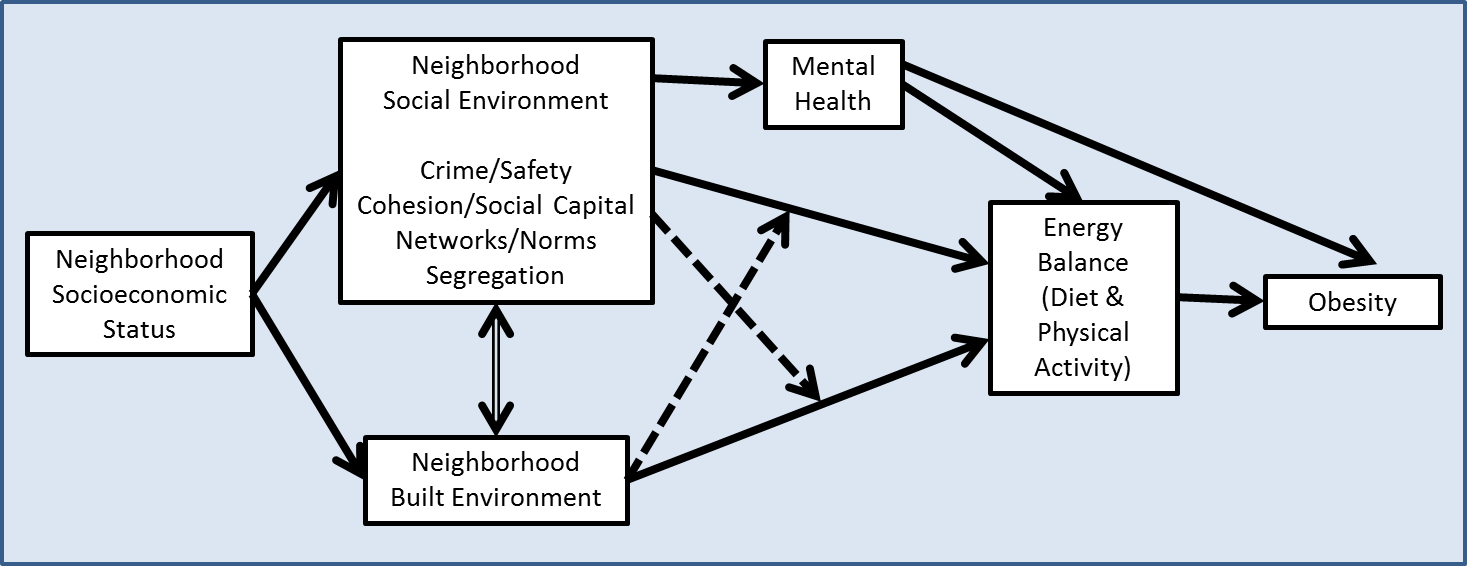
The neighborhood social environment is defined as “Relationships, groups and social processes that exist between individuals who live in a neighborhood”. Several constructs that make-up the neighborhood social environment, such as neighborhood safety, social capital and cohesion, neighborhood poverty, social networks and residential segregation, have all been associated with obesity, physical activity and diet as well as with psychosocial factors that may indirectly impact obesity.

Conceptual model of the relations between the neighborhood social environment and obesity. Solid lines represent direct relations; dashed lines represent modifiers of direct relations.

Conceptual model of the relations between the neighborhood social environment and
obesity. Solid lines represent direct relations; dashed lines represent modifiers of direct relations.

Rather than continue to solely focus on the built environment, integrating constructs of the social environment, would be a more fruitful approach for the prevention of obesity in the US. A positive neighborhood social environment can facilitate the adoption and sustainability of protective factors such as physical activity, exercise, and healthy eating. For example, parents may be more apt to allow children to play outside in a safe neighborhood environment, this can promote greater usage of parks and recreational facilities were neighborhoods have opportunities to meet, talk and make connections developing a sense of cohesiveness and increasing social networks. High levels of social cohesion can influence social norms on individual behavior as well as influence neighborhood built environments (i.e, demanding healthy food establishments or recreational spaces). Interventions that can test the promotion of a positive neighborhood social environment for their benefits in obesity and obesogenic behaviors are needed.

Given that one third of adults and 17% of children 2 to 19 years of age in the United States are obese multifaceted solutions are needed to effectively address this complex issue and prevent obesity in the US.

Posted in Economic, Neighborhood Disadvantage, Neighborhood Environments, Obesity, Social Environments, Socioeconomic Status | Leave a comment

Stigma and the Etiology of Depression among the Obese

Current Social Epidemiology Cluster doctoral student Steve Mooney and former Cluster faculty member Abdulrahman El-Sayed recently published a paper in Social Science & Medicine showing that a weight-stigma mechanism could explain the finding that depression among the obese is more common in contexts in which obesity itself is less common.

Mr. Mooney and Dr. El-Sayed built an agent-based social network simulation, wherein simulated ‘agents’, representing people, were embedded in a network, representing the social networks existing between people. The simulated agents were then influenced by their environments and each other according to pre-set rules. For example, to simulate stigmatization, agents dropped connections to other agents whose BMIs were substantially higher than the BMIs of other agents nearby in the graph.

When they ran this model in a high-obesity context calibrated to Mississippi and a low-obesity context calibrated to Colorado (Mississippi and Colorado are the states with the highest and lowest obesity rates, respectively, in the Centers for Disease Control and Prevention’s annual Behavioral Risk Factor Surveillance System survey), they found that there were more stigmatizing events and consequent depression among the obese in simulated Colorado than in simulated Mississippi.  This result is consistent with the real-world finding that depression among the obese is more common in contexts where obesity itself is less common, suggesting that stigma could be a mechanism underlying this pattern.

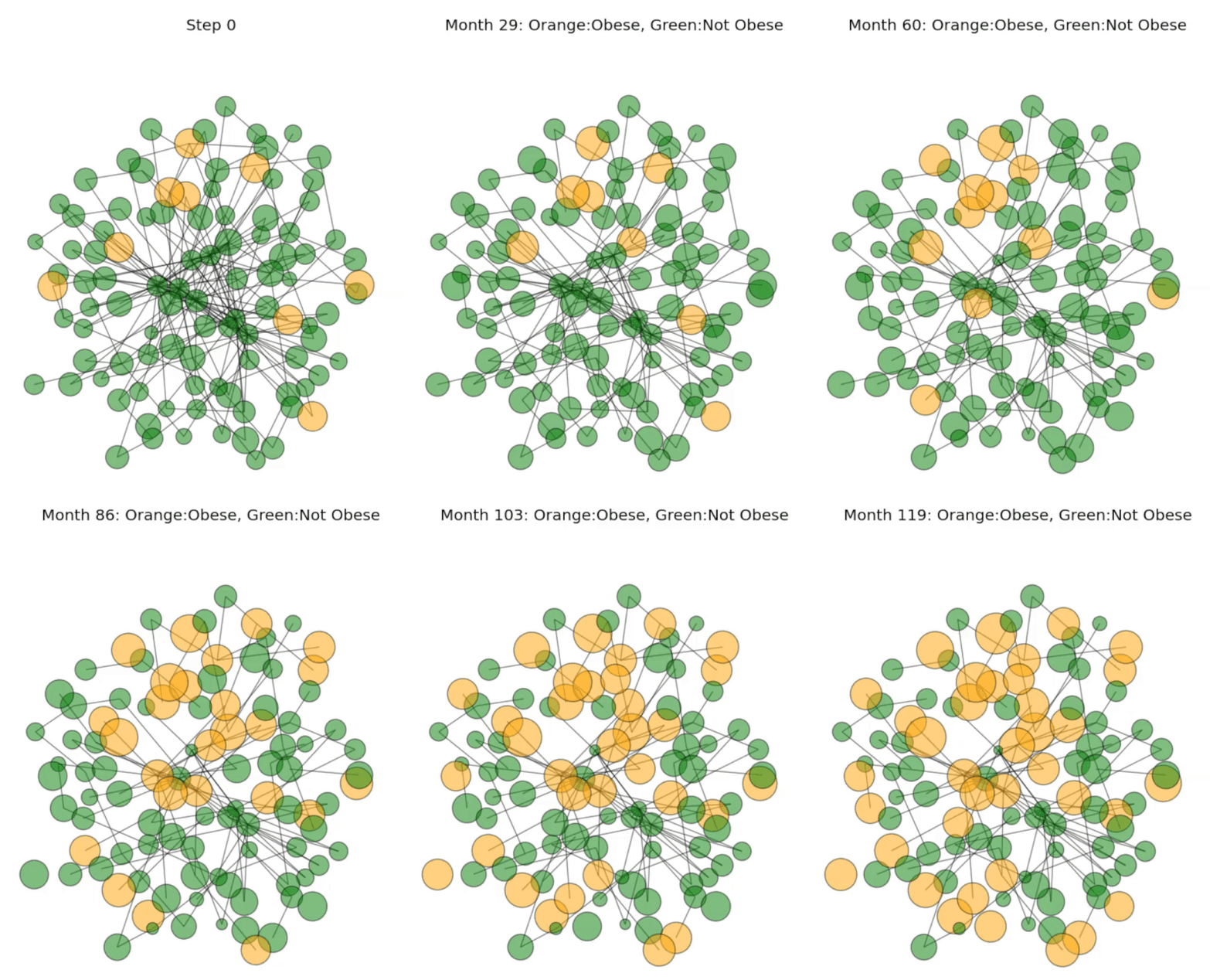
The Agent Based Model running over 10 years. Circles represent agents, and the lines connecting the circles indicate network ties. The relative size of the circle indicates the body mass index of the agent. As the model progresses and more agents become obese, the obese agents become increasingly isolated.

The Agent Based Model running over 10 years. Circles represent agents, and the lines connecting the circles indicate network ties. The relative size of the circle indicates the body mass index of the agent. As the model progresses and more agents become obese, the obese agents become increasingly isolated.

While exploring the dynamics of the model more broadly, they found that while both reducing environmental obesogenic forces (for example, by ensuring access to healthy foods and spaces for physical activity) and encouraging individual resistance to environmental forces (for example, teaching people ‘the seven minute workout’) were effective in blocking obesity, individually-targeted interventions caused stigma-inducing disparities between simulated agents for whom interventions were successful and those for whom interventions were unsuccessful.  This resulted in higher overall levels of depression when only some agents were targeted for intervention or when individually-targeted interventions were only partially successful.  By contrast, environmental interventions that were only partially successful did not induce stigma.

These results add to a literature suggesting that weight-based stigma is a concerning problem, and suggest that individually-targeted interventions should take care to avoid increasing social isolation among those who remain obese.

Posted in Agent Based Model, Depression, Health Disparities, Social Networks, Stigma, Uncategorized | Leave a comment

Social Epi Radio: The Selecter

SERadio_logo3Dr. Michael Friedman’s interview at Psychology Today with Pauline Black, lead singer for The Selecter, and Steve Shafer’s recent review of The Selecter’s new record, Subculture, are vivid reminders of the social issues highlighted by Ms. Black, The Selecter, and the 2-Tone movement overall.  In the interview Ms. Black describes growing up in the 1950’s as a biracial child  adopted by white parents and the racism and sexism she encountered coming of age in 1970’s England.  During a period of racial strife in England, The Selecter, a multiracial band, fronted by a woman, playing a politically conscious mix of ska, reggae and punk and producing top 40 hits, was an important counter narrative to the National Front.

Subculture finds The Selecter still energized to comment on social, economic and political issues.  At the end of the haunting track, “Breakdown”, co-vocalist Gaps Hendrickson calls out a stunningly long list of black youth, women, and men killed by police in the UK and USA.  In his review Shafer writes

Inspired by appalling incidents in both the UK and the US, “Breakdown,” the most politically potent song on the album, posits that the relatively frequent unjustified police killings of mostly unarmed (and sometimes handcuffed) black boys, men, and women are a horrific symptom of entrenched racism, societal dysfunction, and purposeful neglect.

The track “Hit the Ground Running” is about workers locked into “zero-hour contracts” – employees are expected to be on-call at all hours but are given, at the employer’s discretion, anywhere from zero to 40 hours of work per week and are only paid for the hours worked.

Follow us on Spotify:

Posted in Social Epi Radio | Leave a comment

Launching the Social Epidemiology Twitter Feed

TwitterBirdWe have launched a Twitter feed (@CU_SocialEpi) as a companion to our Blog and social media presences.  Folake Eniola and John Pamplin will be leading our efforts to contribute to conversations on Twitter.

Click the button in our sidebar to follow us on Twitter.


John Pamplin

John Pamplin

John is a second year PhD student in the department of epidemiology and a pre-doctoral fellow in the Psychiatric Epidemiology Training Program.  John is broadly interested in the impact of structural drivers of race/ethnic health disparities.  In particular, John is interested in studying the mental health burden of institutional racism and social inequality that is perpetuated by societal structures in the United States.


Folake

Folake Eniola

Folake is a first year Doctoral student in Epidemiology and is a pre-doctoral fellow in NIH funded Initiative for Maximizing Student Development (IMSD).


Posted in Twitter | Leave a comment

Exploring How Residents of NYC Use Neighborhood Spaces

The Built Environment and Health team (including Cluster members Lovasi and Rundle) just published a paper in the American Journal of Preventive Medicine showing that differences in urban design in New York City (NYC) are associated with how residents utilize their residential neighborhood spaces and are associated with resident’s total weekly physical activity.

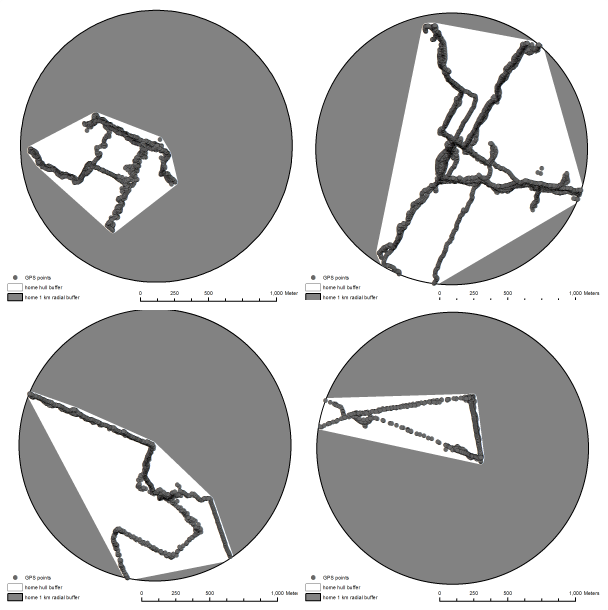
Four illustrative examples showing how GPS logging data can be used to characterize which parts, and how much, of a residential neighborhood is actually utilized by the resident.  The circle represents all neighborhood space within 1Km of a residence and the white area reflects a minimal convex polygon that encompasses GPS waypoints recorded as the person goes about their week.

Four illustrative examples showing how GPS logging data can be used to characterize which parts, and how much, of a residential neighborhood is actually utilized by the resident. The circle represents all neighborhood space within 1Km of a residence and the white area reflects a minimal convex polygon that encompasses GPS waypoints recorded as the person goes about their week.

Using GPS data and physical activity monitors to characterize the activity of study participants over the course of a week, the researchers found that New Yorkers systematically utilize the most walkable areas of their residential neighborhoods and that differences in urban design predict how much neighborhood space participants utilized. Compared to within and between neighborhood differences in crime and in poverty rates and median household income, variation in urban design factors within residential neighborhoods had a much larger impact on the amount of, and which, neighborhood spaces were utilized.

The team also showed that differences in residential walkability were significantly and strongly associated with differences in total weekly physical activity.  Compared to participants living in neighborhoods that scored in the lowest quartile of neighborhood walkability, participants living in neighborhoods that scored in the highest quartile of walkability engaged in 100 more minutes of moderate intensity equivalent physical activity per week.

Posted in Neighborhood Disadvantage, Neighborhood Environments, Socioeconomic Status, Urban Health | Leave a comment

Hey Mr. Sandman: dyadic effects of anxiety, depressive symptoms and sleep among married couples

Neil Gaiman's classic The Sandman

Neil Gaiman’s classic The Sandman

Rundle and colleagues have been developing a series of projects studying how health and health behaviors are transmitted between members of married and domestic partnered couples.  The first in a series of papers on this topic, “Hey Mr. Sandman: dyadic effects of anxiety, depressive symptoms and sleep among married couples.” was recently published in the Journal of Behavioral Medicine. The paper shows that husbands’ anxiety and depressive symptoms predicted a slight increase in their wife’s anxiety and depressive symptoms 1 year later. However, wives’ depressive symptoms or anxiety did not affect their husband’s mental health a year later.  Furthermore, for both wives and husbands, higher levels of anxiety predicted shorter sleep duration for their partner 1 year later.  For depression, symptoms among men were associated with shorter sleep duration among wives a year later, while depression symptoms among women were not associated their husband’s sleep duration a year later.

Ongoing work is assessing the extent to which weight change over a year in one spousal or domestic partner is associated with weight change in the other partner, and similarly how changes in blood pressure and blood lipid profiles over a year track within partners.

Posted in Anxiety, Depression, Social Networks | Leave a comment

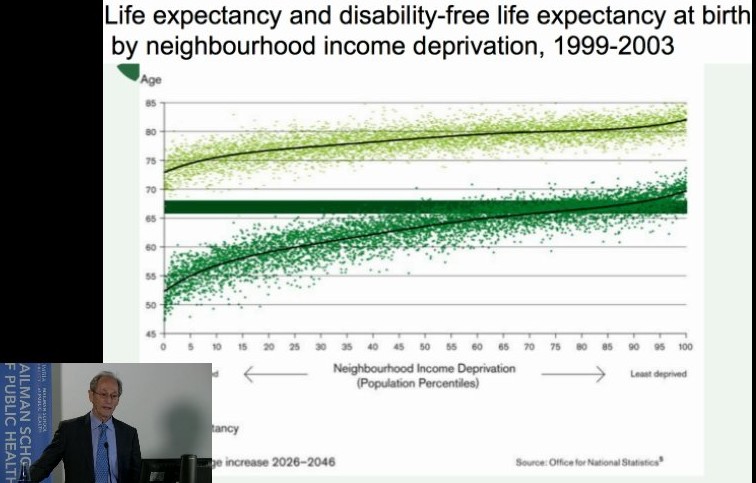
Sir Michael Marmot and Mark Bertolini: Confronting the Health Gap

Sir Michael Marmot and Mark Bertolini (Chairman and Chief Executive Officer, Aetna) speaking at the Mailman School of Public Health Grand Rounds on Confronting the Health Gap.  Archived Live Stream [Here].

Marmot_event_slide


Posted in Uncategorized | Leave a comment

Understanding the Healthy Immigrant Effect and Cardiovascular Disease: Looking to Big Data and Beyond

lb2290_3_LisaBatesLisa Bates and colleagues just published an editorial in Circulation on the “Healthy Immigrant Effect” – the better health outcomes observed among immigrants as compared to their native born peers.  Their editorial comments on research from the Cardiovascular Health in Ambulatory Care Research Team (CANHEART) showing that immigrants to Ontario, Canada experience lower risk of cardiovascular disease compared to long-term residents.  However, as for other outcomes, the protective effect of being an immigrant appears to decline somewhat with longer duration of residence in Canada. The editorial argues that progress in research on immigrant health trajectories would benefit from greater attention to life course issues and the timing of immigration, and to insights from segmented assimilation theory that point to how contextual features of the host environment may be implicated in the other dominant feature of the Health Immigrant Effect – it doesn’t seem to last.  Bates and colleagues have published several papers on the Healthy Immigrant Effect, looking at birth outcomesself-rated healthbody mass index and stroke incidence.

Other members of the Social Epidemiology Cluster have also studied the Healthy Immigrant Effect.  Rundle and colleagues have shown that immigrants in NYC have lower BMIs than their U.S. born peers, but among immigrants average BMI scores are higher among those who have lived in the U.S. for a longer duration.  They have also published research on the links between dietary patterns among Hispanic women and residence in immigrant neighborhoods and work on Hispanic immigrant women’s attitudes and beliefs about what constitutes healthy foods.


Posted in Healthy Immigrant Effect, Immigration | Leave a comment