Research and Columbia Libraries: A Guide to Maximizing Your Resources

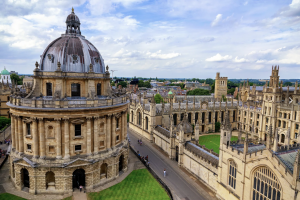
Examining a text in RBML. Photo credit: Elliot Hueske.

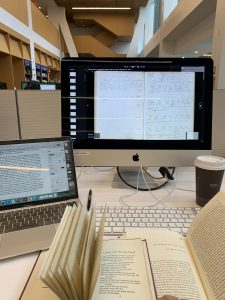
Research settings look different for everyone but relying on textual resources and supporting documents to substantiate a claim remains consistent throughout all research types and environments. Nonetheless, finding a place to start with respect to navigating Columbia’s many libraries or connecting with a librarian can feel overwhelming. Afterall, Columbia has twenty-two libraries that feature extensive and diverse collections of digital and print resources to guide your research. Although I am fond of Avery Library, I have also found myself gravitating to Butler 310 reading room and trying to stake out a table on the mezzanine level. In this post, I hope to offer some insight regarding using the libraries throughout your research and discovering what might be considered their hidden gems! 

Continue reading

Posted in COVID-19, Libraries, major research, Uncategorized | Comments Off on Research and Columbia Libraries: A Guide to Maximizing Your Resources

Why Pursue Seemingly Inapplicable Research?

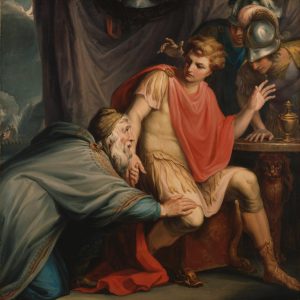
Sandro Botticelli, St. Augustine in His Study. Photo Credit: Wikipedia Commons

There exists a constant pressure in our contemporary age for the academy to divert resources to vocationalist programs. This, in turn, induces a movement towards hyper-specialization and fragmentation between the disciplines, as only “necessary” procedural skills are to be learned and perfected for hyper-specific vocational ends. Any learning, research, or skill development outside of an unreflective ability to accomplish such ends, relative to a certain career path, is increasingly viewed as gratuitous, and there is a constant conversation about whether such aspects of academic tracks ought to be cut. 

Continue reading

Posted in major research, Senior Thesis, STEM research, Summer Research, The Core | Comments Off on Why Pursue Seemingly Inapplicable Research?

The Core and the City

The Met. Photo Credit: Juliet Paiva

Arguably, the two most defining features of the undergraduate experience at Columbia  are the core curriculum and the school’s location in New York City. One of my favorite parts  about Columbia has been the freedom to explore the city and the variety of experiences it has  to offer that stand out from any other US city. I’ve spent my whole life living in cities and love the fast-paced environment, the unique mixtures of people with different backgrounds and  stories, the general feeling of independence that surprisingly breeds a collective identity, and  the unique opportunities that come with all of these things occurring in one place. But life at  Columbia is also marked by the core curriculum, giving undergraduates an expansive and  unified liberal arts education regardless of their specific fields of study. The core fosters a  special form of community, an invisible string that connects Columbia College students and  alumni across time and space. While the core and the city are two distinctive elements of life at  Columbia, we can easily overlook the spaces where they overlap and the rare learning that  takes place there. 

Continue reading

Posted in New York City, The Core | Comments Off on The Core and the City

Evolution and the Importance of Tradition in Literature Humanities

“A Greek manuscript of the beginning of Hesiod’s Works and Days,” photo from John Tzetzes (Wikipedia).

“The words of truth are naturally simple” – Euripides, The Phoenecian Woman 

The history of the formation of the course now known as Literature Humanities is not a well-known story among students at Columbia College nowadays, and this is a regrettable reality. A great deal of thought for over a century has been invested into forming the curriculum as it was taught for decades, and there have been many developments in the philosophy behind many methods for teaching the course that are related to the changes that the course underwent during one particular episode of change in 1937. 

Prior to 1937, the bulk of the Core Curriculum was Contemporary Civilization, which was a course focused primarily on the key philosophical texts of the Western tradition. A committee established in 1934 eventually drafted a proposal in 1937 for an inaugural two-year program, in which one would study key books in the Humanities under the courses Humanities A and Humanities B, with Humanities A focused on a “great books” curriculum. This was described in Herbert Edwin Hawkes’ now famous letter entitled “The Evolution of the Arts College: Recent Changes at Columbia as the product of “an evolutionary rather than a revolutionary process” and thus “a gradual movement of judgment and opinion in a given direction through a considerable time” (33). Because the objective of the reform was to permit a natural outgrowth of the Core Curriculum rather than a stark rupture with the past methods of doing things, a combined method of instruction in which the hallmark of Contemporary Civilization would be incorporated into a two-year progression with the two new Humanities courses was established. 

Continue reading

Posted in Archives, The Core | Comments Off on Evolution and the Importance of Tradition in Literature Humanities

On Balance at Columbia 

Photo credit: Juliet Paiva.

Life at Columbia can often feel like walking on a tightrope. You are constantly pulled in  different directions, unsure where to dedicate your limited time and energy. Striving to live a  harmonious life is not a problem unique for Columbia undergrads, but at a school and in a city  where there is always more to do than one individual could manage, finding balance can feel like  a constant battle. As a senior, I’m trying to strike a balance between my classes, clubs, writing a  thesis, exercise, self-care, trying to figure out what to do after I graduate, and staying in touch  with my family and friends from home, all while at the same time trying to make the most of my  last year here by enjoying time with my friends and focusing on the present moment. I’ve  experienced the precarious feeling of trying to find balance since my first year at Columbia, and  as I begin my senior year with a new host of obligations, I thought I would reflect on what has  helped me most along the way. If you’re considering starting a new research project or adding a research assistant position to your already filled schedule, these general tips will hopefully help  you do it all.  

Continue reading

Posted in major research, postgraduation plans, Uncategorized | Comments Off on On Balance at Columbia 

Why Care about Latin and Greek outside of Classics?

The ancient Erechtheion on Acropolis Hill, Athens. Photo credit: pexels.com 

Why did Columbia historically require Latin and Attic Greek, and what can we learned from the annulment of this requirement? And why care at all? As is no secret, Columbia College once enforced a Greek admission requirement and required all students to study at least two years of Latin. It wasn’t until Columbia moved to its current home, the Morningside Campus, that it waived this admissions requirement and reduced its Latin requirement. It wasn’t until 1916 that Columbia eliminated its Latin course requirement completely. 

Continue reading

Posted in courses, The Core, Uncategorized | Comments Off on Why Care about Latin and Greek outside of Classics?

The Evolution of A Thesis’ Archetype

Thinking through the thesis process. Photo credit: Elia Zhang.

Every department goes through the senior thesis process differently. Some have their students complete a thesis in junior year, some require 4 semesters of continuous work. In this article, I would like to share how my thesis idea has evolved, and the personal growth that this learning process has enabled.

For people who have double majors, the first question we need to figure out is in which department to do a thesis. For most departments at Columbia College, the policy does not allow students to do a “joint thesis” that can be applied to two majors. And after speaking with professors whom I have reached out to during junior spring, I have discovered that the general consensus is that it is not advisable to write two theses at the same time, given the amount of work involved, and the need to cultivate or finetune a new skill set. (However, if you are passionate about two questions that require different methodologies to find out their answers, you should definitely try pushing the limit and figuring out a way of navigating two thesis ideas!)

Continue reading

Posted in courses, Faculty Mentors, Libraries, Senior Thesis, Uncategorized | Comments Off on The Evolution of A Thesis’ Archetype

Approaches to Interdisciplinary Research

Research at the margins, research at the intersection. Photo credit: Elliot Hueske.

It is rarely ever the case that our attitudes are binary or one-dimensional. In fact, life is characterized by the many beliefs, opinions, and preferences that we embrace. Ascribing to one thought or ideology while resisting others is not only nearsighted but can become threatening— rigid self-categorization is constraining, repressive, and inhibitory. Rather it is a feature of behavior and motivation that we are constantly pulled in numerous directions. For example, you might be balancing a dichotomous interest in theatre and economics, or managing commitments to work, family, and school. With shifting workplace, research, and academic environments the opportunity to pursue several interests simultaneously is becoming more feasible. Therefore, it seems intuitive that interdisciplinary research is becoming the new norm. However, from my own experiences I recognize that there is still significant ground to cover before interdisciplinary projects acquire the same status and accessibility as standard research approaches. 

Continue reading

Posted in Archives, courses, Faculty Mentors, Libraries, major research, Uncategorized | Comments Off on Approaches to Interdisciplinary Research

The Stress Counterweight: Interpreting the World, and the Work of CC

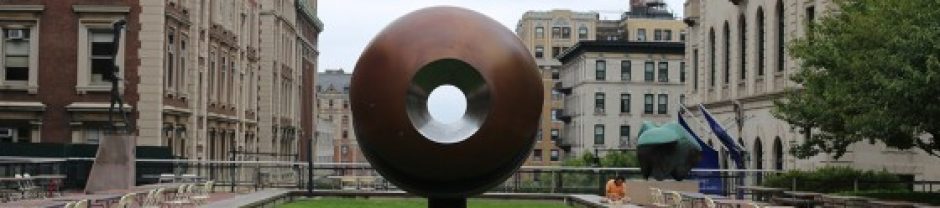
“Mandible,” by Oona Dederer. Photo Credit: Elliot Hueske.

The numerous manifestations of stress are all becoming more salient to us. Whether we are feeling agitated, having trouble focusing, losing sleep, or clenching our jaws, the anxiety of our current historical period is reflected in our mental and physical health. Daily life is seemingly defined by a constant inundation with unsettling and anxiety-provoking news concerning international conflict, the COVID-19 pandemic, attacks on marginalized community groups, and numerous additional emotionally demanding experiences. Negatively valenced stimuli interrogate the psychological and physical well-being of individuals, for example, with respect to the attacks on female bodily autonomy by the overturning of Roe v. Wade. Moreover, recent assaults to community well-being through acts of violence continue to plague the nation. Such a vicious besiege of human rights violations is simply incomprehensible. However, through studying psychology I have recognized the important association between improved psychological health and a modified perspectives when interpreting such stimuli. Instead of allowing adverse feelings to become overwhelming, it is beneficial to integrate contextual information and subjective experience to effectively incorporate such events in a mental repository. While not foolproof, this technique can help us continue functioning without allowing these experiences to become debilitating. For me, such cognitive activity has been largely assisted by the texts and class discussions of Columbia’s Core courses, particularly Contemporary Civilization (CC). My engagement with the texts in the CC syllabus encouraged me to analyze and interrogate historical events in an effort to work toward concrete actions to improve our future and safeguard the rights of subsequent generations. I implore Columbia students to approach Core classes not with a perspective of checking an item off a list of requirements, but with the mindset that successfully completing them will equip you with critical tools in which to interpret and navigate your world. 

For example, my CC class witnessed the January 6 Capitol Hill attack. This event was deeply troubling for the majority of the class and my peers expressed their concerns that democratic foundations were crumbling, while any sense of accountability was seemingly lost. At the time we were studying John Stuart Mill’s on Liberty and Marx’s The Communist Manifesto which, although ideologically distinct, allowed us to characterize attacks on liberty. Putting the authors in dialogue with each other was a meaningful exercise. In smaller groups, we came to recognize that both authors generally agree that assaults to human rights are contingent on the customs of a society. We then questioned whether this permitted us to place the recent Capitol Hill attacks in context with a rigorously bipartisan cultural and political environment. We also considered the implications of America’s history of colonialism and suppression manifesting in this event. Despite significant variation between the texts, Marx asserts that liberty is “the right to do everything which does not harm others” which is similarly articulated by Mill. While Marx’s interlocuters may criticize this statement for being too broad, it became increasingly more relevant after witnessing the direct abuses to well-being occurring in front of us. It was not simply bipartisan division, but an even more extreme and misinformed notion of social exclusion that was severely disconnecting our country. Yet the texts that we were engaging with emphasized the necessity of an enhanced sense of community to avoid a descent into societal isolation. To extend this conversation, we incorporated Alexis de Tocqueville’s Democracy in America. De Tocqueville asserts that humans are becoming increasingly more detached from each other by establishing artificial boundaries between groups. Moreover, he argues that egoism makes individuals retreat from the political sphere and become less committed to their country. The polarization and hierarchies that characterized this moment in time and continue to threaten communities today were heightened in relevance by these class discussions. 

In addition to analyzing the origins of such actions, we also contemplated potential solutions in which to advocate for forming politically active communities. The type of idealized society envisioned by Marx is a kind of utopia. Yet so is the world imagined by Charles Darwin in On the Origin of Species. Darwin visualizes an environment of cohabitation and emphasizes the production of bonds of association. In a somewhat sobering tone, he questions the loss of human unity: “Why do we not see these linking forms all around us? Why are not all organic beings blended together in an inextricable chaos?” Therefore, we read Darwin as proposing claims of radical social unification, rather than strictly as a biologist. CC discussions provided the necessary material in which to cope with and comprehend the events transpiring. Not only were we identifying motifs and themes in the texts, but we were connecting them to our present moment in a way that made it feel less overwhelming. By translating the concepts of great thinkers and interpreting the world through modified versions of these ideas, I began to feel less stressed, to sleep a bit sounder, to unclench my jaw—if only a little. 

Posted in courses, COVID-19, major research, The Core, Uncategorized | Comments Off on The Stress Counterweight: Interpreting the World, and the Work of CC

Musing Ecclesiastes at the Cathedral of St. John 

St. John the Divine. Photo credit: Elia Zhang

It was surprising to think back that, after completing CC, the most moving text to me was the chapter of Ecclesiastes in the Old Testament—I thought, walking toward the Cathedral of St. John on Amsterdam avenue. Ive always known about the cathedral. Although it was in construction, it was supremely beautiful. Yet it took me a long time to find an idle afternoon to visit after possibly the most exhausting semester that I have ever gone through. Whatyou zip code?” The doorman asked me. 10027,” I said, which was the zip code an international student would use residing here near campus. Are you a neighbor?” he said and smiled, so youre free to come in.” Then he saw my blue t-shirt underneath my jacket and said Youre a Columbia student? Show me your ID and—oh, youre doubly free.” Being a Columbia student meant that many places and events in the city were open for free, and hence I felt warmly welcomed, and at the same time, privileged.

Continue reading

Posted in New York City, The Core | Comments Off on Musing Ecclesiastes at the Cathedral of St. John