Aesthetics and Pedagogy in the Historical Core

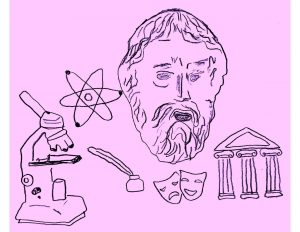
Photo credit: Pexels.com

What in the world does beauty have to do with the Core, and especially with the teaching of the Core? I did a deep dive into its history to find out. 

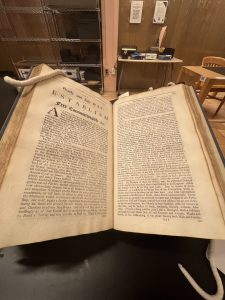
It wasn’t all that long ago that Columbia University Press published comprehensive books of works taught in Contemporary Civilization that could be widely distributed to students. I recently was able to get my hands on an old 2-volume hardcover set of all of the works that might “prove useful” for teaching Contemporary Civilization in 1954. These beautiful soft-red, gold, and black books, complete with a sublime Columbia logo, contain an astounding array of authors and texts. Not only are there more authors and texts contained within than we now cover in CC, there are more than could conceivably be treated in a year-long course. Mill, the tradition of Historical Materialism, Lenin, Bernstein, Shaw, Sorel, Nietzsche, Pope Pius XI, the Oxford Conference, and Columbia’s very own John Dewey are all covered in just one chapter (Chapter X of XXVIII) in Volume 2 of the edition.

Continue reading

Posted in courses, The Core, Uncategorized | Comments Off on Aesthetics and Pedagogy in the Historical Core

Tips for writing a seminar term paper

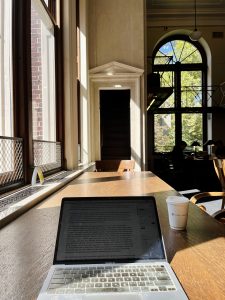
Lehman Social Sciences Library. Photo credit: Columbia University Libraries

It’s the start of a new semester and you’re drowning in new syllabi. Luckily, you glance at the reading list for your niche major seminar, and feel a glimmer of hope: the readings somehow look both interesting and manageable. This is a common Columbia experience, as almost every humanities and social sciences field requires one or two seminar courses that most students take in their junior or senior year. A class that only meets once a week and doesn’t have a midterm… what’s the catch? But there, at the bottom of the syllabus, you see it. Almost all of these courses culminate in something along the lines of a 20-to-30-page paper, due during finals, that accounts for the majority of your grade in the class. It can be a daunting task, but one that feels very distant at the start of the semester when you have months to write this paper. 

Continue reading

Posted in courses, major research | Comments Off on Tips for writing a seminar term paper

Eyes to See and Ears to Hear 

“Sonya comforts Raskolnikov in Siberia,” drawing by Seth Adam Smith. Photo credit: https://sethadamsmith.com/2012/08/04/seeing-the-savior-in-crime-and-punishment/

“Give instruction to a wise man, and he will be still wiser; Teach a just man, and he will increase in learning” (Proverbs 9:9). 

It’s a fortunate staple of most undergraduate students’ experiences of the CORE curriculum at Columbia that we run across a Professor who, by the example of his incisive approach to a text, his skills in fostering dialogue, and his openness to the questions of his students, inspires many students to pursue a text, question, or point further than they originally imagined. But, as many of us have discovered through our journey in the CORE, such opportunities to grow in knowledge only manifest to those who are willing to engage in the dialogue in question. Indeed, the words second-semester Literature Humanities’ students hear in the Gospel of Matthew about the Parable of the Sower and Christ’s conclusion “blessed are your eyes for they see, and your ears for they hear” (13:16) ring true once we realize that one idea, no matter how small, can change our entire life if we have eyes to see and ears to hear. 

Continue reading

Posted in courses, The Core, Uncategorized | Comments Off on Eyes to See and Ears to Hear 

From Research to Researcher: How Collaboration Forms a Scientific Mind

The Columbia SPOCS Team Co-Leads, Kalpana Ganeshan and Swati Ravi, Columbia SPOCS Outreach Lead Theodore Nelson, and Columbia SPOCS Mechanical Engineering Lead
Alfonso Ussia hold up the spaceflight-flown Characterizing Antibiotic Resistance in Microgravity Environments (CARMEn ) payload before unpacking at Columbia University.
SPOCS Biology. Advisor Bryan Wang is not shown. Photo Credit: Theo Nelson.

At the beginning of my Columbia College journey, I, an eager and excited freshman, attended the virtual activities fair, filled with zoom links which would form the entirety of my university environment for what felt like an indeterminate future. In some rooms I found upperclassmen wistfully recounting the glories of olden days; in other rooms spirited organizers promised an endless parade of zoom events. In the Columbia Space Initiative room, the leadership did both, recounting the good old rockets shot 20,000 feet in the air and articulating a zoom-link heavy future. However, their zooming seemed purposeful, to pursue a one-time student payload opportunity, celebrating twenty years of research on the International Space Station.

Continue reading

Posted in COVID-19, major research, STEM research | Comments Off on From Research to Researcher: How Collaboration Forms a Scientific Mind

Searching for a research opportunity? Start here!

Rodin’s The Thinker. Photo Credit: Columbia University Libraries.

Navigating the research landscape for student opportunities can seem intimidating – here are some tips on where to start with brainstorming and searching.

Picture your ideal opportunity
Jot down a few notes relevant to the kind of experience you are seeking. These notes will be helpful when you are searching through opportunity databases or finalizing a list of programs to apply to.

Interested in diving deeper into a particular area, such as the intersection of neuroscience and economics? Is there a discussion topic from a Core class or major elective that you would like to explore further? Previous project themes you would like to continue? A personal example: my Contemporary Civilizations professor’s research focus is on medieval Islamic medicine, and hearing about her experiences inspired me to dive deeper. This led me to propose a project exploring complementary medical systems and their rich cultural intersections through the Research Cluster on Science and Subjectivity.

Continue reading

Posted in Archives, conference presentations, Faculty Mentors, Libraries, major research, New York City, Senior Thesis, STEM research, Summer Research, Uncategorized | Comments Off on Searching for a research opportunity? Start here!

‘A Journey to the ‘Metropole’: Tracing Transnational Networks at the University of Oxford

Standing outside Lincoln College, Oxford; I got lost trying to find Brasenose College, so my professor had to come here to find me. Photo credit: Renu Sisodia and Hitendra Wadhwa.

It has always struck me as somewhat paradoxical that some of the Indian subcontinent’s most famous political activists in the twentieth-century journeyed to Britain to complete their education: from the anticolonial leader M.K. Gandhi, to the first Indian Prime Minister Jawaharlal Nehru, to ‘extremist’ independence activists Aurobindo Ghose [later, Saint Aurobindo] and Subhas Chandra Bose, to the founder of Pakistan, Muhammad Ali Jinnah, to the constitutional scholar and anti-caste activist (and Columbia alum!) B.R. Ambedkar. Whether their English sojourns have been heavily documented (as in the case of Nehru), or omitted from their biographies (as in the case of Bose, among others), I have been fascinated by how a journey to the colonial metropole shaped these figures’ political outlooks—their responses to British imperial power, their engagement with class divides and leftist political activism, their ‘radicalism’ and views on colonial and anticolonial violence, their position on social reform with regard to gender and caste—and gave them access to powerful political networks that they leveraged, to great effect, upon their return to British India [present day India, Pakistan, and Bangladesh].

Continue reading

Posted in Archives, Faculty Mentors, Libraries, Study Abroad, Summer Research, The Core, Uncategorized | Comments Off on ‘A Journey to the ‘Metropole’: Tracing Transnational Networks at the University of Oxford

Uncovering Public Hellenism

Nikolaos Ferekidis (1862–1929) and monogram G.W., The Entry of King Otho of Greece in Athens, copy of the work by Peter von Hess (1839), 1901, οil on canvas, 200×340 cm. National Bank of Greece. Photo credit: https://www.greece-is.com/why-the-1821-greek-revolution-changed-the-world/

At the beginning of my summer, I participated in the Columbia Summer Research Practicum for Public Humanities and Hellenic Studies. Under the supervision of Professor Dimitris Antoniou and Nicolas Nicolaides, our teaching assistant, a group consisting of me and four other students 

engaged in scholarly discussions on the public memory of Greece from the 1800s with most of our focus being on the Greek Revolution of 1821. From reading articles on the religious divides in Eastern Europe to watching videos highlighting specificities of Greek culture to analyzing Greek art from a variety of time periods, I discovered a new passion for historic preservation and public humanities. 

Continue reading

Posted in Archives, Interviews, New York City, Study Abroad, Summer Research | Comments Off on Uncovering Public Hellenism

Laboratory Do’s and Don’t’s!

Reading material packet and laboratory notebook for note-taking. Photo credit: Giovanna Napoleone.

As a current student researcher at the Barnhart Laboratory, I have had the amazing opportunity to investigate mitochondrial morphology during my first year at Columbia College, which I am now continuing over the summer thanks to CCE’s Summer Funding Program and its Work Exemption Program (WEP). However, upon initially joining a new laboratory environment, I wasn’t quite sure of how to approach my project topic learning curve at first. How can I be prepared to go to weekly lab meetings, or navigate concepts I haven’t covered in my science classes yet? Below is a list of Do’s and Don’ts for how to approach a summer research position at a new laboratory! 

Continue reading

Posted in major research, STEM research, Summer Research | Comments Off on Laboratory Do’s and Don’t’s!

Interning in the Archives: My Experience at the Smithsonian National Museum of Natural History

Author Muna Ali in the National Anthropological Archives (NAA) reading room, pictured with rehoused film slides from the Stanford and Jodry papers. Photo credit: Brittany Hance, National Museum of Natural History, Smithsonian Institution.

This summer, I had the exciting opportunity to intern with the Smithsonian National Museum of Natural History (NMNH) as part of a program called Natural History Research Experiences (NHRE). Throughout my 10-week NHRE internship, I was able to prepare a poster presentation on my research, conduct an outreach event with the general public, and interact with museum professionals across varying natural history disciplines.

The work I conducted this summer was twofold: for the first five weeks of the NHRE program, I rehoused film slides from the Dennis J. Stanford and Pegi Jodry papers. Through my rehousing work, I gained hands-on experience with museum archival processing techniques. For the final five weeks of the program, I conducted extensive research on Dennis J. Stanford and Bruce Bradley’s controversial Solutrean hypothesis. Stanford and Bradley postulated that archaeological stone tool similarities between the Clovis people (early peoples of North America) and the Solutrean people (early peoples from modern-day France) “proved” that the first peoples of America arrived from Europe. My project centered around the ontological violence towards Indigenous communities that resulted from Stanford and Bradley’s hypothesis, as well as the co-option of the hypothesis by white supremacists. My project also addressed the need for decolonial methodologies in archival research and archaeological fieldwork, and advocated for a decentering of Western epistemology.

Continue reading

Posted in Archives, major research, Summer Research, Uncategorized | Comments Off on Interning in the Archives: My Experience at the Smithsonian National Museum of Natural History

Fruit Flies and the Life and Times of Mitochondria

Mitochondria (green) in the distal dendrites of a neuron (pink) of the fly visual system. Photo credit: Avi Adler

Around campus, when chatting research, I often say that my hours in the lab are spent “messing with flies.” While this is perhaps a stretch, it is not far from the truth. Most days begin with fly work: the necessary housekeeping of working in a Drosophila biology lab. Although I started using this line with a good sense of humility, to my own surprise my peers in the classroom, dining hall and various social events are sincerely intrigued by it. When pressed further, I explain my expertise in sorting flies by their eye color, wing shape, hair length, etc. This usually leads to a tangent about genetics, and naturally a comment about ordering flies from Bloomington, Indiana. After I’ve thoroughly explained how to mate flies such that the next generation of flies has red eyes and not curly wings, I am usually then asked what I am actually researching.

Continue reading

Posted in STEM research, Summer Research | Comments Off on Fruit Flies and the Life and Times of Mitochondria