Categories
EDforSD

Celebrate World Water Day

Ideas, lesson plans, story books, activities all in this blog.

Monday 3/22 is Water Day. You can find more about Water Day here

https://www.worldwaterday.org/


Did you know that there is a Sustainable Development Goal Dedicated to water- Goal 6 talks about “Clean Water and Sanitation” https://www.un.org/sustainabledevelopment/water-and-sanitation/

Many countries have pledged that “ By 2030, achieve universal and equitable access to safe and affordable drinking water for all”. Do you think we/countries will achieve this goal?

Water is a precious resource, what are some of your ideas to conserve water

  1. Turn off the tap when it’s not in use. …
  2. Soak your dishes in warm water first. …
  3. Run your dishwasher and laundry only when its full. …
  4. Cut those long showers short. …
  5. Use energy-efficient, water-saving devices. …
  6. Use a water softener to tackle hard water problems. …
  7. Fix plumbing leaks. …
  8. Go easy on your sprinklers and gardening hose.

Here are some more ideas https://www.culligannation.com/10-ways-to-conserve-water-sustainable-living/

Story Books:

Here is a book on water conversation https://www.culligannation.com/10-ways-to-conserve-water-sustainable-living/ Michaela Goade is the first Native American to win the Caldecott Medal for her illustrations in “We Are Water Protectors.” – CNN

Maybe you can ask your school to get it for your school library?

Type in “water” and you will find 625 story books free on water. https://storyweaver.org.in/search?query=Water

Nya’s Long Walk (recommended by Ms Adams, Wyoming School)

This story is about 2 sisters who live in South Sudan and the trials and tribulations of walking far distances to receive water. It always sparks interesting and insightful discussions about how fortunate we are to have clean drinking water so accessible. It’s a great book!

https://www.youtube.com/watch?v=yZvgsh0TLhA

Teachers do you want lesson ideas on water?

You could type “water” and the “age group” and a lesson on water will pop up appropriate to the age group. https://worldslargestlesson.globalgoals.org/resources/

Learn more about Water Crises

Here are two water foundations that you should know about. They work on water and sanitation issues globally.

https://water.org/our-impact/water-crisis/

https://www.paanifoundation.in

YOU can do it too.

There was acute water scarcity in their village and the children decided to create a canal with check dams to store surface water. They worked extremely hard to get the funds donated for this through various means.

https://dfcworld.com/VIDEO/ViewVideo/213

Lecture on Water (for high schoolers)

High fluoride in water is a huge problem in many parts of the world. Listen to this lecture here.

https://www.earth.columbia.edu/videos/view/it-takes-a-village-citizen-science-in-rural-india-grades-9-12

Student research (high school)

Science for Everyday Decisions series Center for Sustainable Development Earth Institute, Columbia University Video #18: A Prototype Citizen-Science Microplastics Sampling

https://youtu.be/FALNLzNi7Mo

Protocol to Quantify the Magnitude of Pollution Along a Community Beachfront Spencer Feehan is a senior at Plainedge High School. He conducted a microplastics research with science research advising from his teacher Mr. William Bertolotti, and research and lab advising by Dr. Joaquim Goes of the Earth Institute, Columbia University. With the local beachfront samples Spencer collected, he examined them at Dr.Goes’ lab, to investigate the magnitude of local microplastics issue. His research has inspired junior students to continue the microplastics research, and take up various dimensions of the microplastics issues for investigation. Other students’ research will be featured in the future Science for Everyday Decisions series.

Stay tuned on our YouTube channel: https://www.youtube.com/channel/UCkZHqp2zW-VUbmcWFdaKQ-g/videos Eco Ambassador Program based out of the education team of Center for Sustainable Development, Earth Institute, Columbia University

Simple activities on Water (Recommended by Ms Lori Princiotto, Glenwood school)

https://handsonaswegrow.com/flower-garden-kids/

Kids talk to your parents about the Lawn Problem

In the United States, lawns are so ubiquitous that to my young eye (and many others) they seemed to be almost a basic human right. That’s a serious problem, given the enormous resources that our North American lawn-fetish consumes.

https://blogs.ei.columbia.edu/2010/06/04/the-problem-of-lawns/

Festival on Water? Wait what….

Holi Festival is a festival of colors played with water. It is just around the order Sunday 28th March.

https://time.com/5799354/what-is-holi/


Categories
EDforSD

Day 5: Action Plan for Eco-ambassadors Program

Ashna Swaroop, Middle School, Millburn, New Jersey.

Dvita Bhattacharya, Middle School, Millburn, New Jersey.

Today brought about the end of our week-long Climate Summit. It has been a truly amazing five days, and our session today was a fitting end to this experience. The theme for Day 5 was Climate Action. We asked ourselves, “How can we use what we have learned to make a difference?” and our inspiring speakers helped us answer this very question.

Our first event for today was a panel with several college students. They helped us understand how we could incorporate sustainable development into our high school and college careers, as well as our everyday lives. Our panelists included Sophia Assab (a student at Columbia university studying Economics and Sustainable Development), Charlotte Munson (studying Sustainable Development and Business management at Columbia), Jeremy Zimmerman (a senior in the dual degree program between Sciences Po and Columbia University, studying Political Humanities and Sustainable Development), David Yang (a sophomore at Columbia, planning on double majoring in Computer Science and Sustainable Development), and Isadora Muszkat (in the Dual Degree Program between Tel Aviv University and Columbia, pursuing a degree in Philosophy and another in Sustainable Development).

Each of our panelists outlined their own unique journeys to the study of sustainable development and the environment. Assab, for example, initially planned to study human rights, but felt the need to do more for the earth and the life on it; Munson used to be a professional ballet dancer until she ruptured her ankle at 22 and was forced to give it up. She decided to go back to school and found her passion for sustainability. Our panelists’ diverse, varying paths to this field of study helped highlight how all-encompassing the topic of sustainable development truly is. Somehow or the other, sustainable development is relevant to every subject and area of learning, a lesson all of our speakers touched upon. While each had different ideas to share with us, the common theme through their stories was how sustainability factored into each of their career paths. Munson gave examples of sustainable fashion and environmental engineering. At first glance, neither fashion nor engineering seems to have much to do with the environment. Yet there is always a way to combine sustainability and whatever your passion is. This only serves to once again prove just how relevant and important climate change and the environment are in our world today, as well as what a pressing issue they pose.

Our panelists also spoke about their work to help others and our planet. Yang and Zimmerman, for example, are part of an organization called Engineers without Border, and work to incorporate their passions for computer science and law into the work they do. Muszkat is helping develop activity kits for children in public schools to help them learn about sustainability. Munson worked on a project in India, where she tested the fluoride content in groundwater. And Assab is a part of a Harvard Think Tank working on a bill for environmental change that will be proposed to Congress. Each of these students has done inspiring work to help change the way things are and to make the world a slightly better place. Their determination and talent is an example of what we should work to live up to.

The last question our panelists answered was one that is of utmost importance, especially considering how unfair and dismal our world can seem today. The question we asked was “How do you stay hopeful when things look so bleak?”. Their responses were both insightful and powerful. Munson said that her source of hope lies in humanity’s ability to adapt and respond to challenges. She used the current COVID 19 pandemic as her example. If we, as a country, managed to completely change our lifestyles by quarantining and social distancing, there is at least some hope that we will be able to take the steps necessary to stop climate change. Zimmerman also pointed out how many young people are motivated to stop this issue even if they come from families who don’t believe in climate change. This is a topic that is too often politicized – and the younger generations seem to be able to cut through the din surrounding it and get to the core of the matter. The potential they hold is enough to give us hope even when it seems as though nothing is happening. And thus our panel came to an end, leaving us as the audience with many new ideas to think about and a renewed belief in our ability to overcome climate change.

Next, we met Jeneda and Clayson Benally, a powerhouse brother and sister duo who bring awareness to their culture through punk-rock music. They are part of the Navajo tribe, and started to sing and raise awareness when they realized that their tribe was dying out because of many terrible reasons and the history was being underrepresented. In Navajo traditions, singing and dancing are important in many things, even healing ceremonies. When they were fighting relocation from the place where their tribes have been for generations, that was then when they found their voice. As said by Mr. Benally, “Music, art, activism and advocacy are all intertwined”. As part of the Navajo tribe, they grew up learning to respect the Earth. Nothing was wasted. Growing up like this gave them an idea of how what happens to the Earth, happens to us.

Being asked to move did a number of things to Mr. and Ms. Benally. They had to move because there was coal where they lived, and the government wanted to use it. Even before this, their entire lives have been always sought out to justice and awareness. The coal that was in their backyard was being used in big cities, like Los Angeles, and yet they didn’t even have water and electricity. All of this was being taken away from them. Mr. Benally remembered when he was listening to his grandmother when she said that coal was the liver of the Earth, and forests were the hair. This might not appeal to the officials who wanted to take the coal, but it made sense. Your liver acts as a filter in your body, and the coal did that to water. Beneath all of that coal was an aquifer with pristine, naturally filtered water! This only shows how everything on the Earth is interconnected.

The Benallys also talked about what inspired them to write their music. As mentioned before, they use traditional songs and combine them with hopeful messages about the future. By the way, the traditional songs they use are social songs, not ceremonial songs, which are not to be shared. They were inspired by all the hippies who moved to the west coast and started singing rock music. Blues, folk, and rock n roll really motivated them to sing. Growing up, they were told that they could either be traditional and modern. Now, they identify as traditional, but they also have modern tools to show to others that “culture is cool”, and diversity is important.

Tradition was very important to the Benallys. As indegenious people, Ms. Benally says, they have lived with the Earth for so long, and they know to respect it. “Growing up with the foundation of understanding who I was guided the vision of who I am today”, she adds. Growing up, Mr. Benally endured racism. Once, he was burned by bullies in the locker room, just because of his culture. He was an outcast to his school, and playing punk rock was a place where outcasts banded. They began to play punk rock because it was a place where you could be you. In other words, it was liberating to them, and having that space growing up was so important.

In this summit, we have learned that COVID has done many good things for people. But for the Navajo, COVID has not been nearly as helpful. They’re struggling against COVID, mining, and lack of infrastructure all at the same time. The pandemic has shed light on the fact that they are in need of the basic infrastructure to support their people. And on top of that, many people in their tribe don’t have access to hot water or the internet, and kids have to drive to places with internet (sometimes more than an hour away). On the bright side, they do have community, culture, and the ability to live off of the land like their ancestors did, but that much is not going to cut it.

As a final message for kids, Ms. Benally said that they can make a difference and they should always remember that they should dream big and know what is in their head can be a possibility. Know that it’s okay to fail, because you get to learn from your mistakes. Know that you are not alone in making a difference and that you are loved. And most of all, know that you are the future, and the very breath of your ancestors’ resilience. Together, we are a global community and we want you to succeed. Know that people will be there for you every step of the way.


And with that positive note, the amazing, inspirational, and motivating Climate Education Youth Summit ended.


Categories
EDforSD

Day 4: Power of art, storytelling, images in Climate education

Ashna Swaroop, Middle School, Millburn, New Jersey

Dvita Bhattacharya, Middle School, Millburn, New Jersey

Day 4 of the Climate Education Youth Summit was refreshing and exciting, as the topic was Communication and Arts for Climate Change. We met 3 groups of people, and learned different things from each. Our speakers from the first event were Mr. Andrew Revkin, Mr. Joaquim Goes, and Ms. Valerie J Amor. Let’s learn about each of them, and how they came to be such big figures in Art for Climate Change.

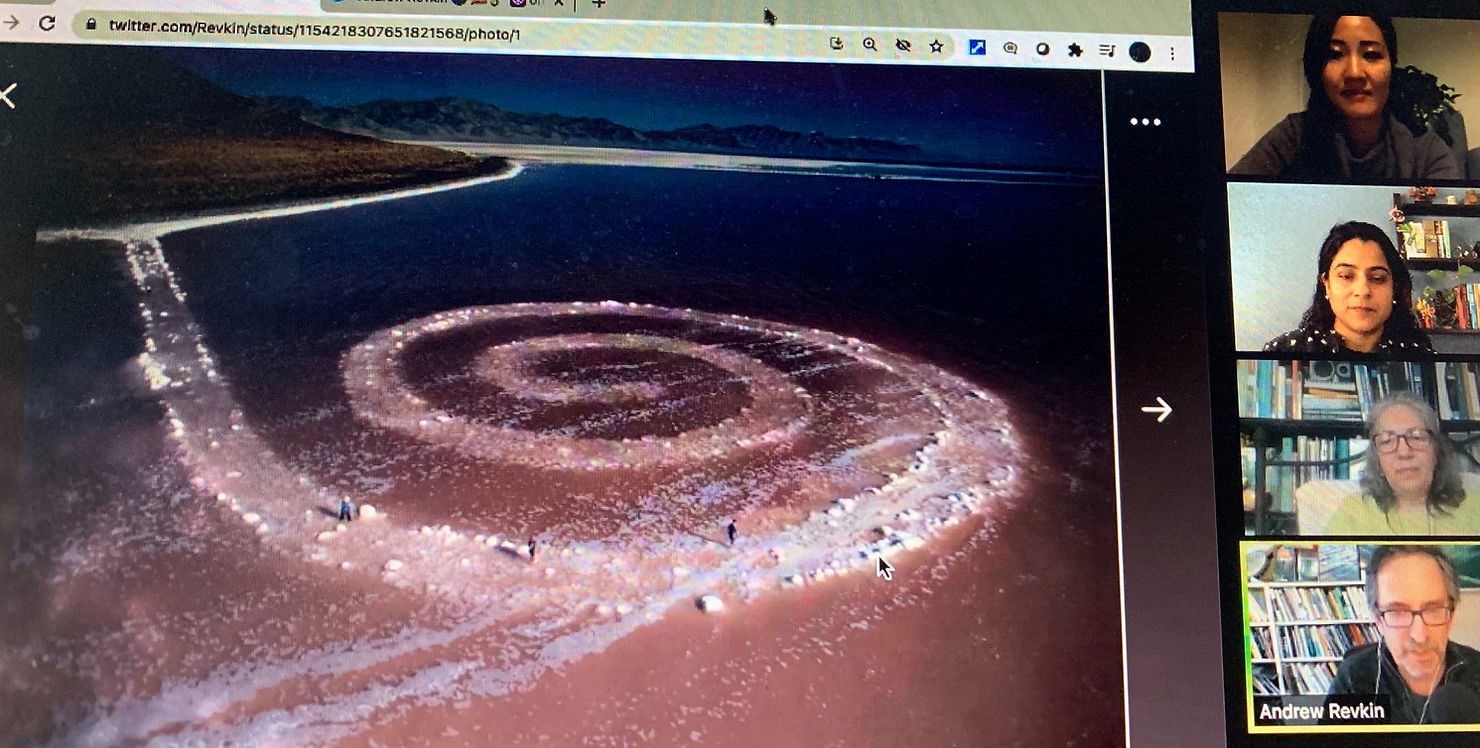
Our first panelist is definitely gifted in his area. Mr. Revkin is a top environmental journalist, and has reported from places such as the White House, the Amazon, and even the North Pole! He has reported for well-known magazines such as National Geographic, and because of his work, he won a high award for science journalism. He even has a film based off of his work, The Burning Season.

Mr. Revkin explained how the pandemic actually did a number of good things for the environment .Availability and ease of not having to travel resulted in less fuel being burnt and less carbon emissions in the air. Levels of pollutants have gone down thanks to the pandemic. It has shown us that we can adapt, make sacrifices and save the planet, all which have become far more reachable than we thought.

Our next panelist, Mr. Goes, is one of a kind. Before he became a mentor to undergraduates, graduates, and postdoctoral students, he studied in Goa, and universities in major cities, such as Japan and Bombay. He researches topics such as impacts from the climate in the oceans, and microplastics in marine ecosystems. He mentors students from his lab at Columbia University (where he works in the Earth institute), and sometimes even from the sea!

Mr. Goes believes that kids should be the driving force to help stop the climate crisis because they will be the ones inheriting the planet. When working with kids, he tries to let them know what’s at stake so that they are motivated to make a difference. In Goa, where he lived, there were many projects that were environmentally bad. The youth in Goa realized what was going on and how it would hurt the planet, and so they stepped in and stopped it from happening. This only shows how strong kids are, and how much change they can make.

Last, but definitely not least is Ms. Valerie J Amor. She is the co-founder for Growing Broward, which is an organization that supports local food systems. She is also the founder of Drawing Conclusions LLC, where they focus on sustainable design. On top of that, she is also the designer of SCALe, which is an award winning educational design charette. She believes that art is the best way for people to open up and talk about climate change. In fact, her art workshops have been so interesting that one of her students was so immersed that he stayed past dinner time just to work on his project!

Being such a qualified person has to have some hardships though. Mainly, the people she worked with (mostly children), were not qualified to join Summits and other official meetings. Ms. Amor told the moderators that letting kids not come was just dismissing someone by their looks. To empower the children, she says that what gets them to talk is making a strong partnership between herself and them. Climate change will affect kids the most, and it is important to include them in these important discussions.

Speaking of kids, the next event was all about students. Behold the NJ Student Climate Challenge, led by Dr. Andrea Rewes from Rider University, and Heather McCall, director of Sustainable Jersey for schools! The Climate Challenge’s purpose is to show kids what they can do to make a difference in the climate crisis. Due to COVID, geographically, it is restricted to a few districts. But from 2021-2022, Dr. Rewes and Ms. McCall hope to expand their challenge statewide! Middle school and high schools can enroll if they live in the Atlantic City Electrics service area. Think Cape May, Gloucester, and Burlington counties. Student session topics include Climate Justice, Renewable Energy Options, Energy Efficiency At Home, Knowing Your Food, Knowing your Environment, and tons more! For teachers, they provide professional development sessions with topics like Integrating Climate Across Classrooms and Climate Science Primer for Educators. The Climate Challenge has something for everyone!

Sometimes, kids feel like they can’t make a difference. The problem seems too big, and they seem too small. But there are lots of things you can do in your school to make it green. Things like finding your school’s carbon footprint, conducting a waste audit, and anti-idling enforcement have saved schools up to $400,000! You could also Green Your School! use an already-there event like a dance show and make the costume, and sets from reused materials. You could also theme the event with something to do with the climate crisis. What a unique way to bring attention to what matters most! In all, the NJ Student Climate Challenge is something that every school should have, so if yours is eligible, then sign up today.

Moving on to our third and final event, a presentation titled “Creation Subverts Destruction: Artivism in Climate Advocacy.” Our teen facilitators were Edie Fine and Virgile-Mihn Perrier. They are representatives of the Extinction Rebellion Youth NYC, a group of youth who use nonviolent actions to advocate for climate justice. They are an art based group, whether it is a dance routine or a trashion show (fashion creatively made from reused items). A few sentences before, you probably read the word artivism and wondered what it was. In a nutshell, artivism is a combination of activism and art, when the art aspect is used to make a difference. An example of artivism is making a dance routine based on social justice. Or making poetry about the climate crisis. Using your medium of art (music, painting, poetry) to make a change is just what the Extinction Rebellion Youth NYC is doing.

Why artivism, though? Art helps us get in touch with the present state of the world, and defies the stereotypes of learning from books and worksheets, and uses creative mediums instead. As always, art helps you express yourself, something that might not happen if you are reading from a textbook. Art helps us get in touch with the present state of the world

Goes back the stereotypes of learning from books, and uses creative mediums. Extinction Rebellion Youth welcomes everyone and every part of everyone. Art is a tactic that can accomplish making a change because it is a stirrer. For example, one of their artivism projects was to make clothes from reused materials, like plastic bags. They did this on a day in New York Fashion week, and they caused quite a commotion. Photographers thought that they were modeling designs for the real fashion week! Getting that kind of publicity felt so good to the models and designers, because everyone was taking them seriously. If you like being creative and making a change then go to https://www.xrebellion.nyc/ for more information on this inspiring group.

Today was a motivational day for many at the Summit, including me. We hope you join tomorrow’s session: Action Planning Day!


Categories
EDforSD

Day 3: Climate Education into Action

Dvita Bhattacharya, Millburn Middle School, NJ

Asha Swaroop, Millburn Middle School, NJ

In Day 3 of the Climate Summit, we explored education and how it relates to climate action. We got to hear from a group of inspiring educators and students who shared how they have made an impact in the fight against climate change. Their stories perfectly illustrate the dedication and passion we should all strive to replicate.

First, we had a discussion panel with three teachers to understand their perspective on education for climate change. Our first panelist was Shakira Provasoli, a science and hydroponics teacher at PS 333 in Manhattan. Ms. Provasoli spoke about the importance of hands-on learning and engagement. In order to truly learn and absorb information, students have to go beyond memorization and be able to apply their knowledge in the real world. Actually ‘doing’ science helps students visualize themselves as scientists. She highlighted the need to expose children to the sciences and the concept of sustainable development from an early age.

Our next panelist was Becky Higgins, a science educator and Johns Hopkins University Science Content Specialist from Connecticut. Ms. Higgins discussed her program “Speak with a Scientist”. The program focuses on having actual scientists come into classrooms to engage with students. This interaction helps the students feel in touch with science, bringing textbook concepts and ideas to life. Ms. Higgins also spoke about how she helps her students take initiative and stand for their beliefs. For example, when her students were concerned about fracking waste being dumped in their neighbourhoods, Ms. Higgins encouraged them to write letters to their mayor regarding the issue. Through her support and help, she shows her dedication to her students and to learning.

Next, we got to meet Cassie Xu, an Associate Director of Non-Degree Education & Outreach Programs at the Earth Institute at Columbia University. Ms. Xu told us about the importance of passion and standing for your opinion. She stressed how important it is to take initiative and ‘take the leap’ with your ideas. Through her teaching career, she has helped students make a difference in issues that they care about and continues to do so today.

Our last panelist was William Bertolotti, a high school teacher at Plainedge High School in New York. Like Ms. Xu, he spoke about the importance of passion and getting involved. His message to students today was to always have the spirit to fight and focus on how we can make the world a little bit better. We don’t have to make huge changes at the beginning – as he said, we can start by doing something simple. Emailing a teacher, finding a way to get engaged, for example. Taking baby steps will help us move onto bigger and bigger ones once the time comes. The common thread between all the panelists’ responses was the message that change is always possible. No matter how insignificant our contributions may feel, we can always make a difference in the outcome. And through their support and dedication to their students, all of our panelists have shown us how much of a difference education can make in the climate crisis.

Next, we spoke to Gabriela Mendosa, Sara Poon, and Elena Rubenstein, three high school girls. They are the creators of the Climate Education Resources Toolkit. The main idea behind the creation of this toolkit was to provide useful, vetted resources to help students and teachers become more aware of climate change. The toolkit is not finished yet, but they plan to publish it on a website by Earth Day 2021. Gabriela, Elena, and Sara’s contribution once again circles around the theme of how education can help us all fight climate change. Their determination to not only inform themselves but also inform others is inspiring and shows us all that we can make change no matter how young or old we are.

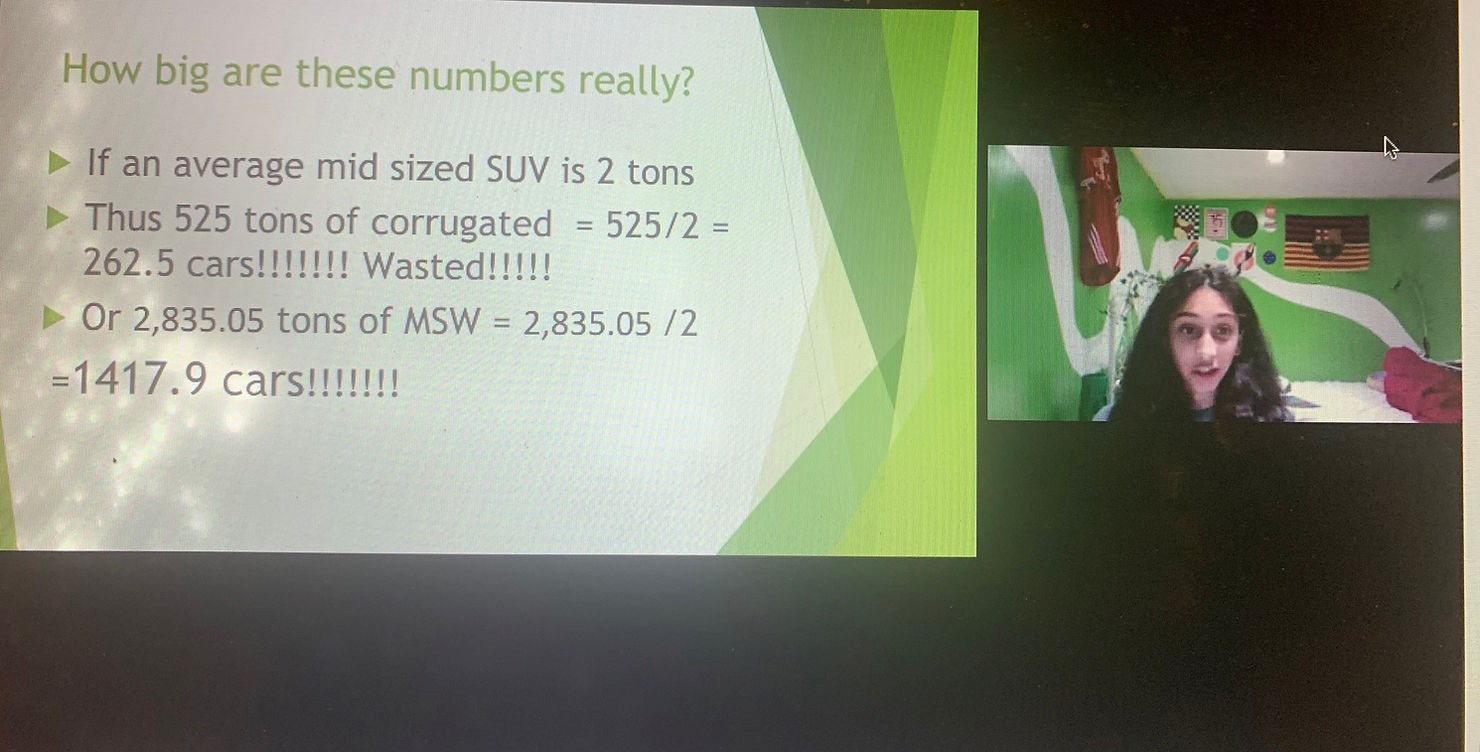
Our last event for the day was a discussion panel with a group of students who have done climate-change-based research. First, we spoke with Vidya Bindal, a seventh grader from Millburn Middle School, about her Yard Cardboard Collection Analysis. Through a series of carefully chosen statistics and figures, Vidya showed us how much waste we produce in Millburn as a town. Her comparisons helped put into perspective the excessiveness of our consumption. Vidya continued to propose a plan outlining which aspects of our waste we should work to cut down first, as well as how to approach doing so. Her work in this area is incredibly impressive, especially considering her youth.

Lastly, we heard from the Readington Middle School Research Team about their own research and analysis. The team was composed of Eddie Lou, Bronwyn Downey, Tatiana Hinka, Riya Gupta, Cristopher Serrao, Olivia Davis and Callum Suggitt, all current students or alumni of Readington Middle School. They shared some of the amazing projects they have worked on. First, they worked to solve the issue of food insecurity by investigating sustainable hyperlocal food production. Through their research, they came up with FIG – an indoor vertical garden. It uses every drop of water to the max, minimizing waste. The garden is fully automated and uses sensors to detect when the soil is too dry and needs to be watered. They are now working to make this system more regenerative and environment-friendly. Their work is truly impressive and shows how even middle and high school students can use science to solve real-world issues. They also found new ways to help virtual learning be more engaging during the coronavirus pandemic. The Readington Research also spoke about the importance of acting now and how we shouldn’t leave the issue of climate change to future generations. Through their own impressive research, they have shown that they are already taking matters into their own hands – and we should all aspire to follow in their footsteps.

All in all, today’s session was filled with amazing people and stories from across states. We got to hear students and teachers talk about their efforts to fight climate change both inside and outside of the classroom. As the Climate Summit continues, we’re sure to hear from even more exciting and inspiring individuals.


Categories
EDforSD

Day 2: Pushing for Climate Action Inside and Outside the Classroom

By Ashna Swaroop, Millburn Middle School, NJ

Dvita Bhattacharya, Millburn Middle School, NJ

Today’s session was all about Education for Sustainable Development, Curriculum Advocacy, Design and Implementation. Aalok Bhatt, a junior at Millburn High School in New Jersey led this session. Aalok is passionate about the environment, keeps up with current events, and hopes to make a difference to his community. The topic that was covered today was something that not many people think of on a day to day basis. Thankfully, we had the experts to help us understand the broad idea of Education for Sustainability.

Those experts, our panelists, consist of Ms. Jaimie Cloud, head of the Cloud Institute of Sustainable Education and Mr. Marc Rogoff, who was once a consultant to NASA and the National Wildlife Federation, and many other note-worthy organizations. Joining them was Mr. Michael Heinz, who works as the Science Coordinator for the NJ Department of Education. All of these remarkable people are working to include sustainability in the education system. Along the way, there have been problems and hardships that they had to overcome. And their journey isn’t over yet! Let’s see where they are now on the road to global education for sustainable development (ESD).

Ms. Cloud, who also works internationally in places such as Qatar, is working on developing benchmarks with school systems about green learning. Mr. Heinz has helped pave the path for New Jersey in becoming the first state to introduce sustainable education in school curriculum. Mr. Rogoff is working on establishing statewide climate change resilience. Finding an appropriate sustainable education curriculum is the challenge according to him. In addition, all three panelists made remarks about teachers not wanting to “add on” to the curriculum they already have. “Adding on” is not the right term for it. ESD needs to be integrated into the school’s existing curriculum. It should be included in other subjects, such as Math and Social Studies.

This problem of integrating ESD was also touched upon by Ms. Cloud. She referred to an example of how educators teach writing. Kids don’t learn how to make longer and longer sentences, she explained. They learn how to make their sentences with richer vocabulary and more meaning. That is how ESD should be assimilated. Making the existing curriculum richer, not longer. The teachers are already doing an astounding amount of work, and they don’t need more things to teach. ESD should benefit teachers, Mr. Rogoff said. After all, kids are the future. Teaching them about sustainability will help them understand their impact on the future.

Speaking about kids and the future, the panelists also had some great advice for youth who want to make an impact on the environment. Advice like that making a change can be hard to balance with other commitments, so it is important to not burn yourself out. Also, when you’re talking to someone with different views, avoid arguing, and instead find common ground that you can both agree on. This could be anything from the quality of food, to air pollution’s effects on people. Look at the things you eat, wear and use. See how you can improve that. Start small, think of the impact on small things. If it affects money and time, you’re going to have to think more about it. Make small steps, little changes. All it takes is a small effort to start the journey to making something great happen. Remember, it’s not only adults who can make a difference. The youth can too!

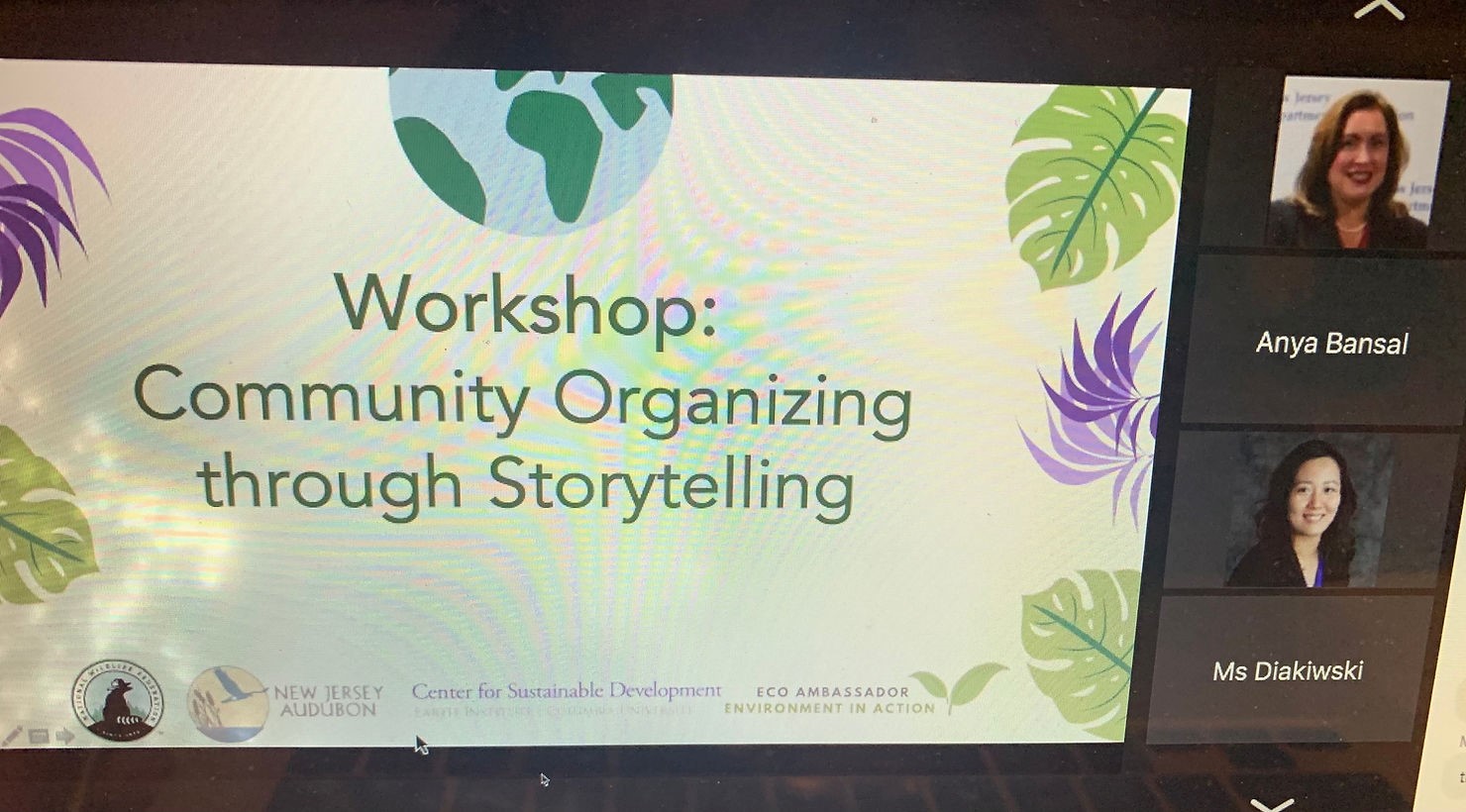
In our next session, we met 3 inspiring teenagers who prove that kids can make just as much of a positive impact on the climate as adults. Let’s see how they are making an impact on the world. Our teen panelists, speaking about Community Organizing Through Storytelling, were Amina Castronovo, Faiza Azam, and Jade Lozada. Amina is working on advocating for climate justice education, on a statewide and citywide level. Faiza is currently behind Ourclimate’s social media accounts. Through that forum, she is making sure people know how to volunteer and get involved with Ourclimate. She was inspired by living in Bangladesh, where the economy was being drastically affected by climate change. Jade was inspired to join organizations like TREEage, because of a poem contest she entered. The theme for the contest was climate change, and Jade wrote a poem about it. Afterwards, she got hooked into learning more about the environment.

Did you know that climate change affects other things besides the environment? In fact, agriculture is impacted greatly by climate change. For example, in India, millions of farmers are protesting, and even locally in California, the wildfires were brought by global warming. To stand up against this and make your voice heard, you could start at your very own school. Get a group of your peers who are interested in the club you want to create, and a teacher that is willing to help. Each public school in NYC is required to have a sustainability coordinator. Have a conversation with them and come up with a virtual event or a meeting that can take place to start off your movement in school. From there, you can talk to the city government, who can put pressure on the state government. Always hold people accountable so that they get the job done, says Amina. Remember that as youth, we know more than we think we do.

All three panelists mention how women are the main representatives in meetings about the climate crisis. There are a lot of females of color and people from the LGBTQ community. There are rarely any men, though. While it is empowering that they are mostly made up by women, they still need everyone to join. The feeling of empowerment was gone when the VSCO girl trend started up . Faiza recalls that she was really sad that it happened, and she was glad to have it end, because caring for the Earth should not be shameful. Instead it should be a passion that shouldn’t seem like work because you love it so much, like the panelists we met today. We hope they inspire you to go out and make a difference for the world. As Amina said, the sceptists say that we can’t change anything. Maybe we can’t, but we have to try. Believing in yourself is what is going to get us through.

Personally, these two days have been very inspiring, and I can’t wait to learn more in the coming workshops.


Categories
EDforSD

Day 1: NY/NJ Climate Education Youth Summit

Updated: Feb 10, 2021

By

Dvita Bhattacharya, Millburn Middle School, New Jersey

Ashna Swaroop, Millburn Middle School, New Jersey

Day 1 of the Climate Education Youth Summit went off with a bang! The theme for today was “Why Climate Action Through Education?”. To help answer this question, we got to hear from a group of amazing change makers and climate activists who are working to help solve the issue of climate change. Their inspiring stories and insightful messages highlighted the importance of this issue and the need for us all to do our part.

To start off the session, First Lady Tammy Murphy of New Jersey spoke about her efforts to solve climate change through education. She proposed introducing elements of climate change education into the school curriculum in 2019. After advocating for this change with the Standards Review Committee, climate change is now a part of the NJ curriculum, and will be going into effect in schools by September 2021. Mrs. Murphy’s work perfectly exemplifies the main point of today’s session: how education can help solve the climate crisis. Our world is slowly and fortunately shifting more towards clean energy(even though there’s still a long way to go). As Mrs. Murphy put it, teaching children about climate change helps prepare them to solve the great issues in our world and gives them the skills to thrive in a world that is more green. Her work proves to us all that education is one of the most important and impactful tools that we have.

Following up that speech, Professor Jeffrey Sachs joined us for a discussion panel facilitated by several young highschoolers and middle schoolers. He is a senior UN advisor, and has done amazing work to battle climate change. Professor Sachs spoke about the work that needs to be done in regards to this issue and addressed some important questions. He compared the fight against climate change to the famous “Moonshot” speech. In 1962, John F. Kennedy set a goal for the USA as a whole: landing a man on the moon. Today, our goal needs to be to decarbonize and turn to clean energy. Professor Sachs stressed that we, as a country, should aim to cut down on our fossil fuel consumption and move towards greener methods. He also answered an important question about climate change and the economy. In our efforts to reduce fossil fuel use, many jobs in that sector have already been lost. How can we balance our economy and our fight for a greener future? His answer was simple: while we may lose jobs on the way to a cleaner, healthier world, the long-term benefits of green energy far outweigh the losses. The new industries that will be sustained by this change will provide new jobs and help the economy flourish as a whole. We all stand to gain more happiness and welfare when our planet is safer and healthier. Lastly, Professor Sachs spoke about our need to grow closer and more trusting as a world. Countries need to work together to solve issues like lack of education and climate change. When we all focus on being global citizens, humanity benefits as a whole.

Next, we had another panel discussion with three inspiring people working to solve climate change. First, we heard from Professor Andre Correa d’Almeida from the School of International and Public Affairs. He spoke about his work creating the Development Practice Lab, which focuses on helping students use research to solve real problems. Professor d’Almeida teaches about sustainable development and works toward possible solutions. He emphasized the need to connect with the real world and get hand-on with reality. Like Professor Sachs, he also believed that global citizenship and international cooperation were the key to solving climate change and many other issues. Our next panelist was Priya Patel from the Environmental Commission in Millburn, NJ. She spoke about how she helped pass the No-Plastic ordinance in the town, limiting the amount of plastic stores used. She talked about how important it is to make your voice heard and just stand for your beliefs. Ms. Patel’s work is inspiring and shows how change is always possible. Lastly, we heard from Radley Faulknor from AmeriCorps VISTA, Public Works Department of Baltimore. He spoke about how redlined groups often face the worst effects of climate change, and how race factors into this issue. These groups face unsanitary living conditions because of their circumstances and homes. All three panelists showed us how faceted the issue of climate change is, and its importance in the world today.

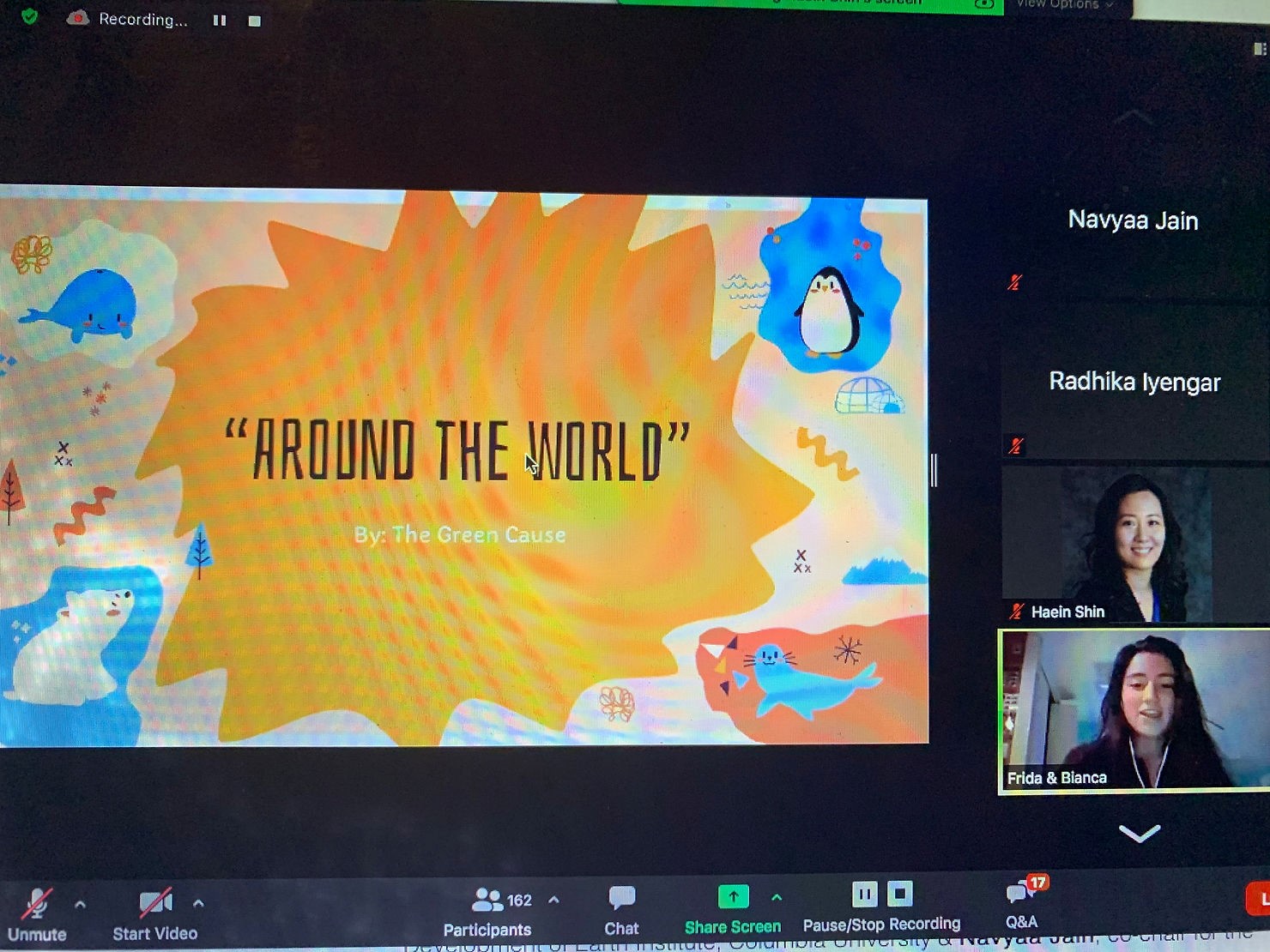
Finally, we heard from Frida Ruiz and Bianca Palomino, two high school girls who decided to take initiative and fight climate change. Frida and Bianca are the founders of the Green Cause, an organization that works to increase environmental education (visit their website here). They produce lesson plans and educational content to help raise awareness within students. The Green Cause’s work perfectly shows how education can make an impact in climate change. Their work is also inspiring to us as the youth – they prove that we don’t need to be adults or have college degrees in order to make a difference. We should all strive to follow their example and work towards fighting climate change, no matter how big or small our contributions are. It takes all of us to make a change in battle, and today’s panelists have shown us all that we can make change regardless of age or circumstance.

Register for the conference here-

Register here: tiny.cc/climatesummit

The New York – New Jersey Youth Climate Education Summit is organized by the Center for Sustainable Development at the Earth Institute Columbia University in partnership with New Jersey Audubon and the National Wildlife Federation in New York City. The main objective of this weeklong Summit is to increase awareness about local environmental issues in the two States and to encourage community activism thought citizen science and other approaches. The Summit will also make youth aware of career pathways in sustainability and environmental education. There will be networking sessions with current sustainability track Columbia University students. The Summit will also provide opportunities for Q and As with world-renowned economists such as Jeffrey Sachs, marine biologist Joaquim Goes, and New York Times reporter and Earth Institute journalist Andrew Revkin. In addition, there will be numerous workshops designed to help youth enhance environmental skills, and play an active role in their communities to address sustainability issues. The Summit is a great opportunity to open young minds to the possibilities in research and activism. The Summit’s Keynote Speaker is New Jersey’s First Lady, Ms. Tammy Murphy who is spearheading Climate Change Education as an integral topic in New Jersey’s K-12 school curriculum.

Join us to ask questions, debate and participate!

Find the recording of Day 1 Here: https://youtu.be/9yD717ApGeQ


Categories
EDforSD

NY & NJ Climate Education Youth Summit!

Updated: Feb 12, 2021

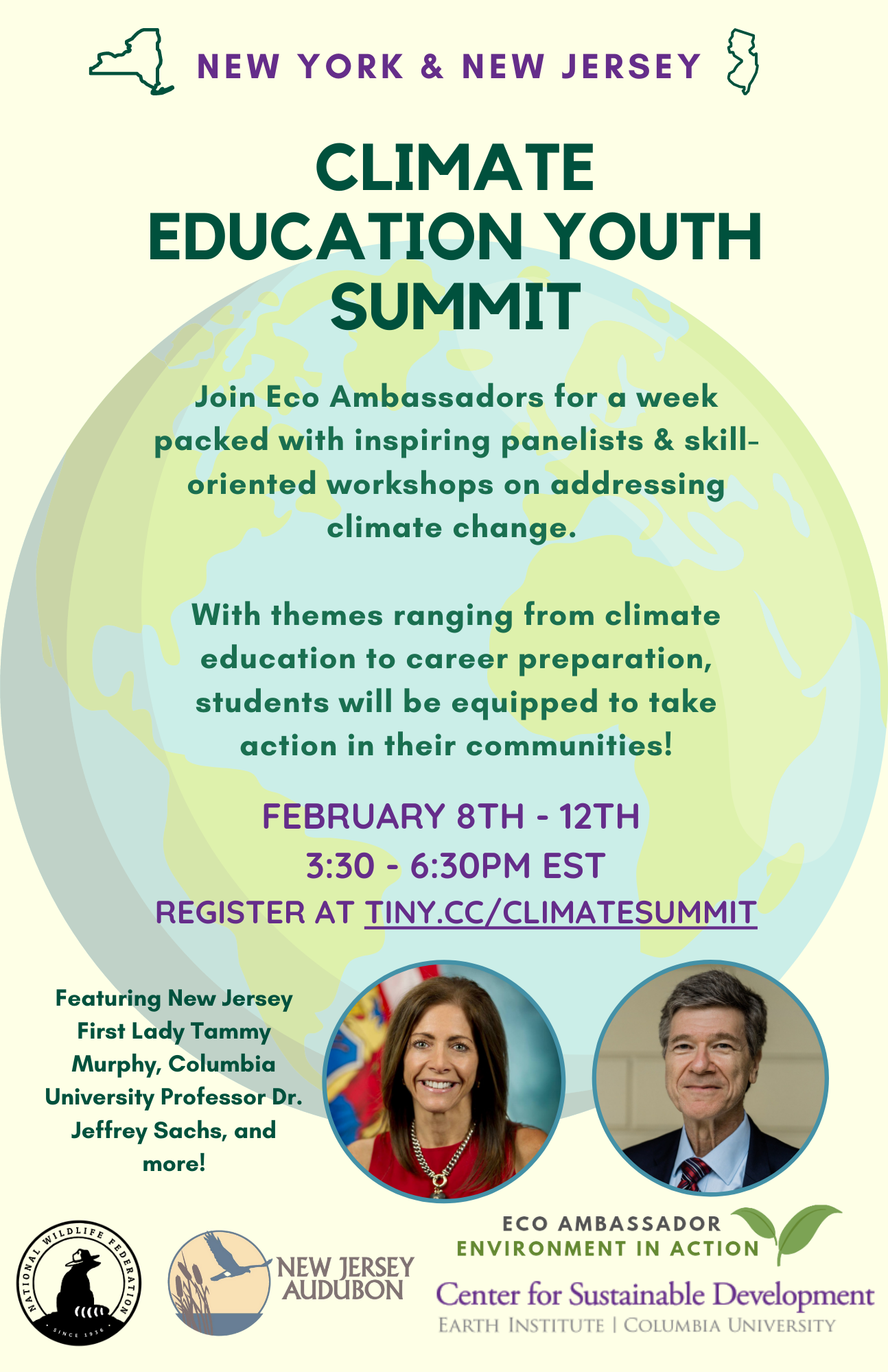
Columbia University’s Eco Ambassadors Program of the Center for Sustainable Development at the Earth Institute, in partnership with the National Wildlife Federation in New York City and New Jersey Audubon, is organizing a Climate Education Youth Summit for New York and New Jersey’s students.

This Summit is best for middle and high schoolers as well as college students, but all are welcome! Each day of the Summit will include a panel of inspiring speakers as well as hands-on, skills-oriented workshops addressing the climate crisis. Our conversations will be based on the following key questions, with a theme each day.

The themes include climate education, community organizing, action planning, communication & arts for climate, and tips from students on college and career preparation.

  • How can communities take up climate change related actions?
  • How are students addressing the issue of climate change education?
  • What role does education play in addressing climate change?
  • How can institutions help to raise awareness and change behaviors?

The goal of the Summit will be to spread awareness about the climate crisis and its links to education through fun and engaging discussions. It will also help students learn how to address sustainability issues in their communities.

Keep scrolling down for the Summit Agenda!
***Each day has a separate registration on Eventbrite***

You can select the registration date in the dropdown date menu “Select a Date” button.

We welcome you to register for all 5 days!

*** Zoom links will be sent to the email address you used on Eventbrite to register***

Please note: Attendees who register for one specific Summit day will automatically receive Zoom links for all five days, to provide convenient access to all the week’s events.

Dates: Monday, February 8th to Friday, February 12th 2021

Time: 3:30pm – 6:30pm

Register here: tiny.cc/climatesummit

The New York – New Jersey Youth Climate Education Summit is organized by the Center for Sustainable Development at the Earth Institute Columbia University in partnership with New Jersey Audubon and the National Wildlife Federation in New York City. The main objective of this weeklong Summit is to increase awareness about local environmental issues in the two States and to encourage community activism thought citizen science and other approaches. The Summit will also make youth aware of career pathways in sustainability and environmental education. There will be networking sessions with current sustainability track Columbia University students. The Summit will also provide opportunities for Q and As with world-renowned economists such as Jeffrey Sachs, marine biologist Joaquim Goes, and New York Times reporter and Earth Institute journalist Andrew Revkin. In addition, there will be numerous workshops designed to help youth enhance environmental skills, and play an active role in their communities to address sustainability issues. The Summit is a great opportunity to open young minds to the possibilities in research and activism. The Summit’s Keynote Speaker is New Jersey’s First Lady, Ms. Tammy Murphy who is spearheading Climate Change Education as an integral topic in New Jersey’s K-12 school curriculum.

Join us to ask questions, debate and participate!

SCHEDULE

Feb 8 Monday theme: Why Climate Action through Education?

Feb 9 Tuesday theme: Pushing for Climate Action Inside and Outside the Classroom

Feb 10 Wednesday theme: Education for Climate Action

Feb 11 Thursday theme: Communication & Arts for Climate Action

Feb 12 Friday theme: Action Planning Day

MONDAY FEB 8th:

WHY CLIMATE ACTION THROUGH EDUCATION?

WELCOME

3:30pm – 3:40pm

Welcome & Introduction by Radhika Iyengar, Director of Education, Center for Sustainable Development at Earth Institute, Columbia University Eco Ambassador Program & online course for teachers and educators.

3:40pm – 3:55pm

Keynote Speech by Tammy Murphy, First Lady of New Jersey

3:55pm – 4:15pm

Guest Speaker Professor Jeffrey Sachs, Columbia University and

Advocate to the UN Secretary General on SDGs with a student panel

  • Purva Bommireddy, Middlesex County Academy for Science, Mathematics, and Engineering Technologies.New Jersey
  • Navyaa Jain, Newark Academy in New Jersey
  • Ishaan Bharadwaj, Millburn Middle School, New Jersey

PANEL: COMING TOGETHER FOR EDUCATION IN SUSTAINABLE DEVELOPMENT

4:15pm – 5:00pm

  • André Corrêa d’Almeida, Adjunct Associate Professor of International and Public Affairs; Assistant Director of MPA in Development Practice at School of International & Public Affairs of Columbia University
  • Priya Patel, Chairperson, Environmental Commission, Millburn, New Jersey
  • Radley Faulknor, AmeriCorps Vista Volunteer, Public Works Department, Baltimore City.gov
  • Moderators: Haein Shin, Education Technical Adviser at the Center for Sustainable Development of Earth Institute, Columbia University & Navyaa Jain, co-chair for the NJ Student Sustainability Coalition

WORKSHOP: LIFE AROUND THE WORLD!

5:00pm – 6:00pm

  • Frida Ruiz & Bianca Palomino, NJ High School Students, founders of the Green Cause

“Life Around the World!

Biodiversity is a curious and adventurous topic for students to engage in as it involves life from around the world. Using educational yet appealing videos along with interactive elements, the goal of the workshop will be for the students to learn and appreciate different lifeforms. The lesson is partially made by members of our initiative, The Green Cause. We plan to integrate both the talent of our members and our experience in virtual sessions to edify the young minds attending the workshop.

TUESDAY FEB 9th:

PUSHING FOR CLIMATE ACTION INSIDE & OUTSIDE

THE CLASSROOM

PANEL: ESD CURRICULUM ADVOCACY, DESIGN & IMPLEMENTATION

3:30pm – 4:45pm

  • Marc Rogoff, Lead Environmental Education Specialist, NJ Environmental Protection
  • Jaimie Cloud, Founder & President, The Cloud Institute for Sustainability Education
  • Michael Heinz, Education Program Development Specialist 3, Office of Standards, New Jersey, Department of Education
  • Moderators: Tara Stafford Ocansey, Education Technology Specialist, Center for Sustainable Development, Earth Institute, Columbia University & Aalok Bhatt, Eco Ambassador & Millburn High School student

BREAK & NETWORKING

4:45pm – 5:00 pm

WORKSHOP: COMMUNITY ORGANIZING THROUGH STORYTELLING

5:00pm – 6:30pm

  • Amina Castronovo, Youth Steering Committee Member, The Climate and Resilience Education Task Force, National Wildlife Federation
  • Faiza Azam, Youth Leader, Our Climate!
  • Jade Lozada, Co-policy director at TREEage,
  • Moderator: Tara Stafford Ocansey, Education Technology Specialist, Center for Sustainable Development, Earth Institute, Columbia University

WEDNESDAY FEB 10th:

EDUCATION FOR CLIMATE ACTION

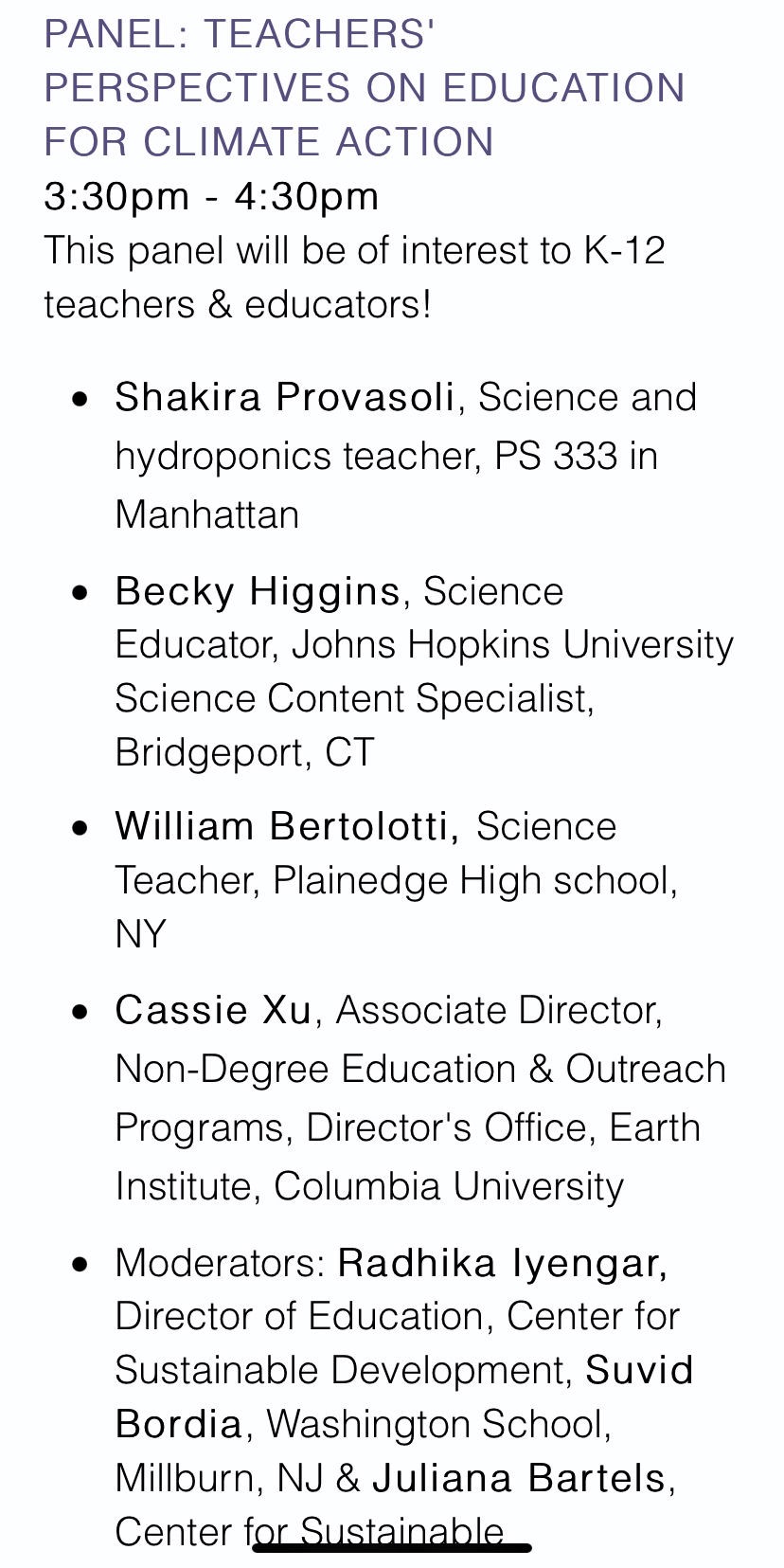
PANEL: TEACHERS’ PERSPECTIVES ON EDUCATION FOR CLIMATE ACTION

3:30pm – 4:30pm

This panel will be of interest to K-12 teachers & educators!

  • Shakira Provasoli, Science and hydroponics teacher, PS 333 in Manhattan
  • Becky Higgins, Science Educator, Johns Hopkins University Science Content Specialist, Bridgeport, CT
  • William Bertolotti, Science Teacher, Plainedge High school, NY
  • Cassie Xu, Associate Director, Non-Degree Education & Outreach Programs, Director’s Office, Earth Institute, Columbia University
  • Moderators: Radhika Iyengar, Director of Education, Center for Sustainable Development, Suvid Bordia, Washington School, Millburn, NJ & Juliana Bartels, Center for Sustainable Development

PRESENTATION: CLIMATE EDUCATION RESOURCES TOOLKIT

4:30pm – 5:00pm

Discussion & Presentation on the Climate Education Resources Toolkit developed by Climate and Resilience Education Task Force Youth Steering Committee members, National Wildlife Federation NYC-based high school students Gabriela Mendoza, Sara Poon, and Elena Rubenstein will share about their work on a climate education toolkit: a compilation of vetted resources- including curriculum sets, lesson plans, websites, organizations to get involved with, and information on environmental justice- curated by high school students, for students and teachers interested in engaging with the climate crisis. For teachers, the toolkit provides insight into how to facilitate climate discussions and classroom activities. For students, the toolkit will teach you how to get involved in student-led activism, reliable research, and interactive activities that lead to a deeper understanding of the climate crisis.

BREAK & NETWORKING

5:00pm – 5:30pm

PANEL: STUDENT RESEARCH

5:30pm – 6:30pm

Readington Middle School Team Research on:

Climate Change, COVID-19, and Creating Community; Growing Food and Resilience in the Garden State; An Investigation into Sustainable Hyperlocal Food Production to Increase Food Security for All — the Science and the Student Action it Sparked

  • Readington Middle School Students
  • Eddie Lou, Grade 9
  • Riya Gupta, Grade 8
  • Tatiana Hlinka, Grade 8
  • Bronwyn Downey, Grade 7
  • Olivia Davis, Grade 7
  • Callum Suggitt, Grade 6
  • Christopher Serrao, Grade 9
  • Millburn School
  • Vidya Bindal, Grade 7
  • Betsy Freeman, Readington Middle School Advisor, Enrichment Coordinator of Green Initiatives and Sustainability
  • Jonathan Hart, Readington Public Schools Superintendent,
  • Moderators: Radhika Iyengar, Director of Education, Center for Sustainable Development at the Earth Institute, Columbia University & Allison Mulch, Project Director for School Sustainability, NJ Audubon

THURSDAY FEB 11th:

COMMUNICATION & ARTS FOR CLIMATE ACTION

PANEL: COMMUNICATION & ARTS FOR CLIMATE EDUCATION

3:30pm – 4:30pm

  • Andrew Revkin, Founding Director of the Initiative on Communication and Sustainability at Columbia University’s Earth Institute
  • Joaquim Goes, Lamont Research Professor at Lamont Doherty Earth Observatory at Columbia University’s Earth Institute
  • Valerie J Amor, Founder, Drawing Conclusions
  • Moderators Haein Shin, Education Technical Adviser, Center for Sustainable Development at the Earth Institute, Columbia University & Kristina Ang, fashion student at Parsons School of Design

PRESENTATION: NEW JERSEY STUDENT CLIMATE CHALLENGE

4:30pm – 5:00pm

New Jersey Student Climate Challenge

Heather McCall, Program Director for Sustainable Jersey for Schools.

Andrea Drewes, Department of Graduate Education, Leadership, and Counseling, Rider University

The New Jersey Student Climate Challenge is a pilot program to highlight the role youth can play in addressing the climate crisis. This free program includes a virtual Climate Summit and a Climate Contest that will provide support and recognition to teams of middle and high school students in Atlantic City Electric’s (ACE) service area as they implement local projects to address the climate crisis. ACE’s service territory includes parts of Atlantic, Burlington, Camden, Cape May, Cumberland, Gloucester, Ocean, and Salem counties. Schools serving students in grade six and above are eligible to participate. View the list of eligible schools here. Based on the success of this pilot project, the project partners hope to implement the New Jersey Student Climate Challenge statewide in the 2021-2022 school year.

WORKSHOP: CREATION SUBVERTS DESTRUCTION: Artivism in Climate Advocacy

5:00pm – 6:00pm

Facilitated by Edie Fine and Virgile-Minh, Extinction Rebellion Youth NYC. Extinction Rebellion is a global nonviolent movement to compel the world’s governments to address the climate and ecological emergency. This workshop delves into the long accepted notion within advocacy that an artistic identity is essential to change. We will be exploring the ways in which visual, literary, and performance art can shake loose our inhibiting notions of the world and make us confront the issues we face. In the climate movement specifically, artivism is central in that it encourages a cultural shift where creating is valued instead of consuming, building instead of destroying. Artivism is about constructing a better, more artful world in place of an antiquated oppressive one.

FRIDAY FEB 12th: ACTION PLANNING DAY

Join Zoom Meeting

https://columbiauniversity.zoom.us/j/91333413908?pwd=YXJQNHFscDkxZ2NjcUV5UmNYeVU3Zz09

Meeting ID: 913 3341 3908

Passcode: 380184

Find your local number: https://columbiauniversity.zoom.us/u/adGtxpYDqn

What will we do with the information we learned at this summit? How can we collectively organize?”

PANEL: TIPS & ADVICE FOR SUSTAINABILITY STUDIES & COLLEGE PREP

3:30pm – 4:30pm

  • Charlotte Munson, Sustainability student, Columbia University
  • Jeremy Ashton Zimmerman, SDG Hub Member, Columbia University
  • Sofia Assab, SDG Hub Member, Columbia University
  • David Yang, SDG Hub Member, Columbia University
  • Isadora Muszkat, SDG Hub Member, Columbia University
  • Moderators: Purva Bommireddy, Team Leader, Bye Bye Plastic Bags New Jersey & Navyaa Jain, High School Co-Chair, NJ Student Sustainability Coalition

INTERVIEW: VOICES OF MUSICIANS

4:30pm – 5:00pm

Jeneda and Clayson Benally belong to the Navajo tribe. Along with their other siblings, they are a part of the family dance troupe, The Jones Benally Family, and the Navajo punk rock band, Blackfire, where they channelized their anger at the injustices faced by their people through their music. The brother-sister duo is also the force behind the award-winning punk rock group, Sihasin, which was formed in 2012. Their first album, ‘Never Surrender’ won critical acclaim and numerous awards. They also collaborated on the song “Sister Moon and Brother Sun” for the 2017 Grammy-nominated album, The Okee Dokee Brothers. Their songs like ‘Strong Together’, ‘Stand Up’ and ‘Shine’ are characterized by powerful lyrics and strong rhythmic beats. They are not only creative performers but also activists who have traveled the world sharing their culture and raising awareness on important issues such as human rights, environmental and animal rights, forced relocation, and the importance of sacred sites, native language, and traditions. Jeneda has been a Miss Flagstaff Indian DaysPowwow Princess and is also a national Native American Honor Roll Society member. Jeneda and Clayson also conduct workshops in schools to foster cultural acceptance and pride and bring hope to the next generation.

Interviewer: Aalok Bhatt


WORKSHOP: ACTION PLANNING

5:00pm – 6:30pm

Tying everything together through discussions & reflections from the week with

Moderators: Radhika Iyengar, Tara Stafford Ocansey & Haein Shin (Center for

Sustainable Development, Earth Institute, Columbia University – education team)

Post-Summit feedback survey
ORGANIZER PROFILES


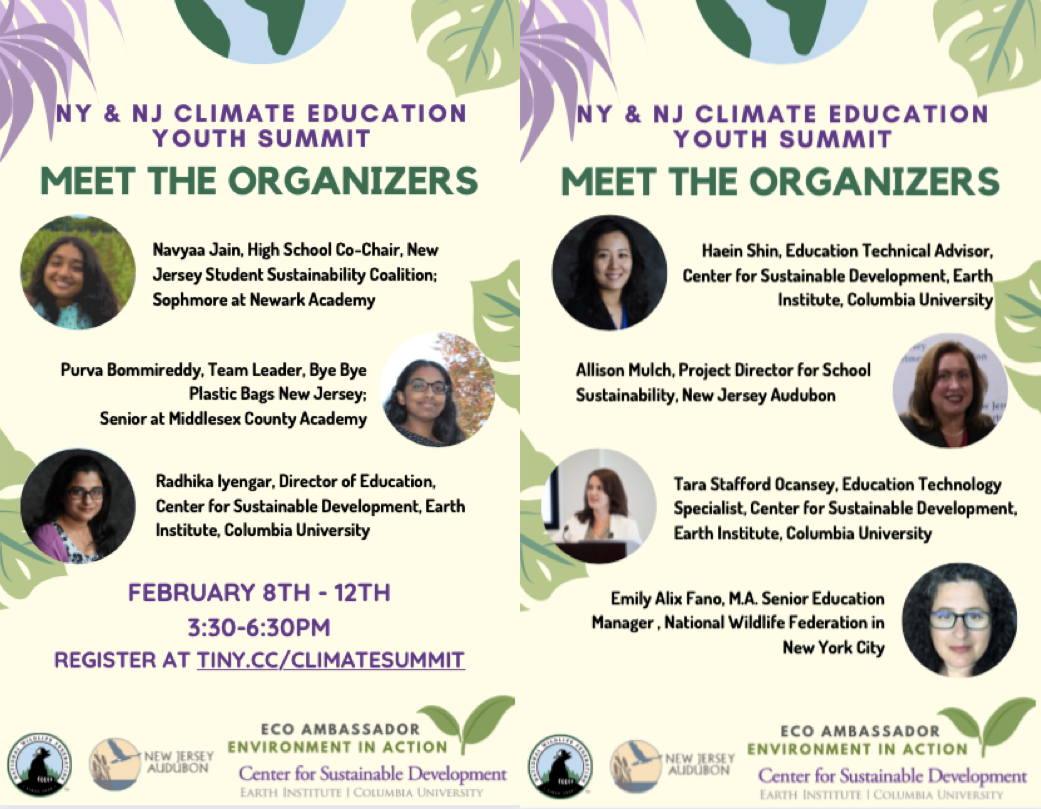
Radhika Iyengar, Director Education, Center for Sustainable Development, Earth Institute, Columbia University.

Radhika is a lifelong learner of sustainability. Her research focuses on Participatory Action Research and the power of the community to learn about local environmental issues and take charge. She uses citizen science approach as a tool for Education on Sustainable Development and Environmental Education. She is the Chair of the Environmental and Sustainability Education Special Interest Group at the Comparative International Education Society. Radhika would like to learn about factors that help to translate environmental knowledge into community action.


Emily Alix Fano, M.A. Senior Education Manager , National Wildlife Federation in New York City

Emily “Alix” Fano has a Master’s degree in Urban and Environmental Policy from Tufts University, is a published author, and a trained presenter with Al Gore’s Climate Reality Project. In April 2020 she was designated a NYC Climate Hero by the Human Impacts Institute as part of a campaign to celebrate New Yorkers working to create a healthier, more just and resilient City. In her role as Senior Education Manager for the National Wildlife Federation in New York City, Emily designs and manages a variety of urban environmental conservation, stewardship, and climate resiliency programs for K-12 youth. In addition to planning conferences, teacher trainings, and special events, she Co-Chairs the NYC Pollinator Working Group and convenes the Climate and Resilience Education Task Force.


Allison Mulch, Project Director for School Sustainability, NJ Audubon

Allison has worked directly with 450 NJ Schools supporting administration and teaching staff with implementation of Eco-Schools USA in New Jersey and management of the U.S. Department of Education Green Ribbon Schools program (ED-GRS) in a partnership with the NJ Department of Education. Allison oversees the state’s ED-GRS Nomination Committee composed of education, government and corporate leaders, is a Nominee for the New Jersey Commission for Environmental Education, and a co-contributing author for the Building Ecological Solutions to Coastal Hazards in a partnership with the NJ Department of Environmental Protection. Allison also served as Director of the NJ Sustainable Schools Consortium at the Educational Information and Resource Center.


Haein Shin, Education Technical Adviser, Center for Sustainable Development, Earth Institute, Columbia University

Haein designs, curates and creates content for education for sustainable development as a means to facilitate conversations and trainings for sustainability practices, including Eco Ambassador Program, an education initiative to bring communities, educators and learners together for environmental action as well as training programs for job readiness, digital literacy and life skills for international youth. She started her career as a community educator with the US Peace Corps to implement education, environment, gender and health programs for children, youth and adults. Over the course of the past ten years, she has worked on project and program implementation, management, qualitative and implementation research for Monitoring and Evaluation in Morocco, Saudi Arabia, Myanmar, India and 10 countries in Sub-Saharan Africa.


Tara Stafford Ocansey, Education Technology Specialist, Center for Sustainable Development, Earth Institute, Columbia University

Tara’s work focuses on supporting education and community stakeholders to influence their systems of education and governance to be more responsive to their needs, including through action research, teacher training and support, and development of teaching and learning content around social emotional learning, community organizing, entrepreneurship, and sustainability skills. Tara has developed eco-friendly vocational training programs for marginalized youth and adults in Ghana and Rwanda, and led action research projects aimed at influencing education decision-makers in India, Nigeria, Kenya, and Uganda. Prior to joining the Earth Institute, Tara worked as a community organizer with CALPIRG, helping to advance climate policy solutions including the nation’s first carbon cap and trade policy, and with Arts for LA, developing an advocacy training program for Los Angeles County school districts.


Purva Bommireddy, Team Leader, Bye Bye Plastic Bags New Jersey

Purva is a high school senior studying Civil and Mechanical Engineering at the Middlesex County Academy for Science, Mathematics, and Engineering Technologies. She advocates for youth action, civic engagement, and public education around single-use plastics with Bye Bye Plastic Bags NJ and the NJ Student Sustainability Coalition. At the intersection of sustainability and innovation, Purva aims to pursue Environmental Engineering to address emerging design challenges.


Navyaa Jain, High School Co-Chair, NJ Student Sustainability Coalition

Navyaa is a high school sophomore at Newark Academy in New Jersey. Navyaa is the high school co-chair for the NJ Student Sustainability Coalition where she advocates for sustainability and climate change youth action. Working as an intern for Rebecca Parson’s 2020 Congressional Campaign, she advocated for action through policy, and hopes to pursue Environmental Law and Policy to strengthen legal action against corporates.


Isabel Avina, Climate and Resilience Education Task Force Coordinator

Isabel Avina is a climate organizer and consultant based in Brooklyn, New York. Isabel’s work centers climate justice education for liberation, coalition building, queer ecology, and radicalizing our conception of education. Isabel received her Master’s in environmental ethics from New York University, where she also received a Bachelor’s in environmental science. She is currently the Coordinator of the Climate and Resilience Education Task Force, a NY-based coalition gathered around the advancement of climate education through policy, student empowerment, and teacher support. Prior to this position, Isabel worked for NYC’s Department of Environmental Protection (DEP), where she led the agency’s climate education efforts, and authored their NYC-based climate education module for teachers and students citywide.


Categories
EDforSD

FIVE SHORT Videos TO WATCH on youtube, as we stay socially distanced.

Updated: Jan 15, 2021

By Vidya T. Bindal

As virtual schooling keeps most of us staring at our screens, I fear that locked in our rooms, we might be beginning to feel that the four walls of our rooms define our world. The truth is that our world is literally the huge planet we live on, and even when we live a hectic un-changing routine of long screen-based hours of school and homeworks, the real world–our planet and everything in it is constantly changing. The Bad news is that most of the current changes are in a bad direction. The Good news is we might still be able to do something. So here is what I did over the short winter-break in December. I kept adding to my Santa list, reluctantly wrapped a few gifts for my sister, made a few greeting cards, drank a lot of hot chocolate, tossed my soccer ball a zillion times, but most significantly, I watched five short films that continue to echo for me almost daily. I want to share my take on these five very short youtube based films. They give us interesting insights into Climate Change, and did I mention, that these are short (so we could easily squeeze these into our busy schedules, and not wait for a weekend to watch them).


Video 1

Climate Change Short Film: The End of Humanity

https://www.youtube.com/watch?v=sEbAaPhshUM

Review for video 1

In this five minute documentary, I was fascinated to see all the possible things that will happen when climate change crescendos to its absolute worst! With factual evidence and an alarmingly long list of what will happen, I was shown captivating yet horrifying pictures and videos of our oceans that will soon turn acidic, of the many species that will soon die out, and of the drought that will hit and wipe out civilization as we know it. The pictures were extremely saddening and brought reality to my eyes, and also touched on the biggest reasons for climate change. I recommend this capsule show to see what looks very distant right now.

Video 2

How to Save Our Planet

https://www.youtube.com/watch?v=0Puv0Pss33M

Review for video 2

In a more positive view of climate change, this video touches on what the downfalls of climate change will be, while also talking about what we can do to prevent such a disastrous end to our planet. One of the main points in the short film is that we have to learn to live in harmony with the earth. We need to figure out how to live sustainably, and as the narrator puts it, “In the next few decades we need to do something unprecedented.” The fact that this is something humans have not been able to do is quite disappointing and really puts reality into perspective as well as the greed of humans. This short film brings a more effective view of climate change while still reminding us of the dangers ahead. I felt a bit optimistic upon seeing this video, because I felt I can start a positive change.

Video 3

His Epic Message Will Make You Want to Save the World

https://www.youtube.com/watch?v=B-nEYsyRlYo

Review for video 3

“How are we not a miracle? We are perfectly positioned to the sun so we don’t burn but not too distant so we don’t turn to ice. Goldilocks said it best, we are just right.” This is a quote from the video, the video that had me overcome with emotions within the span of 4 minutes. Sadness, happiness, anger, and shame. As the narrator put it, we have been alive on this earth for 3 seconds compared to how old the earth is. We have caused so much damage in those three seconds, whether it be our animals completely dying out, not having enough clean food to eat, or not having enough water to drink. Through rhymes and gripping imagery, I was shown how beautiful our earth is, and just how much we would lose. I would recommend this short film for people to watch because of the feeling of empowerment and the feeling of saying to yourself, “I can do this. I can save our earth.”

Video 4

This is us – Climate Change is Real

https://www.youtube.com/watch?v=ap24Ep9vjB0

Review for video 4

In this particular short film, I saw something that wasn’t seen in the other ones. The main element was about getting people to raise their voices. Together. As one. As stated in the video, when humans spoke out against something together, it worked. Unnervingly clear pictures and videos showed trees being chopped down and of the ice caps melting, but also showed empowering pictures of people coming together to protest what our current leaders are doing for climate change. As the short film said, “This is us.”

Video 5

Nature Is Speaking – Julia Roberts is Mother Nature

https://www.youtube.com/watch?v=WmVLcj-XKnM

Review for video 5

In a new take on environmental videos, we are shown Mother Nature’s point of view on climate change. This video may make you rethink what you think of mother earth because through this video, yes she is hurt, and she is bitter. She realizes that if she flourishes, we flourish, and if she falters, we falter. She has taken out species bigger than ours and kept species bigger than ours alive. Nature does not need us, it makes no difference to her if we are there or not. We neednature because we rely so heavily on it, and without it we cannot survive. “One way or the other your actions will determine your fate. Not mine. I am nature. I will go on. I am prepared to evolve.”

Haunting!


I hope you enjoy these videos and feel inspired!


Vidya T. Bindalis a 7th grader at the Millburn Middle School, NJ. She is an avid soccer player and an eco-ambassador and thus she can be found kicking a ball in the wooded backyard by herself all day long!


Categories
EDforSD

Education and Sustainability

By Aalok Bhatt


From the way we study, work and go about our lives to how we view the inequalities in our society in terms of race, gender and economics, change is everywhere. And yet, beyond the pandemic there is another crisis that threatens us all. It’s climate change.

Until I became a part of the Eco Ambassador program, brought to our local community by Dr. Iyengar and Ms. Shin, I thought I was doing my bit for the environment by carrying a reusable water bottle to school and saying no to the occasional single use plastic bag. It was at a talk I attended at the UN conference on climate change two years ago that the seriousness of the issue hit me. The amount of water it takes to produce a pound of steak is the same as the amount of water used by an average person to shower over a three year period! The amount of water it takes to produce a t-shirt is a staggering 2700 litres! Besides the environmental degradation caused by the meat and fashion industry, I also learned about the abuse of animal rights and workers’ rights, and the lack of ethics in the fashion and food industry.

I found these facts very interesting and I thought to myself, why is this not taught at school? We are taught about the effects of climate change, but we are not taught what to do, and why well enough. I believe that environmental studies should be an integral part of our curriculum just like math, history and science. Education is not just about preparing ourselves for a career but also about making us responsible citizens of the world. Unfortunately for my generation, it is a world threatened by rising temperatures, shrinking forests and oceans brimming with plastic. When I spoke about this in spring at a virtual conference organized by the Earth Institute, I shared the link with my Biology teacher, Mr. Rollo. He agreed with me and told me that going forward, he would consciously talk about how to combat climate change while teaching.

Our high school does offer a course in Environmental Studies, but it is an AP course that only high school seniors can take. Also, there is a tough entrance exam to qualify for this course, so not everyone can access it. Maybe schools should make important courses like these accessible to all students and start educating them from the elementary school itself.

In terms of education, we not only need to revise our textbooks and curriculum, but also need more programs at grassroots levels to encourage community participation and practical learning for students. I’ll give my own example. In my first year as an eco-ambassador, I designed a poster campaign highlighting the adverse effects of plastic in my town. As part of my initiative, I went to local businesses to understand their single use plastic consumption and educate them about this issue. I also met up with the recycling director of my town and realized that most of us were recycling the wrong way by adding contaminants. So, Wouldn’t it be nice if we all learned about this in our schools? Most of the local restaurants agreed to display my posters and ask their customers whether they wanted plastic cutlery and bags. The superintendent of our board of education allowed me to put up these posters in our schools. They were also put up in our town library. Not only that, my fellow eco ambassadors and I along with boy scouts members, members of the high school environment club and our town’s Green Team rallied for a ban and a tax on single use plastic bags at our town council meeting and we were successful in getting it approved.

Recently too, our school environment club organized a flyer competition to highlight the recycling rules of our township for all high school students. This encouraged many of us to research and present the rules in a creative manner and we ended up internalizing important points without trying too hard. This summer, I tried to spread awareness in my town on reducing meat consumption and the importance of eating local produce. Since we were all stuck at home because of COVID, I made a short film on Meatless Mondays and had fun researching the material and making it. It would be great if such initiatives and projects become a part of our mainstream curriculum and everyone benefits from the knowledge. Thankfully, we will soon have a government that believes in addressing the climate crisis and plans to allocate $2 trillion towards this cause.


Aalok Bhatt is a Millburn High School Student and is passionate about environmental issues.


Categories
EDforSD

The Biden-Harris agenda should commit to Education for Sustainability

By Julia Sommer

Member of Green Team for South Orange Maplewood School District (NJ) and sustainability educator


The formal education system experienced by millions of American youth is one in which academic subjects occupy separate silos that often lack relevance and timeliness to students’ lives. As Covid-era schooling is now conducted mostly through screens at home, parents are seeing firsthand how such a structure leads to lack of engagement, both cognitive and emotional. At the same time, Americans’ levels of civic learning are dangerously low as public schools for years have prioritized math and reading over civic literacy. We no longer expect or demand that our schools will focus on what it means to participate actively in our democracy. The Biden-Harris administration could address all these ills through a commitment to Education for Sustainability. Imagine if the government provided incentives for every school, K-12 and beyond, to hire a Sustainability Coordinator and every district to hire a Climate Literacy Officer? (A handful of schools already do the former and Portland, OR has actually done the latter.) Educators in such roles could support teachers and administrators in developing interdisciplinary projects that ensure all students learn about the causes and effects of climate change. An empowering education would teach students how to work within democratic institutions to enact local, state, and federal policies that ensure a healthier planet as well as economic stability in the coming years. Students’ education would become both relevant and timely if they studied local problems related to the environment and devised real-world solutions with the support of educators trained in Action Civics. Teaching this curriculum successfully is a serious shift from the system currently in place and will only happen with significant financial support for professional development. I can think of no initiative that could have a greater impact on Earth’s future than empowering youth to mitigate Global Warming’s effects through civic engagement.