Categories
EDforSD

Shoe Drive for the Planet

By Jasmine Ali

I was cleaning out my closet and I had decided to drop off my old clothes at GreenDrop in Springfield, where the clothes are then donated to thrift shops and organizations such as the Red Cross. I realized my family had some old shoes, and I did a google search to find organizations where I could donate them. I came across Soles 4 Souls, and their mission of turning shoes into opportunity was inspiring. I decided to start a shoe drive in our community to help keep shoes from going to our landfills and instead to a good cause.
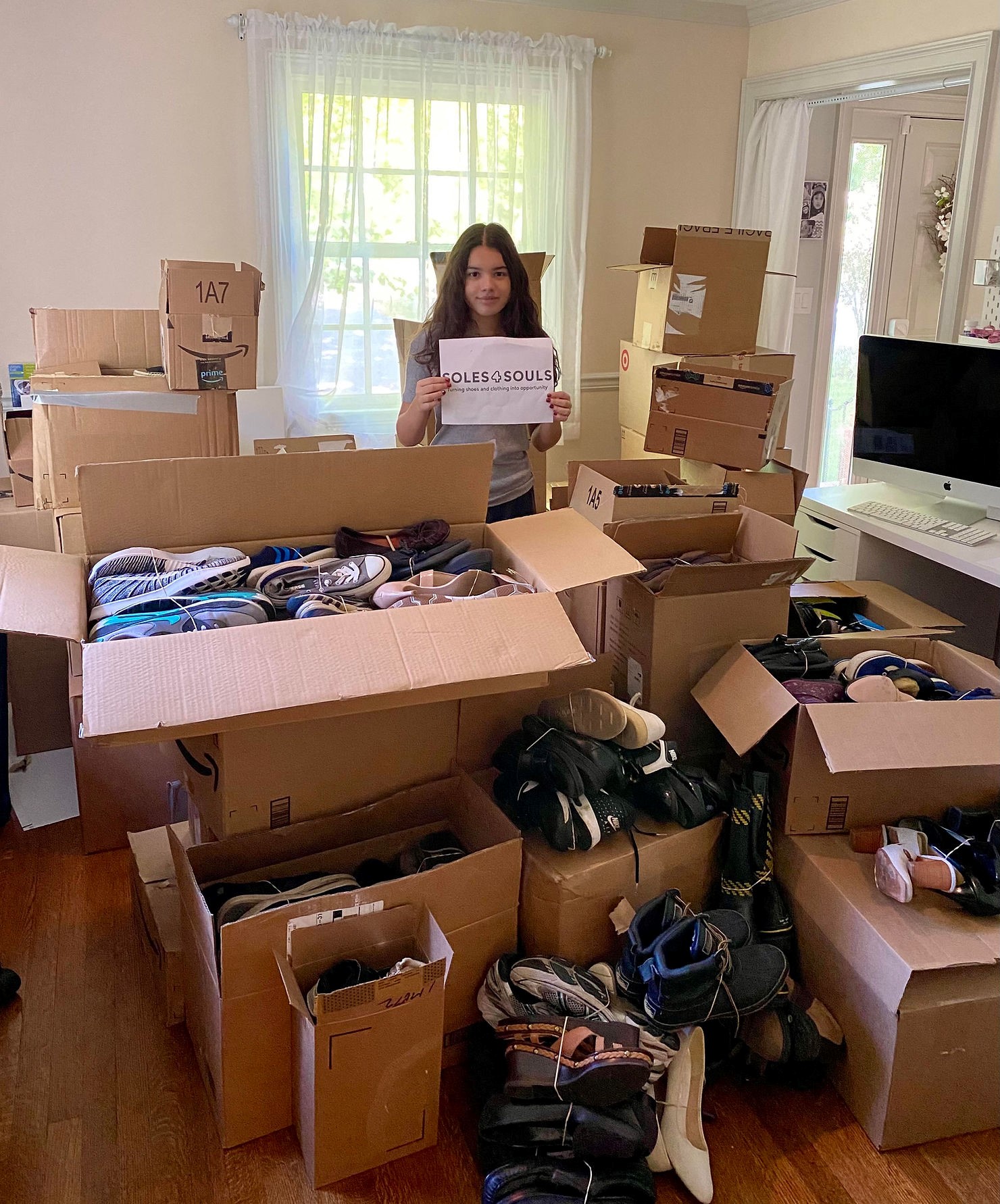
I set my goal to be 500 pairs of shoes, which seemed ambitious at the time, however, the community was so supportive and I ended up collecting about 700 pairs! According to the Soles4Souls website, 700 pairs of shoes saves 21,000 pounds of carbon from going into the atmosphere, and in the countries where the shoes are shipped to, they can provide food, shelter, and education for a family for 12 months. I am deeply thankful for those who supported my initiative by donating their shoes and giving me shipping boxes to send them to the Soles4Souls headquarters. Together, we made a powerful impact.


Volunteering is an essential part of my life. Conducting a shoe drive was just one part of what I do. I volunteer regularly with the South Mountain Conservancy where I help pick up litter and make new trails. I organized an environmental education summer camp for elementary school aged children in our community last summer. I’m the coordinator for Extinction Rebellion Youth NJ, an environmental movement that uses nonviolent civil disobedience to compel government action on the climate crisis. I also work with the Green Cause, a youth-led environmental education organization. I am also a part of other environmental groups such as Fridays for Future, NJ Student Sustainability Coalition, MHS Ocean Conservation Club, and Sunrise Millburn. My greatest passion is protecting our environment. I’m vegan for the environment, and I’ve just started an Instagram account called @veganmillburn where I highlight the vegan options in our town to help normalize and promote vegan food. I also like to paint and draw. I’m a huge plant lover, and I’m starting a butterfly garden in my yard this year to help save the butterflies and honeybees.

In college, I hope to major in Environmental Studies. I’m very interested in pursuing something that has to do with environmental policy or environmental education. I want to do everything I can to combat climate change and help conserve our oceans. Thank you to everyone who donated shoes for helping me get one step closer to achieving my goals.


Bio

Jasmine Ali is the coordinator of Extinction Rebellion Youth NJ and a member of many other environmental groups. She is a proud volunteer for the South Mountain Conservancy where she works to protect and preserve the local reservation. She also teaches children about the science and impacts of climate change through presentations and lab activities. She hopes to study Environmental Analysis in college, with an emphasis on Environmental Policy or Environmental Education.


Categories
EDforSD

What can U.S. Sustainability Curriculum Learn from the SDG Agenda?

Updated: May 12, 2021

An Analysis of the UN Sustainable Development Report and its context to the United States’ Sustainability Education Curriculum

In this day and age, the emphasis on sustainability education has never been greater. The 2020 Global Sustainable Development Report from the United Nations points out that SDG-4 and its goal to provide quality education for all people makes it a priority to share accessible knowledge and information. In order to fully understand the educational context of this report, it is reasonable to break up the topic into three main categories. One, being the direct awareness category where people focus on sustainability within the environment. The second topic is social equality for all people and specifically towards women in third-world countries. Finally, there is a priority in establishing economic stability for all people to sustain themselves. With these three distinct yet integrated categories, the overarching theme can be applied to spreading sustainability education all around the globe. Schools in the United States could implement new changes to curriculum that revolve more around addressing and utilizing this information to effectively educate the future generations.

In the topic of sustainability within the environment, many aspects of this category are already covered in segments of U.S. learning curriculums. However, more additions and information should be implemented to reinforce this idea. In specific textbooks and courses that mention the importance of sustainability in the ecosystem, they should be edited to go further in providing information on how these measures can be achieved within a certain community. By adding a more hand-on perspective within these textbooks as well as sharing the importance of environmental sustainability, school curriculums can maximize their potential of educating students and ensuring that future generations are well informed about how to maintain and improve the environment. In the document provided by the United Nations, it breaks down each goal into three components of learning. Likewise, school curriculums in textbooks should include these three components of: cognitive learning, socio-emotional learning, and behavioral learning. Currently many curriculums only focus on the scientific aspect of these goals, not mentioning how people should respond to it. By including these three components, students would be better educated and know how to deal with these issues hands-on.

In terms of social equality, awareness for women’s rights is clearly established to an extent throughout the United States. However, activism for these social rights should be spread to other developing countries in Africa to help empower women. Women in African countries, due to their social inequalities, are hindered from the ability to make sustainable decisions. With proper education, students in U.S. schools should learn about how to empower and support women in these afflicted areas. Adding educational units in schools to spread information on social behaviors, and current gender roles within developing countries also can play a monumental part in achieving equality around the world. Schools can specifically tie these learning standards into regular courses like world civilization, or modern world history.

Finally, in terms of the economic aspect of sustainability, curriculums should be modified based on the sustainability theme of how to ensure economic safety and well-being for teenagers and young adults. Courses surrounding personal finance and business should incorporate the important findings from the UN Sustainable Development Goals to establish that they have the ability to sustain themselves following graduation. Due to the connection between the economy and the environment, schools should prioritize a clear distinction between financial well-being and it’s practical uses within the environment. This connection would not only serve as real-life advice for students, but also would help sustainable measures be passed around all local communities.


By Matthias Choi

Matthias Choi is a junior at Northern Valley Old Tappan and has been an avid proponent for environmental sustainability in New Jersey. As the founder of e-Salvage, he hopes to continue to foster local engagement and ensure the health of the community. In the future, Choi would like to continue to contribute to sustainability education, and spread its values to the younger generation. His current projects are working with local schools and members from other states to create e-cycling drives to reduce electronic waste.