Categories
Eco Ambassadors

Thoughts on Sustainable Development

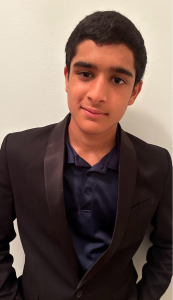
By Aaryan Jain

Sustainable development is the practice of reconciling the vast, consuming machine of human industry with nature, the very force it relies on. Sustainability’s urgency must be addressed by the youth, as they will inherit the Earth and cope with a multitude of ecological and climatic problems, including extreme heat, sea level rise, and diminishing ecosystems, as well as the stark inequalities caused by them. In order to face these challenges, we will need to redefine almost every aspect of our economy and society, an endeavor that will take decades of innovation and reform.

Sustainability starts at home – while individual actions aren’t enough to deal with climate change by themselves, being able to lead a more eco-friendly lifestyle shows that as a society, sustainable living isn’t impossible. So how could we change our habits? For one, we could aim to live a less materialistic life. The rampant consumerism
inflicts an unnecessary toll on the environment, as the manufacturing of goods and commodities, along with their disposal, contributes to the emission of greenhouse gasses and the pollution of air and water, as well as straining critical natural resources. An excellent example of this is fast fashion, the hyper-materialist trend of regularly purchasing and disposing clothes. The UN Environment Program estimates that the fast fashion industry is the second largest consumer of water, and accounts for 2-8 percent of global emissions. That’s right – fast fashion is only second to agriculture in terms of water consumption! Living a less material lifestyle is one of the most important actions that individuals can take to help the environment. Another action we can take is to learn more about our influences – as individuals and as a society – on the health of the climate and biosphere; reflecting on how our way of living interacts with the environment, positively and negatively, will allow us to make more conscious decisions. By moderating our consumption of resources, and becoming environmentally literate, we will be one step closer to an eco-conscious future.

The youth’s connection with biodiversity is diminishing, as technology demands an ever growing amount of time; data from UCL indicates that the average amount of time spent outdoors, by people under 30, has fallen by nearly 1.4 hours since 1980. As society turns its head away from nature and towards the screen, it will become unengaged with the well-being of its plants and animals, and indifferent to conservation efforts. This is dangerous, as our way of life is dependent on nature, and our protection of it will become increasingly more vital. Education can serve as an important link between communities and sustainability, via the guidance of students, who will bring the lessons they learn in school back to their families and friends. Sustainable education’s intent should be to spark interest and a positive association with environmentalism, not fear. It should aim to harness student’s appreciation of the natural world, and teach them of the connections between humans and ecology in a non-threatening way. By encouraging students to foster a closeness with nature, society will become more environmentally responsible.

In the fight for sustainability, concerned individuals, and particularly students, will face numerous barriers from their neighbors, statesmen, and business-owners. Our economic, political, and social systems are too rigid to accept a radical overhaul. In addition, sustainability has remained expensive and inconvenient. For example, it is generally much cheaper to buy industrially produced eggs and corn than their counterparts from local farms, regardless of their respective environmental footprints. Another example is renewable energy. Our current methods of capturing and distributing it drive up the cost, leaving it uncompetitive and undesirable. If we are serious about making sustainable living a reality, we must make environmentalism economically feasible. This is where public policy comes in: our governments have the power to incentivize people and organizations to live more sustainably, using methods like tax breaks or subsidies, as well as investing in the development of green technology. To fully implement sustainability, we need to pressure national and local governments to support green industries and make green living easier.

It is clear that as our world changes, adaptation will become increasingly more vital; reducing our individual and collective strains on nature and learning more about our importance in it will help to build a richer world, with less suffering and more abundance. If we want to ensure the continuous health of our species, we must recognize nature for its importance in our flourishing, and learn to co-exist with it.

Bio:
Aaryan Jain is a rising sophomore at Millburn High School. Deeply passionate about the health of our ecosystems and the protection of biodiversity, he is a volunteer in local efforts to reintroduce vital plant and insect species and an advocate for a minimalist, low-waste lifestyle.

Aaryan’s love for nature sprouted at a young age, when he developed an interest in gardening. A practice of reconnecting with nature, gardening allowed him to view the world through the eyes of the tomato plant, the insect, and the organisms that depend on them. As he continued to learn more about the encroachment of suburbia on wild habitats, he shifted from growing vegetables to native plants, such as the Swamp Milkweed, Purple Cornflower, or Switchgrass, in hopes of attracting monarch butterflies, native bee species, or birds like the American Robin or Rock Pigeon. A participant in the Eco-Ambassador program and a member of the Milburn Green Team, he has taken part in community projects to alleviate his town’s environmental impact, such as by helping to pass ordinances to reduce plastic waste, spreading awareness about the benefits of native plants, participating in plant drives to encourage the use of critical plant species in residential and community gardens, and by creating informational videos about his township’s food recycling program.

A member of a competitive rowing team, he has the opportunity to train in the Passaic River regularly. Rowing in the Passaic allowed him to understand the depth of humanity’s impact on nature – the visible littering of artificial debris and the discharging of oil on the river surface were appalling. In his downtime, he plays the violin and likes to read fantasy and nonfiction books.

In the future, Aaryan plans to work with science and technology to help make the world a healthier, happier place.
Categories
Eco Ambassadors EDforSD

The Magnificent Athabasca

by Sia Bagul
Grade 6
Millburn Middle School, NJ

“Sia, wake up!” my mom shouted. My eyes fluttered then closed again, I probably was just dreaming… BANG! BANG! BANG! “Huh?” My eyes opened as my mom rushed into my room in our Airbnb, “Sia we’re late!” “What?” I thought. Then it hit me, The Athabasca glacier, the bus! I checked the time , it was 9:00am. The bus was at 10:45, I jumped out of bed and ran into the bathroom, soon enough we were heading into our car.

Finally at 10:43 we arrived, we entered the service area and ran to our bus,”Here’s our bus ticket,” My dad gasped almost out of breath. I was so glad that we made it on time. The sunflowers dazzled in my imagination, quickly changing to gray storm clouds until, “Sorry sir, you have arrived too late, please find another bus,” “NOOOOO! I scream in my head, “This can’t be true!” But all over again we headed back into the service area, and to the ticket booth, and we headed out on time for another bus at 11:15. Not so bad, as we explored the service area gift shop. Finally, at 11:00 we headed towards the bus 15 minutes early, surely we were actually going on the bus.

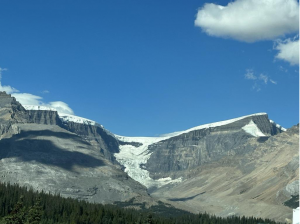
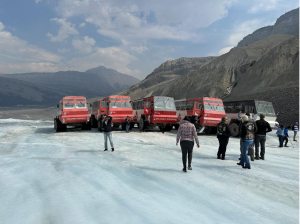
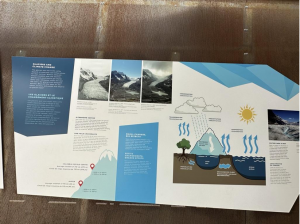
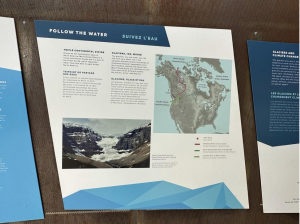
All over again we were back at the bus,” Tickets please,” We handed our tickets and we were on our way to the glacier. Time passed and we were finally stepping off of the bus. But we weren’t there yet, so we had to take one more bus to the glacier. This bus had big, thick tires – like the Antarctic expedition buses so it could climb the slippery ice. We headed into the bus and sat down. On the way we saw Sunwapta lake. It’s a gray lake where its water comes from the Athabasca glacier mixed with rocky flour. According to the bus driver, she said the Athabasca glacier supplies water to a few other lakes. Near the Athabasca glacier, on the way we saw one more glacier on the top of the mountain called ‘Snow Dome’, she said it divides the continent 3 ways and supplies water to the Arctic Ocean, Atlantic Ocean and the Pacific Ocean, fascinating..!!

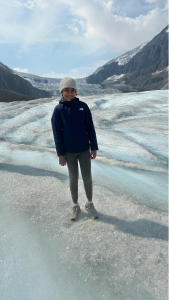
When the bus stopped, I slipped in my jacket and headed out. The glacier was slippery and it had many ice crystals where you could step without sliding around. I tried to pretend to ice skate but that didn’t go well. I ended up falling and getting my pants wet. My family and I noticed a little stream on the side, on the glacier. Someone said it is freshwater and that most of Canada’s water comes from these glaciers. I bent down and used my hand as a cup to drink the water. As I sipped it, it felt like I was drinking diamonds, it was cold, the water was clean and refreshing, it was amazing! Finally it was time to go. On the way back, the bus driver said, the water we drank could be 1000 years old, and we were lucky to sip it. We stepped off the bus and arrived back at the service area.

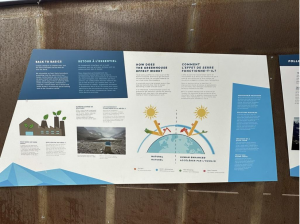
We walked around until we noticed a board. It explained what a threatening thing was happening to the glacier. It explained how it was melting fast, it lost most of its volume in the past 100 years due to climate change, and it also lost 16ft per year, soon enough this glacier would be gone, most of Canada would have to find a different source of water. This made me feel terrible, “This beautiful glacier is melting fast? ” On the side of the board it also explained how we can help, just by recycling, not littering, and turning off lights when you’re done using them could help. With enough people doing this we could help.

When we started to head back, I kept thinking about all the things written on the board. It made me mad to think that some people were just careless about earth, and how earth could eventually be ruined because of humankind, but that didn’t have to happen, if we all take some love and care for this earth, we could save it, we could save all the beautiful things that earth has, we can fix this.

Categories
Eco Ambassadors EDforSD

Action speaks louder than words in Millburn: In support of Native Plants

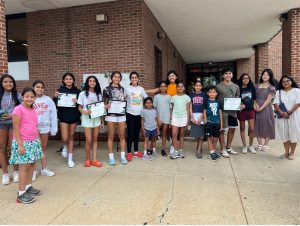
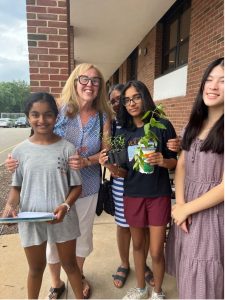
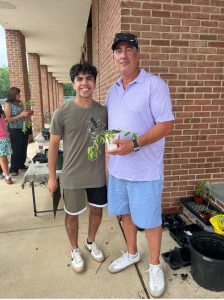
Millburn for Climate Action group is an informal group with climate community organizers. Along with Columbia University’s Eco Ambassador Program of Center for Sustainable Development of the Climate School, the group convened 50 young people who were ready to share their eco-activism through native plant swap. The native saplings were grown from seeds by local residents. The resident gardeners pooled their saplings together and with permission from the Millburn Library Director, Mr Michael Banick, were able to set up 500 native plants to share in Millburn.

The backdrop of this event was rather dismal with record breaking heat the past 4 days and temperature escalating to new heights. What should one do for the environment, when things look out of control. Well, the answer is do what you can. Millburn for Climate Action group and the Eco Ambassador group convened a plant swap where the young people led the stage. They helped to set-up, and share the plants with individuals going to the libraries and talk to each other about the importance of native plants. Young people managed a recruitment list to native plant, they shared tips on how to grow milkweeds with library goers and some were relentless that the passersby need to get the knowledge about native plants and get some for their own yards.

To support them were Jackie Benjamin Lieberberg, former Township Committee mayor, who encouraged the young people to be pro-environment. Republican candidate Ben Stoller also shared his concern that environment needs to be the focus at the town’s leadership level. Rene Paparian, a long time environmentalist made everyone aware of native plant resolution that is process by the Environmental Commission. Members of the Environmental Commission, Odarka Stockert was generous to share her native plant collection. One of the key points that the Resolution focusses on is to have all government buildings only include native plants and have more community spaces that include native plants. With the community leaders supporting native plants and young voices, Millburn is on a steady path to environmental sustainability.

What steps are needed in Millburn? Young voices discussed that household need to convert their yards to eco-friendly havens. Plant more natives can result in supporting the specialized bees, monarchs and many other insects. We discussed how not to be afraid of insects and how they support the eco-system. Something that Doug Tallamy has researched and proven that we need to turn our yards into bio-diversity clusters. Our yards can be so much more than the boring green grass. We discussed how milkweeds support the monarch population passing Millburn and how our yards needs can help the monarch population. Easy small steps to reduce grass and support native plants. We also discussed how “weeds” is a mis-name and that we need to popularize milkweeds, black eyed susans and other natives. Second, we discussed at the township level, we need more land patches with native plants. This will involve presenting our case at the Township meetings, meeting with the DPW which is involved with planting in the town. Many more steps to be taken. But the Eco Ambassadors are ready.

Categories
Eco Ambassadors

2022 Announcements & Newsletters

January/February 2022
NJ Climate Change Education Summit & More!
https://shoutout.wix.com/so/f4Nur8fUu?languageTag=en

March 2022
Youth Symposium, Fireside Chats & More!
https://shoutout.wix.com/so/c8Nz6cLm4?languageTag=en

April 2022
Celebrate Earth Day!
https://shoutout.wix.com/so/e8O0YkoMB?languageTag=en

June 2022
Summer Eco Ambassadors are Back!
https://shoutout.wix.com/so/deO6CO39s?languageTag=en

Looking ahead to Fall 2022
https://shoutout.wix.com/so/37OAn6v02?languageTag=en

ICSD 2022 Program Available
https://shoutout.wix.com/so/83OAnHNxy?languageTag=en

Opportunities for Eco Ambassadors
https://shoutout.wix.com/so/b6OBRgiia?languageTag=en

October 2022
https://shoutout.wix.com/so/54OEZQR_Q?languageTag=en

Categories
Eco Ambassadors

2021 Announcements & Newsletters

January 2021
https://shoutout.wix.com/so/a3NSRXSR7?languageTag=en

February 2021
https://shoutout.wix.com/so/86NTknZ6V?languageTag=en

Eco Ambassador Summer 2021 Program Launch
https://shoutout.wix.com/so/3eNb7C5u4?languageTag=en
https://shoutout.wix.com/so/4cNb7xHYl?languageTag=en

June Workshop: Discovering Existing SDG14 Resources
https://shoutout.wix.com/so/82Nc5BKgu?languageTag=en
https://shoutout.wix.com/so/8aNdD3sYV?languageTag=en

Eco Ambassador Summer 2021 Program Update
https://shoutout.wix.com/so/09NddN_kg?languageTag=en

Eco Ambassadors: Submit your Summer Topic!
https://shoutout.wix.com/so/d0NeQSmIF?languageTag=en

July Workshop
https://shoutout.wix.com/so/e9Ng1Hf4i?languageTag=en
https://shoutout.wix.com/so/92NgWPSJx?languageTag=en

ArcGIS Office Hours
https://shoutout.wix.com/so/cbNh9uqBZ?languageTag=en

August Eco Ambassador StoryMap Draft Sharing Session
https://shoutout.wix.com/so/9eNihhybY?languageTag=en

September Pre launch Event
https://shoutout.wix.com/so/47Nlgs-q9?languageTag=en

October Events & Opportunities for Eco Ambassadors
https://shoutout.wix.com/so/3eNns1a3l?languageTag=en

COP26 & Book launch events
https://shoutout.wix.com/so/89Nq1ERgC?languageTag=en

Eco Ambassador Storytelling Finalists!
https://shoutout.wix.com/so/d5Nqpefyc?languageTag=en

Categories
Eco Ambassadors

2020 Announcements & Newsletters

Happy 2020
https://shoutout.wix.com/so/7dM_lVZua

February 2020
https://shoutout.wix.com/so/15N105raW

March 2020
https://shoutout.wix.com/so/89N3M1Ym7

June 2020
https://shoutout.wix.com/so/73NA0SJ6F

August 2020
https://shoutout.wix.com/so/b8NFkegrS

September 2020
https://shoutout.wix.com/so/a4NHFzG-v

September Event Reminder 2019
https://shoutout.wix.com/so/74NINgJf8

November 2020
https://shoutout.wix.com/so/81NMpJkVY

December 2020
https://shoutout.wix.com/so/98NOWAIo8

Categories
Eco Ambassadors

Activity: How much energy are you using at home?

With SDG Hub – Columbia University facilitators, the Eco Ambassador Program was able to learn more about renewable energy and the importance of being aware of energy consumption. Energy use in the world has direct relation to carbon dioxide emissions linked to global warming and climate change.

Check out the energy audit activity and watch the video (link coming soon) on the energy session!

SDG Hub Energy Audit