By Eshaan Jain
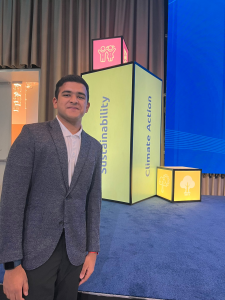
Hello Everyone! My name is Eshaan Jain. I am an 11th grader at the Pingry School in New Jersey, USA. Firstly I want to thank the RewirEd Summit, the Center for Sustainable Development, and particularly Dr. Radhika Iyenagar for the opportunity to participate in this panel. I would also like to thank all the authors of the eco-innovations report for providing a comprehensive roadmap for policymakers to promote youth engagement and innovations. Drawing from my own personal experiences as a youth volunteer focused on various environmental initiatives, I would like to note key recommendations from this report that I found to be the most compelling.
First and foremost, I couldn’t agree more with the recommendation that policymakers should enhance education about sustainability by integrating topics such as global citizenship and SDGs as mandatory within school curricula. If concepts like sustainability and climate change are not taught to students around the world as part of their core curricula right from an early age, then we are at risk of raising future generations who will continue to believe in the false paradigm of infinite economic growth achieved by endless production and consumption of material things as the only measure of success.
In my own case, a 5th grade classroom activity was a key learning moment. In this activity, a School Green Team Facilitator divided our classroom into two groups and gave a pack of chips to one group and asked them to eat it while the other group longingly looked on. Then the Facilitator asked the first group to throw their empty chip packets on the desks of the other group. So one group got to eat chips and the other had to deal with the waste! We further learned in that classroom session that this scenario played out in reality in our town of Millburn, one of the wealthiest in the state. Millburn has a very large waste footprint but our waste gets burnt in an incinerator located in the underprivileged town of Newark. For a group of 5th graders, this simple classroom activity was a very powerful illustration of the concept of environmental justice as well as an eye-opener about the problem of waste management.
My first introduction to the issue of plastic pollution also happened in 5th grade while participating in an Earth Day Poster competition. I learned that if we stayed on our current path of unchecked plastic production, by 2050 there will be more plastic in the oceans than fish. When I heard that an ordinance to ban single-use plastics in our township was being debated, I knew I wanted to help, but honestly had no idea where to start. However, encouraged by my first mentor in the environmental space, my Mom, I, along with my brother, set up a table at our local library for 3 days during our winter break. We brought several educational materials with us including a monster-like figure created out of plastic bags and asked the local community passing by to take a pledge to give up single-use plastics in their homes as well as support the plastic ban ordinance in our township. Millburn did end up passing the ordinance.
Since these early exposures, concepts of sustainability, equity, and justice have become important lenses through which I see the world. These early experiences also taught me that education is the first step to solving any societal problem, and lastly, as young as I was, I had the power to make a change and inspire others. I have since then worked on several community projects as an Eco Ambassador. First I have become intimately involved with supporting ecosystems through promoting Native Plants in our local community – SDG 13(Climate Action), SDG 15(Life on Land). As part of this effort, this summer I worked on drafting a Native Plant Ordinance for our township’s Environmental Commission for adoption. I have also participated in several local native plant sales and swaps as well as volunteered in native plantation efforts in community gardens.
More recently, with a firm belief in the importance of engaging with policymakers and government, I along with four other students in my town hosted a discussion with the candidates running for the Township Committee elections this Fall. Our discussions focused on understanding the candidate’s commitment and focus on driving sustainability and climate resiliency-related policy changes in our town. Now that elections are over, we intend to work with the elected candidates to implement policies like banning gas-powered blowers or expanding food scrap recycling in our town.
Furthermore, determined to spread awareness at a larger scale about SDG 14 (Life below water), last year I co-founded a student organization, AllForOceans, with a friend to engage students by connecting their love for marine life and aquatic sports with a platform to become stewards of our oceans. We have now expanded to 15 high schools in 3 countries. Looking ahead, we hope to create a global community of young ocean enthusiasts who will all work towards achieving five out of ten targets set by SDG 14: Reduce marine pollution; protect and restore ecosystems; reduce ocean acidification; sustainable fishing; and conserve coastal and marine areas.
As I look back on all the initiatives I have worked on since 5th grade, I realize how important mentorship and access to resources have been to enable me. Honestly, I doubt I would ever be as deeply involved in environmental issues as I am now, much less get to speak here at the RewirEd Summit if I was not guided by mentors like my Mom or Dr. Radhika Iyengar along the way. I was fortunate to have great mentors who filled the gap in sustainability education at school. However, for most other students the issue is glanced over in school and probably not talked about at home. No surprise that one of the key findings of this report is that Youth engagement in SDG innovation is an untapped opportunity across North America, and frankly all across the globe.
Therefore, I wholeheartedly agree with the recommendation that Policymakers should promote mentorship initiatives that connect young innovators with experienced advisors and professionals as well as provide access to innovation hubs, incubators, and accelerators to young people. To this end, I, and a few other students, are working with the Ban-Ki Moon Foundation and the Center for Sustainable Development to create a toolkit of resources and training to teach other students how to become global citizens, and what that really entails. I hope this toolkit, which will be released sometime late next spring, will help students around the world start their own innovations in the SDG space.
In closing, I would like to quote one of my favorite presidents, Franklin D. Roosevelt, who once said, “We cannot always build the future for our youth, but we can build our youth for the future.” This quote couldn’t be more apt today given the existential crisis my generation is facing with climate change. I hope that the adults negotiating our future at this conference realize that while they have not fulfilled their obligation of being good stewards of our planet, at the very least they owe it to our generation to equip us with the knowledge and tools to deal with the challenges staring us in the face.