

Statement of Support for Governor Cuomo’s Announcement to Bring Back State Funded College Courses to New York State Prisons

The Justice Initiative at Columbia University along with a group of university and prison-based educators working within New York State released a statement today to express our support for Governor Cuomo’s recent announcement to bring back state funded college courses.  Please click the link for a downloadable copy of the Statement of Support for Governor Cuomo’s Announcement to Bring Back State Funded College Courses to New York State Prisons.

Statement of Support for Governor Cuomo’s Announcement to Bring Back State Funded College Courses to New York State Prisons

February 26th, 2014

We are university educators and prison-based educators working within New York State writing to express our support for Governor Cuomo’s decision to restore state funding for college programs in prison. For decades, researchers have demonstrated the positive impact of college in prison on women and men in prison, the prison environment, the children of persons in prison, recidivism rates, employment upon reentry, public safety, and the tax burden of mass incarceration. College in prison saves lives, builds families, cultivates non-violence, and humanizes our society.

In 1994, after President Clinton withdrew Pell grants from people in prison, college in prison programs shut down across the country. At Bedford Hills Correctional Facility, women in the prison brought together a coalition of college presidents, professors, correctional administrators, and community members to work with the women in prison to create College Bound, a consortium of colleges committed to restoring college in prison. Once college was reestablished, a systematic evaluation was conducted by a team of women in the prison and university researchers, in collaboration with the New York State Department of Corrections. The study found that with college, women’s recidivism rates dropped dramatically to 7.7% from 29.9% (for those without college) over 36 months.

This finding was published in Changing Minds (2001) which also documented other profound impacts of college in prison, specifically on discipline and peace in the prison, women’s commitment to “giving back” and “paying taxes,” educational outcomes of women’s children, and ultimately the savings of tax dollars that did not have to be used for prisons. This is just one example of the more than 20 years of research, with virtually every study demonstrating the benefits of college in prison. It is a rare achievement for a social intervention to show such consistent evidence.

Today, two decades since Pell grants were withdrawn, we applaud Governor Cuomo for his commitment to restore tax dollars for college in prison. Both conservatives and progressives agree that college in prison is critical if we seek to build a society based on non-violence, dignity, second chances and our collective well-being. As Janice Greishaber, Executive Director of the Jenna Foundation for Non-Violence and the designer of Jenna’s Law states,, “Educating the incarcerated is not an exercise in futility, nor is it a gift to the undeserving. It is a practical and necessary safeguard to insure that those who have found themselves without the proper resources to succeed have these needs met before they are released. It is a gift to ourselves and to our children, a gift of both compassion and peace of mind. We are not turning the other cheek to those who have hurt us. We are taking their hands and filling them with learning so that they can’t strike us again.”

College in prison is a necessary investment in our collective future. We look forward to a time when public funding makes college available for all eligible incarcerated persons. It is the most cost effective strategy for reducing recidivism, strengthening families and communities, and increasing public safety.

Michelle Fine, María Elena Torre, Andrew Cory Greene & Alexis Halkovic of the Public Science Project, The Graduate Center of the City University of New York
Cheryl Wilkins, Samuel Roberts & Cameron Rasmussen of the Justice Initiative at Columbia University
Eddie Ellis of the Center for Nu Leadership on Urban Solutions
Vivian Nixon of College and Community Fellowship
Susan Sturm of the Center for Institutional and Social Change
Suzanne Kessler, Dean, School of Liberal Arts and Sciences Purchase College, SUNY
Eve Tuck, Assistant Professor of Educational Studies, SUNY New Paltz
Sigmund Shen, Associate Professor of English, LaGuardia Community College
Regina Peruggi, former president Marymount Manhattan College, Kingsborough Community College Michael Wilson, Assistant Professor of Education, Teachers College
Yolanda Sealey Ruiz, Assistant Professor of English Education, Teachers College
Ernest Morrell of the Institute for Urban and Minority Education, Teachers College
Claudia Cohen of the International Center for Cooperation and Conflict Resolution, Teachers College Robert Fullilove, Associate Dean, Community and Minority Affairs, Columbia University Mailman School of Public Health
Bryonn Bain, Visiting Professor, Artist-in-Residence, New York University
Ernest Drucker, Scholar in Residence and Graduate Faculty John Jay College of Criminal Justice, City University of NY
Brett Stoudt, John Jay College of Criminal Justice, City University of NY
Caitlin Cahill, Pratt Institute
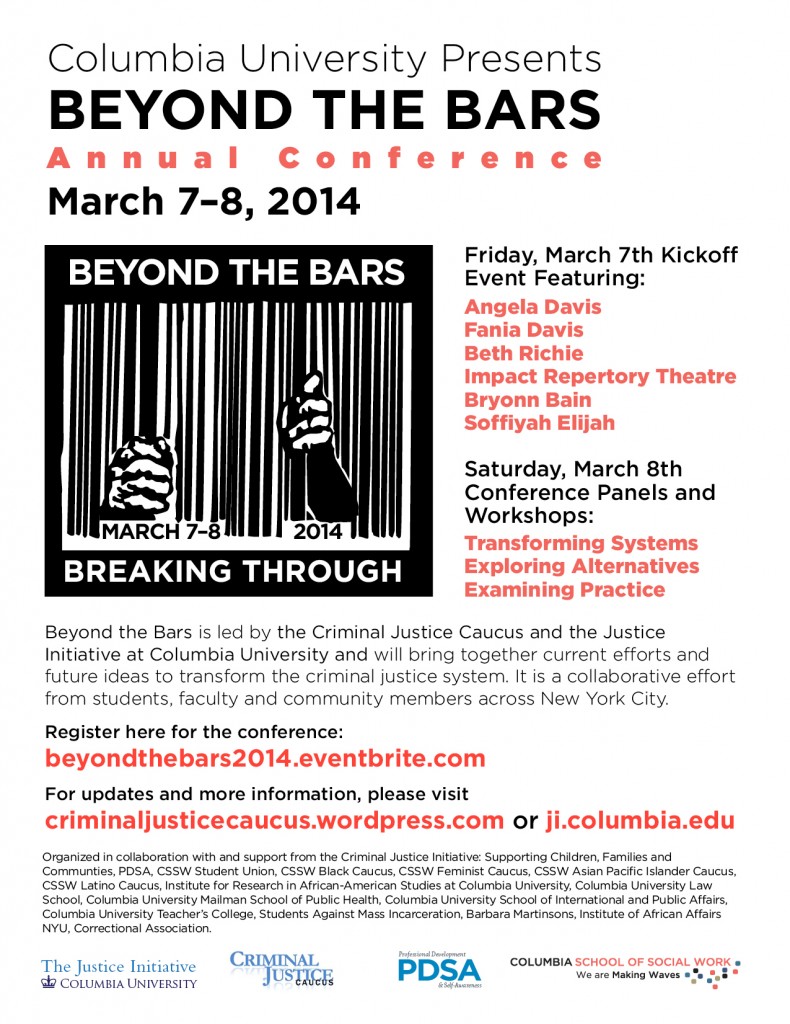
Beyond the Bars: Breaking Through Conference March 7th and 8th

Beyond The Bars: Breaking Through is the fourth annual student- driven interdisciplinary conference on mass incarceration held at Columbia University. Given the greater consciousness in society of the state of Mass Incarceration in the United States, this conference seeks to enable people to further the discussions around a variety of issues, and take action based on new knowledge. The conference launches Friday night with well-renowned guest speakers and performances. It continues into Saturday, with informative, thought-challenging, action-based panels and workshops headed by community members, professionals, professors, and students in a variety of fields concerned with mass incarceration.

Please register through the eventbrite page.

Beyond the Bars 2014 -Flyer JPG 

Friday Night Kick-off Event:
Lerner Hall, Roone Arledge Auditorium
2920 Broadway New York NY 10027 **Use Broadway Entrance**
1 Train to 116th Street
Speakers include Angela Davis, Fania Davis, Beth Richie, and other leading voices.
Performances by Bryonn Bain and Impact Repertory Theatre

Saturday Panels and Workshops
Columbia University School of Social Work
1255 Amsterdam Ave. New York NY 10027 (Between 121st and 122nd St)
1 Train or AC/BD to 125th Street, walk to Amsterdam and head South


 Morning Panels
Panel # 1: Transforming Systems: Education at the Center  (10:00 AM -11:30 PM)
Panel #2:  Transforming Systems: Imagining Justice and Safety without Mass                                                 Incarceration (11:45 AM – 1:15 PM)

Lunch Break  1:15- 2:15

Afternoon Workshops

Block #1: 2:15 – 3:45
1. The Impact of Parental Arrest on Children
2. Faith-Based Communities: Their Role in the Criminal Justice System
3. Immigration Detention and Mass Deportation
4. Humane Alternatives to Long-Term Solitary Confinement
5. Campaign Development 101: Through the Lens of Raise the Age
6. Reproductive Health Rights in Prison: A Skills-Based Workshop
7. Women, Reentry, and Gender-Responsive Programming

Block #2: 4:00 – 5:30

1. The Intersection of Higher Education and the Criminal Justice System
2. Our Elders Behind Bars. Our Families Divided
3. Restorative Justice in the Context of Domestic Violence: Exploring Culturally        Sensitive Practices in Communities of Color
4. Policing Under Bratton: A New Era or Business as Usual?
5. Tracking Trans* Individuals Across the Justice System Continuum: Identifying Service Gaps and Promoting Safety
6. How Can it Be Done Better? An International Comparison of Justice Systems
7. Theater for Social Change in an Era of Mass Incarceration

Justice Fact of the Week Campaign

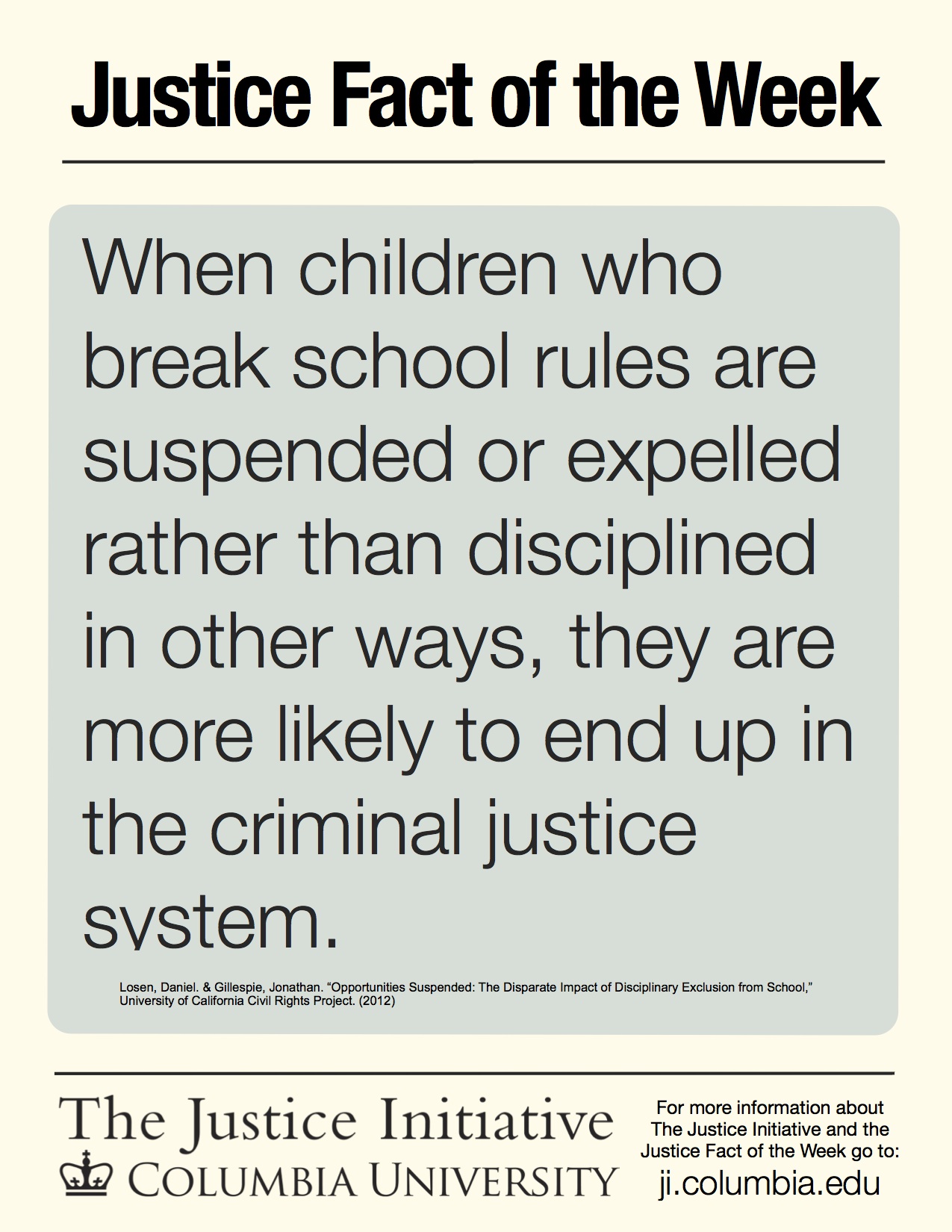
The Justice Initiative is working in collaboration with students and faculty from SIPA, and John Jay on The Justice Fact of the Week Campaign, focused on raising awareness of issues of incarceration and criminal justice in the New York State Legislature.  We are sending one fact every week about criminal justice and incarceration to all New York State Legislators in the Assembly and the Senate. The purpose of the campaign is to assist in shifting legislators thinking about criminal justice and incarceration policy from punitive policies, to policies working towards prevention, healing and rehabilitation.  The fact campaign working to specific policy engage legislatures in thinking more broadly about the large body of research that demonstrates that programs and policies that are less punitive are more likely to reduce our prison population, increase public safety and support the development of healthy communities.

Our latest fact is looking at the School to Prison Pipeline

Justice Fact of the Week 3 JPG

To see more facts check click here.

Restoring Justice: From Punishment to Public Health

Dr. Ernest Drucker’s latest piece in the American Journal of Public notes the increasing consensus that the “culture of punishment” in the US has significant negative consequences for the health of the US population and calls for a new approach to criminal justice.

“A new approach to criminal justice is needed, one based on public health and prevention: primary prevention, to shrink the system by changing drug laws and stopping mass arrests; secondary prevention, to reduce the harms of imprisonment by building education, job training, and humane treatment into our prisons; and tertiary prevention, restoring life and justice to those needlessly serving long sentences, who pose no threat to public safety and cost us billions annually.”

Dr. Drucker adds

“It is time for a new system of pardons, executive clemency or general amnesty for these prisoners of the war on drugs and other punitive policies that have wasted so many young lives.  The overarching imperative is to shift our criminal justice system from the goals of retribution and punishment to those of public health and restorative justice.”

For the full piece click here.

Ernest Drucker is an Adjunct Professor of Epidemiology at the Columbia University Mailman School of Public Health, Professor Emeritus in the Department of Family and Social Medicine, Montefiore Medical Center/Albert Einstein College of Medicine; and Senior Research Associate and Scholar in Residence at John Jay College of Criminal Justice of The City University of NY. He is licensed as a Clinical Psychologist in NY State and conducts research in AIDS, drug policy, and prisons and is active in public health and human rights efforts in the US and abroad.

Eric Holder Calls for States to Reinstate Voting Rights for Formerly Incarcerated

On Tuesday Attorney General Eric Holder called on states to repeal laws restricting voting rights for formerly incarcerated individuals. “It is time to fundamentally rethink laws that permanently disenfranchise people who are no longer under federal or state supervision,” Holder stated in his speech at the Georgetown University Law Center. Currently, eleven states have laws restricting voting rights prohibiting nearly 6 million individuals from voting due to former felony convictions.

Holder made the case for reinstating voting rights to individuals who have completed their sentence. Calling the current bans “counterproductive,” Holder drew parallels between current restrictions to post-Reconstruction era laws used to disenfranchise African-Americans. He also argued that “by perpetuating the stigma and isolation imposed on formerly incarcerated individuals, these laws increase the likelihood they will commit future crimes.”

His statement on Tuesday is part of a larger effort of the Justice Department to address racial inequities and civil rights violations in the criminal justice system. Earlier this year Holder urged Congress to pass reforms on mandatory minimum sentencing for low-level drug defendants.

The Investing in Justice Pilot Project recipients begin research this spring

The Justice Initiative is excited to launch its inaugural cohort of pilot project recipients who are engaged in a variety of different research projects focusing on issues of incarceration including reentry, peer mentorship, aging in prison, barriers to employment, and incarcerated mothers and shared parenting. The faculty recipients come from several schools across Columbia and many of them are working in collaboration with community organizations and advocates.

Steps to Reentry: An understanding of the steps to successful community reintegration
Pamela Valera, PhD
Columbia University Mailman School of Public Health

The Power of Peers: A Strengths-Based Leadership and Social Capital Development Project
Susan Sturm, J.D.
Columbia Law School

Hearing the Voices of Criminal Justice Involved Mothers and Transforming the
Dialogue into Reflective Planning for Shared Care Giving of Their Separated
Children
Mary Byrne, PhD
Columbia University School of Nursing

Graying Out the Threat? Exploring the Impact of Age and Race in Criminal Sentencing Decisions
PIs: Valerie Purdie-Vaughns, Ph.D & Michael North, Ph.D
Columbia University Psychology Department

Out But Still Doing Time: Effects of Employment Screenings on Job Applicants with Criminal Records
PIs: Valerie Purdie-Vaughns, Ph.D & Michael J. Naft, J.D.

Art and the Politics of Mass Incarceration: Well Contested Sites Symposium
Selby Schwartz, PhD
Columbia University Undergraduate Writing Program

For more detailed descriptions of there projects click here.

Beyond the Bars: A Yearlong Focus on Incarceration starts Tuesday February 18th with “Lost In Detention”

The yearlong series is a program of events that will span the spring and fall semesters of 2014 aimed at raising consciousness and engaging students, faculty and community members in dialogue around issues of incarceration and criminal justice.  The series will begin with a screening of Lost In Detention, a Frontline Documentary that “explores the secretive world of immigration detention and examine the Obama administration’s controversial get-tough immigration policy.” The screening will be followed by a Q&A with with director and producer Rick Young and award winning journalist and correspondent Maria Hinojosa.   The series will continue with Beyond the Bars: Breaking Through, the 4th annual criminal justice conference organized the Criminal Justice Caucus and The Justice Initiative at Columbia University.  For more information about the rest of the spring programming click here.

Jeffrey Fagan to speak at Public Health’s Dean Seminar Series December 12th

The School of Public Health continues there Dean’s Seminar Series Thursday Dec 12th.

Policing, Dignity and the Harm Principle: The Case of Stop and Frisk

Jeffrey Fagan, PhD
Professor of Epidemiology,
Mailman SchoolIsidor and Seville Sulzbacher Professor of Law, Columbia University
Director, Center for Crime, Community and Law

Thursday December 12th  12:00-1:30pm
Allen Rosenfield Building, Hess Commons  722 W. 168th St.

Please RSVP to Chelsea Davis @ [email protected]

Investing in Justice Request for Proposals due December 15th

Through the Investing in Justice Pilot Projects, CJI seeks to fund and support collaborative research, curricula development and conferences that are working to address issues of incarceration and criminal justice. The request for proposals is out and all applications are due by Dec 15, 2013. Please see below for more information.
Investing in Justice Request for Proposals
The Criminal Justice Initiative seeks to support four multidisciplinary pilot projects on criminal justice in the U.S. to improve and advance our collective knowledge of critical issues relating to incarceration, reentry, aging people in prison and parole policy, school to prison pipeline, education inside and out, children and families affected by incarceration, restorative justice, drug policy and innovative ways of understanding and addressing the needs of all who are affected by the criminal justice system.

The pilot funding aims to support faculty who are working on criminal justice and mass incarceration projects. The pilot projects seek to foster collaborations between university faculty and community-based organizations.

Pilot Projects

1) Research pilot projects that would produce new knowledge and enable faculty to produce compelling, well-crafted proposals for external funding. We strongly encourage interdisciplinary research proposals, partnerships with Columbia and outside university faculty and researchers, and collaborations with community-based organizations. We also strongly encourage applications that focus on current criminal justice issues of deep social significance. Successful proposals will clearly describe the project’s methodology, explaining how the project will answer the research question.

2) Development of curricular initiatives. Criminal justice related courses are of great importance to our goal of increasing the exposure of students to issues of mass incarceration and criminal justice and to understand how these issues impact their work. We strongly encourage proposals that include collaborations with those directly affected by the criminal justice system, including those who are formerly incarcerated people, in the development of curricula. In addition we encourage proposals that seek to develop new pedagogy and methods of learning outside of the classroom that allows students to engage with these issues in ways they may not otherwise.

3) Conferences relating to criminal justice and mass incarceration. Conference proposals should be clear about the stated outcomes and how the conference will reach them. Conferences can address and serve a number of purposes including but not limited to education and awareness, policy and advocacy and services and service providers.
If you are interested in proposing an innovative project that does not fall into one of the three categories, please contact us with your idea and any questions.
Eligibility
Individual faculty or a group of faculty from all disciplines and schools at Columbia University
Faculty members with full-time professional titles, instructors; and officers of research.
Funding

All awards will be made on a competitive basis, each up to $5,000. Application
Applications
Proposals are limited to 5 pages (describing the project, nature of collaboration with relevant community partners and participants, and expected impact)
Letters of support from collaborating community organizations or faculty at other institutions
Detailed budget and narrative
Principal investigator’s CV, and of other key collaborators
Submission date: All applicants should be in contact with us before submitting your final proposal for a preliminary discussion of your project. Proposals are due by Dec 15th and should be emailed to Cameron Rasmussen at [email protected]. Accepted applicants will be notified no later then January 15th, 2014. Funding will be released on February 1st, 2014 and accepted applicants will have one year to complete their project. Where applicable, InstitutionalReview Board approval is required before funds to successful applicants can be disbursed.

Samuel K. Roberts writes editorial for Huffington Post

The hunger strike at Pelican Bay is the third such action in the past two years and only the most recent in a 20-year history of protests against conditions there going back to the 1995 Madrid v. Gomez case. Now the strike has spread to roughly two thirds of the state’s 33 prisons, currently involving at least 12,000 prisoners and perhaps as many as 30,000. Strikers’ demands vary, but in total include an increase in hourly wages (currently 13 cents); more humane treatment; and the restoration of educational, rehabilitative, vocational, and mental and physical health services recently excised from prison budgets. Read More

Samuel K. Roberts, PhD
Associate Professor of History and Sociomedical Sciences
Columbia University