

- This event has passed.
Reducing Incarceration: Endless Punishment, Long-Term Sentences and Aging in Prison – Release and Reentry
March 28, 2014 @ 10:00 am - 6:00 pm
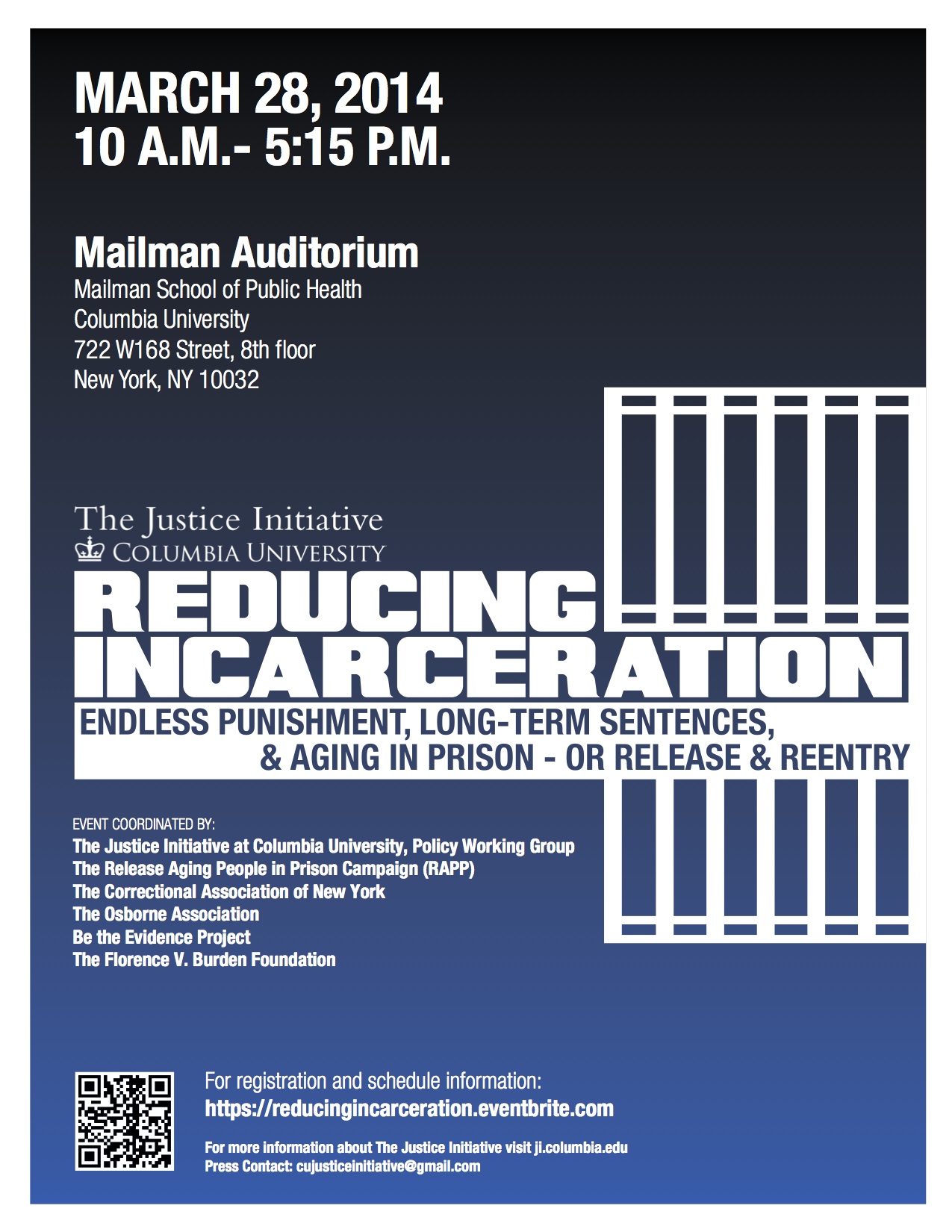
“Reducing Incarceration: Addressing Punishment, Long-Term Sentences, and Aging in Prison” is a symposium coordinated by Columbia University’s Justice Initiative, with the co-sponsorship of our partners: the Release Aging People in Prison Campaign (RAPP; http://nationinside.org/campaign/release-of-aging-people-in-prison/), the Correctional Association of New York (www.correctionalassociation.org), the Osborne Association (http://www.osborneny.org), the Be the Evidence Project (www.fordham.edu/btep), and the Florence V. Burden Foundation.
Where: Columbia’s Mailman School of Public Health (the Mailman Auditorium of the Allan Rosenfield Building, 722 West 168th Str.)
When: Friday 28 March, 10am-5pm.
Among the presenters will be
Soffiyah Elijah, Executive Director of the Correctional Association of NY
Marc Mauer, Executive Director of The Sentencing Project
Phyllis Harrison-Ross, MD, member, New York State Commission on Correction
Lilliam Barrios-Paoli, Deputy Mayor for Health and Human Services
Larry White, Advocate, rights of people in prison
Mujahid Farid, Lead Organizer of the Release Aging People in Prison Campaig
Brian Fischer, former Commissioner of Department of Correction & Community Supervision
Edward Hammock, former Chair of the New York State Parole Board
Will Bunting, of the American Civil Liberties Union
Letitia James, New York Public Advocate
Sandra Pullman, Assistant Attorney General, New York
Danylle Rudin, Florence V. Burden Foundation
Liz Gaynes, Executive Director of the Osborne Association
Tina Maschi, PhD, LCSW, ACSW, Founder and Executive Director of the Be The Evidence Project
Karen Murtagh, Executive Director of Prisoners’ Legal Services of New York
Jamie Fellner, JD, of Human Rights Watch
Rev. N.J. L’Heureux, Exec. Director Queens Federation of Churches
Recent reports have demonstrated that the existence of a growing population of elderly and aging people in prisons is one of the many effects of mass incarceration over the past 30 years. Mandatory minimum sentence laws of the 1980s and after have placed many individuals in long-term sentences, sentences which are not particularly commensurate with the crimes for which they were convicted. In addition to that problem, one of the issues we’re addressing is that of increasingly difficult parole criteria. In New York State, we have observed that parole boards quite often judge applicants on the seriousness of the original crime, not their demonstrated rehabilitation.