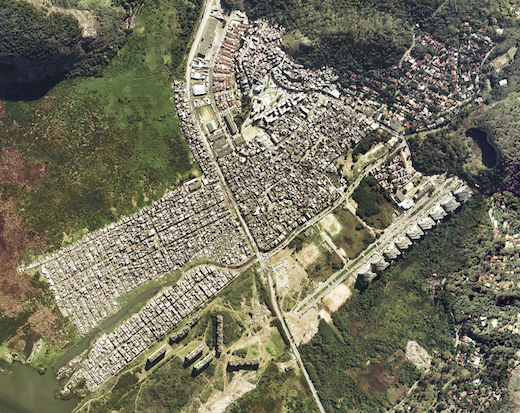
The Rio das Pedras Community
Dr. Gina Lovasi and her team are working to adapt standard methods for social epidemiologic research for use in resource constrained settings. Her work in an informal community in Rio de Janeiro, Brazil does not have the benefit of readily available spatially aligned administrative data, remote sensing and visualization tools, WiFi assisted GPS technology, or even digitized street maps; tools commonly used in research studies in the U.S. She and her team had to develop data collection and field tools on the fly.
Dr. Lovasi’s research site, Rio das Pedras, is home to approximately 63,500 residents and is the third largest informal community in Rio de Janeiro, Brazil. A tightly woven community, Rio das Pedras has continually attracted new residents while developing a growing local economy. Despite the collective successes, some services and infrastructure that many developed areas take for granted are missing in Rio das Pedras. Aggravated by seasonal flooding, hectic vehicle traffic, continuous construction, soil instability, and improvised waste disposal facilities, the limited access to municipal services and transportation likely predispose residents to injury and poor health. However, there is limited data that can accurately characterize the health of residents of Rio das Pedras, and fewer data that can point out areas of improvement. As a result, there is little evidence to guide infrastructure investment or other initiatives to protect the health of residents. To fill this gap, Dr. Lovasi and her team are undertaking a Community Needs Assessment (Community Health Diagnosis) for the Rio das Pedras area.
Systematic Social Observation (SSO), also known as Neighborhood Auditing, is a standard approach to collecting data on the social and built environment characteristics of a community. However, this method requires that the field team be able to identify and record their location, a challenge in Rio das Pedras which does not have a formal and stable street naming and building numbering system. Dr. Lovasi’s team also needed a way to collect and organize data and photos in the field to support their understanding and documentation of the community’s resources and dis-amenities. Continue reading →