Beyond Diabetes: Exploring Metformin’s Promise in Prostate Cancer Therapy

By Rafaela Muniz de Queiroz 

Cancer and diabetes are two major contributors to mortality in patients, ranking among the top 10 causes of death worldwide by the World Health Organization (WHO). Both diseases pose a significant challenge to public health systems, representing a complex challenge that requires comprehensive strategies to reduce their impact on global mortality rates. Metformin, among other drugs, is the main first-line prescribed medication for the management of type 2 diabetes, and it is known for its efficacy and tolerability. Yet, metformin has gained attention for its role in other contexts, including cancer and cardiovascular disease.

Prostate cancer is a significant global health concern and a leading cause of cancer-related deaths among men. While treatments like radical prostatectomy (RP) and radiotherapy are effective for many patients, for others, the disease progresses leading to metastasis, which can be difficult to treat and is often fatal. Previous studies have pointed to metformin’s potential role in prostate cancer, but conflicting findings have led to an inconclusive verdict on the use of metformin for this disease. A recent breakthrough study headed by Alexandros Papachristodoulou from Dr. Abate-Shen’s group in the department of Molecular Pharmacology and Therapeutics at Columbia University Irving Medical Center, has shed light on a potential new avenue for the use of an anti-diabetic drug in the treatment of prostate cancer.

The prostate gland is susceptible to inflammation and oxidative stress, both of which can accelerate prostate cancer progression. Interestingly, oxidative stress influences the behavior of NKX3.1, a gene that plays a crucial role in protecting the prostate epithelium from cancer-related stress. In their work, Dr. Papachristodoulou and colleagues examine the interplay between NKX3.1 and the widely used diabetes drug metformin. The interplay between NKX3.1 and metformin are found in the mitochondria. NKX3.1 helps protect against harmful free radicals (unstable molecules that can damage cells by stealing electrons from other molecules) and supports normal mitochondrial function, while metformin has a known ability to regulate mitochondrial function and reduce oxidative stress.

The study published in 2024 used a comprehensive number of strategies to investigate its hypothesis, including in vitro work with the use of human prostate cancer cell lines, in vivo work using mouse models, and analysis of retrospective cohorts of patients. The authors show an impressive reduction of tumor size in mice under oxidative stress, by exposure to the herbicide Paraquat, and treated with Metformin. This difference was only seen if tumors did not express NKX3.1. They show that metformin treatment can fully rescue mitochondrial function that had been lost upon oxidative stress in prostate cancer cells lacking NKX3.1, pointing to a possible molecular mechanism for the effects seen in mice.

Moreover, the study analyzed the biochemical recurrence (BCR)-free survival, evaluated by the blood levels of PSA, the antigen used to diagnose and surveil prostate cancer in patients. This parameter is used in the clinic to show the percentage of patients that remain disease-free after RP over time. Utilizing data from two cohorts of patients, the researchers showed that those expressing low levels of NKX3.1 and taking metformin had a much higher rate of BCR-free survival compared to patients not taking the medication. The group of patients expressing high levels of NKX3.1 showed no difference in BCR-free survival when taking or not the drug. In addition, when the disease progression of a group of prostate cancer patients that have been followed up for up to 10 years was investigated, the authors observed that among the patients with low-NKX3.1, all patients treated with metformin evolved to have their disease classified more favorably during follow-up, while most patients not exposed to the medication had a worse development of the disease.

These findings open exciting possibilities for personalized treatment strategies for prostate cancer. It offers hope for a future where precision medicine plays a pivotal role in combating this disease and improving patient outcomes. By identifying patients with low NKX3.1 expression levels, clinicians may be able to tailor metformin therapy to those who are most likely to benefit, potentially improving patients’ quality of life and extending survival rates. While further research and clinical trials are needed to validate these findings, this study represents a significant step forward in understanding the biology of prostate cancer and exploring novel therapeutic avenues. 

Original paper

Reviewed by: Trang Nguyen, Erin Cullen
CRISPR versus acute lymphoblastic leukemia

Acute lymphoblastic leukemia (ALL) is an aggressive form of cancer arising from malignant transformation of immature cells that were otherwise fated to become white blood cells, or lymphocytes. ALL occasionally affects adults but is more commonly a pediatric cancer: children under the age of 5 have the highest risk of being affected. Upon diagnosis, it is possible to treat ALL with an aggressive regimen of multiple chemotherapy drugs that is successful for over 80% of patients. Unfortunately, when tumors reappear after initial treatment, in relapse, the cases become extremely difficult to treat. Additionally, the cellular landscape of ALL in relapse has a high degree of genetic heterogeneity and variability between different patients. Oncologists and cancer biologists suspect it is this genetic complexity that makes ALL in relapse especially hard to fight in the clinic. 

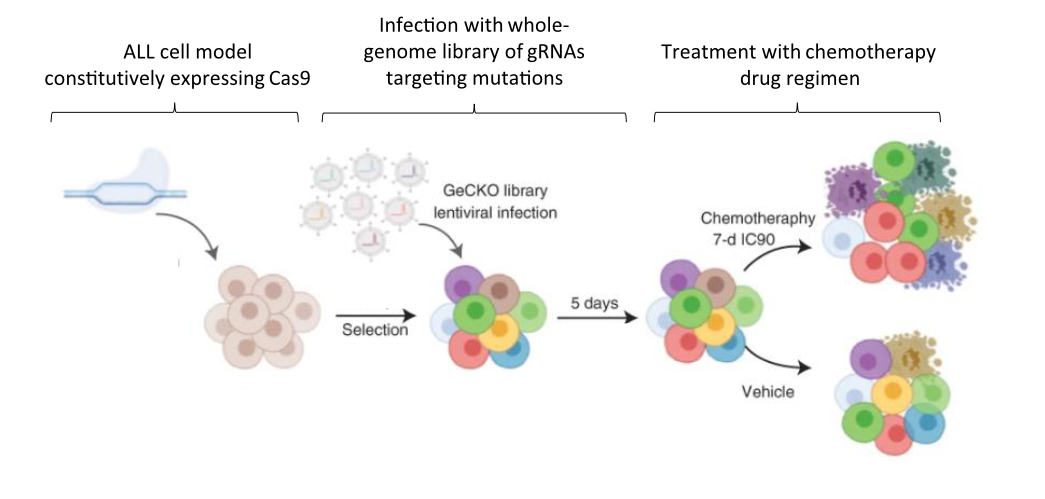
In a study published in Nature Cancer last year, Dr. Jessie Brown and colleagues set out to improve outcomes for patients with ALL by clarifying how mutational complexity in relapsed tumors interacts with chemotherapy drugs to resist treatment. To this end, the team first employed extensive genetic sequencing on ALL samples collected upon diagnosis, remission, and relapse in order to identify the mutational landscape that distinguishes relapse tumors from the others. Samples were collected from 175 patients in total – 149 from pediatric cases and 26 from adults. Next, in order to functionally characterize the mutations they identified, the authors used a genome-wide genetic screening strategy to identify drug–gene interactions and determine why the relapse-specific mutational landscape is less responsive to chemotherapy. The screen was carried out in a representative model ALL cell line using CRISPR, a genetic editing tool used to specifically activate or inhibit the expression of single genes. 

Fig 1. Schematic of experimental design for CRISPR-based screen in ALL model cell line. A library of targeting molecules called guide RNAs (gRNAs) was used to activate or inhibit genes identified to have mutations associated with ALL in relapse. Figure adapted from Oshima, Zhao, Durán, Brown, et al. 2020.

Between these two approaches, the team succeeded in characterizing relapse-specific mutations that arise during the administration of chemotherapy itself, a process known as clonal evolution. Additionally, the number of mutations they identified increased with patient age at diagnosis, a finding that allowed the researchers to establish that the most recent commonality between the mutant cells present at diagnosis versus later at relapse often develops early, years before the leukemia is officially diagnosed. Importantly, this finding is consistent with the hypothesized fetal origin of many pediatric ALLs, which postulates that chromosomal abnormalities leading to cancer are already present at birth. It is also consistent with the higher rate of relapse previously observed in adult patients.

When the mutations uniquely acquired during relapse were further investigated using CRISPR screening in an ALL model cell line, a strong positive selection was revealed for those that conferred chemotherapy resistance. By using CRISPR to manipulate the expression of genes affected by each mutation of interest and assessing how the ALL model cells fared in each experiment, the researchers were able to analyze the relationships between the effect of the mutation and application of each drug. Of the drugs investigated, functional overlaps in the cellular mechanisms mediating the activity of each were identified between several groups of them. The significance of this finding is two-fold. First, it helps researchers and medical providers understand why the presently used multi-drug regimen might be effective for ALL in the first place. Second, it suggests that other drugs acting via similar mechanisms of action could be effective treatments in the future. Moving forward, ALL in relapse might be treated not just with combinatorial chemotherapy, but with specific combinations, doses, and schedules of drugs that meet the personalized genetic vulnerabilities of specific ALL cases. 

One inhibitor tested in the study’s cell-based CRISPR screen, an inhibitor called ABT-199, also known as Venetoclax, is already being tested for inclusion as a new therapeutic. If approved, it could become part of the arsenal of drugs used to compose personalized chemotherapeutic cocktails for patients with ALL in relapse. According to co-first author Dr. Brown, “it is currently in Phase I/II clinical trials for relapsed ALL and other malignancies and we hope that this work and our follow-up studies can further underscore the mechanisms of action of this inhibitor in combination with commonly used chemotherapies.” 

Altogether, this study identified a number of mutations that make relapsed ALL distinct from ALL before treatment with chemotherapy and functionally characterized the interactions of these mutations with multiple chemotherapy drugs. While ALL is not a common cancer – it accounts for less than 0.05% of all incidences of cancer in the United States – those affected must be treated with aggressive chemotherapy that can negatively affect the lives and health of patients in many ways. Because of this, understanding how to better target ALL at diagnosis and treatment-resistant ALL in relapse is a high priority for researchers. The findings of this work help to identify targets for reversing chemotherapy resistance and improving treatment outcomes for pediatric and adult patients alike. 

Dr. Jessie Brown is a postdoctoral research fellow in the Ferrando Lab at Columbia University Irving Medical Center studying therapeutic resistance in relapsed acute lymphoblastic leukemia.  

Follow this blog

Get every new post delivered right to your inbox.