Brain: The Jack and Master of all trades

Brain is invariably the “mastermind” of our body coordinating almost every essential function required to keep us alive and make us aware. Its complex architecture and multifaceted nature have intrigued scientists for decades. The deeper one delves into deciphering the brain, the more one marvels at the intricacies of its coordinated mechanisms and innervations. The brain communicates with every other part of our body through neural connections and ensures synchrony inside our systems. It has three major components: cerebrum, cerebellum and medulla oblongata, each distinct in its roles (Figure 1). The brain is indispensable for our existence. Not only does it regulate our sense of being, cognition and emotions, but also our sensory, motor, and involuntary functions. Additionally, it  controls secretion of hormones, modulates satiety, and is responsible for our memories. Needless to say, minute structural or functional disruptions in this delicate network can wreak havoc in our systems. 
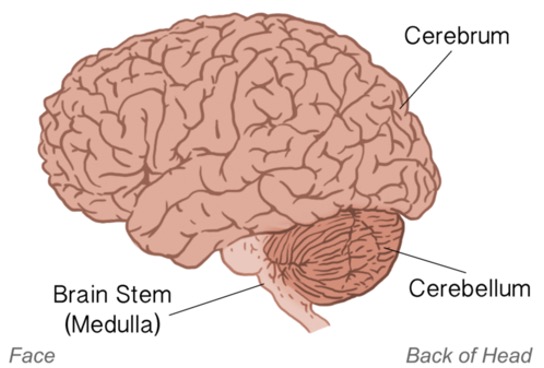
 

Figure 1: Major parts of the brain (Image taken from bio.libretexts.org)

Just as you begin to wonder how one organ, which is practically the size of two fists, can carry out such a diverse variety of actions, studies begin to unravel previously unrecognized functions of the brain. The gut-brain axis is one such exciting new area wherein the brain “talks” to the gut and vice versa thereby influencing the functioning of each other. Another prominent and extremely astonishing function that has recently emerged is the ability of the brain to control immune responses by modulating inflammatory signals. In this context, Columbia postdocs Hao Jin, Mengtong Li and their colleagues have very beautifully uncovered exactly how the brain serves to “sense” inflammatory cues and send signals to the body to respond correctly to these cues in their pioneering work published in Nature.

Inflammation is an immune response. It is of paramount importance to have an equilibrium between pro-inflammatory (which perpetuates inflammation) and anti-inflammatory (which curtails inflammatory signaling pathways) states in our systems to enable a potent defense mechanism. Both hyperactivation and hypoactivation of these responses can have dire consequences in organismal physiology. So how does the body-brain axis orchestrate this inflammatory balance? 

Jin et al., have shown how the brain plays a significant role in determining this balance thus contributing to immune homeostasis. They have very carefully dissected the body-brain circuit controlling this communication between the immune system and brain. They have identified the neuronal populations which are activated by an incoming immune insult and how these then trigger and direct the balance between pro-inflammatory and anti-inflammatory responses. 

Briefly, a peripheral immune insult is sensed by vagal neurons (part of parasympathetic system) which then transmit the signal to a distinct region of the brain, caudal nucleus of the solitary tract (cNST) in the brainstem region. When cNST neurons were inhibited, there occurred a profound elevation in pro-inflammatory response and a corresponding decrease in anti-inflammatory response. This ultimately causes the immune regulation to go haywire.  On the contrary, when these cNST neurons were activated, anti-inflammatory responses were upregulated whereas pro-inflammatory responses were downregulated (Figure 2). 

Figure 2: Schematic representation of components of the body-brain axis orchestrating inflammatory states and organismal immune homeostasis (Images of neuron and brain taken from Adobe Stock and iheartcraftythings.com). 

The study also shows distinct neuronal clusters in cNST which respond to the immune response. It was further shown how cytokines, which are signaling molecules released from immune cells downstream in response to an upstream peripheral immune insult, signal specifically to vagal neurons which then propagate the signal to cNST neurons to perpetuate the inflammatory response. Vagal neurons also have specific lines of signalling, one distinct population of neurons carry anti-inflammatory signals whereas another set carry proinflammatory signals to cNST neurons. 

Thus, this study uncovers a remarkable crosstalk between the brain and the rest of the  body which serves to crucially maintain immune homeostasis. Modulation of intricate components of this axis holds therapeutic potential in either selectively impeding a heightened pro-inflammatory immune response or activating an anti-inflammatory state to alleviate a dysregulated immune state. 

Reviewed by: Erin Cullen, Margarita T Angelova

New Technology allowing gene switch to study multiple sclerosis

Our genetic blueprint consists of thousands of genes (more than 30,000) with new genes being discovered and added to the growing list. Our genes provide DNA instructions to the protein-making machinery in our bodies. These instructions can influence our health and dictate if we will get debilitating diseases. Have you ever wondered how scientists unlock which genes are responsible for what? For example, does gene A control our hair colour or gene B dictates if we will develop an autoimmune disease such as multiple sclerosis? The answer lies in DNA recombination technology which allows scientists to delete, invert or replace DNA instructions. The technology called Cre-lox recombination relies on the use of an enzyme called Cre recombinase which can bind, cut and recombine DNA at specific sites that are inserted in pairs in the DNA. The Cre-binding site in DNA is called the LoxP sequence that consists of 34 nucleotides DNA sequence made up of two inverted repeats separated by a spacer.  Cre enzymes can recognize these LoxP sequences and edit the stretch of DNA resulting in gene deletion or inversion.

In a recent research article, Dr. Olaya Fernandez Gayol and colleagues use an advanced version of Cre-lox technology called DIO (Double Floxed Inverted Open reading frame) to understand the role of the Interleukin-6 (IL-6) gene in multiple sclerosis (MS). MS is a chronic disease of the brain and spinal cord in which our immune system eats away the myelin sheath around nerves disrupting the communication between the brain and the body. IL-6 is a proinflammatory cytokine known to promote MS. Gayol et al use an experimental mouse model of MS which acutely develops brain inflammation called encephalitis (Encephalo- “the brain” + itis “inflammation”) within 3 weeks of disease induction. This mouse is referred to as EAE (Experimental Acute Encephalomyelitis) which closely mimics human MS disease.  

Scientists have conventionally studied the role of IL6 in EAE mice by irreversibly deleting the IL6 gene in one cell type. However, the results were confounding due to the compensatory expression of IL6 from other cell types. Gayol et al circumvent this problem by wiping out IL6 from all the cells and then recover IL-6 expression specifically in the microglial cells. It is akin to entering a dark room and turning ON a light switch at one corner of the room to clearly see what’s lying there. 

Figure 1.  Cartoon depicting the genetic strategy used by Goyal et al to recover IL6 gene expression exclusively in microglial cells in the mouse brain. Created with Biorender.com.

Olaya and the team use the cutting edge DIO method to wipe out IL6 and introduce the inverted form of the IL6 gene which makes this gene non-functional (Figure 1A). This inverted form of the IL6 gene does not produce IL-6 protein and mice carrying the inverted IL-6 gene (referred to as IL6-DIO-KO) are healthy (Figure 1A). As shown in figure 1B, Cre mediated recombination flips the IL6 gene in the correct orientation to make it active. The IL6 gene flipping occurs exclusively in the microglial cells and only upon treatment of mice with tamoxifen (TAM) drug. Mice in which IL-6 expression is active (referred to as IL6-DIO-ON) develop EAE disease (Figure 1B).

The team carefully optimized the duration of tamoxifen treatment in mice. Just 5 days of TAM did not flip the IL6 gene, so they extended the drug treatment to 11 days and found the IL6 gene turned on in all IL6-DIO-ON mice. Olaya says it is important to validate when creating new mouse models. “We used EAE to validate the mouse because it was a model readily available in our lab and IL6KO [deficient] mice happen to be completely resistant to the disease.” Their interesting finding that IL6-DIO-ON with IL6 gene active exclusively in microglia indicate that IL6 made in the brain promotes disease in the EAE mouse model. 

As compared to more traditional methods of generating gene mutation which requires extensive mice breedings or continuous drug treatment, the strategy presented by Olaya and colleagues is labour and cost-effective. Their findings showed that in the absence of IL-6, EAE disease does not develop in mice. On the other hand, turning on the IL-6 gene (like a gene-switch) using DIO technology, mice develop the disease.  Overall, this technology is highly customizable to understand the role of different genes in specific cell types in the disease context. It paves the way to gain a deeper insight and more thorough analysis of different molecular blocks involved in disease.


Dr. Olaya Fernandez Gayol is a postdoctoral research scientist in the Department of Pediatrics and co-president of Columbia University Postdoc Society(CUPS).  She also manages the CUPS Press office that provides postdocs with a platform to publicize their science while improving their science communication skills. 

Follow this blog

Get every new post delivered right to your inbox.