By: Maithê Rocha Monteiro de Barros
As global life expectancy continues to rise, so does the concern about age-related cognitive decline and conditions like Alzheimer’s disease. One question that is consistently asked is “Why do some brains age better than others?”.
While brain changes are a natural part of aging, what if some people are better equipped to handle these changes without experiencing significant cognitive impairment in areas such as memory and reasoning? This is where Cognitive Reserve (CR) comes in. CR is the brain’s ability to withstand brain anatomical damage from aging or disease without showing cognitive impairment. CR acts like a shield and individuals with higher CR can withstand brain damage from aging or disease longer before their thinking abilities are affected.
What builds this reserve? Factors such as higher education, demanding occupations and engaging in intellectual or socially stimulating activities have been linked to building a good CR, but could your personality also play a role in building a good CR? A new study published by a former Columbia postdoc Annabell Coors and colleagues shows that personality could be a key factor for building CR. The study explored how certain personality traits might benefit CR.
To understand this study, it is important to take a closer look at some key aspects of personality, often described through the Big Five traits outlined below.
1 – Openness to experience: How imaginative, insightful, and open to new ideas and experiences you are.
2 – Conscientiousness: How organized, responsible, and disciplined you are.
3 – Extraversion: How outgoing, energetic, and sociable you are.
4 – Agreeableness: How cooperative, compassionate, and trustworthy you are.
5 – Neuroticism: This is the opposite of ‘emotional stability’, therefore it describes how prone you are to emotional instability, anxiety, and negative emotion.
The authors assessed personality in 399 healthy adults aged 19-80 years and tracked 273 of them over an average of 5 years. They included a wide age range to check whether personality is a factor underlying CR even at a younger age.
To get a complete picture, the researchers measured 3 aspects of each participant:
1 – Personality was assessed for each participant using a 50-item Big Five scale form, where they rated statements on a 5-point scale to whether they agreed to the statement or not.
2 – Cognition was assessed across domains such as perceptual speed, memory, fluid reasoning and vocabulary.
3 – Brain status was assessed by MRI scans to check each participant’s brain structure.
It makes sense that personality could influence CR, as it might affect how much someone seeks out new learning opportunities or engages in intellectual activities.
Does Personality Really Offer Protection?
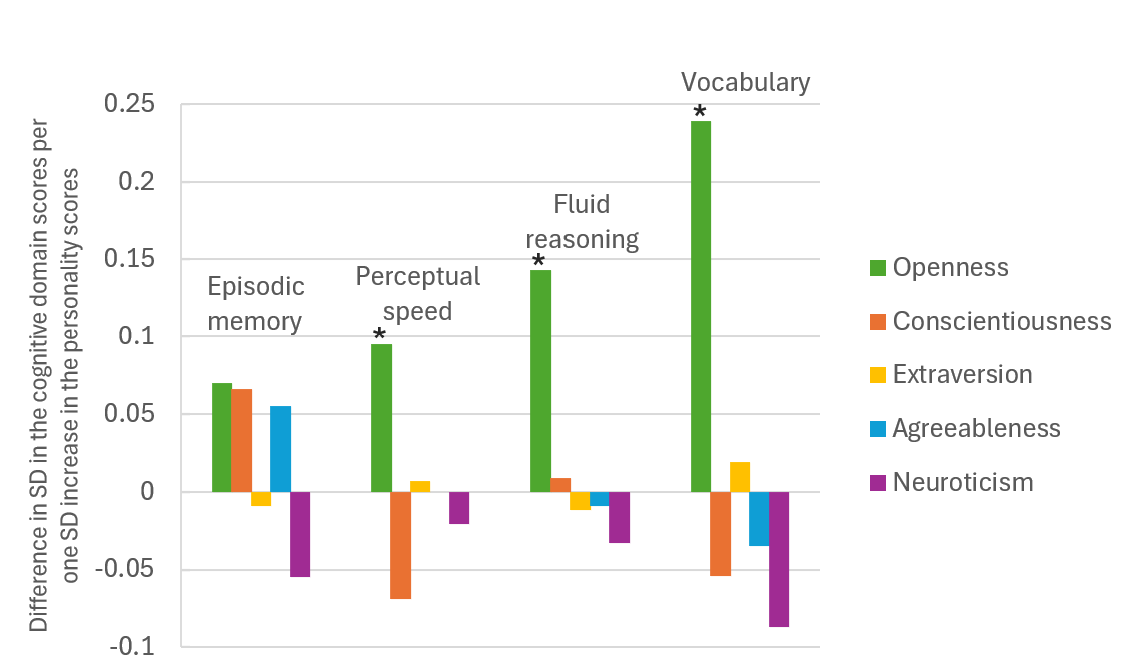
After analysing the data and accounting for age, sex and brain physical status, one personality trait clearly stood out from the rest as having a protective effect openness to experience.
Higher scores on the Openness to Experience scale were significantly associated with better performance in ‘Perceptual speed’, ‘Fluid reasoning’ and ‘Vocabulary’ as seen in Figure 1.
Nurture Your Openness
The implication of this study is that high openness to experience is a personality trait that benefits CR, helping individuals maintain better cognitive performance and experience less decline as the brain suffers from pathological and age-related changes.
It is important to remember that openness is not a fixed trait, and it varies from person to person. Being open is a way of engaging with the world by trying out new things, exploring new ideas, cultivating a desire to learn and feeding your own curiosity.
So, what new thing are you going to try today?
Reviewed by: Saheli Chowdhury and Margarita T. Angelova