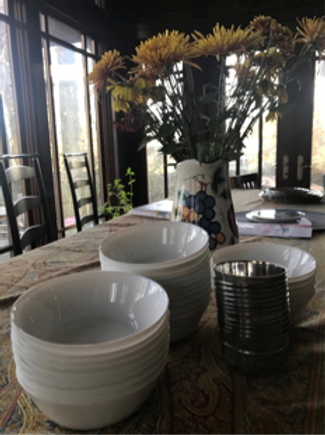
My name is Aalok Bhatt and I am an Eco Ambassador for the Environment in Action program in Millburn, NJ. As part of my duty to spread eco awareness in my community, this year, I hosted an eco-friendly Thanksgiving feast at my place. My family took a series of steps in order to achieve this goal. To begin with, we decided to do away with the convenience of using disposable plates and cutlery as these generate a lot of waste that pollutes our environment. Instead, we decided to use our own plates and steel cutlery, and borrowed some additional plates, bowls and glasses from the Bartan Bank, a community bank of crockery, cutlery & glasses set up with the contribution of a few like minded members of our community. These items can be borrowed by anyone who is hosting a party, by booking in advance and ensuring an eco friendly experience for all!
Our family informed all of the guests that it was going to be an eco friendly party and we asked them to not bring any desserts or gifts with plastic packaging. All those who attended were very cooperative, as people came with plants and homemade appetizers for the party. Our Thanksgiving dinner generated virtually no waste this year, as compared to previous years. We also went to great lengths to make sure that the produce that was used for making all the dishes had a low carbon footprint, in terms of packaging. For dessert, homemade bite sized truffles were served.
We also bought cheesecake from our local Trader Joes and it came in a cardboard packaging, and not plastic. This cheesecake was cut up into small pieces and served on a platter along with the truffles. This not only cut down on food waste but also on plates and bowls used for serving dessert. Small steps like these can help clean our planet as all of the plastic that was ever made still exists in one form or another, polluting our oceans and destroying our ecosystem. It only took our family a small amount of effort and commitment to take these steps, and even our guests did their part. I am confident that if everyone takes steps like these, then we will curb our plastic waste significantly, and live on a clean and happy planet.
About five months back I visited the Information Communication Technology (ICT) Center, in Mahbubnagar, in one of the newly carved out South-Indian states of Telangana. Having contributed to the development of some parts of the study material for the center, through consultation with the Center for Sustainable Development at Earth Institute Columbia University, I was understandably very eager to interact with the students on the field. And indeed, the experience was every bit I had hoped for, and more.
Women, from class 12 onwards, sometimes even simple housewives, are highly encouraged to attend the center for three-month courses, to learn basic computer literacy and various other life-skills. The entire course is free of cost, and all it requires is for students to demonstrate sincerity in attendance and an eagerness to engage. None of these were lacking in the women who primarily belong to underprivileged and uneducated families. The ICT Center seemed like the right crack in their dark shell to let light in. It is hoped that through the exposure to education and information at the center, the women would feel more empowered to pursue higher interests of education or financial independence.
What stands out for me, till date, is the look that I had forgotten, in my almost two decades of staying on the Western Hemisphere. A look of naivete that comes from being inexperienced, underexposed, small in age and economically weak. I saw that in many, if not all women there. Yes, they were excited to be learning new things at the Center, but they were also unsure of how their sliver of enlightenment reconciles with their station in life. They are, after all, women. And if being a woman in India is perilous enough, being a woman from a poorer section of the society can only be more so.
That look has haunted me, and as though to shake me from my first-world stupor, last week, India is sent rocking, by yet another brutal rape-murder, this time in the city limits of Hyderabad, the capital city of Telangana, and an hour and a half car-ride from Mahbubnagar!
That India has infamously earned the title of the ‘Most Dangerous’ Place in the civilized world to be a woman, is not just shameful, but also sad. Crimes from female infanticide, sexual harassment, acid-attacks, dowry deaths, rapes and marital rapes are only on the rise. A rape occurs almost every 20 minutes somewhere in India. In a 24 hour cycle, that is a staggering 72 females violated. And those are just the officially reported numbers! Several cases go unreported due to a devious mix of many reasons, including societal taboos around rape, and lack of judicial support for the victims.
Females of all ages are under threat! Minors as young as two years old are victims of such crimes. Since women who are raped represent nothing in common except their gender, rape in India is clearly not a crime of a caste, or a class, or a religion. Rape in India is a crime by men against women. It is misogyny at its worst, and as perverse as it gets, for the nature of the annihilation of the female is becoming more horrible with each crime.
While this is the time to halt an average Indian male on his tracks, and look him in the eye to question him, on his mind-set, and that of other men in his circle, it is also the time to give all out superpowers to centers like this one, where a self-driven set of women from a vulnerable section of the society gather to be granted the gift of upliftment. This captive audience is the exact student body that needs to be empowered with most importantly, the ability for self-advocacy.
The women need to be taught basic English fluency and computer literacy, but also their basic right to speak to men about why crime against women is not just not right but also is economically, demographically and sociologically harmful for men also. The women need to be taught the ability to discuss misogyny with family and friends of all genders, especially in the light of the new high-profile Rape case. They need to be able to come back with a reply, when people say that the recent rape victim was ‘calling’ for trouble by traveling at 8pm in the night. The reply is simple, and every woman, at the ICT Center and otherwise, should memorize it: 8pm is evil because of the evil minds of the perpetrators, just like 8 am or 6 pm or 4 am! Men CANNOT be allowed to declare sun-down as their hour of unbridled lust.
Women at the ICT Center, were the first I thought of when the recent rape case came to light, because of the geography. However, I realize that women all over India, need to talk to men about why crime against women is on the rise, because the solution, if any, has to come collectively. The first step to this cross-gender conversation is empowerment of the self. No being shy, no being coy, no being pretty nor kind. Just straight up and ready to talk. I am very sure that the self-advocacy unit of the ICT Center in India especially, will continue to focus on this. This is particularly required, since crimes such as the recent ones, and in close geography, can be highly threatening and demoralizing, for those who belong to the neighborhood. Looks like there is a lot of work to be done, continuously.
…Because Sustainability is a seemingly uphill task, every small success is worth celebrating….so here is a page from the diary of a ‘Sustainability-Attempter’:
Hosted an almost 40 women
Diwali meet/greet Lunch-chai-chat session at home over the weekend, and declared weeks ahead that wanted to make it eco-friendly….here are the lessons:
Everyone was SO ONBOARD! They all wanted to support as much as they could.
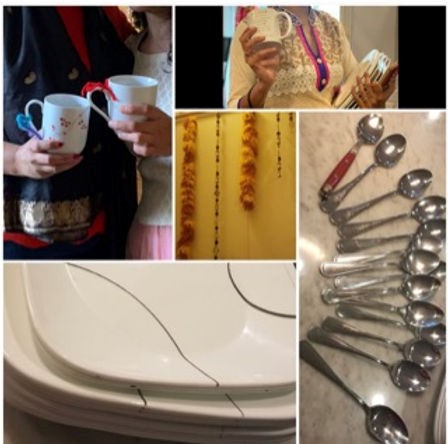
Utensils and cutlery were the main target, and immediately, the idea that we could use a bunch of pooled in mix-n-match reusables like steel or Corelle/corningware, was accepted. Likewise for the spoons…..Pool in—wash and return!
Liquid containers are the BIGGEST MENACE —since people typically use a plastic cup once and then go for a fresh one since their used one gets lost in the pool of other used cups. Markers for plastic cups, helps, but we all know that reusable over single-use would be Swell! In that spirit, friends VOLUNTEERED to get their own cups. One best samaritan…actually got 12 tea-cups—-each with a different colored cord tied to its handle as a marker (ok this last gesture made me very emotional, and it makes me BELIEVE that with true-blue efforts like that—-the earth might just have a second shot at green-clean.)
Everyone–most actually— complied with NO gifts policy, opting instead to contribute for a CHARITY……and thus, icing on the cake, we were together able to raise $85 in cash!
As decors we used everything from last Diwali, plus my kids, over a course of a month, made strings of ‘woolen marigolds’ —we can wash them and reuse for next year! they also made some posters for diwali, with diyas.
NO WATER BOTTLES, NOR ANY PLASTIC CUTLERY WAS USED.
The hitch: Borrowing plates and spoons from friends, NEEDS time! Plus, it may not be possible for everyone to LEND their plates/spoons (for multiple reasons– veg, non-veg is an issue, or maybe some plates are too dear/fancy)…and that is perfectly understandable……the idea is DO NOT GIVE UP…..I don’t think anyone means anything personally…..so keep going!
So, overall 40 BEAUTIFULLY DRESSED, FANCY AND FUN ladies got together over the course of a couple of hours, over food and oodles of chai, AND NOT EVEN ONE FULL BAG OF TRASH WAS CREATED!!!!!!!!!!!!!!!!!!!!!!!!!!!
Friends were creative enough to tease me that this is a BYOB (as in Bring Your Own Bartan–a hindi word for pots) party…..but overall we were all happy.
I feel so so so OBLIGED to all the friends who made this Diwali truly precious for me, and for all of us–I hope!
We are thrilled to share the experiences and voices of our ICT Center trainees.
The ICT Center Model developed by Center for Sustainable Development (CSD) and Infrastructure for Sustainable Development (i4SD), which envisioned bringing digital skills, solar energy and potential future employment for women under one roof, has become a reality.
On December 18th, 2018, ICT Women’s Center in Mahabubnagar District of Telangana State in India opened for its first classes managed and led by Srinivas Akula and Navatha Kanike. The Center for Sustainable Development’s education team- Radhika Iyengar, Haein Shin and Tara Stafford Ocansey- set the curriculum framework, with Joaquin Aviles Lopez offering infrastructure support.
Now, a year later (by the end of 2019), we will have around 300 trainees who successfully completed the program!
The Center offers training on English, computer, financial/business and life skills. Our trainees shared their experiences in the video below:
Often, environmental education and sustainability are used interchangeably. In the mix, we have a more programmatic approach with end goals and timelines, and we call it sustainable development (referring to the Sustainable Development Agenda 2030). Dating back to the 1960’s, environmental education was school-based and dealt with climate change. A landmark change in way environmental education was perceived as the Earth Summit held in Rio de Janeiro in 1992. Environmental education after 1992 was seen only as half the story. The second half was missing in formal curricula. This second half was called “Sustainable Development,” and this after 1992, environmental education transformed into education for sustainable development.
Rose and Bridgewater (2003) cover all these dimensions and define environmental education as “…a lifelong teaching/learning approach that has the potential to strengthen people’s capacity to address environmental and development issues, to be more aware of and better understand such complexity; to develop knowledge, values and attitudes, life-skills and ethical behaviors consistent with sustainable development, as well as for effective participation in decision-making” (p. 265). The authors add that environmental education is useful for understanding natural and social processes and their inter-linkages. It also improves the socio-economic development of individuals and society (Kassas, 2002; Rose & Bridgewater, 2003). They state that the main objective of environmental education is to create equitable, participatory, culturally, and socially aware citizens, that are respectful of human rights and want to achieve a common goal of having a well-balanced environment. Clarke (1993) also combines all the different parts like values, attitudes, and action and its objective is to increase public awareness of environmental problems and possible solutions from the immediate locality. Kassas (2002) focuses on more beliefs and values that would collectively form perceptions of the environment and human linkages. Aho (1996) focuses on understanding inter-linkages, and leading a peaceful coexistence combines both action and cognitive abilities. The action side is highlighted in the form of environmental citizenship that focuses on creating an environmentally responsible citizenry (Kasas, 2002).
This broadening definition of Education for Sustainable Development (ESD) was further boosted at World Summit on Sustainable Development (“Rio plus 10”) was held in Johannesburg in 2000. Mid 2000’s saw the Launch of the United Nations Decade of Education for Sustainable Development (2005–2014) by the United Nations General Assembly in December 2002.
Nature conservation to environmental education to education for sustainable development has broadened the scope to education to prepare individuals for life’s challenges. However, some basic operations need to change-
Sustainable Development Goals (4) calls for “Lifelong Learning Approaches” for education. Therefore, education should not be restricted to schools or curriculums, but also should reach the masses, whether educated or not.
Since sustainability challenges are inter-connected, and therefore education should tackle all forms of challenges.
References:
Aho, L. (1984). “A theoretical framework for research into environmental education.” International Review of Education30 (2): 183-191.
Kassas, M. (2002). “Environmental education: biodiversity.” The Environmentalist22 (4): 345-351.
Rose, O. H., and P. Bridgewater (2003). “New approaches needed to environmental education and public awareness.” Prospects33 (3): 263-272.
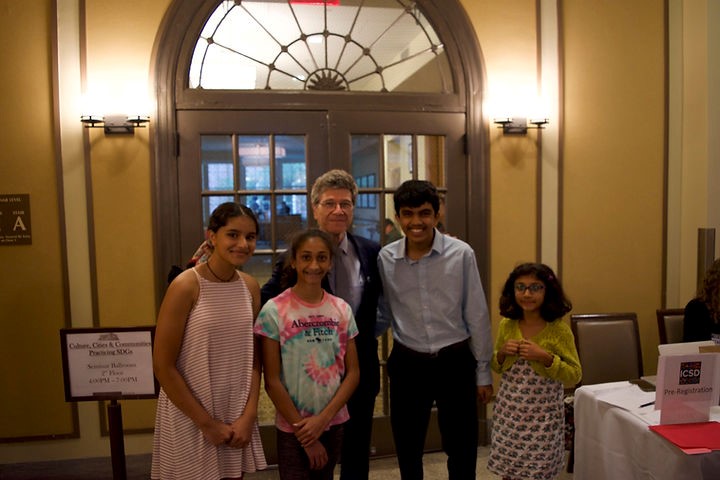
Professor Jeffrey Sachs with our Eco Ambassadors (from left to right) Skai Pundalik, Vidya Bindal, Aalok Bhatt, Veda Bindal
Our Eco Ambassadors were selected to share their summer projects at the 2019 International Conference on Sustainable Development’s Education for Sustainability event.
Please click the Eco Ambassadors’ names for the projects selected:
Author: Celine Chung is an amazing artist and photographer and is interested in issues relating to women’s rights
Celine and the MSK ladies out on an Architectural Exposure Trip in Bhopal
Abstract
The issue of women’s rights, education, and power is prevalent in many of the world’s changing societies. In a case study of two architectural monuments in Bhopal, India, the influence of the Begum women on the Shaukat Mahal and the Gohar Mahal are considered. Through learning the history of these monuments, a group of local Bhopal women grew to understand their culture and history in a new light. This research discusses how women’s history and accomplishments have been erased or rewritten, particularly by the Indian government, and how that erasure affects the attitudes and self-understanding of women in Bhopal today. Literature and statistics on sexual assault in India and a photo novella project from Peru are also considered in terms of literacy, education, and empowerment among women. Ultimately, historical and cultural materials need to include women’s narratives as well as men’s.
In Bhopal, there once stood a ruling female empire that today’s women can only dream of. The under-studied history of the Begums not only makes up a significant part in the city’s history and development, but the history also features female leadership, something that Bhopal and many parts of the nation historically lack. Regardless, evidence of such history still stands in Bhopal today, in part in the form of local architecture.
In 1742, Yar Mohammad Khan, the Nawab, or governor, of Bhopal, died, leaving behind his wife, Mamola Bai (1715–1795). Since the couple did not have children, Mamola became the de facto ruler of Bhopal. Mamola was revered during her 50-year reign. According to legend, when Mamola became ill, saint Shah Ali Shah gave Mamola 10 years of his life so that she would be able to continue leading the city. Soon after the ritual, the saint passed away. The island burial ground of Shah Ali Shah is now a pilgrimage site.
In 1785, Salvador Bourbon, a French royal, came to Manji Mamola when the Bhopal government was searching for allies to counter British forces. Mamola was known for her keen political insight and, after gauging the kind of influence the British had, immediately befriended Salvador. She also bestowed him the position of General in the Bhopal State Army and gifted him land so that he would remain in the Bhopal State. However, not everyone was pleased with Salvador’s presence in Bhopal. Thus, Mamola gave Salvador a Muslim name, Inaya Masih. In doing so, Mamola was able to pacify orthodox Pathans by suggesting that Salvador would adapt to Muslim ways of life. Salvador and his cousin Pedro later became leading figures of the Bhopal court. For generations, the Bourbon family served the Bhopal state.
During his time in Bhopal, Salvador was well known as a highly educated member of the state and as an honorable, warm-hearted person. A Hindu woman came to Salvador to save her son from being killed by Diwan Chote Khan, his father. Salvador willingly took the child in and gave him a new name: Balthazar Bourbon, or his Muslim name, Shahzad Masih. Balthazar’s son, Sebastian Bourbon, became Prime Minister to Begums of Bhopal (Iyengar, 2018).
Soon after the Bourbons were introduced to Bhopal’s royal court, Qudsia Begum would establish a strong line of constructive female rulers. After the death of her husband, Qudsia Begum became the ruler of Bhopal; for the next 107 years, the political power of the city rested in the four generations of Begum women leaders (Khan, 2000). After she was appointed ruler, Qudsia began the construction of the Shaukat Mahal. The Bourbon family contributed to its design; thus, there is a heavy French influence in the architecture. The Shaukat Mahal was first built as Balthazar Bourbon’s palace. Sebastian Bourbon’s wife, Madan Dulhan, lived in women’s wing of the palace, also known as Zeenat Mahal. The Bourbon and Begum families continued to have the most work done to the women’s wing.
Due to its distinct Indo-French architecture, the Shaukat Mahal stood out from the Mughal-style architecture of the buildings that surrounded it. A well-known example of a Mughal-style building is the Taj Mahal, located in Agra, Uttar Pradesh. The Taj Mahal is famous for its majestic white domes and arched entrances, both typical features of Mughal buildings. Furthermore, Mughal architecture usually has one central corner. The Shaukat Mahal, on the other hand, has two. The arches are also more triangular in shape, evidencing French Romanesque style. Several fleur de lis engravings can be found on the buildings of the Shaukat Mahal, especially on the Zeenat Mahal. The symbol, which served as the royal coat of arms of the Bhopal royal family, was used by French monarchs since the 12th century and can also represent the Holy Trinity in the Catholic Church (Ostlund, 2019). Additionally, there are chapel-like structures perched on the roofs of the buildings. These structures served as a symbol of the Catholic church within a ruling Muslim community. The planning that went into the Shaukat proved to not only be stylistic, but also strategic. Past the gate and in the middle of a small courtyard is a triangular fountain. The Bourbons and Begums used this fountain as a cooling system for relief from the city’s heat. There is also a secret tunnel that leads to the Upper Lake. The tunnel is used as an emergency escape route for women living in the Zeenat Mahal. However, the women would also use the tunnel to leave the building unnoticed and go for a swim.
Two streets across from the Shaukat Mahal and right beside the Upper Lake stands the Gohar Mahal. Although now used for tourism, exhibitions, cultural events, and fairs, the Gohar Mahal was built in 1820 by Nazar Muhammad Khan, the Nawab of Bhopal at the time, for his wife, Qudsia Begum. The building got its name from Qudsia’s birth name, Gohar Ara Begum. The Gohar Mahal acted as a residential and working place with no separate or designated parts for men and women (as the female ruler at the time of building, Qudsia did not see the need for divide). During the latter half of her life, Qudsia Begum lived in the Gohar Mahal while her daughter, Sikander Begum, ruled Bhopal.
The architecture of the Gohar Mahal contains Hindu and Mughal influences. The structure is three stories tall, and its entrance faces southeast. The positioning of the entrance follows Vastu Shastra, a traditional Hindu form of architecture that incorporates intense planning and science rather than superstition in order to help produce the best home (Prasad). The use of mud to put pieces of the buildings together is native to South India, and the building’s faded red exterior also speaks to Mughal influence. Lastly, one of the Gohar Mahal’s defining characteristics is its large courtyard. The purpose of this courtyard was to provide natural light and air exchange throughout the entire palace. A small fountain in the courtyard also created a cooling system similar to that of the Shaukat Mahal.
Although Bhopal has such significant and symbolic architecture relating to the lives and history of women, some women who live in Bhopal for almost their whole lives do not learn about it. During summer 2019, a few members of Mahashakti Seva Kendra (MSK) were brought to see the Shaukat Mahal and Gohar Mahal. MSK is an all-women’s organization that was built to empower victims of a massive gas leak at Bhopal’s Union Carbide plant in December 1984 that killed over 20,000 people. Even after the incident, over half a million people were exposed to methyl isocyanate gas and other harmful chemicals. Since 1992, MSK’s founder and president, Indira Iyengar, has been working to support these families affected by the tragic gas leak. MSK has developed non-chemical based natural dye products and has used its profits to assist the affected families. By providing programs that teach their women how to make certain textiles and products and offering employment, MSK thus trains women on how to develop a sense of agency and independence in their lives (Mskonline.org).
The women bubbled with excitement on the day of their visit to the Shaukat Mahal and Gohar Mahal. The small field trip was the first time that they ventured into the city without their sons and husbands. At the Shaukat Mahal, a man walked out of one of the buildings and into the courtyard. He welcomed the women to the Shaukat Mahal and began to share the history of the place in English. During his speech, the man claimed to be one of the descendants of the ruling class of Bhopal that lived in the Shaukat Mahal. He emphasized the role of women in Bhopal’s and the building’s history. However, when he began to translate the history into Hindi for the women to understand, something was off. The women later explained that the man began to joke that, similar to how the Begum women ruled diligently over the city, his wife rules over him, always telling him what to do. For the women, this attitude was strange. After all, in Bhopal, women barely have any agency; today, they have little power compared to the Begums of the 18th century. From that moment on, the women began to doubt the guide’s credibility.
The guide noted another thing: the Shaukat Mahal is falling apart. The building is now considered private property and therefore is ineligible for any funding for restoration. The former palace now houses living quarters, a restaurant, and an inn. The Shaukat Mahal is over 180 years old and represents women’s history and capability in Bhopal. Unfortunately, the crumbling buildings may have limited time before they decay into rubble.
Upon learning of the details and the kind of planning that went into the construction of the Shaukat Mahal and Gohar Mahal, the MSK women were pleasantly surprised by the attention given to the royal women and by the ingenious of Qudsia Begum and the rest of the royal family. Though these women were previously unfamiliar with the Shaukat Mahal, they knew of the Gohar Mahal because of the exhibitions it hosts.
Regardless of the time they had resided in Bhopal, the women were unaware of the rich history of their city. They also shared that the children that get to attend school do not learn about Bhopal’s powerful female rulers and buildings, either. The once-powerful rulers were absent from public education. In India, the federal government oversees the education of the country’s children, including the content of textbooks. The government can also use this power to manipulate information. In 2017, the history on the Mughal empire, a Muslim empire which ruled India for over two centuries, was changed and nearly deleted from many textbooks (“Mughals disappearing”). The Mughal empire is remarkable for several reasons, from its legacy in literature to its great architectural structures; this empire includes both the Shaukat Mahal and the Gohar Mahal. Yet in the state of Madhya Pradesh (of which Bhopal is the capital), officials altered the history of the Sino-Indian War. This war between Chinese and Indian armies ended in Indian defeat, with a loss of nearly 4,000 Indian soldiers and a drop in the nation’s morale. However, the new textbooks claim otherwise: “What famously came to be known as Sino-India war of 1962 was won by India against China” (Menon, 2017). Textbooks with this incomplete history are used in several Madhya Pradesh schools affiliated with the Central Board for Secondary Education (CBSE) of the government of India. The state itself is ruled by the Bharatiya Janata Party (BJP), which is also the party of Indian Prime Minister Narendra Modi. Thus, as the historical facts of the Gohar Mahal and Shaukat Mahal were deleted from school materials, children had no way to know learn the truth.
Although once ruled by powerful women, India is recorded as the most dangerous country for women due to sexual violence in 2011 and 2018 (Goldsmith & Beresford, 2018). After the gang rape of eight-year old Asifa in 2012, a wave of protests against violence towards women took over India’s cities. Women in India have been victims of all kinds of assault for many years, and they are not always safe in their homes: 95 percent of rapists across all reported cases have been family members (Narayan, 2018).
In a society governed by patriarchy and violence, it is no surprise that there is little to no mention of the Begum women in many school curriculums. In fact, many women in India do not even have access to an education at all. Although the constitution of India claims to provide equal rights for men and women, women lag far behind men at all levels of opportunity. One of the major factors that impact women negatively is poverty—30 percent of people in India live below the poverty line, and women make up 70 percent of that population. Regarding sex crimes, the literacy of women is related to the rate of reporting. According to data from the National Crime Records Bureau (NCRB), an Indian government agency, “there exists a positive correlation between the female literacy rate of a state and reported cases of rapes per 100,000, indicative that women are more likely to report crimes with higher levels of education” (Bandyopadhyay, 2018).
There exists a strong correlation between education, empowerment, and subsequent action. More importantly, countless forms of art that have empowered women to take action regarding the problems in their community. An example that combines art, empowerment, and research is the photo novella. Photo novella involves research in which the research subjects are asked to take photographs relating to the topic of research. The process may include photo interviewing, photo eliciting, reflexive photography, and photo-voice.[1]Photo novella may encourage participants to engage in critical thinking and reflection. The images become data when the participants begin to discuss their perspectives on the photos taken (Burke & Evans, 2011).
One example of a successful photo novella project is a 1984 empowerment project based in Peru by the Asociación Perú-Mujer. The organization aimed to encourage illiterate and semi-literate rural women to participate in local health and family planning initiatives in ways that better protected their own health interests. The researchers handed out four different kinds of booklets consisting of a series of simple line drawings with descriptive text that depicted the lives and problems of families in the community; the booklets were designed as coloring books, and each type targeted a different area of the country. The booklets covered the burdensome underbellies of family life: unemployment, living costs, alcoholic partners, domestic violence, housework, and decision making, just to name a few. Despite the distress sparked by these booklets, the participants were able to begin a discussion because they were all so familiar with the problems. The project was also the first time many of the women had access to coloring and reading materials.
The results were overwhelmingly positive. After the experiment, the women reported a greater sense of self-worth. In fact, many used their newly earned sense of confidence to work together and take action in the community. They replaced an incompetent town doctor, helped to move health clinicas closer to homes, and worked to support women living in violent family settings (Wang & Burris, 1994).
Some researchers attribute the success of Perú-Mujer to good use of feminist theory: “Feminist research view women as authorities on their own lives; it enables them to construct their own knowledge about women according to their criteria as women, and to empower themselves through knowledge making” (Wang & Burris, 174). Women must be the focus and source of action. Thus, power must be organized into different kinds. The article targets three different types: the power to (affirmative power, ability to do things), the power with (the ability to work with others toward a common goal), and the power over (the ability to influence or to direct other people or the environment). According to Wang and Burris, “Photo novella attempts to create the conditions in which women can further develop power to, power with, and power over, in order to effect positive changes for health in their individual lives, and in their communities” (174). The positive feedback of photo novella is evidence of the importance of art education and engagement in local institutions in improving the quality of life of not only the women in the community, but also the entire community itself.
The efforts to teach the women of MSK on Bhopal’s local architecture relate to the Perú-Mujer photo novella research because both demonstrate forms of thoughtful education projects that have empowered women to take action in their communities. Upon learning about the Shaukat Mahal and Gohar Mahal, the women of MSK were inspired to educate a promising and conscious younger generation that can sustain their city’s significance on a national and global scale. The protofeminist history of the architecture has pushed these women to develop into critical and active members of society. History is flexible not because it can be manipulated, but because there is always room available to include the narratives of those who have not always received the spotlight.
The women of MSK were amazed with the architecture of Gohar Mahal and Shaukat Mahal. They were unaware of how the construction worked, and that the buildings were physically made. As the guide explained how the buildings were constructed with specific details about each structure, a new perspective opened to some women. One element that was especially interesting, yet surprising to some women, was how some women were in charge of the building process. The idea that women are capable and able to conduct something major became a new concept to the MSK women.
The history of the two architectures continues to appeal to women in MSK, as usually they are told how things are done by their husbands. The husband will tell the wife where everything should be, even the toilet. For example, one member of MSK was absent from the visit, as she had to aid her husband in building their house.
Previously, architecture and buildings did not have much meaning to the women at MSK. Rather than holding symbolic significance, buildings and structures were simply rooms of various sizes and functions. Even if the women had wanted to spend more time to understand why a building was made or what was the meaning behind it, they did not have the resources. Next time they have the opportunity to visit Gohar Mahal and Shaukat Mahal, the women of MSK may look at them with fresh eyes and see what more there is about the history of the place. They now know more of the symbolic meanings and history of the two buildings.
Though the Shaukat Mahal was in bad shape, neither the government nor the people who lived there cared when it was falling apart. Nobody knew the history, thus they could not put any value towards it. Nobody could value or support the heritage. However, the women of MSK now consider it an important part of their culture. They want to go back with their children and introduce the next generation to the culture of their city. In the past, they could not explain this magnificent culture to their children, as they did not know either. However, now that they have access to the knowledge about these historical locations, they wish to share it.
Now, with the knowledge they have, these women want the history of these structures to be integrated into textbooks so that children can learn about the past. Only big leaders of big cities are mentioned in history books; rarely are those in small places, and small palaces are never mentioned. Outside sources for history and other information are hard to access for women and children in Bhopal, thus it is difficult to build understanding. As no one knows the true history, cultivating interest in these places is a challenge.
Although major cities in India continue to fight for women’s rights, India remains a country with one of the lowest track records for women’s rights. This is more severe in smaller cities such as Bhopal. Ironically, in the past, strong and independent women ruled over the palace of Bhopal, yet today, women have no power. The historical events are hidden by the government, so few people really know about the past. To educate and empower the women of Bhopal, as well as in many other minor cities in India, access to accurate materials for education is vital.
References
Bandyopadhyay, S. (2018, May 8). A closer look at statistics on sexual violence in India. The
Burke, D., & Evans, J. (2011, June 1). Embracing the creative: The role of photo novella in
qualitative nursing research. International Journal of Qualitative Methods,10(2), 164-77.
doi: 10.1177/160940691101000205
Goldsmith, B., & Beresford, M. (2018, June 18). Poll ranks India the world’s most dangerous
country for women. The Guardian. Retrieved September 2019 from https://www.theguardian.com/global-development/2018/jun/28/poll-ranks-india-most-dangerous-country-for-women
Iyengar, I. (2018). The Bourbons and Begums of Bhopal: The forgotten history. New Delhi,
India: Niyogi Books.
Khan, S. M. (2000). The Begums of Bhopal: A history of the princely state of Bhopal. London: I. B. Tauris Publishers, 71.
Menon, H. C. (2017, August 16). In the version of history in India’s new textbooks, China lost
Gender and women empowerment approaches: Interventions through PRIs and SCOs in Northern India (article)
○ PRI: Panchayati Raj Institutions
○ CSO: civil society organizations are organisations not owned or run by the government and include all organizations involved in development interventions.
○ After WWII, world-level institutions of development such as the World Bank (WB), Food and Agriculture Organization (FAO), United Nation Development Program (UNCO, 2012) began to promote institution building
○ How the meaning and use of the term “gender” has been debated
■ The article states that the origin of the term gender may have been in the 1970s by American and English feminists. The World Bank considers gender a socio-economic variable, and the FAO defines gender as a relationship between men and women in both a physical and perceptual sense. The article argues that the point of debate is to help make the term represent men and women on an equal level. Regardless, world institutions agree that the role of women is often subdued due to social norms.
■ Either husbands or in laws are identified as village representatives by the community. Women were only present in documents, not in person
Women in Politics and Schooling Investments (article)
○ The Indian constitution gives a lot of political power to the 28 states and 7 Union Territories
○ Many politicians originate from elite, upper-caste families
■ Regardless, women representation on state and national level remains low
Conclusion
Transcript
Celine: What do you remember from the buildings that we saw two days ago?
Pooja: On the main gate [of Shaukat Mahal] there were some iron things, and at the main gate, the year the building was made was written. There was something on the walls that they did not understand. [At Gohar Mahal] there were statues of turtles and elephants. They keep talking about what they saw inside. … So the queen sits inside the thing and people pick it up from both sides.
Celine: Did you ever hear of these two palaces before we went?
Women: No
Pooja: They haven’t heard of Shaukat Mahal, but they heard of Gohar Mahal because of the exhibitions that are held there.
[After the presentation]
Celine: After learning not only about the history but also the innovative structure, how do you feel about [the Shoukat Mahal and Gohar Mahal]?
[Women clap]
Pooja: I was telling them that my grandmother is a Bourbon. They liked the whole idea of how smart those people were with the construction. Earlier, we did not know that. We thought the buildings were just made. There was so much thought put into making the buildings, and that was something really new for us.
Celine: And it is also interesting, because usually women are not in charge of the building process. One of the female ruling Begums would always be in charge of the people on how to make it.
Pooja: In today’s times, the husband will tell you where the toilet be and the husband takes charge. One of the girls is not coming to work because she is getting her house built, so they want to see how she is getting it done.
Celine: Do you now consider these two buildings a big part of your culture?
Pooja: Now next time when they go, they want to take their children and introduce them to the culture of their city. We didn’t know and we didn’t tell our children. But now they want to take all of their children there and explain things to them.
Celine: Did you ever think that architecture was important? Did this change the way you look at any building?
Pooja: There are very small, small rooms inside the buildings, and they want to spend more time and understand why it was made and what was the meaning behind them. Next time, they want to visit these places again to look at them with fresh eyes and see what else there is about the place.
Celine: For the Shaukat Mahal, not only does the government not care, but when it was discovered that the place was falling apart, not a lot of people who lived there cared either.
Pooja: So nobody knew about the history. If people tell or if it is in school, then we would know about the history. Since nobody cared about the place, nobody valued or supported heritage. That was one of the main things. Another thing is that we are so busy in our own day-to-day things that we have no inclination. And even if we knew, one person cannot do anything, and who is going to form that group?
Celine: What I think is that, whoever is in power gets to decide what kind of history the people know; there is always a different person in power, and it is usually not the women who get to decide. But the thing is, even just noting art a little bit, it really helps your brain to help analyze things better and you can notice things better. You can see the world with different eyes.
Pooja: They want [the information] to be integrated in the history books also so that their children also learn. We only learn about the big leaders in the history books, and small places and small palaces are never mentioned. We don’t get all the sources to get to know this. There is no place where we can go and understand. Nobody wants to help and explain the places. They are talking about the guide you mentioned at Shaukat Mahal. He was saying that he was very scared of his wife. And the moment he said that, they knew that he was lying, because nobody is scared of wives. He said things like, “My wife tells me to do things. She tells me to sit down. She tells me to stand.” They knew that whatever he said was all wrong. It is never like that in Indian households.
[1]Photo voice is a process by which people can identify, represent and enhance their community through a specific photographic technique. Images are used to generate questions to members of a community and implicitly push these members to reach some sort of solution (Wang and Burris, 1997).
Environment in Action initiative of The Center for Sustainable Development(CSD) within The Earth Institute at Columbia University came about as a means to apply the knowledge and research of Lamont Doherty Earth Observatory scientists at The Earth Institute to science curricula of schools and community centers in developing countries where the Center works in education spheres.
It soon became clear that regardless of country and setting, every community of learners can benefit from environmental education at homes, schools, businesses and communities.
By presenting science that is alive and relevant to the daily lives of students, the Eco Ambassadors program is meant to engage our next generation youth in all places, so that they can begin educating their own communities about local environmental issues and start small steps to solving these issues with community action. It aims to engage interested participants in meaningful ways, using Design for Change’s Feel-Imagine-Do-Share method. The initiative is in partnership with Sustainable Development Solutions Network’s Global Schools Program.
The first pilot of the Eco Ambassadors program took place in Millburn, New Jersey. With summer months as the focus period, the program ran from June to September, from recruitment in June, workshop in July, project planning and action in July and August, to final presentations at a side event of International Conference on Sustainable Development in September. Details of the conference events that took place can be found here.
Our Eco Ambassadors took on initiative for awareness and engagement of various community members ranging from peers and family, to local businesses, township leadership and school authorities for sustained conversations at multiple levels (individual and systemic). Rather than having the projects be a one-time activity (on plastic reduction, composting and waste management, tree planting and biodiversity loss), the Eco Ambassadors, their parents and their community (educators, club members, even township leadership and officials!) are showing interest and looking to continue the program.
Based on our Eco Ambassadors’ request, we will be holding the Fall 2019 kick off workshop in Millburn Public Library on Thursday, October 23rd (3pm-5pm) and Sunday October 26th (11am-12:30pm).
We are also exploring a partnership to a Columbia University chapter and continuing conversations for potential collaboration with students from CUNY and Kean University.
More to come in 2019 and 2020! We will keep you posted!
For questions (and interest!) on Eco Ambassador program, please contact: [email protected]
As India charges forward as an economic, technological and political powerhouse, it’s important that strides are also made to ensure that its success isn’t limited to only half of the population. It’s important to understand how the fundamental tenet of who we are today and where will go as a community, is based on the figures and stories that started it. Oftentimes it is necessary to draw on cultural and historical figures interred deeply in our culture, in order to move forward. With Navratri around the corner, we must take this time to reflect on our history and mythology as a guide for resolving the present day issues our society faces.
Navratri is the celebration of Ma Durga, her different forms, and her fight against the demon king Mahishasura. Ma Durga has been regarded as “the Shakti” or the energy and power behind the force of good which Hindus celebrate. She wields weapons like a chakra, Vishnu’s discus, and bows and arrows, as they are symbolic of her strength. Her name “Durga” means “the invincible” as she represents endless intelligence and power. Hindus have revered her as the Divine self within themselves and prayed to her for her blessings on each new endeavor they go forth with.
As Navratri promulgates a period of devotion to the female warrior Goddess, this begs the question —if we worship female deities and pray to depictions of strong, powerful women, then why are women in modern-day society often treated unequally?
These questions are often times lost among the structural barriers created in order to speed growth and development. Cultures across the world use archaic frameworks as a crutch so as not to disturb the status quo, especially when devoting money, time and effort, to compound on previous successes and to compete. But we must also recognize that our female counterparts become further disadvantaged as the fruits of economic success often do not trickle down nor include them.
This Navratri, as we continue to move forward, we must take time to contemplate in our history and mythology which can guide us towards a deeper understanding of resolving the externalities our society faces. We ought to contemplate and reflect on bolstering the status of women across the world by embracing the powerful stories of Ma Durga.