As India charges forward as an economic, technological and political powerhouse, it’s important that strides are also made to ensure that its success isn’t limited to only half of the population. It’s important to understand how the fundamental tenet of who we are today and where will go as a community, is based on the figures and stories that started it. Oftentimes it is necessary to draw on cultural and historical figures interred deeply in our culture, in order to move forward. With Navratri around the corner, we must take this time to reflect on our history and mythology as a guide for resolving the present day issues our society faces.
Navratri is the celebration of Ma Durga, her different forms, and her fight against the demon king Mahishasura. Ma Durga has been regarded as “the Shakti” or the energy and power behind the force of good which Hindus celebrate. She wields weapons like a chakra, Vishnu’s discus, and bows and arrows, as they are symbolic of her strength. Her name “Durga” means “the invincible” as she represents endless intelligence and power. Hindus have revered her as the Divine self within themselves and prayed to her for her blessings on each new endeavor they go forth with.
As Navratri promulgates a period of devotion to the female warrior Goddess, this begs the question —if we worship female deities and pray to depictions of strong, powerful women, then why are women in modern-day society often treated unequally?
These questions are often times lost among the structural barriers created in order to speed growth and development. Cultures across the world use archaic frameworks as a crutch so as not to disturb the status quo, especially when devoting money, time and effort, to compound on previous successes and to compete. But we must also recognize that our female counterparts become further disadvantaged as the fruits of economic success often do not trickle down nor include them.
This Navratri, as we continue to move forward, we must take time to contemplate in our history and mythology which can guide us towards a deeper understanding of resolving the externalities our society faces. We ought to contemplate and reflect on bolstering the status of women across the world by embracing the powerful stories of Ma Durga.
During the 2019 United Nations General Assembly (UNGA) week, the Center for Sustainable Development (CSD) of the Earth Institute, Columbia University partnered with various schools and organizations to discuss topics surrounding gender, as well as data usage for sustainable development goals, as a side conversation to Sustainable Development Solutions Network’s International Conference on Sustainable Development.
On the gender front, CSD partnered with Barnard College’s She’s The First chapter co-hosted Gender in Culture, Cities and Communities.
On data usage, CSD partnered with School of Public and International Affairs (SIPA)’s Master of Public Administration in Development Practice (Development Practice Seminar Series) and SIPA’s Pan-African Network – to co-host an event on data usage for Sustainable Development Goals (SDG) implementation in Kaduna State of Nigeria.
We are honored to share reflections and perspectives from Commissioner Balaraba Aliyu-Inuwa (Ministry of Public Works and Infrastructure of Kaduna State, Nigeria) on the gender landscape in her state through her personal and professional experiences, as well as her sharing on the data usage for SDGs.
She is the first woman to be appointed to her current Commissioner role in Kaduna State. With a development practitioner background, she has previously served as Commissioner for Works, Housing and Transport, as well as for Rural and Community Development of Kaduna State.
She coordinated and designed the delivery of Kaduna Rural Development Program, and has worked as an Education Specialist and Deputy Programme Director for the Earth Institute at Columbia University on the Nigeria MDG Scape up Programe based in Abuja.
Thank you Commissioner for your ongoing collaboration and support for our ideas and discussions!
Please CLICK HERE for the video of her interview on gender.
Please CLICK HERE for the video of her interview on data usage.
Through lived experiences, we know the following statement to be true:
“Gender equality is not just the concern of half of the world’s population; it is a human right, a concern for us all, because no society can develop – economically, politically, or socially – when half of its population is marginalized.” (Robinson, Figueres & Mohammed, 2015)
This event aims to celebrate individuals and organizations who keep the mission to support women and men in their daily endeavors while reflecting on the gaps that persist in their endeavors. Speakers and panelists will discuss gender equality from culture, cities and communities lens, to shed light on efforts for advancement and representation of women as well as ideas and discussions on what factos need to be further considered going forward.
I had the privilege of attending the UN’s psychology conference on Gender issues. Mental well being is at the heart of the Sustainable development goals in the United Nations. Psychology can show us a new perspective or understanding about gender issues. It is embedded with the inner foundation of our society. Mental health and inner well being is at the heart of sustainable goals. This article is about migration and how it impacts women.
There are over 258 million migrants around the world today, and more than 50 per cent are women and girls. The experience of migration differs significantly for women and men, girls and boys: every aspect of migration, from those who remain behind, to the decision to migrate, transiting across borders, to settling in the country of destination, is influenced deeply by gender considerations, including the discrimination that they may face.
The remittances sent by women migrant workers improve the livelihood and health of their families and strengthen economies. Many of the women who are immigrants just want to earn a dignified living and fend for their children.
The migrant women around us have diverse faces, dreams and realities, and help sustain our economies, homes and communities. Every sixth domestic worker in the world is an international migrant, with women making up 73.4 per cent of international migrant domestic workers. With half of the estimated 260 million migrants worldwide being women, it is critical that the implementation of the Global Compact effectively includes their voices and addresses their needs and priorities.
Women are more vulnerable during migration. They feel displaced and uprooted and likely so. They are leaving their country and a part of their identity behind. It is therefore crucial to understand how gender interacts with migration and to respond accordingly. I strongly think that not only women even men have to adapt to such a transformation.
The irony is that displacement might actually empower women. Let’s take an example of a immigrant from an orthodox conservative country. If she migrates into a culture that is broad minded, that is more accepting than her home culture she would potentially, be empowered. And not only her, even her children would be living it up to their fullest potential. Migration can provide immense opportunities and benefits not only for the migrants themselves and their families, but also for the countries of origin, transit and destination. As the first intergovernmentally negotiated agreement to cover all dimensions of international migration, the Global Compact for Migration builds upon the commitments made by governments in the New York Declaration for Refugees and Migrants.
Author Bio
Tara Seth has successfully completed her M.A. in Psychological Counseling at Teachers College, Columbia University, New York in May 2018. She is a writer for the “Page community” as well as Power in Praxis. She currently teaches in a bilingual school and is a student, an Aspiring Actor at New York Film Academy. She strongly beliefs and advocates gender empowerment and makes an active effort to propagate this belief. #GenderEmpowerment#WomensRights
When was the last time you bought something to wear? Was it last month? Last week? Yesterday? Here in Delhi, shopping is more of a recreational activity than an errand. We say that the air-conditioned malls provide much-needed retreat from the scorching summer heat. Once there, what else to do but shop? Or we immerse ourselves in search of that addictive dopamine rush when we buy a branded item for a bargain price at a local market. And lost in rejoicing at the low price at an H&M showroom in a swanky mall or at the local market of Sarojini Nagar, we stay completely oblivious to the large cost to our environment.
A study by the Ellen McArthur found that one whole garbage truck’s worth of textiles are wasted every second. Furthermore the fashion industry is the second largest polluter globally, and generates more greenhouse emissions than all international flights and maritime shipping combined. Yes: while we in New Delhi dispute over odd-even number-plate days for cars, and walk around with face masks, we also continuously contribute to an industry that will use up a quarter of the world’s carbon budget by 2050 if the conditions do not change.
On March 14th, 2019, the UN Environment Assembly launched the Alliance for sustainable Fashion, which is ‘seeking to halt the environmentally and socially destructive practices of fashion, and instead harness the industry as a driver for improving the world’s ecosystems’. Many companies internationally are also finding creative solutions to this problem. In the Netherlands, a company called Wintervacht uses blankets and curtains to produce coats and jackets. Indosole, based both in Bali and San Francisco collects discarded tires in Indonesia to turn into shoes, sandals and flip-flops. Ecoloaf, in Spain, uses plastic waste from the ocean to make clothing, bags, and shoes.
For a country with it’s own fashion sense, led by the scintillating Bollywood, where are India’s solutions? While we do not lack in resources or entrepreneurial ability, we lack awareness of this matter. Ultimately it is only through increased awareness that we will be able develop sustainable habits. In the past 15 years, the pieces of clothing bought by an average consumer has increased by 60%, while the duration for which each piece of garment is worn has decreased by 36%.
We have begun to see clothes as disposable items, wherein lies the biggest malaise. We have to begin to invest in fewer but more durable items, and reduce the quantity of our textile waste, before it is too late. We have to make fast fashion unfashionable, because we know it is not sustainable, for Earth!
Author Bio:
Kaavyayini Pal is a class 12thstudent from Sri Ram School, Gurgaon, India. As she awaits her Board exam results, she indulges in meditating on the issue most dear to her sensibilities-Sustainability, for she truly believes that it is her generation that has to bear the biggest brunt of all that is ecologically wrong with the Earth today, and that it is also her generation which will come up with the right solutions for these problems they inherited.
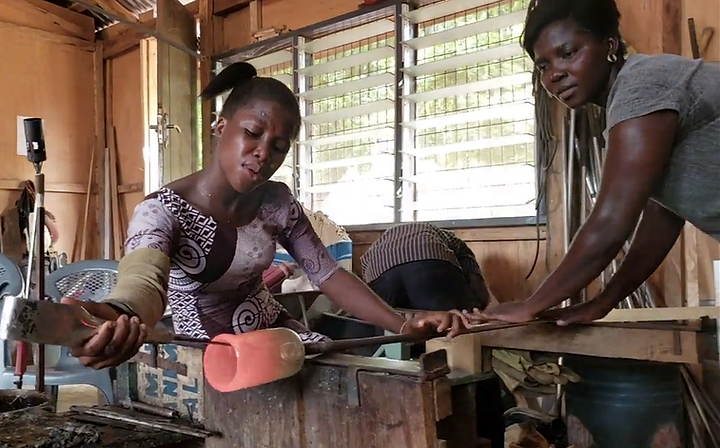
This is a story about a training program for young women in Ghana to learn skills of glassblowing along with business planning, marketing, and digital skills, but it also about so much more than that. It’s about how we consider the linkages between our sustainable development challenges through our program design to tackle numerous challenges at once. Sustainable development has been defined in many ways, but perhaps the most common and generally agreed upon definition defines sustainable development as “the ability to meet the needs of the present without jeopardizing the ability of future generations to meet their own needs” (Brundtland, 1987). The Sustainable Development Goals adopted in 2015 lay out an ambitious vision for how we can build more equitable and prosperous societies without sacrificing the well-being of our planet. What these young Ghanaian women are doing is not just about learning a trade. The program is equipping them with skills (SDG 4) to earn a livelihood (SDG 8), empowering women (SDG 5), shifting the culture toward one that values sustainably produced products and addressing pollution through a kind of grassroots waste management practice (SDG 12).
Sub-Saharan African countries have the youngest populations in the world, and are therefore hard hit by the global crisis of youth un- and under-employment and lack of relevant skills. In 2016 the International Labor Organization (ILO) estimated that the unemployment rate among youth aged 15-24 would peak at approximately 13.1% of the global youth population in 2017. Lack of access to a full cycle of basic education, poor quality of education for those who do receive it that lacks opportunities to learn practical skills aligned to local economic demand combine to stymie progress toward addressing this challenge. So in looking at strategies to address this issue in sustainable ways, we must ask, how can the challenges of climate change and environmental degradation be woven into strategies for improving youth access to education and training opportunities so that youth are equipped to live healthy lives and create jobs for a sustainable future?
Trainees shape the hot glass.
As Technical and Vocational Education and Training (TVET) is emerging as a key strategy for improving the livelihoods of youth and adults and promoting economic growth for developing nations, there is an opportunity to ensure that environmental education is infused into how vocational and life skills are taught. The ways various trades are approached, including the materials used, the manner in which waste is handled, and how products are produced and marketed all play roles in sustaining or degrading the environment. By incorporating concepts of environmental sustainability and environmentally-conscious design and decision making into TVET programs, learners will be encouraged to translate the lessons into their own ways of living.
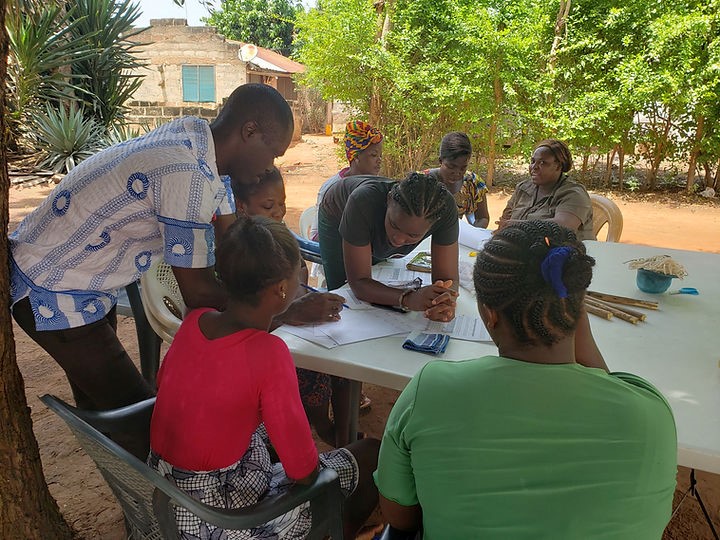
Trainees participate in business financial planning activity
The Center for Sustainable Development (CSD), through their Connect To Learn initiative, has been helping to increase young people’s access to quality education since 2010, supporting over 1,350 girls on secondary school scholarships across 11 countries, investing in digital tools for their schools, and training teachers with skills for integration of technology and inquiry-based pedagogies. As more girls began graduating without practical skills for employment and lacking funds to continue their education, CSD began investing more in vocational, digital, and life skills training, and is now building on this work by building in environmental education components.
This is taking shape in Ghana through a partnership with Youth and Women Empowerment (YOWE) in Odumase Krobo, a part of the country famous for their ancient practice of bead making using manually crushed recycled glass and local dyes. YOWE enlisted the support of local innovator and expert glassblower Michael Tetteh. Tetteh started his glassblowing career as a beadmaker, until his passion, curiosity and enterprising spirit led him to seek the mentorship and training support of expert glassblowers from Europe. After traveling to Europe to train in glassblowing, he setup his own glassblowing factory in his home, figuring out how to build the firing ovens and cooling chambers himself, and continuing to hone his skills. With growing popularity in his products, combined with a shifting culture in Ghana that is increasingly middle class and interested in proudly made local products, CSD and YOWE developed a training program to train young women in this traditionally male-dominated profession.
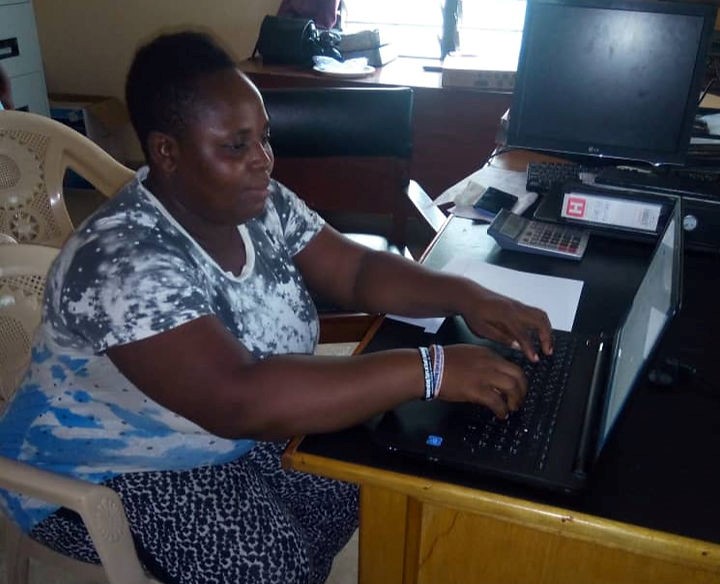
Glassblowing trainee practices using a computer during a digital skills training
Eight young women were trained in the trade, receiving companion trainings by CSD and YOWE teams in business planning and marketing. The program is now adding a digital skills component to help the apprentices have skills to be able to research new market opportunities, promote their products, and communicate with potential buyers beyond their own communities.
Trainer Michael Tetteh is passionate about using recycled glass in his production, and in minimizing waste wherever possible. This is novel in an area where effective waste management is sorely missing. While Ghana has made strides in recent years to implement trash pickup services in more heavily populated areas through a public-private partnership with company Zoom Lion, smaller towns and rural areas often still lack such waste management support. This combined with a general lack of awareness about the negative impacts of poor waste management lead to gutters and waterways choked with plastic and other waste. Recycling service happens only on an ad hoc basis, with individuals sometimes combing communities collecting recyclable materials to take to one of few disparately located recycling facilities as a source of income. Until improved waste management services arrive at scale, the humble glassblowing factory is helping to fill that gap. As more and more people learn about the factory, visitors come from far and wide, many bringing bags of glass bottles with them to be used in the production. Local restaurants collect their bottles and bring them to the factory to be transformed into gorgeous vases, dishes, candleholders and tiles.
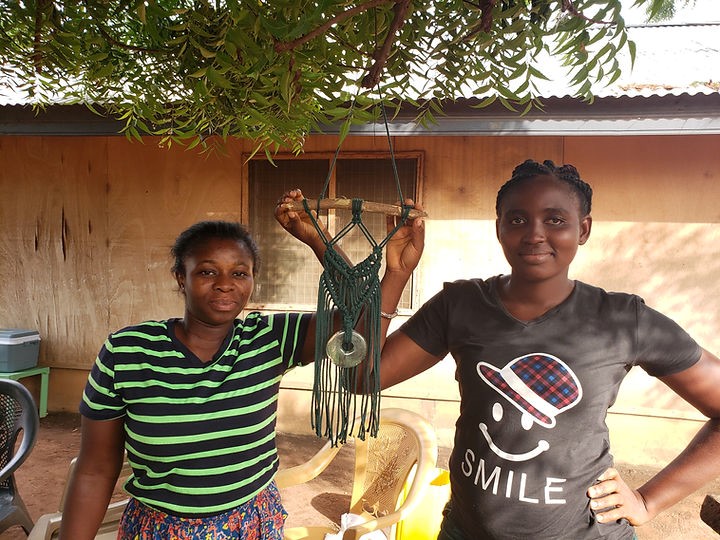
Trainees show off a macarame design featuring their handblown glass ornament
After just ten months of training, the original batch of trainees have truly become glassblowing artists. Five of the women are continuing on to work in the factory with their trainer, and the group is in the process of procuring land to build a bigger factory closer to the road to Accra to help facilitate the scale-up of their business. At the same time, the group is working to identify new ways of marketing their glass, adding on complementary skills such as macramé to create hanging vases and other decorative pieces.
The women will have their products for sale at the next Trade Fair Exhibition in Accra later in 2019. Stay tuned!
MIT and Harvard educated Jyoti Singhvi is the founder of JYOTI New York, an entrepreneur and mentor with first-hand experience of overcoming challenges to take a passion from an idea to a business. Haein Shin, Education Technical Adviser at Columbia University’s Center for Sustainable Development (CSD) interviews Jyoti Singhvi on her career to share her insights and advice for aspiring youth, especially for young women trainees in CSD’s education programs.
Navatha Kanike is a dynamic Center Manager and leader at ICT Women’s Center, one of Columbia University’s Center for Sustainable Development (CSD) education and energy initiatives. Haein Shin, Education Technical Adviser at CSD interviews Navatha to hear her thoughts and observations on the Center, which offers training for young women to learn skills aligned to the job market in her locality. The goal of the Center is to increase employment prospects for young women through the training on Information and Communications Technology (ICT), conversational English, life skills, environment and business skills.
Deepa Narayan has just released a new book, “Chup: Breaking the Silence About India’s Women“, published by Juggernaut. Dr. Radhika Iyengar from Columbia University’s Center for Sustainable Development interviews Dr. Narayan on how her research has illluminated the ways that even education women who believe themselves to be empowered women often behave in ways that undermine their own empowerment, and serve to make women invisible. The conversation closes with ideas for addressing bias in forward-looking ways.
7 Reasons why Manikarnikais a movie worth watching:
You might be a regular movie watcher who enjoys movies indiscriminately or, you could be someone who only watches movies that stir the usual air of social norms. Luckily, this movie fits the bill in both categories. It is a fairly well-made movie, with a gripping story line.
The Time-Period it covers: It is based in a time around the year 1857 – which was when the Sepoy Mutiny spread from Delhi/Meerut, all the way to the west and east of India, setting the course for the first ever pan-India Freedom movement against the British Rule. We see the urgency which must have reverberated through India at that time and allows us to see why it took an additional ninety yearsfor India to finally gain Independence. We see that what was lacking in 1857 was not bravery, but a concerted leadership on the part of the Indians. With that realization, we can certainly appreciate the roles that freedom fighters like Mahatma Gandhi, Nehru and Patel played as central figures of the freedom fight that eventually led to the British exiting India in 1947.
The Subject of the movie: The movie is about Rani Laxmi Bai of Jhansi, who till date is one of the extremely rare breeds of women warriors to appear, not just in Indian, but in the world history. She is married to a king who suffers from a feeling of weakness against the British that contrasts starkly with his wife’s youthful valor and an amazing grip on ways of warfare to match. She is superbly trained in horse-riding, archery and sword-fighting, and also exhibits a thorough read of the ways of the world. We see an example of this latter, when widowed and childless, she soon assumes the status of the leader for her region of Jhansi, and takes many decisions that she thinks will ensure the protection of the people of Jhansi. It is impressive to see that one of the first things she does as an independent ruler is to send a letter to the then British High-command in India, extending a diplomatic channel for the two powers to engage with one another. The British of course reject such a channel, and instead send troops to bring the Rani to her knees. The movie then is a continuous saga of the young Rani’s unabated courage and skill on one battle ground after another, till she finally dies at war.
The Details: While the movie is about an important and interesting topic, the devil, as always, is in the details:
Rani’s courage is palpable from the start and gradually becomes truly larger than anything one has seen on a big screen. Thus, while as an unmarried youngster she can shoot a leaping tiger mid-air with her arrow, by the time she is the Queen of Jhansi, she wields her sword on the enemy mercilessly, literally decimating multiple opponents with one swoosh of her sword, balanced atop a racing horse. She is fearless, and every part of her presence says that. In fact, there is a scene where she stands in front of a large idol of Goddess Kali (the goddess of destruction of the evil and ego), having just slayed a large number of enemy soldiers within a short time. No co-incidence that the posture she assumes with a sword in hand, ferocity in her eyes, and the dead foe at her feet, compels the viewer to liken the Rani to the Goddess herself. I think it is this viewpoint which is an interesting take on how someone named Laxmi (the goddess of wealth) demonstrates that women’s appreciation and gravitation towards the non-violent forms like knowledge and wealth, and motherhood and love, should not be misconstrued as an inability to take to destructive forms.
Continuing on the same lines, the Rani, when faced with a shortage of men to fight in her army, invokes participation from women. She addresses the women of Jhansi, thus: If God has chosen for women to do the most important task and bear human children, then surely taking up arms and fighting in wars cannot be any challenge to the strength of women. It is an amazingly poignant moment to see women giving up their metallic jewelry to melt it to make arms for them. No ballad on women could compare with the poetry of this scene. It is not just a slap on the face of the many myths that are perpetuated about women’s obsession with vanity, but also builds up women, queens and ordinary women alike, in newer light of not just softness and maternal instincts, but also of intelligence combined with sheer physical power. In fact one of Hindi language’s most popular poems by the late poetess Subhadra Kumari Chauhan that immortalizes the Rani by saying “She fought a lot, she fought like a man!” can be read in a new light now, “She fought a lot, she fought!”
Rani Laxmibai embodies the true essence of a liberated woman, who is a daughter, a wife, and a mother, but more than just that. She cares for the family she is put in, but does not take any role as given. She writes her own script wherever she is placed.
i). As a daughter, she outlearns her brothers in all skills taught to them. As a wife, she is her husband’s true consort in appreciating and participating in his love for books and arts. As a mother, even when her own child is poisoned to death, she extends her full protection to the child they adopt.
ii). In fact, even as a queen she is not just a beautifully dressed doll, she is also a ruler, who goes out to her people to see their ways of life first hand. To me, personally, it is one of the most fabulous twists on a typical Bollywood narrative to see that the only supposedly ‘item number’ kind of song and dance, where one finds dancers swaying their hips and busts on a somewhat raunchy number is being performed not for a man or a band of men, but for the Rani who sits on a throne like seat in a tribal area lavishing her praise at the performers. (To put the dance in context, it is a tribal dance about a bumble-bee stinging a passerby). This contrasts sharply with how Indian cinema has often portrayed women in history. For example, most recently in the blockbuster film Padmavat, the Rani was full of beauty, glamour, coyness and a great sense of right and wrong as laid out by the traditions of the time, and thus to protect her pride, at the end she prefers to jump into fire than be caught by enemy. However, isn’t that exactly how patriarchy wants to see women- as beautified commodities abiding by the norms laid out by religions and cultures dominated by men as priests, kings and lawyers.
iii). Rani Laxmibai, is a gender-bender in the true sense. As a widow, she refuses to have her hair shaved off, and does not take to wearing white clothes, nor to retiring to a life of an ascetic in the devotion of gods in the holy city of Kaashi.
For all the physical beauty the Rani possessed, nowhere in the movie, are we forced to think of her as a beautiful temptress. Infact the movie is a no-brainer to show to even little tween girls, because seduction or titillation is not the path taken by the director. Thus even when creating a male heir is a big premise in the movie, since the British threaten to take over any kingdom that has no male heir (so much for gender equality by the West!), there are no scenes of love-making. The movie is a slam dunk in succeeding to single-mindedly portray women in their often underplayed, and ignored, avatar of fierce strategists. The image of the Rani with the enemy’s blood dripping from her sword and smeared on her clothes, will surely inspire little children to embrace the fact that courage, and (unfortunately) violence, is not a prerogative of males. The disposition to violence is not a natural to any gender, and thus the stereotype of ‘boys will be boys’ when it comes to disruptive behavior definitely needs to be re-considered.
For lovers of period costume, especially amazingAmrapalijewelry, there is plenty to relish. The jewels are charming in their sheer size and variety, and remind the viewer once again, why India had beckoned invaders from all over the world again and again.
The movie is a labor of love for the female director, Kangana Ranaut, making her debut. She claims that she wanted to show patriotism as a mission larger than any life. Interestingly, this sentiment, and perhaps her own history of being outspoken about all casting couch advances made towards her, has earnt her the wrath of the popular Bollywood group. Her movie has been shunned by Bollywood big names, who have maintained a tight-lipped disapproval for a woman claiming right to patriotic fervor, a prerogative retained typically for male protagonists like Manoj Kumar back in the days, or for newer crop of male soldiers like Hrithik Roshan in Lakshaya. And it is just when, those inside the movie-world decide to ostracize Ranaut, that people at large, like you and me, stand up to show our support for a voice of dissent, not for the sake of dissent, but for the sake of stirring the air which otherwise continues to stifle many who even remotely imagine a world different from one ordered to them by the system.
Nidhi Thakur is an economist, with specialization in labor and health economics. Her interest in Gender issues, is an on-going evolution of her resistance to the many systemic biases that are perpetuated through political, social and unfortunately even religious institutions, in order to preserve a power hegemony which perversely favors a small section of society. She believes in empowerment through education, skills, financial independence and political voice. She has published in academic and non-academic journals, and is currently a Lecturer in Kean University, Union, NJ, where she hopes to interact and hopefully influence, and be influenced by, the lives of many a first-generation college goers from minority backgrounds. She has an M.A. in Economics from Jawaharlal Nehru University, New Delhi, a Ph.D. in Economics from University of Arizona, and a Post-Doc from University of Chicago.