Categories
Eco Ambassadors

2021 Announcements & Newsletters

January 2021
https://shoutout.wix.com/so/a3NSRXSR7?languageTag=en

February 2021
https://shoutout.wix.com/so/86NTknZ6V?languageTag=en

Eco Ambassador Summer 2021 Program Launch
https://shoutout.wix.com/so/3eNb7C5u4?languageTag=en
https://shoutout.wix.com/so/4cNb7xHYl?languageTag=en

June Workshop: Discovering Existing SDG14 Resources
https://shoutout.wix.com/so/82Nc5BKgu?languageTag=en
https://shoutout.wix.com/so/8aNdD3sYV?languageTag=en

Eco Ambassador Summer 2021 Program Update
https://shoutout.wix.com/so/09NddN_kg?languageTag=en

Eco Ambassadors: Submit your Summer Topic!
https://shoutout.wix.com/so/d0NeQSmIF?languageTag=en

July Workshop
https://shoutout.wix.com/so/e9Ng1Hf4i?languageTag=en
https://shoutout.wix.com/so/92NgWPSJx?languageTag=en

ArcGIS Office Hours
https://shoutout.wix.com/so/cbNh9uqBZ?languageTag=en

August Eco Ambassador StoryMap Draft Sharing Session
https://shoutout.wix.com/so/9eNihhybY?languageTag=en

September Pre launch Event
https://shoutout.wix.com/so/47Nlgs-q9?languageTag=en

October Events & Opportunities for Eco Ambassadors
https://shoutout.wix.com/so/3eNns1a3l?languageTag=en

COP26 & Book launch events
https://shoutout.wix.com/so/89Nq1ERgC?languageTag=en

Eco Ambassador Storytelling Finalists!
https://shoutout.wix.com/so/d5Nqpefyc?languageTag=en

Categories
Eco Ambassadors

2020 Announcements & Newsletters

Happy 2020
https://shoutout.wix.com/so/7dM_lVZua

February 2020
https://shoutout.wix.com/so/15N105raW

March 2020
https://shoutout.wix.com/so/89N3M1Ym7

June 2020
https://shoutout.wix.com/so/73NA0SJ6F

August 2020
https://shoutout.wix.com/so/b8NFkegrS

September 2020
https://shoutout.wix.com/so/a4NHFzG-v

September Event Reminder 2019
https://shoutout.wix.com/so/74NINgJf8

November 2020
https://shoutout.wix.com/so/81NMpJkVY

December 2020
https://shoutout.wix.com/so/98NOWAIo8

Categories
Uncategorized

2019 Announcements & Newsletters

Happy Autumn 2019
https://shoutout.wix.com/so/83MuYkTYS

Happy November 2019
https://shoutout.wix.com/so/44Mv22tAR

November 2019
https://shoutout.wix.com/so/f0MvgN97Z

Week before Thanksgiving 2019
https://shoutout.wix.com/so/93Mw5APvR

December 2019
https://shoutout.wix.com/so/fcMxTJST3

Happy December 2019
https://shoutout.wix.com/so/56MxwlZXu

Categories
EDforSD

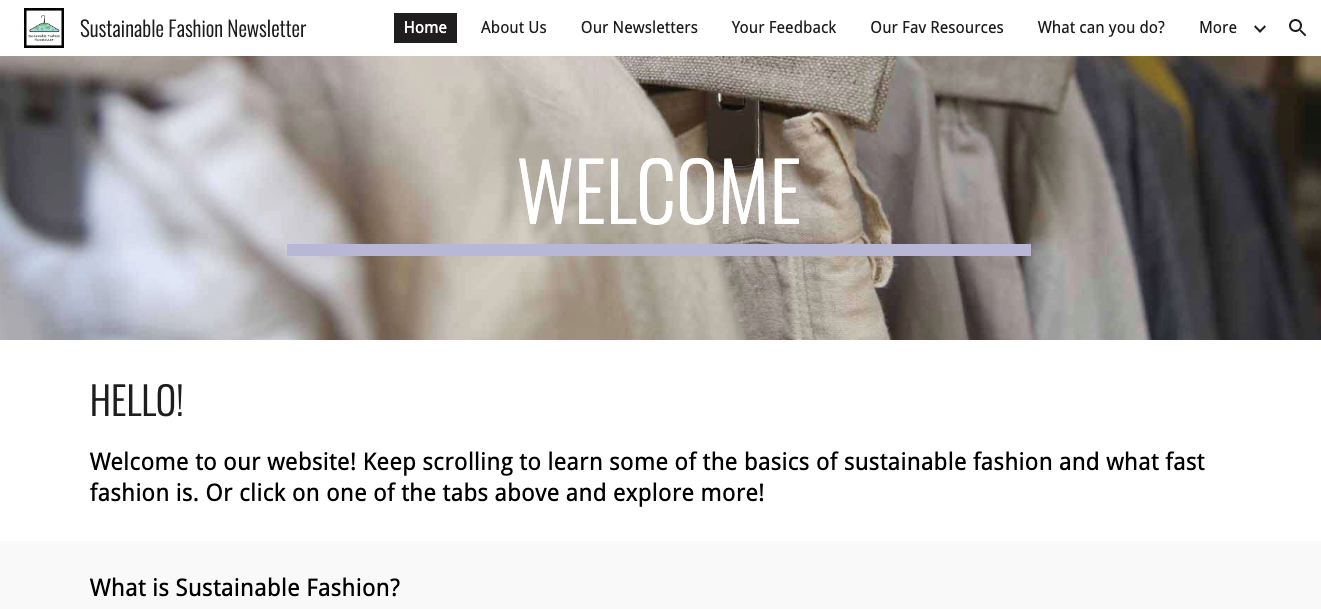
Keep your closet eco-friendly!

Check out the Sustainable Fashion’s October 2022 Newsletter by Lilian Brennan and Tabitha Webster!

https://drive.google.com/file/d/16d6HX3HJh7lAIdUI9UrqCbFQgy6z3c-k/view?usp=sharing

The website: https://sites.google.com/hvrsd.org/sustainablefashionnewsletter/home

Instagram:

https://www.instagram.com/fashion4theenvironment/


Categories
EDforSD

Middle School, Milkweed & Monarch by Vidya Bindal

Updated: Aug 23, 2022

by Eco Ambassador Vidya Bindal, Rising Freshman, Millburn Public School

At long last, there is a sign of hope and there are new wings to fly far and wide, literally. For me, as my middle school years come to an end, and I eagerly look forward to high-school there are a wide variety of electives to choose from and varsity sports, and then there is also a great news to share from the world of Nature. The World Wildlife Fund recently reported that there were 35% more monarch butterflies in Mexico’s forests this year than the previous year!

The monarch butterfly is a beautiful insect, and a legend in its own right. It travels upward of 3000 miles to and from the Northeastern United States to Mexico. It is not just one of nature’s most eye-catching creations, with the bright orange wings, but as is typical of nature, it is also highly helpful in pollination and preservation of local eco-systems.

The monarch butterfly population had been on the decline since 1995 when such a drop was first reported. Since then, this legendary insect was losing its tribe, largely for three main reasons:

  • Overlogging of forests in the areas of Mexico where the butterflies migrate to tide over winter in the north.
  • Climate crisis. As our planet warms, each new year recording higher temperatures, the butterflies’ migratory route between Canada, the US, and Mexico becomes less hospitable.
  • And last but not the least loss of Milkweed plants. Milkweed is a critically important plant because the choosy Monarch only lays eggs on these plants, and this plant then becomes the only food source for monarch caterpillars.

The loss of these butterflies was thus indicative of not just a loss of a natural process but also a distressing reminder of how we the humans are causing irrecoverable damage to our planet. However, as we can see from the latest WWF report, perhaps some people somewhere made note and started to undo the damage done on this innocent creature. I want to think that I know some, if not all, of those people. I know that my township of Millburn has been actively promoting the creation of monarch waystations in private yards, and a community native plants gardens with ample milkweeds, was especially created for this purpose. I am equally proud to mention that not only did we attempt such a garden in our backyard too, but that as eighth graders in our science class we dived fully into the nuances of the life-cycle of the Monarch butterfly culminating the year-long project with germinating milkweed seeds and growing them in our classrooms, to finally be able to take them to our homes and plant them. I was told by my school that while monarchs as a topic are not formally a part of the curriculum yet, teachers are encouraged to introduce ‘extra’ elements in the class to help students learn about different content and skills in science. In that context, I was filled with more hope for Nature when even my younger sister reported doing a similar native plants project in her school’s newly formed environmental club.

To have our in-class school experience be so meaningfully aligned to a real problem in Nature was already gratifying, and then to learn that our efforts, combined with those of many other smaller entities like us, are having an impact, is the icing on the cake. I look forward to a greater immersion in real-world problems of our world, in high school now.


Source: https://www.worldwildlife.org/stories/eastern-monarch-butterfly-population-shows-signs-of-recovery


Photo by Vidya Bindal. Lake Placid, NY.

Categories
EDforSD

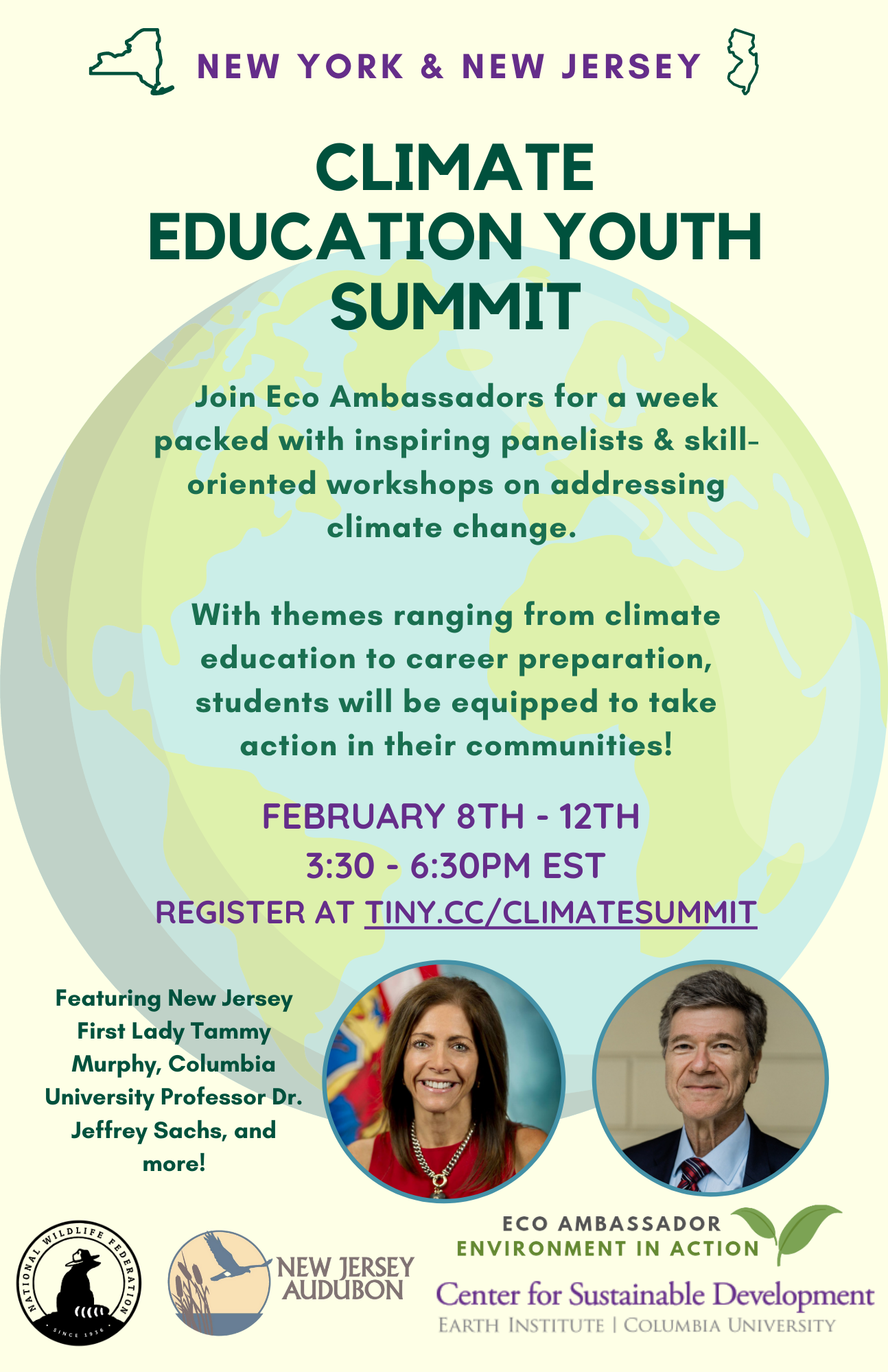
NY & NJ Climate Education Youth Summit!

Updated: Feb 12, 2021

Columbia University’s Eco Ambassadors Program of the Center for Sustainable Development at the Earth Institute, in partnership with the National Wildlife Federation in New York City and New Jersey Audubon, is organizing a Climate Education Youth Summit for New York and New Jersey’s students.

This Summit is best for middle and high schoolers as well as college students, but all are welcome! Each day of the Summit will include a panel of inspiring speakers as well as hands-on, skills-oriented workshops addressing the climate crisis. Our conversations will be based on the following key questions, with a theme each day.

The themes include climate education, community organizing, action planning, communication & arts for climate, and tips from students on college and career preparation.

  • How can communities take up climate change related actions?
  • How are students addressing the issue of climate change education?
  • What role does education play in addressing climate change?
  • How can institutions help to raise awareness and change behaviors?

The goal of the Summit will be to spread awareness about the climate crisis and its links to education through fun and engaging discussions. It will also help students learn how to address sustainability issues in their communities.

Keep scrolling down for the Summit Agenda!

***Each day has a separate registration on Eventbrite***

You can select the registration date in the dropdown date menu “Select a Date” button.

We welcome you to register for all 5 days!

*** Zoom links will be sent to the email address you used on Eventbrite to register***

Please note: Attendees who register for one specific Summit day will automatically receive Zoom links for all five days, to provide convenient access to all the week’s events.

Dates: Monday, February 8th to Friday, February 12th 2021

Time: 3:30pm – 6:30pm

Register here: tiny.cc/climatesummit

The New York – New Jersey Youth Climate Education Summit is organized by the Center for Sustainable Development at the Earth Institute Columbia University in partnership with New Jersey Audubon and the National Wildlife Federation in New York City. The main objective of this weeklong Summit is to increase awareness about local environmental issues in the two States and to encourage community activism thought citizen science and other approaches. The Summit will also make youth aware of career pathways in sustainability and environmental education. There will be networking sessions with current sustainability track Columbia University students. The Summit will also provide opportunities for Q and As with world-renowned economists such as Jeffrey Sachs, marine biologist Joaquim Goes, and New York Times reporter and Earth Institute journalist Andrew Revkin. In addition, there will be numerous workshops designed to help youth enhance environmental skills, and play an active role in their communities to address sustainability issues. The Summit is a great opportunity to open young minds to the possibilities in research and activism. The Summit’s Keynote Speaker is New Jersey’s First Lady, Ms. Tammy Murphy who is spearheading Climate Change Education as an integral topic in New Jersey’s K-12 school curriculum.

Join us to ask questions, debate and participate!

SCHEDULE

Feb 8 Monday theme: Why Climate Action through Education?

Feb 9 Tuesday theme: Pushing for Climate Action Inside and Outside the Classroom

Feb 10 Wednesday theme: Education for Climate Action

Feb 11 Thursday theme: Communication & Arts for Climate Action

Feb 12 Friday theme: Action Planning Day

MONDAY FEB 8th:

WHY CLIMATE ACTION THROUGH EDUCATION?

WELCOME

3:30pm – 3:40pm

Welcome & Introduction by Radhika Iyengar, Director of Education, Center for Sustainable Development at Earth Institute, Columbia University Eco Ambassador Program & online course for teachers and educators.

3:40pm – 3:55pm

Keynote Speech by Tammy Murphy, First Lady of New Jersey

3:55pm – 4:15pm

Guest Speaker Professor Jeffrey Sachs, Columbia University and

Advocate to the UN Secretary General on SDGs with a student panel

  • Purva Bommireddy, Middlesex County Academy for Science, Mathematics, and Engineering Technologies.New Jersey
  • Navyaa Jain, Newark Academy in New Jersey
  • Ishaan Bharadwaj, Millburn Middle School, New Jersey

PANEL: COMING TOGETHER FOR EDUCATION IN SUSTAINABLE DEVELOPMENT

4:15pm – 5:00pm

  • André Corrêa d’Almeida, Adjunct Associate Professor of International and Public Affairs; Assistant Director of MPA in Development Practice at School of International & Public Affairs of Columbia University
  • Priya Patel, Chairperson, Environmental Commission, Millburn, New Jersey
  • Radley Faulknor, AmeriCorps Vista Volunteer, Public Works Department, Baltimore City.gov
  • Moderators: Haein Shin, Education Technical Adviser at the Center for Sustainable Development of Earth Institute, Columbia University & Navyaa Jain, co-chair for the NJ Student Sustainability Coalition

WORKSHOP: LIFE AROUND THE WORLD!

5:00pm – 6:00pm

  • Frida Ruiz & Bianca Palomino, NJ High School Students, founders of the Green Cause

“Life Around the World!

Biodiversity is a curious and adventurous topic for students to engage in as it involves life from around the world. Using educational yet appealing videos along with interactive elements, the goal of the workshop will be for the students to learn and appreciate different lifeforms. The lesson is partially made by members of our initiative, The Green Cause. We plan to integrate both the talent of our members and our experience in virtual sessions to edify the young minds attending the workshop.

TUESDAY FEB 9th:

PUSHING FOR CLIMATE ACTION INSIDE & OUTSIDE

THE CLASSROOM

PANEL: ESD CURRICULUM ADVOCACY, DESIGN & IMPLEMENTATION

3:30pm – 4:45pm

  • Marc Rogoff, Lead Environmental Education Specialist, NJ Environmental Protection
  • Jaimie Cloud, Founder & President, The Cloud Institute for Sustainability Education
  • Michael Heinz, Education Program Development Specialist 3, Office of Standards, New Jersey, Department of Education
  • Moderators: Tara Stafford Ocansey, Education Technology Specialist, Center for Sustainable Development, Earth Institute, Columbia University & Aalok Bhatt, Eco Ambassador & Millburn High School student

BREAK & NETWORKING

4:45pm – 5:00 pm

WORKSHOP: COMMUNITY ORGANIZING THROUGH STORYTELLING

5:00pm – 6:30pm

  • Amina Castronovo, Youth Steering Committee Member, The Climate and Resilience Education Task Force, National Wildlife Federation
  • Faiza Azam, Youth Leader, Our Climate!
  • Jade Lozada, Co-policy director at TREEage,
  • Moderator: Tara Stafford Ocansey, Education Technology Specialist, Center for Sustainable Development, Earth Institute, Columbia University

WEDNESDAY FEB 10th:

EDUCATION FOR CLIMATE ACTION

PANEL: TEACHERS’ PERSPECTIVES ON EDUCATION FOR CLIMATE ACTION

3:30pm – 4:30pm

This panel will be of interest to K-12 teachers & educators!

  • Shakira Provasoli, Science and hydroponics teacher, PS 333 in Manhattan
  • Becky Higgins, Science Educator, Johns Hopkins University Science Content Specialist, Bridgeport, CT
  • William Bertolotti, Science Teacher, Plainedge High school, NY
  • Cassie Xu, Associate Director, Non-Degree Education & Outreach Programs, Director’s Office, Earth Institute, Columbia University
  • Moderators: Radhika Iyengar, Director of Education, Center for Sustainable Development, Suvid Bordia, Washington School, Millburn, NJ & Juliana Bartels, Center for Sustainable Development

PRESENTATION: CLIMATE EDUCATION RESOURCES TOOLKIT

4:30pm – 5:00pm

Discussion & Presentation on the Climate Education Resources Toolkit developed by Climate and Resilience Education Task Force Youth Steering Committee members, National Wildlife Federation NYC-based high school students Gabriela Mendoza, Sara Poon, and Elena Rubenstein will share about their work on a climate education toolkit: a compilation of vetted resources- including curriculum sets, lesson plans, websites, organizations to get involved with, and information on environmental justice- curated by high school students, for students and teachers interested in engaging with the climate crisis. For teachers, the toolkit provides insight into how to facilitate climate discussions and classroom activities. For students, the toolkit will teach you how to get involved in student-led activism, reliable research, and interactive activities that lead to a deeper understanding of the climate crisis.

BREAK & NETWORKING

5:00pm – 5:30pm

PANEL: STUDENT RESEARCH

5:30pm – 6:30pm

Readington Middle School Team Research on:

Climate Change, COVID-19, and Creating Community; Growing Food and Resilience in the Garden State; An Investigation into Sustainable Hyperlocal Food Production to Increase Food Security for All — the Science and the Student Action it Sparked

  • Readington Middle School Students
  • Eddie Lou, Grade 9
  • Riya Gupta, Grade 8
  • Tatiana Hlinka, Grade 8
  • Bronwyn Downey, Grade 7
  • Olivia Davis, Grade 7
  • Callum Suggitt, Grade 6
  • Christopher Serrao, Grade 9
  • Millburn School
  • Vidya Bindal, Grade 7
  • Betsy Freeman, Readington Middle School Advisor, Enrichment Coordinator of Green Initiatives and Sustainability
  • Jonathan Hart, Readington Public Schools Superintendent,
  • Moderators: Radhika Iyengar, Director of Education, Center for Sustainable Development at the Earth Institute, Columbia University & Allison Mulch, Project Director for School Sustainability, NJ Audubon

THURSDAY FEB 11th:

COMMUNICATION & ARTS FOR CLIMATE ACTION

PANEL: COMMUNICATION & ARTS FOR CLIMATE EDUCATION

3:30pm – 4:30pm

  • Andrew Revkin, Founding Director of the Initiative on Communication and Sustainability at Columbia University’s Earth Institute
  • Joaquim Goes, Lamont Research Professor at Lamont Doherty Earth Observatory at Columbia University’s Earth Institute
  • Valerie J Amor, Founder, Drawing Conclusions
  • Moderators Haein Shin, Education Technical Adviser, Center for Sustainable Development at the Earth Institute, Columbia University & Kristina Ang, fashion student at Parsons School of Design

PRESENTATION: NEW JERSEY STUDENT CLIMATE CHALLENGE

4:30pm – 5:00pm

New Jersey Student Climate Challenge

Heather McCall, Program Director for Sustainable Jersey for Schools.

Andrea Drewes, Department of Graduate Education, Leadership, and Counseling, Rider University

The New Jersey Student Climate Challenge is a pilot program to highlight the role youth can play in addressing the climate crisis. This free program includes a virtual Climate Summit and a Climate Contest that will provide support and recognition to teams of middle and high school students in Atlantic City Electric’s (ACE) service area as they implement local projects to address the climate crisis. ACE’s service territory includes parts of Atlantic, Burlington, Camden, Cape May, Cumberland, Gloucester, Ocean, and Salem counties. Schools serving students in grade six and above are eligible to participate. View the list of eligible schools here. Based on the success of this pilot project, the project partners hope to implement the New Jersey Student Climate Challenge statewide in the 2021-2022 school year.

WORKSHOP: CREATION SUBVERTS DESTRUCTION: Artivism in Climate Advocacy

5:00pm – 6:00pm

Facilitated by Edie Fine and Virgile-Minh, Extinction Rebellion Youth NYC. Extinction Rebellion is a global nonviolent movement to compel the world’s governments to address the climate and ecological emergency. This workshop delves into the long accepted notion within advocacy that an artistic identity is essential to change. We will be exploring the ways in which visual, literary, and performance art can shake loose our inhibiting notions of the world and make us confront the issues we face. In the climate movement specifically, artivism is central in that it encourages a cultural shift where creating is valued instead of consuming, building instead of destroying. Artivism is about constructing a better, more artful world in place of an antiquated oppressive one.

FRIDAY FEB 12th: ACTION PLANNING DAY

Join Zoom Meeting

https://columbiauniversity.zoom.us/j/91333413908?pwd=YXJQNHFscDkxZ2NjcUV5UmNYeVU3Zz09

Meeting ID: 913 3341 3908

Passcode: 380184

Find your local number: https://columbiauniversity.zoom.us/u/adGtxpYDqn

What will we do with the information we learned at this summit? How can we collectively organize?”

PANEL: TIPS & ADVICE FOR SUSTAINABILITY STUDIES & COLLEGE PREP

3:30pm – 4:30pm

  • Charlotte Munson, Sustainability student, Columbia University
  • Jeremy Ashton Zimmerman, SDG Hub Member, Columbia University
  • Sofia Assab, SDG Hub Member, Columbia University
  • David Yang, SDG Hub Member, Columbia University
  • Isadora Muszkat, SDG Hub Member, Columbia University
  • Moderators: Purva Bommireddy, Team Leader, Bye Bye Plastic Bags New Jersey & Navyaa Jain, High School Co-Chair, NJ Student Sustainability Coalition

INTERVIEW: VOICES OF MUSICIANS

4:30pm – 5:00pm

Jeneda and Clayson Benally belong to the Navajo tribe. Along with their other siblings, they are a part of the family dance troupe, The Jones Benally Family, and the Navajo punk rock band, Blackfire, where they channelized their anger at the injustices faced by their people through their music. The brother-sister duo is also the force behind the award-winning punk rock group, Sihasin, which was formed in 2012. Their first album, ‘Never Surrender’ won critical acclaim and numerous awards. They also collaborated on the song “Sister Moon and Brother Sun” for the 2017 Grammy-nominated album, The Okee Dokee Brothers. Their songs like ‘Strong Together’, ‘Stand Up’ and ‘Shine’ are characterized by powerful lyrics and strong rhythmic beats. They are not only creative performers but also activists who have traveled the world sharing their culture and raising awareness on important issues such as human rights, environmental and animal rights, forced relocation, and the importance of sacred sites, native language, and traditions. Jeneda has been a Miss Flagstaff Indian DaysPowwow Princess and is also a national Native American Honor Roll Society member. Jeneda and Clayson also conduct workshops in schools to foster cultural acceptance and pride and bring hope to the next generation.

Interviewer: Aalok Bhatt


WORKSHOP: ACTION PLANNING

5:00pm – 6:30pm

Tying everything together through discussions & reflections from the week with

Moderators: Radhika Iyengar, Tara Stafford Ocansey & Haein Shin (Center for

Sustainable Development, Earth Institute, Columbia University – education team)

Post-Summit feedback survey

ORGANIZER PROFILES


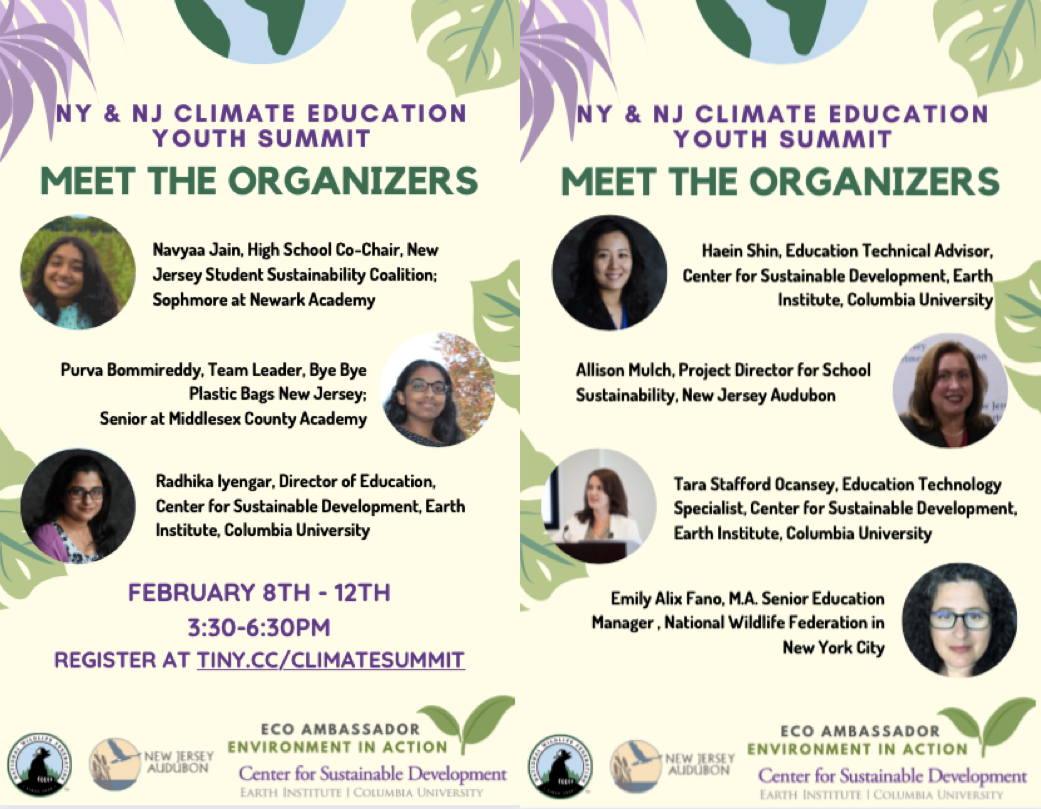
Radhika Iyengar, Director Education, Center for Sustainable Development, Earth Institute, Columbia University.

Radhika is a lifelong learner of sustainability. Her research focuses on Participatory Action Research and the power of the community to learn about local environmental issues and take charge. She uses citizen science approach as a tool for Education on Sustainable Development and Environmental Education. She is the Chair of the Environmental and Sustainability Education Special Interest Group at the Comparative International Education Society. Radhika would like to learn about factors that help to translate environmental knowledge into community action.


Emily Alix Fano, M.A. Senior Education Manager , National Wildlife Federation in New York City

Emily “Alix” Fano has a Master’s degree in Urban and Environmental Policy from Tufts University, is a published author, and a trained presenter with Al Gore’s Climate Reality Project. In April 2020 she was designated a NYC Climate Hero by the Human Impacts Institute as part of a campaign to celebrate New Yorkers working to create a healthier, more just and resilient City. In her role as Senior Education Manager for the National Wildlife Federation in New York City, Emily designs and manages a variety of urban environmental conservation, stewardship, and climate resiliency programs for K-12 youth. In addition to planning conferences, teacher trainings, and special events, she Co-Chairs the NYC Pollinator Working Group and convenes the Climate and Resilience Education Task Force.


Allison Mulch, Project Director for School Sustainability, NJ Audubon

Allison has worked directly with 450 NJ Schools supporting administration and teaching staff with implementation of Eco-Schools USA in New Jersey and management of the U.S. Department of Education Green Ribbon Schools program (ED-GRS) in a partnership with the NJ Department of Education. Allison oversees the state’s ED-GRS Nomination Committee composed of education, government and corporate leaders, is a Nominee for the New Jersey Commission for Environmental Education, and a co-contributing author for the Building Ecological Solutions to Coastal Hazards in a partnership with the NJ Department of Environmental Protection. Allison also served as Director of the NJ Sustainable Schools Consortium at the Educational Information and Resource Center.


Haein Shin, Education Technical Adviser, Center for Sustainable Development, Earth Institute, Columbia University

Haein designs, curates and creates content for education for sustainable development as a means to facilitate conversations and trainings for sustainability practices, including Eco Ambassador Program, an education initiative to bring communities, educators and learners together for environmental action as well as training programs for job readiness, digital literacy and life skills for international youth. She started her career as a community educator with the US Peace Corps to implement education, environment, gender and health programs for children, youth and adults. Over the course of the past ten years, she has worked on project and program implementation, management, qualitative and implementation research for Monitoring and Evaluation in Morocco, Saudi Arabia, Myanmar, India and 10 countries in Sub-Saharan Africa.


Tara Stafford Ocansey, Education Technology Specialist, Center for Sustainable Development, Earth Institute, Columbia University

Tara’s work focuses on supporting education and community stakeholders to influence their systems of education and governance to be more responsive to their needs, including through action research, teacher training and support, and development of teaching and learning content around social emotional learning, community organizing, entrepreneurship, and sustainability skills. Tara has developed eco-friendly vocational training programs for marginalized youth and adults in Ghana and Rwanda, and led action research projects aimed at influencing education decision-makers in India, Nigeria, Kenya, and Uganda. Prior to joining the Earth Institute, Tara worked as a community organizer with CALPIRG, helping to advance climate policy solutions including the nation’s first carbon cap and trade policy, and with Arts for LA, developing an advocacy training program for Los Angeles County school districts.


Purva Bommireddy, Team Leader, Bye Bye Plastic Bags New Jersey

Purva is a high school senior studying Civil and Mechanical Engineering at the Middlesex County Academy for Science, Mathematics, and Engineering Technologies. She advocates for youth action, civic engagement, and public education around single-use plastics with Bye Bye Plastic Bags NJ and the NJ Student Sustainability Coalition. At the intersection of sustainability and innovation, Purva aims to pursue Environmental Engineering to address emerging design challenges.


Navyaa Jain, High School Co-Chair, NJ Student Sustainability Coalition

Navyaa is a high school sophomore at Newark Academy in New Jersey. Navyaa is the high school co-chair for the NJ Student Sustainability Coalition where she advocates for sustainability and climate change youth action. Working as an intern for Rebecca Parson’s 2020 Congressional Campaign, she advocated for action through policy, and hopes to pursue Environmental Law and Policy to strengthen legal action against corporates.


Isabel Avina, Climate and Resilience Education Task Force Coordinator

Isabel Avina is a climate organizer and consultant based in Brooklyn, New York. Isabel’s work centers climate justice education for liberation, coalition building, queer ecology, and radicalizing our conception of education. Isabel received her Master’s in environmental ethics from New York University, where she also received a Bachelor’s in environmental science. She is currently the Coordinator of the Climate and Resilience Education Task Force, a NY-based coalition gathered around the advancement of climate education through policy, student empowerment, and teacher support. Prior to this position, Isabel worked for NYC’s Department of Environmental Protection (DEP), where she led the agency’s climate education efforts, and authored their NYC-based climate education module for teachers and students citywide.


Categories
Eco Ambassadors

Activity: How much energy are you using at home?

With SDG Hub – Columbia University facilitators, the Eco Ambassador Program was able to learn more about renewable energy and the importance of being aware of energy consumption. Energy use in the world has direct relation to carbon dioxide emissions linked to global warming and climate change.

Check out the energy audit activity and watch the video (link coming soon) on the energy session!

SDG Hub Energy Audit

Categories
EDforSD

Event: Reaching the Hardest to Reach with Education Technology During COVID

Updated: Oct 26, 2020

Reaching the Hardest to Reach with Education Technology During COVID Co-Sponsored by The Center for Sustainable Development (CSD), Earth Institute, Columbia University & South Asia Special Interest Group (SIG) at the Comparative International Education Society (CIES).

Education has been disrupted during the COVID19 pandemic. Millions of children have trying different models of learning remotely with the help of parents, teachers, extended families and others. What have we learned so far from the ground? What has worked and what needs to be improved?

This panel will look at the Kerala model from India and learn from the governmental and NGO actions on the ground. Join us in discussing education in the COVID19 times with concrete examples from Kerala on the use of technology to ensure learning continuity.

Let us also learn the lessons for sustainable development and what we can infuse in the education systems to build back better.

Our esteemed panelists:

  • Anvar Sadath, CEO, Kerala Infrastructure and Technology for Education, Government of Kerala
  • Professor V.K. Damodaran, President Vakkom Moulavi Foundation Trust and Member, Governing Board and Executive Committee Kerala State Council for Science, Technology and Environment
  • Sajitha Bashir, Adviser, Office of the Global Director for Education, World Bank

Remarks

  • Tania Saeed, Assistant Professor-Tenure, Department of Humanities & Social Sciences, LUMS University, Pakistan
  • Yanis Ben Amor, Executive Director of Center for Sustainable Development, Earth Institute, Columbia University

Moderators

  • Radhika Iyengar, Director Education of Center for Sustainable Development, Earth Institute, Columbia University. Chair of the Environmental and Sustainability Special Interest Group at CIES
  • Haein Shin, Education Technical Adviser, Center for Sustainable Development, Earth Institute, Columbia University

Please see below documents and links shared by our speakers:

Facing Forward : Schooling for Learning in Africa. By Bashir, Sajitha; Lockheed, Marlaine; Ninan, Elizabeth; Tan, Jee-Peng.   World Bank regional flagship

https://openknowledge.worldbank.org/handle/10986/29377?CID=EDU_TT_Education_EN_EXT

TV Based Learning in Bangladesh : Is it Reaching Students?

https://openknowledge.worldbank.org/handle/10986/34138

Status Report – Government and Private Schools During COVID-19, India.  By Oxfam

https://www.oxfamindia.org/sites/default/files/2020-09/Status%20report%20Government%20and%20private%20schools%20during%20COVID%20-%2019.pdf

Survey on National Education Responses to COVID-19 School Closures  – UNESCO-  UNICEF- World Bank

https://datacatalog.worldbank.org/dataset/survey-national-education-responses-covid-19-school-closures

The effect of school closures on standardized student test outcomes.    Study about Belgium schools during COVID

https://feb.kuleuven.be/research/economics/ces/documents/DPS/2020/dps2017.pdf

National report at Times Of India published on 22nd October

https://timesofindia.indiatimes.com/india/what-kerala-did-that-others-could-not/articleshow/78783667.cms

Comparative and International Education Society (CIES)

https://www.cies.us/

South Asia Special Interest Group of CIES

http://sigs.cies.us/southasia/

Center for Sustainable Development

https://csd.columbia.edu/

Categories
Power in Praxis

Research & Reflections on Menstrual Hygiene Management & Education (India & Nepal)

Research & Written by INES IM

In India, Rayka Zehtacbhi’s 2018 Oscar-winning documentary film Period. End of Sentence and Amit Virmani’s 2013 documentary film Menstrual Ma, both detailing the efforts of Indian entrepreneurs supplying and manufacturing low-cost sanitary pads for their respective communities, have generated buzz. Nepal’s menstruation problems, on the other hand, have recently come under worldwide scrutiny following the media-covered deaths of girls practicing Chaupadi.[1] Chaupadi is a practice in Nepal that forces women to spend 4-5 days in a shed extraneous to their homes while menstruating— deriving from the belief that menstruating women are untouchable.[2]
In between the release of the two films, in 2015, the Ministry of Drinking Water and Sanitation (now the Ministry of Jal Shakti)[3] of India released the Menstrual Hygiene Management India: National Guidelines. The Guide detailed efforts for reform in India, focusing on how to improve the education, resources, and stigma in India on/around menstruation as a part of Swachh Barat, or the ‘Clean India’ initiative.[4] The Nepali government banned Chaupadi in 2015 and criminalized it in 2017 with fines and jail time.[5] This legislation and media suggests that people’s attitudes towards and the stigma around menstruation have been changing for the better. However, it is difficult to determine the actual effects of what the media and government have done. There could be a disparity between the world’s view of India and Nepal’s management of menstruation and the actual situations of the countries.
This paper aims to link Indian and Nepali government legislation to the individual experience and fill in the gaps of information that exist between the two. This paper also aims to cover more recent data, as most articles detailing menstrual taboos are from the late 90’s or early 2000’s.[6] And finally, this paper aims to hear personal narratives and views of women living in Nepal and India from their own words.

Literature Review
Menstrual management is clearly deemed as important for many reasons, but most broadly and basically in that, as said in the 2016 Menstrual Hygiene Matter resolution, “many [menstruation related] myths and social norms restrict women and girls’ levels of participation in society.”[7]
Almost all literature on poor menstrual management seems to recognize that in many underdeveloped countries, such as India and Nepal, tackling bias/stigma around menstruation is the main goal. The Maverick Collective 2017 stated Hindu beliefs and scriptures have influenced practices to deem “[menstruating] women “untouchable,” and prohibiting … [them] from inhabiting public space, socializing with others, and sharing food and water sources.”[8] According to the 2012 WaterAid Menstrual Hygiene Management resolution, Hinduism (practiced by approximately 80% of the population in India[9] and Nepal[10]) holds beliefs that bodily excrements, including menstrual blood, are pollution.[11] Thus, women in India and Nepal often suffer through cultural practices and beliefs such as Chaupadi (Nepal-specific), abstaining from religious activities, not being allowed to prepare food[12], not being allowed to touch running water[13], and a large number of other practices. A 2009 WATERAID report quoted a participant living in Dhading: “a woman is ritually impure during menstruation and anyone or anything she touches becomes impure as well.”[14]
Including the practices mentioned before, author Kothari, in a study in Japiur, India, described the negative practices to be divided into either the psychogenic category (i.e, the fear of menstrual blood), and sociogenic (“patriarchal social systems perceiving woman as impure or dirty”)[15]. This finding was supported in a 2001 Delhi study, where authors Garg, Sharma, and Sahay described the area’s understanding of menstruation to be the removal of dirty blood, or ganda khan— a belief that further supports the taboo of menstruation being a dirty, impure thing.[16] In general, menstruation seems to have a prevailing stigma of shame, and many areas seem to have negative perceptions of menstruation.[17]
Literature on the subject of menstruation has looked to tackle both the purveyors and implications of these cultural stigmas. One factor that seems to be present on both ends of the problem is education, or the lack thereof.
In both India and Nepal, there seems to be a severe lack in quality menstrual education in schools. According to the Maverick Collective study, “adolescent girls lack consistent access to education on sexual and reproductive health [in Nepal]”.[18] WaterAid cited that mothers and sisters seem to be the main source of education when it comes to menstruation in both India and Nepal[19] In many cases, as proven by studies in India, many girls seem to have their first education on menstruation after their menarche.[20] In addition, according to a 2012 WaterAid study, many girls are unaware about the biological function of menstruation.[21]
Lack of education is a huge problem for physical, health reasons, especially in rural or tribal contexts. According to a study in Gujarat, India, “lack of menstrual hygiene was found to result in adverse outcomes like reproductive tract infections. Better knowledge about menstrual hygiene reduced this risk.”[22] The current literature reflects that girls need adequate menstrual hygiene education so that they can manage their own menstruation in a clean, safe way.
Written works often gloss over the individual stories, needs, and cultural idiosyncrasies of specific groups of people in an effort to be all-encompassing. Specifics are reserved for the more urban areas of India and Nepal where the problems are less severe. Thus, the data from rural areas, where issues like Chaupadi (Nepal-specific) are more prevalent, is not in abundance.
Rather than detailing individual experiences, current literature seems to mainly be static and data-based. Because the implications of menstrual taboos are so personal, there is value in the personal narrative that isn’t being reflected in these studies.
It was extremely difficult to find relevant, recent literature on menstruation and menstrual health in India and Nepal. Studies on taboos in India were decades old, and general guidelines were also years behind. With the fast-paced and recent government legislation in India and Nepal correlating with Menstrual Hygiene Management, more recent literature is important for an accurate depiction of the narrative around menstruation.
Safe menstrual hygiene management is no small problem— almost all women menstruate every month. Nepal is a country with an estimated population of 29 million people— daily, 290,000 women in Nepal are menstruating.[23] India, on the other hand, has a population of around 1,296,834,042 as of July 2018,[24] with 649,574,719 members of that population being women as of 2018.[25] It is imperative that accurate, relevant information on such a large number of the global population is accessible.

Data and Methodology:
This paper primarily relies on document analysis based on secondary data research accompanied by personal interviews. Sources of documents include academic journals, public policy papers, government policy documents and literature on menstrual hygiene management as well as data from published documents of international organizations. Informal personal communication with professionals working in the sphere of young women’s education accompanied the secondary data for individual-level perspectives. While the sample size for personal communication is few, the conversation served as a means to understand the current status and practices of MHM from various levels. Limitations in the paper arose from inconsistent and scare data for specific figures in India and Nepal pertaining to recent and accurate data findings[HS1] .

Findings:
The 2017 Maverick Collective report in Nepal published that 83% of women in Nepal use cloth, and 15% actually use sanitary pads.[26] An interviewed international development professional providing education services to rural women of Nepal shared similar observations, stating that, as of 2019, most girls, even those living in urban areas, use cloths. However, she also stated that the Nepali government has recently been providing sanitary napkins for girls.
An article by the Guardian published that 88% of Indian women use ash, newspapers, and leaves during menstruation[27], and a corresponding journal by Shah et al published that 12% of Indian women use sanitary pads.[28] Overall, the main barrier for women when it came to using sanitary pads was that they were too expensive.[29] However, in the town of Mahabubnagar in the outskirts of Telangana State, one educator interviewed shared that, as of 2019, only very few women still use cloths (and those women are mostly isolated in rural areas). She also asserted that free sanitary pads (2 pads per girl) are being distributed in government schools.
A large factor contributing to poor menstrual hygiene management seems to be a lack of access to public, gender separated bathrooms. India’s Ministry of Jal Shakti boasts, at the time of writing this paper, that 99.83 percent of India to has access to public toilets, though whether those toilets are gender-separated is unclear.[30] The educator from Mahabubnagar asserted that separate bathrooms do not seem to be a priority for the government, though they were mandated in the 2015 Menstrual Hygiene Management guidelines. She stated that she had not seen changes in terms of gender separated toilets.
The education professional in Nepal stated that the Nepali government is taking efforts to construct toilets for girls. According to the Maverick collective report, in 2017, only 46% of Nepal had access to high quality sanitation facilities, and only 28% of schools had gender separated toilets.[31] The professional’s statement may represent some change.
Both interviewees supported data founding other papers on the state of menstrual education in their respective countries. The studies in Haryana and Jaipur reported that 68% and 92% of girls in the study weren’t aware of what menstruation was before their menarche, respectively.[32][33] The Indian educator asserted that, at least in her community, girls were seldom ever given education before their menarche— most of their came from their mothers after their first period. However, she asserted that she had seen Menstrual Hygiene Management education being implemented in districts— that education consisted of instruction on how to use pads, how to be hygienic, and just formal education on menstruation in general. Specifically, she had seen the topic of biological menstruation being taught to students, though the girls were separated from the boys.
As for reproduction, specifically, the Nepal contact asserted that in the hill and mountain areas of Nepal, the marriage and motherhood age was roughly 18-22, and in the plains areas, the age was 13-16 (illegal, young planned marriage is still being practice). The contact from India also asserted that women are being married early, illegally, in India.
The Nepali professional relayed that girls are usually taught about menstruation by their mothers. She asserted that schools in Nepal currently don’t have formal programs on menstruation. As an official of an NGO that supplies menstrual education for girls in Nepal, our contact works to educate girls and their mothers in non-formal, non government-affiliated classes on menstruation and reproductive health. However, she stated that there is discussion on endorsement and revision of school curriculums to include menstrual education.
Both contacts in Nepal and India somewhat corroborated assertions of negative cultural stigma around menstruation. Ms. Tahniyath disagreed that there are taboos around menstruation in India, but also noted that girls often feel uncomfortable speaking about menstruation due to a negative stigma. Ms. Joshi asserted that the cultural taboos in Nepal stemmed from Hindu beliefs in untouchability. She said that the negative stigma is most clearly seen in the practice of Chaupadi.
The contact in India mentioned that many girls and women stay at home from school or work to deal with their menstrual cycles. She even said that they cite ‘stomach pain’ as their reason for leaving, as the taboos are so prevalent that it would be embarrassing to mention menstruation. The contact in Nepal said that many girls do not go to school as a result of heavy bleeding during menstruation. Due to the poor facilities of school and lack of access to management materials, a lot of girls in Nepal find it more manageable to stay at home.
The Indian government has been making legislative strides to combat the problems with menstruation in India over the past couple of years with their Menstrual Hygiene Management India: National Guidelines.[34] In Prime Minister Narendra Modi’s independence day speech in 2014, he said, quoted, that “[is the] dignity of women is not our collective responsibility?” and that “all schools in the country should have toilets with separate toilets for girls. Only then our daughters will not be compelled to leave school midway.”[35] The guideline details efforts to reform menstruation education, dissolve taboos, improve facilities, distribute sanitary napkins, provide disposal, and in general foster an atmosphere of support.[36] Smaller efforts have also been made— for instance, Maharashtra state implemented a plan to make menstrual hygiene education mandatory in schools, as well as educating parents on dissolving menstruation taboos in 2017.[37] The educational professional in India stated that she had not only heard of the government’s efforts, but had also seen results. Over the past years, she had seen the government sending doctors to schools, implementing education, raising awareness, and giving out pads. She also stated that the Indian government had begun publishing advertisements, articles, and films that involve menstruation, a step that she believes indicates a change in attitude— for the better.
Nepal’s main legislation efforts have been specifically against Chaupadi. As part of their 2017 criminalization of the practice, the government has torn down Chaupadi sheds and implemented fines— however, an article published by NPR detailed how government policy isn’t effective against long-held cultural beliefs.[38] The Nepal educator corroborated these findings: she asserted that the practice still continues, even after the ban as Chaupadi is a social practice. Because people believe it averts bad luck, many people are afraid of stopping so as to avoid ill towards their families. She added that the criminalization[HS2] has not been effective.
Notably, both contacts in India and Nepal said that there are serious health risks resulting from poor menstrual hygiene management in their respective countries. The Indian professional emphasized how women in India have recently been vocally expressing discomfort over irritations, infections, itching, and excess discharge. She stressed that suppression of discussion on menstruation issues have led to complications such as miscarriages. The Nepal educator said that Chaupadi practice has led to death for many women. She also noted that the criminalization of the practice has led to other, unsafe alternatives.

DISCUSSION
One surprising result of the data collection was to see how much positive change is occurring in Nepal and India. The lack of coverage on the effects of the Nepali and Indian government’s menstruation reform efforts projected the image that change was not occurring. However, both contacts in India and Nepal emphasized that they were seeing significant differences; however, long-lasting, systematic change would take time. For example, the educator in Nepal emphasized how, even with it outlawed, women in Nepal believing in the benefits of Chaupadi were inflicting the practice on themselves. The professional in India mentioned how she could not really think of any negative cultural practices against menstruation, an assertion that could be due to the practices being so deep rooted that they are unnoticeable as unusual to an Indian woman. It also points to regional, economic and spatial inequalities that exist in such a large country with varying population groups. In addition, the fact that menstrual education, if it is even being taught, is only being taught to women, further indicates how much farther reform has to go. Without education, people in Nepal and India will not know better against the taboos and Hindu beliefs of impurity associated with menstrual blood. The taboos bring a vicious cycle to menstrual education— affected adult figures don’t feel comfortable discussing the issue with minors, and thus generations of people remain scared and uneducated when it comes to menstruation.
Along those lines, it is interesting to see how non-government organizations are stepping up to educate women in Nepal where the government is not. The Nepal educator’s organization, World Education, offers courses on menstruation and reproductive health to mothers and daughters. It is programs like these that seem to be influencing conversation to change the Nepali government’s education system to include a reproductive health aspect.
One question that naturally arises is whether or not menstrual hygiene reform, when compared with other issues, is a priority for developing countries like India and Nepal. However, one has to realize that menstruation is an issue that affects the life of almost every woman. Education, work, and overall participation in every-day life are hindered by complications due to menstruation— without dealing with menstruation issues, women are systematically at another disadvantage against the men around them. And menstruation issues don’t only affect women; women being forced to stay home from work or school are thus hindered from contributing to the economy and their country.
In both countries, there doesn’t really seem to be menstrual education, formal or not, for younger girls (i.e. younger than menarche age). With menstrual and reproductive education (if any) and the average marriage and childbirth ages for girls happening in their late teens in India and Nepal, girls are being educated too late on reproduction. There seems to be a disparity with the importance of menstruation/reproductive education and the age at which it’s being taught.
On a positive note, menstruation reform is directly giving some women jobs. In Jharkhand, India, over 55,000 women have been trained as rani mistri (or female masons) to construct toilets under Swachh Barat. Their resulting financial freedom is an interesting plus to the already positive effects of the Swachh Barat initiative in general, and indicates a shift in power for women in some parts of India and a possible turning of the gender narrative.[39]
Finally, it is interesting to see, compared to the data from the studies referenced in this paper, how rapidly change is occurring. Swachh Barat’s progress is a perfect example of recent change in India; the interviewed professional contacts’ assertions of attitude and small policy changes happening in their respective countries are others. Menstruation is an incredibly personal, hard to encapsulate issue— but the attitudes, policies, and knowledge around it is constantly changing and evolving. It is clear to see from the data in this paper that things are improving, and only seem to be going up.

The Way Forward:
As in accordance with the purpose of this paper, the world has the right to know if the reforms in India and Nepal are working. It is important to make sure that the Indian and Nepali government continue their work to improve menstrual hygiene management in their respective countries and follow their proposed legislations and guides. Hopefully, the educational work being done by NGOs, especially in Nepal, will influence the government to change for the better.
More women in the government could significantly improve menstrual hygiene management in Nepal and India. Women officials could provide more empathy and understanding towards fellow menstruating women, especially because of the taboos and fear around menstruation (especially from men).
The governments in India and Nepal must increase access to sanitary napkins: namely, pads. Relatedly, more efforts should be made to have gender separated bathrooms and disposal facilities. These steps are outlined in global Menstrual Hygiene Management guides, and in the Indian National Guide, but true implementation of these reforms is paramount for the safety and hygiene of women in both countries.
The deep cultural stigma in Nepal and India is not only a main cause of poor attitude and practices towards menstrual hygiene, but also a main reason why reform, such as the banning and criminalization of Chaupadi in Nepal, is not effective. There is no room for true change to happen without the removal of cultural stigma. Although, of course, this will be difficult, the task really falls on educators (both governmental and independent) to teach the next generation against the menstrual taboo. Hopefully, in the long run, future generations of Nepali and Indian people, especially young women and men, will feel that the discussion of menstruation is a comfortable, safe, and healthy one to have.

[1] Danielle Preiss, “Banished To A ‘Menstrual Shed,’ A Teen In Nepal Is Bitten By A Snake And Dies,” Goats and Soda, July 10, 2017, Women & Girls, accessed August 24, 2019, https://www.npr.org/sections/goatsandsoda/2017/07/10/536483652/banished-to-a-menstrual-shed-a-teen-in-nepal-is-bitten-by-a-snake-and-dies.
[2] Khagendra Dahal, “Nepalese Woman Dies after Banishment from House during Menstrual Period,” British Medical Journal 337, no. 7680 (November 22, 2008): 1194, https://www.jstor.org/stable/20511378.
[3] Press Trust of India, “Govt forms ‘Jal Shakti’ Ministry by merging Water Resources and Drinking Water Ministries,” Business Standard (India), May 31, 2019, accessed August 24, 2019, https://www.business-standard.com/article/pti-stories/govt-forms-jal-shakti-ministry-by-merging-water-resources-and-drinking-water-ministries-119053100711_1.html.
[4] Ministry of Drinking Water and Sanitation Government of India, Menstrual Hygiene Management National Guidelines, by Ministry of Drinking Water and Sanitation, December 2015, accessed August 24, 2019, http://www.ungei.org/resources/files/pub_doc107.pdf.
[5] Danielle Preiss, “Law In Nepal Sets Penalties For Forcing A Woman Into A Menstrual Shed,” Goats and Soda, August 10, 2017, [Page #], accessed August 24, 2019, https://www.npr.org/sections/goatsandsoda/2017/08/10/542585664/law-in-nepal-sets-penalties-for-forcing-a-woman-into-a-menstrual-shed.
[6] Suneela Garg, Nandini Sharma, and Ragini Sahay, “Socio-Cultural Aspects of Menstruation in an Urban Slum in Delhi, India,” Reproductive Health Matters 9, no. 17 (May 2001): https://www.jstor.org/stable/3776394.
[7] Sarah House, Thérèse Mahon, and Sue Cavill, Menstrual Hygiene Matters (WaterAid, 2012), 25, last modified 2012, accessed August 24, 2019, https://menstrualhygieneday.org/wp-content/uploads/2016/12/Menstrual-hygiene-matters-low-resolution.pdf.
[8] Maverick Collective, “Menstrual Health and Hygeine Management in Nepal Scoping Review,” review, Maverick Collective, last modified June 20, 2017, accessed August 26, 2019, http://maverickcollective.org/menstrual-health-and-hygeine-management-in-nepal-scoping-review/.
[9] The World Factbook, “South Asia:: India,” in The World Factbook, by Central Intelligence Agency, last modified October 2, 2019, accessed October 14, 2019, https://www.cia.gov/library/publications/the-world-factbook/geos/in.html.
[10] The World Factbook, “South Asia:: Nepal,” in The World Factbook, by Central Intelligence Agency, last modified October 2, 2019, accessed October 14, 2019, https://www.cia.gov/library/publications/the-world-factbook/geos/np.html#field-anchor-people-and-society-religions.
[11] House, Mahon, and Cavill, Menstrual Hygiene, 26.
[12] WaterAid, Is Menstrual Hygiene and Management an Issue for Adolescent School Girls?, 1, March 2009, accessed October 14, 2019, https://sswm.info/sites/default/files/reference_attachments/WATERAID%202009%20Menstrual%20hygiene%20school%20adolesencegirls-nepal.pdf.
[13] Shruti Chopra and Krishnan Sharma, “The Development of Menstrual-related Beliefs and Behaviors During Adolescence in Semi Rural Haryana (India): A Conceptual and Empirical Formulation,” Anthropologie (1962-) 49, no. 2 (2011): 101, accessed August 24, 2019, https://www.jstor.org/stable/26272368.
[14] WaterAid, Is Menstrual, 10.
[15] Bela Kothari, “Perception about Menstruation: A Study of Rural Jaipur, Rajasthan,” Indian Anthropologist 40, no. 1 (Jan/June 2010): 45, accessed August 25, 2019, https://www.jstor.org/stable/41920109.
[16] Garg, Sharma, and Sahay, “Socio-Cultural Aspects,”.
[17] UNESCO, Puberty Education & Menstrual Hygiene Management (Paris, France: UNESCO, 2014), 10.
[18]Maverick Collective, “Menstrual Health,” review, Maverick Collective.
[19] WaterAid, Is Menstrual, 17.
[20] Kothari, “Perception about,” 47.
[21] House, Mahon, and Cavill, Menstrual Hygiene, 22.
[22] Sobha P. Shah et al., “Improving Quality of Life with New Menstrual Hygiene Practices Among Adolescent Tribal Girls in Rural Gujarat, India,” Reproductive Health Matters 21, no. 41 (May 2013): 205, https://www.jstor.org/stable/43288976.
[23] Maverick Collective, “Menstrual Health,” review, Maverick Collective.
[24] The World Factbook, “South Asia:”.
[25] The World Bank, “Population, female – India,” chart, The World Bank, 2019, accessed October 14, 2019, https://data.worldbank.org/indicator/SP.POP.TOTL.FE.IN?locations=IN&view=chart.
[26] Maverick Collective, “Menstrual Health,” review, Maverick Collective.
[27] Lakshmi Sandhana, “India’s Women Given Low-cost Route to Sanitary Protection,” The Guardian, January 21, 2012, Women, accessed October 14, 2019, https://www.theguardian.com/lifeandstyle/2012/jan/22/sanitary-towels-india-cheap-manufacture.
[28] Shah et al., “Improving Quality,” 205.
[29] Shah et al., “Improving Quality,” 213.
[30] https://sbm.gov.in/sbmdashboard/IHHL.aspx
[31] Maverick Collective, “Menstrual Health,” review, Maverick Collective.
[32] Kothari, “Perception about,” 47.
[33] Chopra and Sharma, “The Development,” 95.
[34] Ministry of Drinking Water and Sanitation Government of India, Menstrual Hygiene.
[35] Ann Schraufnagel, “India’s Need for School Toilets,” Pulitzer Center (Washington, DC), February 16, 2016, accessed August 26, 2019, https://pulitzercenter.org/reporting/indias-need-school-toilets.
[36] Ministry of Drinking Water and Sanitation Government of India, Menstrual Hygiene.
[37] Pallavi Smart, “Maharashtra Government Makes Menstrual Hygiene Mandatory in Schools,” Mid-Day (Maharashtra, India), November 1, 2017, accessed August 29, 2019, https://www.mid-day.com/articles/maharashtra-government-makes-menstrual-hygiene-mandatory-in-schools/18700182.
[38] Preiss, “Banished To A ‘Menstrual,” Women & Girls.
[39] Pratibha Singh, “How female toilet builders are taking on menstrual hygiene management in India,” Unicef: for every child (blog), entry posted May 28, 2019, accessed August 26, 2019, https://www.unicef.org/stories/how-female-toilet-builders-are-taking-menstrual-hygiene-management-india.
Categories
Uncategorized

Hello world!

Welcome to Columbia Blogs. This is your first post. Edit or delete it, then start blogging!