Solar Wind Secrets: How the Sun’s Darkest Regions Reveal a Hidden Source of Solar Wind

For decades, scientists have known that the fast solar wind, a steady stream of charged particles from the Sun, comes from coronal holes, dark regions in the solar atmosphere where magnetic field lines open into space. But the origin of the slow solar wind, a more variable and less understood component of the Sun’s particle flow, has remained a puzzle. Now, a new study published in The Astrophysical Journal by Columbia postdoc Alexandros Koukras and his colleagues suggests that the boundaries of coronal holes may hold the key. Their findings not only provide the most detailed measurement to date of elemental abundances (how different chemical elements are distributed in the solar atmosphere) at these transition zones, but also offer an unexpected solution to the so-called missing open flux problem, where measurements of the Sun’s magnetic field in space don’t match what models predict at the solar surface.

The Solar Wind’s Slower, Stranger Sibling. Unlike the fast solar wind, the slow wind appears to come from plasma that was once trapped in closed magnetic loops and then somehow escaped. The most likely escape route? A process called interchange reconnection, where open and closed magnetic field lines “swap” connections, freeing previously confined material. This process is thought to happen at coronal hole boundaries (CHBs), the turbulent edges where open-field coronal holes meet the magnetic loops of the quiet Sun. The “quiet Sun” refers to the vast, relatively stable regions of the solar surface that are neither active regions nor coronal holes. These areas are filled with dense magnetic loops and contribute significantly to the Sun’s background radiation and structure. But until now, it’s been difficult to detect direct evidence of this process in action. The study focuses on exactly this type of transition zone. As shown in Figure 1, a dark coronal hole sits at the center of the Sun’s disk, flanked by brighter quiet-Sun regions. The research team measured a clear gradient in elemental composition across the outlined boundary area: direct evidence of interchange reconnection in action. Though visually subtle, these edges are dynamically rich zones where magnetic field lines open, plasma escapes, and the slow solar wind may be born.
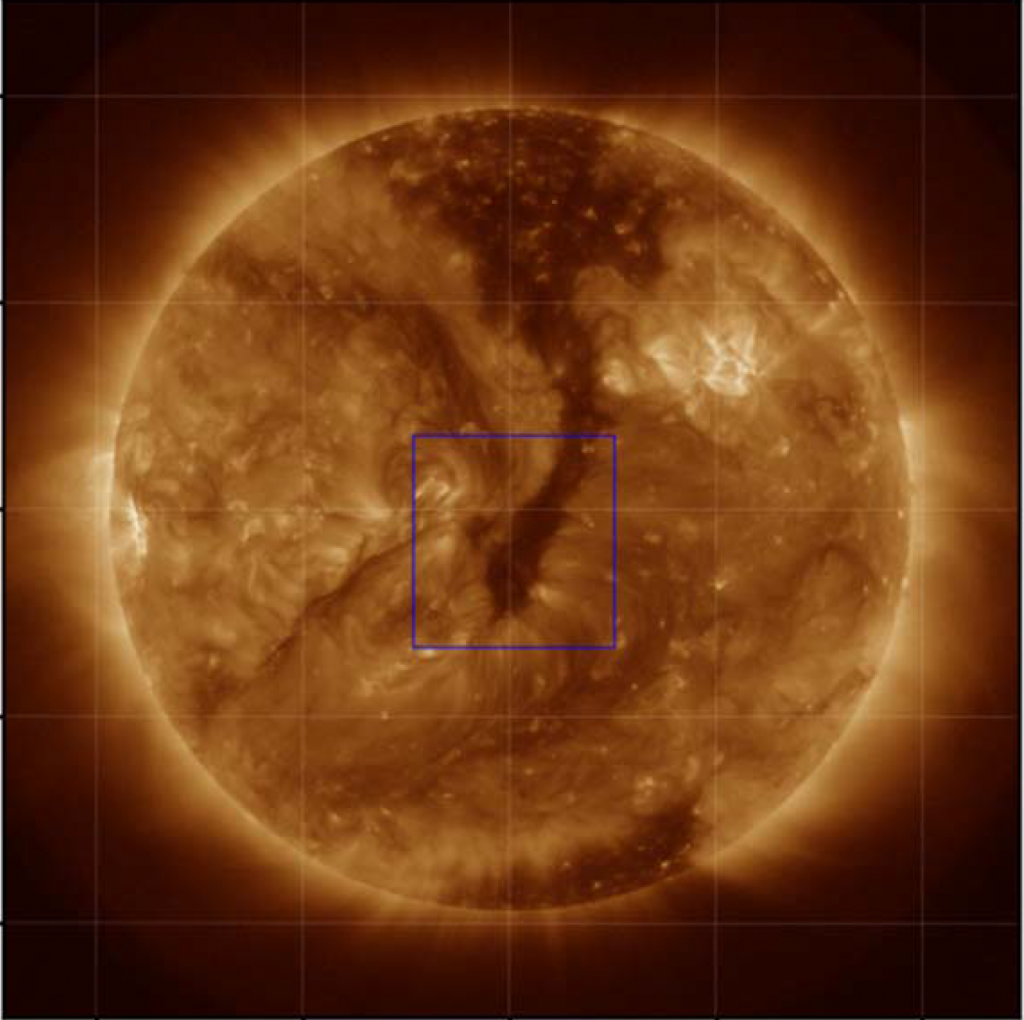
Figure 1. Extreme ultraviolet (EUV) image of the Sun captured by NASA’s Solar Dynamics Observatory on March 25, 2016. The dark area at the center is a coronal hole, a region where magnetic field lines open into space (lower brightness indicates lower density and temperature). The bright surroundings represent the quiet Sun, filled with closed magnetic loops. The blue box highlights the region analyzed in this study (located at the boundary between the coronal hole and the quiet Sun) where open and closed magnetic field lines interact through interchange reconnection. In this transition zone, researchers detected gradients in plasma composition, revealing magnetic reconnection in action. Adapted from the original paper. 

Reading Magnetic Fields Through Chemistry. To investigate this, Koukras and his colleagues turned to a powerful diagnostic: the first ionization potential (FIP) bias. This is the ratio of an element’s abundance in the corona compared to the photosphere, and it’s known to change depending on whether plasma is confined or freely escaping. Using extreme ultraviolet (EUV) spectroscopy data from the Hinode spacecraft, the researchers measured how the FIP bias changes across a CHB. They applied two independent analysis methods: differential emission measure (DEM) modeling and linear combination ratios (LCR), to validate their results. What they found was striking: a clear, consistent gradient in the FIP bias extending outward from the coronal hole boundary, across a region roughly 30-60 megameters wide, about the size of a supergranule on the Sun. (A megameter is equal to one million meters.)

A Hidden Source of Solar Wind and Open Magnetic Flux. These gradients aren’t just chemical quirks. They trace ongoing magnetic reconnection. As field lines shift from closed to open, they carry enriched plasma into space, fueling the slow solar wind. But the study also revealed something even more surprising. By calculating the amount of magnetic field “leaking” through these boundary regions, the researchers estimate that 37–71% more open magnetic flux may originate from CHBs than previously accounted for. This is a big deal, because models of the Sun’s open magnetic field consistently underestimate what spacecraft measure in space. The discrepancy is known as the open flux problem, and this new study suggests that we’ve simply been overlooking an important source.

Small Loops, Big Impact. Another interesting twist? The reconnection at these boundaries seems to involve smaller magnetic loops than those typically assumed in models. While previous theories focused on massive 200 megameter loops, this study shows that reconnection can happen with loops as small as 30-60 megameters. This has implications for how we model solar dynamics, especially during active periods in the solar cycle. This research offers one of the clearest observational insights into interchange reconnection at the solar surface. It bridges local plasma behavior with global heliophysical questions, such as how the solar wind is generated and how magnetic energy is transported throughout the space surrounding the Sun. Future missions like Parker Solar Probe and Solar Orbiter may help confirm these findings with in-situ data. But already, this work points to a new understanding of how the quiet edges of the Sun contribute to its most dynamic outputs. For more detail, check out the original publication.

Reviewed by: Maithê R. M. de Barros
How can your personality protect your mind as you get older?

By: Maithê Rocha Monteiro de Barros

As global life expectancy continues to rise, so does the concern about age-related cognitive decline and conditions like Alzheimer’s disease. One question that is consistently asked is “Why do some brains age better than others?”.

While brain changes are a natural part of aging, what if some people are better equipped to handle these changes without experiencing significant cognitive impairment in areas such as memory and reasoning? This is where Cognitive Reserve (CR) comes in. CR is the brain’s ability to withstand brain anatomical damage from aging or disease without showing cognitive impairment. CR acts like a shield and individuals with higher CR can withstand brain damage from aging or disease longer before their thinking abilities are affected. 

What builds this reserve? Factors such as higher education, demanding occupations and engaging in intellectual or socially stimulating activities have been linked to building a good CR, but could your personality also play a role in building a good CR? A new study published by a former Columbia postdoc Annabell Coors and colleagues shows that personality could be a key factor for building CR. The study explored how certain personality traits might benefit CR. 

To understand this study, it is important to take a closer look at some key aspects of personality, often described through the Big Five traits outlined below.

1 – Openness to experience: How imaginative, insightful, and open to new ideas and experiences you are.

2 – Conscientiousness: How organized, responsible, and disciplined you are.

3 – Extraversion: How outgoing, energetic, and sociable you are.

4 – Agreeableness: How cooperative, compassionate, and trustworthy you are.

5 – Neuroticism: This is the opposite of ‘emotional stability’, therefore it describes how prone you are to emotional instability, anxiety, and negative emotion.

The authors assessed personality in 399 healthy adults aged 19-80 years and tracked 273 of them over an average of 5 years. They included a wide age range to check whether personality is a factor underlying CR even at a younger age.

To get a complete picture, the researchers measured 3 aspects of each participant:

1 – Personality was assessed for each participant using a 50-item Big Five scale form, where they rated statements on a 5-point scale to whether they agreed to the statement or not.

2 – Cognition was assessed across domains such as perceptual speed, memory, fluid reasoning and vocabulary.

3 – Brain status was assessed by MRI scans to check each participant’s brain structure.

It makes sense that personality could influence CR, as it might affect how much someone seeks out new learning opportunities or engages in intellectual activities.


Does Personality Really Offer Protection?

After analysing the data and accounting for age, sex and brain physical status, one personality trait clearly stood out from the rest as having a protective effect openness to experience. 

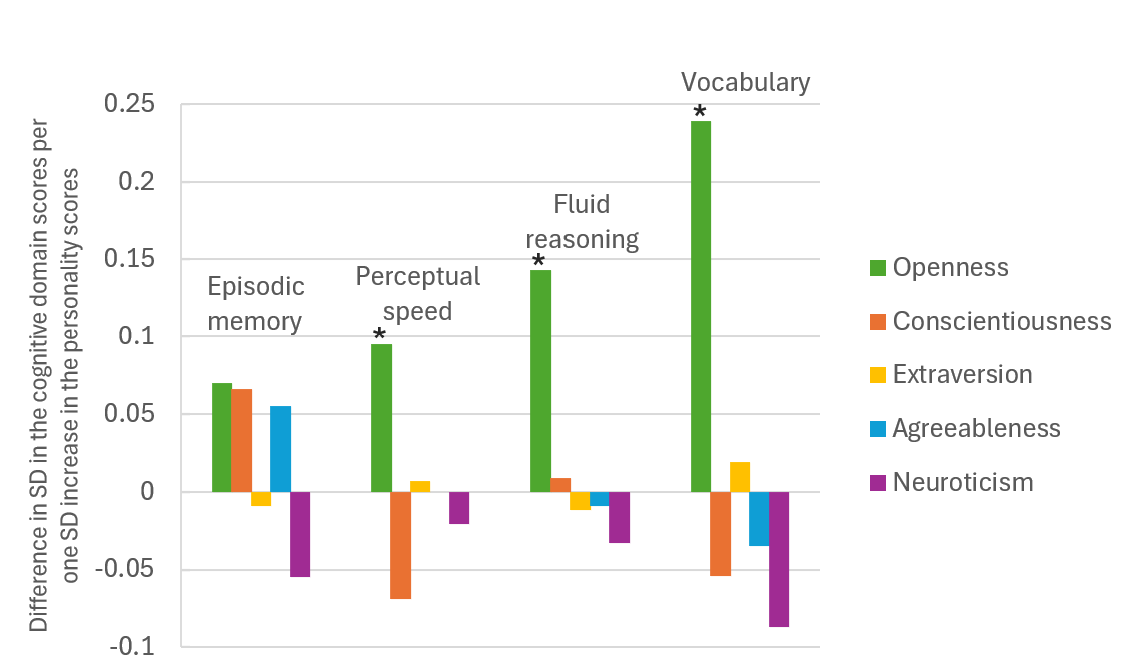
Higher scores on the Openness to Experience scale were significantly associated with better performance in ‘Perceptual speed’, ‘Fluid reasoning’ and ‘Vocabulary’ as seen in Figure 1.

Maithe-Personality and Cognitive Domain Scores
Figure 1. Personality and Cognitive Domain Scores. How much performance in the 4 cognitive domains (Perceptual speed, Episodic memory, Fluid reasoning and Vocabulary) differs across each of the BIG 5 personality dimensions. Asterisks (*) indicate statistically significant associations. SD stands for standard deviation. (Source: Adapted from Figure 2).


Nurture Your Openness 

The implication of this study is that high openness to experience is a personality trait  that benefits CR, helping individuals maintain better cognitive performance and experience less decline as the brain suffers from pathological and age-related changes.

It is important to remember that openness is not a fixed trait, and it varies from person to person. Being open is a way of engaging with the world by trying out new things, exploring new ideas, cultivating a desire to learn and feeding your own curiosity. 

So, what new thing are you going to try today?


Reviewed by: Saheli Chowdhury and Margarita T. Angelova

Orchestrating a bacterial vaccine – a personalized therapy for cancer treatment

By Janice Chithelen

Do you spend a good amount of time choosing the next new mobile or laptop? What built-in features do you look for? Now imagine the same level of customization for cancer treatment.  What if individuals undergoing broad-spectrum chemotherapy – a common method of cancer treatment that is often harsh and produces side effects, could instead avail a more tailored, bacterial-based vaccine designed specifically for their tumors?

From Traditional Vaccines to Personalized Cancer Immunotherapy

Traditional bacterial-based vaccines for infectious diseases work by expressing antigens – specific biomolecules such as proteins, lipids and others that are recognized by the immune system. This recognition triggers elimination of the pathogen and results in a robust immune response and long-term memory. Typically, these vaccines use pathogenic bacteria or viruses that express antigenic proteins foreign to the host. Factors such as biosafety profile, host tolerance, and efficacy determine whether the vaccine would contain whole live bacteria, attenuated (weakened) bacteria or just antigenic subunits – i.e specific protein fragments. Normally a host immune response is triggered when patrolling immune cells, such as macrophages, engulf antigens or bacteria and process them into smaller fragments.  These fragments are then displayed on the cell surface to be recognized by T cells (a type of immune system cells), which initiate an immune response – such as killing target cells, recruiting other immune cells, and activating antibody response.

Unlike foreign infections, cancer presents a unique challenge since cancer cells are transformed non-foreign cells. In order to specifically recognize cancer cells from normal host cells, researchers use neoantigens – i.e. modified or altered proteins uniquely produced by tumour cells due to their abnormal state. In their recent study, Columbia postdocs Mathieu Rouanne, Edward Ballister, Jaeseung Hahn and their colleagues developed a novel cancer vaccine by expressing tumour specific neoantigens. They used the probiotic Escherichia coli Nissle 1917 (EcN) strain as the antigen expression system. The EcN strain was chosen  for its biosafety profile as a non-pathogenic bacteria known to have a beneficial action on the gut.

Engineering a Probiotic Vaccine Platform

The researchers undertook a specific approach to further optimize the bacteria for the production and delivery of multiple neoantigen-containing short protein sequences.  In order to clearly distinguish the tumor cells from normal host cells, multiple tumor specific neoantigens were identified from databases and included in the therapeutic vaccine so that the collectively expressed neoantigens would initiate a specific and durable immune response similar to a multivalent vaccine. The authors included additional features to fine tune their system :

1) Deletion of specific bacterial proteases (proteins that degrade other proteins) which significantly increased the neoantigen accumulation. A higher neoantigen accumulation also led to better antigen presentation on the surface of the patrolling immune cells  which triggered a better T cell-mediated killing of the cancerous cells.

2) Absence of proteases led to increased susceptibility to clearance of the bacteria by human blood factors like phagocytosis (ingestion by patrolling immune cells essential to clear the pathogen and also present them to other immune cells) – indicating a good biosafety profile.

3) Removal of suppressive plasmids (naturally occurring non-genomic DNA molecules that negatively influence the stability of the engineered therapeutic DNA). This additionally boosted the neoantigen production by another 10-fold.

4) Optimizing the neoantigen producing DNA with regulatory regions that additionally increased the neoantigenes’ levels.

5) Coexpression in their system of the protein  LLO (listeriolysin perforin), a protein from  intracellular pathogen Listeria, in order to release the antigen inside the immune cell which further triggers a more potent T cell-mediated immune response.

Figure a: Scheme of the bacterial vaccine platform and its engineered components – deletion of bacterial proteases OmpT and Lon for neoantigen accumulation, removal of suppressive (cryptic) plasmids and LLO coexpression thereby leading to defensive host responses like primary phagocytosis,  and T cell immune response. Figure b: Representative images (tumor intensity in blue) of lung metastases in mice and treatment with the bacterial vaccine for 22 days. M1 – M5 are the different mice treated with either saline (PBS – upper row), negative control (empty) bacterial vaccine (middle row), or bacterial vaccine expressing respective tumour neoantigen (lower row). Image adapted from the original publication and from www.vecteezy.com/eezy.

The vaccine was tested in mouse models of colorectal and aggressive melanoma cancer using various delivery methods. The live vaccine was not only found to be well tolerated by mice and specific against tumor cells, but it also shrank tumours, prevented metastases, and enhanced mice survival. It was also observed that intravenous vaccine delivery which is one of the less invasive forms (as compared to surgical tumour removal) led to optimal anti-tumor effects. The vaccine  effectively activated both helper and killer T cells, which is crucial for killing the tumour cell. This also demonstrated signs of long-term protection, suggesting an overall broad and lasting defense against tumor growth. The authors also showed that the tumour specific neoantigen expressing DNA sequence could be exchanged with sequences expressing neoantigens of another cancer type and the modification worked when applied to respective specific cancer mice models. This meant that the bacterial vaccine could be re-programmed based on the tumour type.

Such a model of using a live bacterial vaccine to treat solid tumours presents a major leap in cancer treatment by turning a probiotic bacteria EcN into a programmable cancer vaccine. This paper reflects a comprehensive demonstration that engineered bacteria could be customized to safely and effectively direct the immune system against solid tumors. It combines precision, safety, and adaptability paving the way for personalized cancer vaccines, but further testing in human trials is still required. What still remains to be accomplished would be to test the system further in human trials and further improving the vaccine platform and adapting it for patients with weakened immune systems, especially those undergoing chemotherapy. Though more research is needed before human trials, the approach described by Columbia postdocs Mathieu Rouanne, Edward Ballister, Jaeseung Hahn and their colleagues could one day lead to safer, smarter, and more personalized cancer treatments.

Reviewed by : Margarita T Angelova, Saheli Chowdhury, Maithê R. M. de Barros

Brain: The Jack and Master of all trades

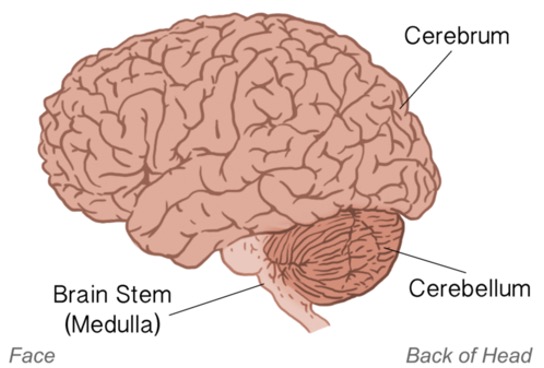
Brain is invariably the “mastermind” of our body coordinating almost every essential function required to keep us alive and make us aware. Its complex architecture and multifaceted nature have intrigued scientists for decades. The deeper one delves into deciphering the brain, the more one marvels at the intricacies of its coordinated mechanisms and innervations. The brain communicates with every other part of our body through neural connections and ensures synchrony inside our systems. It has three major components: cerebrum, cerebellum and medulla oblongata, each distinct in its roles (Figure 1). The brain is indispensable for our existence. Not only does it regulate our sense of being, cognition and emotions, but also our sensory, motor, and involuntary functions. Additionally, it  controls secretion of hormones, modulates satiety, and is responsible for our memories. Needless to say, minute structural or functional disruptions in this delicate network can wreak havoc in our systems. 


Figure 1: Major parts of the brain (Image taken from bio.libretexts.org)

Just as you begin to wonder how one organ, which is practically the size of two fists, can carry out such a diverse variety of actions, studies begin to unravel previously unrecognized functions of the brain. The gut-brain axis is one such exciting new area wherein the brain “talks” to the gut and vice versa thereby influencing the functioning of each other. Another prominent and extremely astonishing function that has recently emerged is the ability of the brain to control immune responses by modulating inflammatory signals. In this context, Columbia postdocs Hao Jin, Mengtong Li and their colleagues have very beautifully uncovered exactly how the brain serves to “sense” inflammatory cues and send signals to the body to respond correctly to these cues in their pioneering work published in Nature.

Inflammation is an immune response. It is of paramount importance to have an equilibrium between pro-inflammatory (which perpetuates inflammation) and anti-inflammatory (which curtails inflammatory signaling pathways) states in our systems to enable a potent defense mechanism. Both hyperactivation and hypoactivation of these responses can have dire consequences in organismal physiology. So how does the body-brain axis orchestrate this inflammatory balance? 

Jin et al., have shown how the brain plays a significant role in determining this balance thus contributing to immune homeostasis. They have very carefully dissected the body-brain circuit controlling this communication between the immune system and brain. They have identified the neuronal populations which are activated by an incoming immune insult and how these then trigger and direct the balance between pro-inflammatory and anti-inflammatory responses. 

Briefly, a peripheral immune insult is sensed by vagal neurons (part of parasympathetic system) which then transmit the signal to a distinct region of the brain, caudal nucleus of the solitary tract (cNST) in the brainstem region. When cNST neurons were inhibited, there occurred a profound elevation in pro-inflammatory response and a corresponding decrease in anti-inflammatory response. This ultimately causes the immune regulation to go haywire.  On the contrary, when these cNST neurons were activated, anti-inflammatory responses were upregulated whereas pro-inflammatory responses were downregulated (Figure 2). 

Figure 2: Schematic representation of components of the body-brain axis orchestrating inflammatory states and organismal immune homeostasis (Images of neuron and brain taken from Adobe Stock and iheartcraftythings.com). 

The study also shows distinct neuronal clusters in cNST which respond to the immune response. It was further shown how cytokines, which are signaling molecules released from immune cells downstream in response to an upstream peripheral immune insult, signal specifically to vagal neurons which then propagate the signal to cNST neurons to perpetuate the inflammatory response. Vagal neurons also have specific lines of signalling, one distinct population of neurons carry anti-inflammatory signals whereas another set carry proinflammatory signals to cNST neurons. 

Thus, this study uncovers a remarkable crosstalk between the brain and the rest of the  body which serves to crucially maintain immune homeostasis. Modulation of intricate components of this axis holds therapeutic potential in either selectively impeding a heightened pro-inflammatory immune response or activating an anti-inflammatory state to alleviate a dysregulated immune state. 

Reviewed by: Erin Cullen, Margarita T Angelova

Ancient Viral DNA: From Genome Invaders to Gene Whisperers

Over the past decade, scientists discovered how bacteria defend themselves against viruses using CRISPR, a system that has revolutionized gene editing. But what if bacteria and viruses have been repurposing their own genetic tools for entirely different functions? A new study published in Nature by Columbia postdocs Tanner Wiegand, Egill Richard and Chance Meers uncovers a surprising twist in this evolutionary story: ancient genes, once used by viruses and mobile DNA elements called transposons, have evolved into RNA-guided transcriptional regulators – natural gene regulators that operate much like the immune system CRISPR, but without cutting DNA.

Bacteria are constantly in an evolutionary arms race with viruses. The mobile DNA pieces transposons have played a major role in bacterial evolution by jumping between locations in the genome and spreading genes. One of these genes, TnpB, was long thought to function only as a simple DNA-cutting enzyme, helping transposons move around. However, scientists have now discovered that some TnpB-derived proteins have lost their cutting ability and instead evolved into RNA-guided transcription factors – proteins that turn genes on or off by blocking access to DNA.

Wiegand and colleagues named this new class of proteins TldRs (TnpB-like nuclease-dead repressors). Unlike CRISPR proteins, which evolved from transposon-related genes to protect bacteria from viruses, TldRs appear to have been repurposed independently for gene regulation. These proteins rely on small RNA molecules to guide them to specific sequences in bacterial genomes, where they bind and shut down target genes by preventing transcription.

One of the most fascinating discoveries in the study is how viruses have co-opted TldRs to manipulate their bacterial hosts. The researchers found that some bacteriophages – viruses that infect bacteria – carry TldR genes along with a bacterial gene called fliC, which encodes flagellin, the protein that makes up the bacterial flagellum (a whip-like structure used for movement).

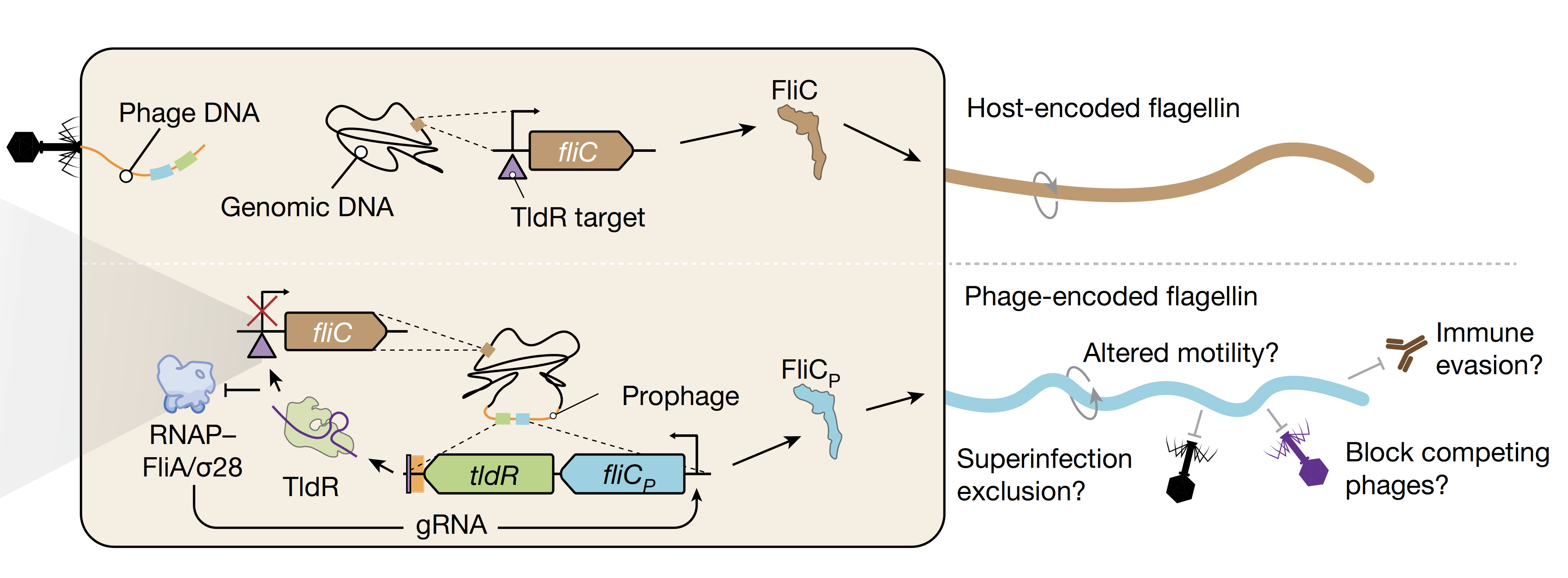
Normally, bacteria express their own version of fliC to build flagella, which are crucial for swimming and sensing the environment. However, in bacteria infected with certain bacteriophages, the viral version of fliC (fliCᴾ) replaces the host’s version. The study shows that TldRs, guided by their RNA molecules, specifically silence the bacterial fliC gene while allowing the viral version to be expressed. This means that the bacterium’s flagella are partially “rewired” to contain viral proteins instead of its own (Figure 1).

Why would a virus want to do this? In their study, Wiegand et al. propose a few possibilities:

  • Evading the immune system – Many bacterial flagellins are recognized by immune cells, and replacing them with a different version could help bacteria (and their resident viruses) go unnoticed.
  • Avoiding other viral infections – Some bacteriophages recognize flagella as entry points to infect bacteria. By altering flagellar proteins, the virus controlling the bacterium might block access to competing viruses.
  • Affecting bacterial motility – Flagella are primarily involved in motility. Changing their structure could alter how bacteria swim in various environments.

Figure 1: Schematic representation of the repression of the bacterial fliC gene by the RNA-guided viral-encoded TldR and consequent expression of the viral version of the flagellum gene, fliCp. Figure from the original paper. 

One of the most exciting aspects of this discovery of this new class of gene regulators is their potential for biotechnology tools development. CRISPR-based gene editing relies on programmable RNA-guided proteins, and TldRs appear to work on the same principle – but without the need to cut DNA. Instead, they act as natural gene “dimmer switches”, fine-tuning expression levels in a targeted way. Because TldRs are much smaller than CRISPR-Cas proteins, they could be useful for future genetic engineering applications where space is limited, such as in gene therapy or synthetic biology. Unlike traditional CRISPR editing, which involves cutting DNA (which can lead to unwanted mutations), TldRs could provide a more precise way to repress or regulate genes without permanent genome changes.

This study is a striking reminder of evolution’s endless innovations and how nature continuously repurposes molecular tools over evolutionary time. The same transposon-derived genes that gave rise to CRISPR have now been independently adapted to regulate gene expression in bacteria. It also underscores how much we still have to learn about the diversity of RNA-guided systems beyond CRISPR, which could lead to new technologies inspired by nature’s own innovations.

With further research, TldRs might become a new class of programmable genetic tools, opening new doors in medicine, synthetic biology, and biotechnology. As we continue to explore these hidden layers of microbial evolution, who knows what other surprises nature has in store?

Reviewed by: Temistocles Molinar, Saheli Chowdhury

How Hepatocytes dance to the yin and yang of Hepatic Stellate cells

By: Saheli Chowdhury

Liver is the largest gland of our body, making up around 2-3% of our body weight. The liver is rightfully called the “human metabolism laboratory” because it is responsible for all major metabolism related activities of our body and is the metabolic hub. Besides, it also harbors a complex architecture and is composed of diverse cells. Each of these cell types have specific biological roles that work together to regulate hepatic physiology on several levels. Hepatocytes are the principal cells which largely coordinate the major metabolic pathways. Based on the location of hepatocytes, the liver is divided into three zones (Zone 1, 2, and 3) with distinct functions. Proper maintenance of these zones is key to hepatic homeostasis. Hepatic stellate cells (HSCs) are another type of liver cells that can exist in two states. In their resting state, they serve to store vitamin A. Under conditions of liver injury, HSCs “switch” to an activated state under the influence of numerous factors and are classically known to be mediators of liver fibrogenesis. Fibrogenesis or fibrosis is a state where normal liver tissue is replaced by a hard scar tissue which renders the liver incapable of functioning normally. Liver cells do not function independently, with a complex network of crosstalk existing among hepatic cells with each cell type regulating the functioning of others.

Of late, there has been an alarming increase in the usage of terms like Metabolic Syndrome and “Fatty Liver” (also called Metabolic Dysfunction Associated Steatotic Liver Disease or MASLD). This happens under conditions of metabolic overload when normal physiology of the liver is perturbed culminating into forms of hepatic injuries. This triggers a burgeoning process which results in irreversible damage and in many cases leads to liver failure with dire consequences. Liver is also known to be a tremendously flexible organ capable of regenerating itself after injury or surgery. Almost all chronic liver diseases follow a similar pathogenesis and culminate into fibrosis. HSCs  are usually considered a villain because they trigger liver fibrosis. They get activated by various inducers and signals of liver injury and expedite the fibrogenesis reaction. Just as good things have a bad side to them, even bad things have a good side to them! So how do HSCs bring out their heroic side?

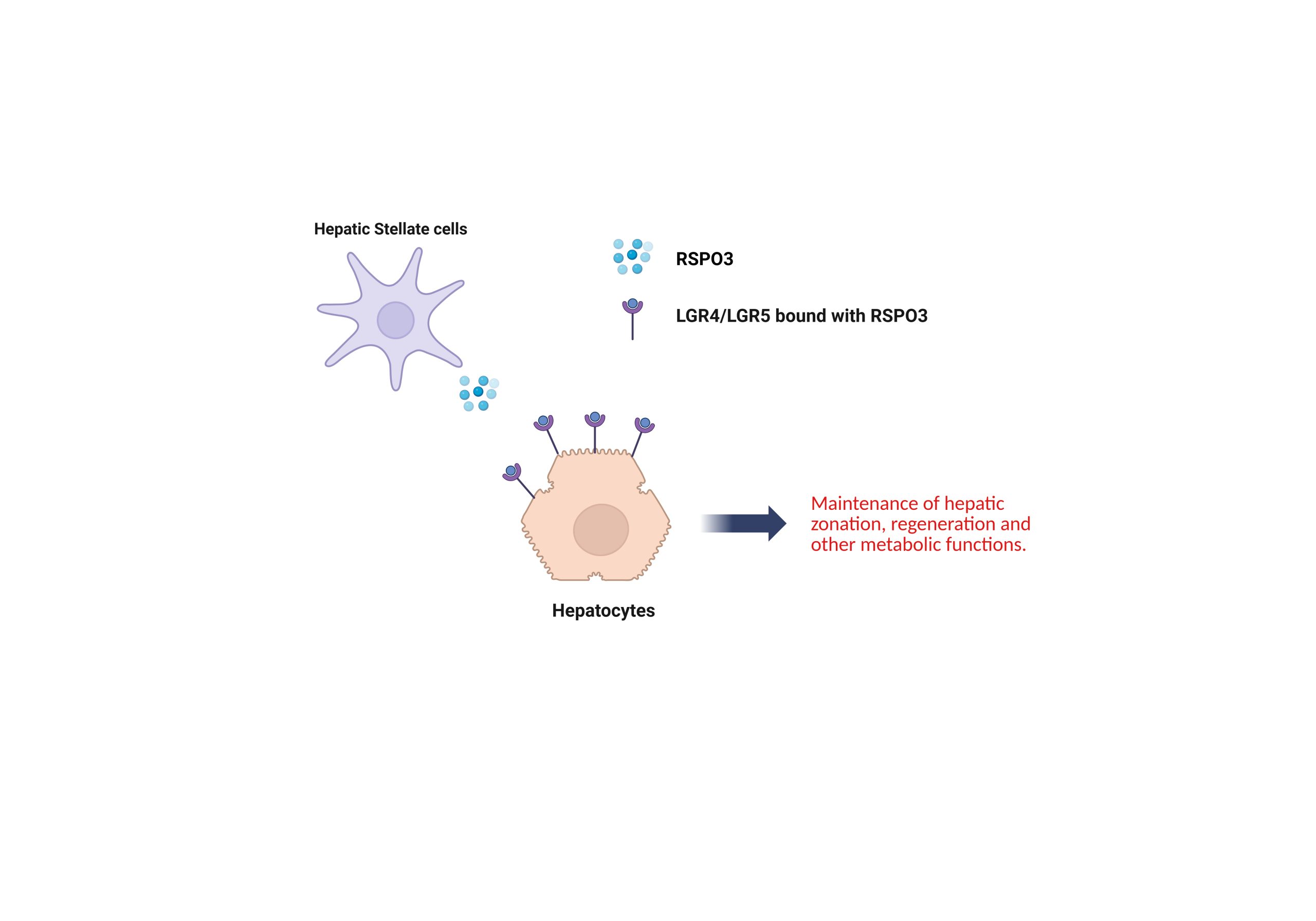
Recently, Columbia postdoc Atsushi Sugimoto and his colleagues unraveled novel functions of HSCs, not linked to fibrogenesis. The authors discovered that HSCs and hepatocytes participate in a unique crosstalk to maintain proper hepatocytes zonation, mediate metabolism-associated functions, response to injury, and subsequent liver regeneration. Cells are capable of communicating via secreted molecules. A molecule secreted from one cell acts as a ligand which binds to cognate receptors present in the other cell type thereby perpetuating a downstream response. In case of HSCs, they secrete the signal molecule RSPO3, a protein which binds to its specific receptors (LGR4 and LGR5), enriched in hepatocytes.

The study found that when HSCs were depleted by expression of a toxin in mice liver, liver regeneration was impaired. HSC depleted livers showed an expansion of Zone 1 and condensed Zone 3. Using various biochemical and bioinformatics tools the authors described an increased secretion of RSPO3 in HSCs and its subsequent reduction upon HSC depletion. Further, deletion of receptors of RSPO3 in mice hepatocytes caused altered zonation and regeneration, showing that RSPO3 is pivotal in determining liver zonation. When RSPO3 was reintroduced in HSC-depleted mice livers, the ability of the liver to regenerate from injuries was adequately restored.

Figure 1: Schematic representation of the study showing cell-cell communication between HSCs and hepatocytes and the functions they regulate. Image generated using BioRender

The study by Sugimoto and his colleagues describes a protective, beneficial role of HSCs that is accomplished by secreting RSPO3 (Figure 1) which in turn, participates in intracell communication with hepatocytes to help ensure hepatic homeostasis. The dual functions of HSCs suggest that if activated “bad” HSCs could be reverted to their resting “good” state and further modified to release more RSPO3, it would ultimately aid in improving liver healing. This discovery suggests therapeutic potential in targeting HSCs to further enhance their protective effects and abrogate progression of chronic liver diseases.

Reviewed by: Margarita Angelova, Divya Vimal

Neural mechanisms of Camouflage: insights from Dwarf Cuttlefish atlas

Camouflage is a common and essential survival strategy that is widely shared across the animal kingdom from reptiles, amphibians and fish, to birds and even some mammals. This ability allows them to hide in plain sight, but it is also a useful tool for hunting and a means of communication. Have you ever wondered how some animals can camouflage?

Fig1: Adult dwarf cuttlefish ( 8cm in total body length)

The dwarf cuttlefish (Fig.1) is renowned for its rapid and complex camouflage abilities, controlled by its brain. Five pairs of nerves emerge from the different brain regions and project to the different parts of the body (mantle, arms and fin) to regulate its skin’s chromatophores (these specialized cells contain different pigments, such as black, red, yellow, or brown, which contribute to the overall coloration of the skin). 

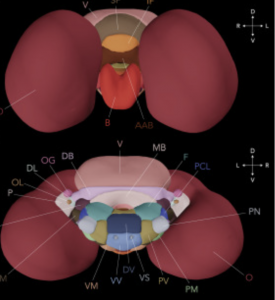
Even though we usually crown the octopus as the master of disguise, the cuttlefish is, in fact, at the top of this game. The reason for this is that the cuttlefish’s skin possesses more color changing chromatophores per square inch than its fellow cephalopods (up to 200 per square millimeter to be precise). Recently, Columbia postdoc Tessa Montague and her colleagues introduced a groundbreaking brain atlas for the dwarf cuttlefish, *Sepia bandensis*. The team used a combination of Magnetic Resonance Imaging (MRI), deep learning, and histology to create this comprehensive neuroanatomical roadmap, which is now available online through the interactive web tool Cuttlebase (https://www.cuttlebase.org/). This study aims to understand how the cuttlefish brain processes visual information to achieve camouflage. Interestingly, despite that the brain has a global volume close to the one of a mouse (94% similarity), its organization is widely different. For example, the optic lobes that only represent a few percent in the mouse brain comprise 75% of the brain in the cuttlefish, indicating their crucial role in visual processing and behavior related to camouflage and environmental interaction. The research revealed significant insights into the neural basis of cuttlefish behavior and offered a valuable resource for further studies on neural representation and brain function. 

Fig. 2: Frontal (top) and posterior (bottom) 3D views of cuttlefish’s brain (from Cuttlebase)

To achieve this, the team scanned the brains of eight cuttlefish using MRI. In combining manual segmentation with deep learning techniques to extract each brain from its surrounding tissue, they created the first merged, annotated template brain (Figure  2). 

With such  3D model of brains like Cuttlebase, scientists can target brain regions to investigate precisely the function in the camouflage behavior. 

The 3D and histological brain atlases presented here are invaluable tools for studying how cephalopods, like the dwarf cuttlefish, control their behavior through their brains. 

With the help of the interactive platform Cuttlebase, researchers can precisely guide instruments for brain experiments and identify specific brain regions for their studies. These atlases also allow scientists to explore how genes and neural activity are distributed across different areas of the brain.

The brain atlas not only helps in understanding cephalopods but also serves as a resource for comparing the brain structures of different species. While little is known about the biology of the dwarf cuttlefish (Sepia bandensis), the common cuttlefish (Sepia officinalis) has been extensively studied to understand behavior, learning, memory, and skin pattern control. Despite the differences in their sizes, behaviors, and habitats, the data shows that their brain structures are quite similar. For example, Sepia bandensis lives in the Indo-Pacific coral reefs and uses high-frequency skin patterns to blend into its tropical environment. On the other hand, Sepia officinalis lives in the rocky waters of Europe and uses larger patterns to resemble rocks. Both species display unique aggression patterns during social interactions: Sepia officinalis shows a zebra pattern, while Sepia bandensis has a stippled pattern. These differences in behavior might be better understood through studies of neural activity.

This atlas is also useful for understanding evolutionary processes by comparing species that are evolutionary distant but still share similar anatomical organization. Thus, a recent study shows that despite about 600 million years of evolution, cuttlefish brains share some features with those of fruit flies. For instance, both have a central brain with two large optic lobes on the sides and learning and memory centers. Recent studies even suggest molecular similarities between certain brain cells in octopuses and fruit flies, highlighting the evolutionary connections.

This comprehensive brain atlas, combined with molecular and cellular maps, offers a deeper understanding of how these intelligent invertebrates evolved their complex cognitive abilities and behaviors. Comparing this atlas to those of other species, like the nematode C. elegans or the Human Connectome Project, provides valuable insights into brain function across different phyla. Such comparisons are crucial for uncovering universal principles of neural organization and function as well as the distinct evolutionary paths and ecological requirements of mammals and cephalopods reflected by neuroanatomical differences.

The creation of detailed brain atlases is foundational for advancing our knowledge of brain anatomy and behavior across the animal kingdom. These studies highlight the critical role of brain atlases in exploring neural structures and functions, significantly contributing to neuroscience. Despite the existing atlases, there is a pressing need for more to fully understand brain evolution throughout the animal kingdom.

By expanding the collection of brain atlases across a wider range of species, researchers can uncover evolutionary pathways and adaptations that have shaped cognitive abilities. The detailed information provided by these atlases helps correlate brain structure with function and behavior, offering insights into the neural basis of complex traits. Increasing the number of brain atlases will enable scientists to trace the development of neural mechanisms from simple organisms to complex beings, enhancing our understanding of brain evolution and capabilities.

Investing in the creation of more brain atlases will build a robust framework for comparative neuroanatomy, deepening our understanding of individual species and illuminating broader evolutionary trends. The insights from these comparative studies are crucial for developing new hypotheses about brain function, improving neural models, and advancing our knowledge in neuroscience and related fields. If you want to know more details check out the original paper.

Written by: Nathalie Houssin

Reviewed by: Trang Nguyen,  Margarita Angelova, Jerry Gourdin

Layer by layer – How reducing the thickness of layered magnetic materials can change tomorrows electronics

By Daniel Čavlović


What if I told you that nearly all electronic devices like phones or computers waste incredible potential in the way they are designed to work? All currently used electronic devices move electrons from one place to another creating a current relying solely on the particle’s negative charge. Very old-school physics known for centuries. But electrons are more than just charges! According to quantum mechanics – yes bear with me – an electron always possesses an additional intrinsic property, its spin, which can be either spin-up or spin-down (often depicted with arrows). These spins are slowly moving into the attention of applied research even though the quantum mechanics behind it is known for one century. The next-generation of electronics will leverage the full potential of the disregarded information stored in spins. But to build a so-called spin transport electronic (spintronic) device we need to find materials that are able to store, transport, and switch the spin information.

A group of researchers has synthesized and studied a novel material TaFe1.14Te3 which could be perfect for spintronic applications. By pressing elemental tantalum (Ta), iron (Fe), tellurium (Te), and some tellurium chloride into a pellet, sealing in a fused glass tube under vacuum and heating between 600 – 700 °C for a week they obtained needle-like crystals of this material. What makes this newly forged material so special is the way of how the elements are connected to each other. Even though the crystals resemble three dimensional needles, the underlying fundamental structure shows stacked layers of two dimensional sheets. Just like a stack of papers, each sheet is firmly connected and requires scissors to cut the sheet. On the other hand only loose forces keep the stack of sheets together and as little as a bit of wind blows the stack of paper away). Amusingly, the same way that you can remove the top sheet from a paper stack with tape, this quite literally works the same way with TaFe1.14Te3 (see Figure 1 below). This Nobel Prize winning technique is known as mechanical exfoliation and led to the isolation of the first in-depth studied 2D material, graphene. Graphene is a single layer of graphite (mistakenly called ‘lead’ in pencils). In graphite each layer of graphene interacts with the layers in between it’s sandwiched in. Thus, all defects or inconsistencies are diffused into and covered up by the mountain of layers. Like picking out the best singer from the choir for a solo, by reducing the number of layers of the material the properties start to change and become more featured and outstanding. In the case of graphite (the pen material) one single layer of it—graphene—becomes incredibly conductive and mechanically robust. Cool properties but not very useful for electronic devices because graphene has no band gap. It’s pretty much just a “wire” which always conducts electricity. In contrast a band gap is like a wire with a switch, where two states can be addressed (for binary information). Single layers of TaFe1.14Te3 indeed do possess a band gap and are magnetic too, both properties required for spintronics. Its magnetism is especially interesting: The studies revealed that in each single layer of this material there are quasi-one dimensional chains of iron atoms decorated with unpaired electrons whose spins give rise to its magnetism. In a single layer all neighboring spins align and point in the same direction, a property called ferromagnetism or 2D magnet.

Figure 1: Schematic side-view of a TaFe1.14Te3 layer being pulled off as an illustration of mechanical exfoliation.

You can imagine each of those spins in iron atoms like a compass needle always aligning with the earth’s magnetic field. But what happens if you stack another layer on top of it? The top layer’s spins align in the opposite direction with respect to the layer below forming an antiferromagnetic bilayer. This shows that the spins between two layers strongly interact with each other. While a single layer interacts strongly with an external magnetic field from let’s say a magnet closeby the bilayer does not care about external magnetic fields because of the much stronger interaction with its neighboring layer. You may have heard that a magnet can damage or wipe your computer’s hard drive, which is true for older technology which relied on ferromagnetic layers. One elegant solution to this is to store information in antiferromagnetic bilayers which further enables minimizing the size and amount of materials needed for electronic devices.

The researchers have studied TaFe1.14Te3 and its electronic structure in even more detail. They found that the material shows metallic behavior, further supported by calculations, and itinerant magnetism but at the same time local moments which makes the exact electronic structure complicated to determine. What this means is that as a whole it shows local sites where the magnetism arises from but is spread out and averaged as it never resides fully localized. The underlying origin of this special magnetism is still subject of further studies of this material which is probably being deciphered at this very moment.

The most important property–stability under ambient conditions–may sound boring but is essential for practicable applications. Even though there are other 2D materials known which show similar remarkable properties but their translation from fundamental research towards application is not really feasible because they react with trace water or oxygen from the air we breathe!

Even though spintronic devices are far from being commercialized, one day you might hold a superior and more energy efficient spintronic phone in hand and admire the success of technological advancement. Remember, that all originated from fundamental research which managed to leverage the hitherto elusive spin information with 2D materials like TaFe1.14Te3


Original paper

Reviewed by: Trang Nguyen


Unlocking the code of longevity: How your diet might hold the key to a sharper mind

By Divya Vimal

We’ve all grown up hearing about the virtues of eating our greens and maintaining a healthy diet. But what if I told you that beyond just keeping your body in shape, a healthy diet could be your secret weapon against the ravages of aging and even dementia in later life? Yes, that’s right- those veggies might just be your ticket to a sharper mind and a healthier future! A groundbreaking study delved into this intriguing possibility, focusing on whether a healthy diet could slow down the biological clock and reduce the risk of dementia.

The researchers examined information from the Framingham Offspring Cohort, consisting of 1,644 participants aged 60 years and older, and has been under follow-up since 1971. They used algorithms also called epigenetic clocks to measure how quickly participants were aging biologically by assessing the methylation status of the DNA in white blood cells. One such epigenetic clock is DunedinPACE, which was utilized in this study as a predictor of health-span and lifespan. Meanwhile, they assessed diet quality using the Mediterranean Dash Intervention for Neurodegenerative Delay diet (MIND) diet score and tracked the occurrence of dementia and mortality. The MIND diet has been developed for prevention of dementia, combining key principles from two healthy diets (i.e. Mediterranean diet and Dietary Approaches to Stop Hypertension Diet). The MIND diet emphasizes high intake of neuroprotective foods such as fish, green leafy vegetables, berries, and nuts, while minimizing intake of red meat, butter, sweets. The MIND diet is a composite scoring system based on components of the MIND diet. Each component of the diet was scored from zero to one, reflecting the frequency of food consumption. Scores were assessed weekly, and the total MIND diet score, ranging from 0 to 15, was calculated as the sum of the 15 component scores. Higher scores indicated better adherence to the diet over the long term. 

Excitingly, the results revealed a compelling link between diet, aging, and dementia risk. Participants who adhered more closely to the MIND diet enjoyed a slower pace of biological aging (each 1-standard deviation (SD) increase in MIND diet score associated with a 0.20-SD slower DunedinPACE). For each improvement in the MIND diet score, there was a reduction of 34 fewer incident dementia cases per 10,000 people a year, suggesting that a healthier diet could lead to fewer cases of dementia over time- a striking finding! Digging deeper, about 27% of the diet’s impact on dementia risk was attributed to its effect on the aging pace. This suggests that a good diet might protect your mind by keeping your body younger at the cellular level.

Furthermore, a slower pace of biological aging was independently associated with lower risks of both dementia and mortality. This means that not only does a healthy diet potentially safeguard your mind, but it could also help you live longer.

Covariate analysis (statistical method) including factors like socio-economic status, genetics, lifestyle, and health conditions didn’t change the main results. Interestingly, there were no significant differences in how diet affected aging based on sex or APOE4 status (a genetic risk factor for Alzheimer’s). Furthermore, the study revealed that maintaining a healthy diet at different life stages, from mid-life to older age, was associated with slower biological aging, reduced risk of dementia, and lower mortality rates. Alternatively, similar analysis with the Mediterranean Diet Score and the Dietary Guideline Adherence Index mirrored the associations between different measures of diet quality and health outcomes underscoring the well-known health benefits of the Mediterranean diet. These findings collectively underscore the significant impact of diet on aging and health outcomes, emphasizing the importance of maintaining a healthy diet throughout life.

While the study had its limitations, such as a predominantly white cohort and participant recall bias, its implications are profound. It hints at the possibility that by monitoring our biological age, we might gain valuable insights into how to prevent dementia and age-related decline. Furthermore, the study couldn’t differentiate if a healthy diet directly affected organ health, leading to slower aging (egg before the chicken) versus its impact on cellular aging indirectly preserving organ health (chicken before the egg).

In essence, this study highlights the power of diet in preserving both body and mind. It paints a hopeful picture of a future where something as simple as dietary choices could be the key to a longer, healthier life with a more agile mind. 

Original paper

Reviewed by: Aline Thomas and Trang Nguyen

Beyond Diabetes: Exploring Metformin’s Promise in Prostate Cancer Therapy

By Rafaela Muniz de Queiroz 

Cancer and diabetes are two major contributors to mortality in patients, ranking among the top 10 causes of death worldwide by the World Health Organization (WHO). Both diseases pose a significant challenge to public health systems, representing a complex challenge that requires comprehensive strategies to reduce their impact on global mortality rates. Metformin, among other drugs, is the main first-line prescribed medication for the management of type 2 diabetes, and it is known for its efficacy and tolerability. Yet, metformin has gained attention for its role in other contexts, including cancer and cardiovascular disease.

Prostate cancer is a significant global health concern and a leading cause of cancer-related deaths among men. While treatments like radical prostatectomy (RP) and radiotherapy are effective for many patients, for others, the disease progresses leading to metastasis, which can be difficult to treat and is often fatal. Previous studies have pointed to metformin’s potential role in prostate cancer, but conflicting findings have led to an inconclusive verdict on the use of metformin for this disease. A recent breakthrough study headed by Alexandros Papachristodoulou from Dr. Abate-Shen’s group in the department of Molecular Pharmacology and Therapeutics at Columbia University Irving Medical Center, has shed light on a potential new avenue for the use of an anti-diabetic drug in the treatment of prostate cancer.

The prostate gland is susceptible to inflammation and oxidative stress, both of which can accelerate prostate cancer progression. Interestingly, oxidative stress influences the behavior of NKX3.1, a gene that plays a crucial role in protecting the prostate epithelium from cancer-related stress. In their work, Dr. Papachristodoulou and colleagues examine the interplay between NKX3.1 and the widely used diabetes drug metformin. The interplay between NKX3.1 and metformin are found in the mitochondria. NKX3.1 helps protect against harmful free radicals (unstable molecules that can damage cells by stealing electrons from other molecules) and supports normal mitochondrial function, while metformin has a known ability to regulate mitochondrial function and reduce oxidative stress.

The study published in 2024 used a comprehensive number of strategies to investigate its hypothesis, including in vitro work with the use of human prostate cancer cell lines, in vivo work using mouse models, and analysis of retrospective cohorts of patients. The authors show an impressive reduction of tumor size in mice under oxidative stress, by exposure to the herbicide Paraquat, and treated with Metformin. This difference was only seen if tumors did not express NKX3.1. They show that metformin treatment can fully rescue mitochondrial function that had been lost upon oxidative stress in prostate cancer cells lacking NKX3.1, pointing to a possible molecular mechanism for the effects seen in mice.

Moreover, the study analyzed the biochemical recurrence (BCR)-free survival, evaluated by the blood levels of PSA, the antigen used to diagnose and surveil prostate cancer in patients. This parameter is used in the clinic to show the percentage of patients that remain disease-free after RP over time. Utilizing data from two cohorts of patients, the researchers showed that those expressing low levels of NKX3.1 and taking metformin had a much higher rate of BCR-free survival compared to patients not taking the medication. The group of patients expressing high levels of NKX3.1 showed no difference in BCR-free survival when taking or not the drug. In addition, when the disease progression of a group of prostate cancer patients that have been followed up for up to 10 years was investigated, the authors observed that among the patients with low-NKX3.1, all patients treated with metformin evolved to have their disease classified more favorably during follow-up, while most patients not exposed to the medication had a worse development of the disease.

These findings open exciting possibilities for personalized treatment strategies for prostate cancer. It offers hope for a future where precision medicine plays a pivotal role in combating this disease and improving patient outcomes. By identifying patients with low NKX3.1 expression levels, clinicians may be able to tailor metformin therapy to those who are most likely to benefit, potentially improving patients’ quality of life and extending survival rates. While further research and clinical trials are needed to validate these findings, this study represents a significant step forward in understanding the biology of prostate cancer and exploring novel therapeutic avenues. 

Original paper

Reviewed by: Trang Nguyen, Erin Cullen

Follow this blog

Get every new post delivered right to your inbox.