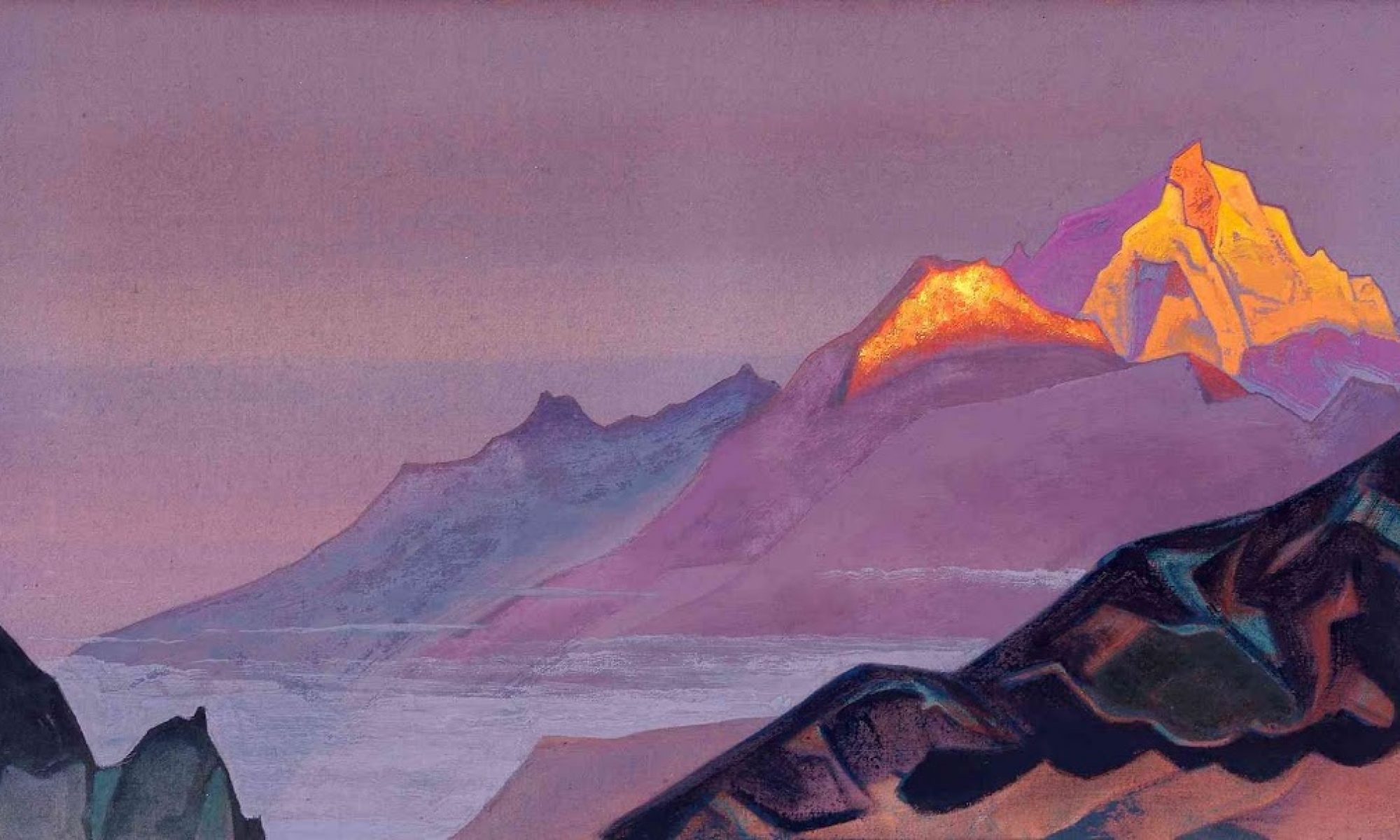
The Occident

It would be amiss for this website not to include a section on how the Occident has represented Shambhala as a sacred space, given that it has entered the popular imagination especially in the 20th Century and that the West has become a large perpetuator of discourse that employs its imagery. From Marco Polo to Galen Rowell, occidental literary paradigms have perpetuated plenty of surreal presentations of Tibet as enigmatic and isolated (Llamas and Belk, 258). The parallels between Tibet’s and Shambhala’s inaccessibility made the two open to conflation, with increased slippage between mentions of Shangri-la and Tibet itself – the myth now takes on national meaning (and it is interesting to note that many of the Western sources about “Shangri-la” that I had encountered during my research were not actually about Shangri-la or Shambhala but simply borrowing the word as a gateway to talking about Tibet). The popularization of the idea of “Shangri-la” came from James Hilton’s 1933 book, Lost Horizon, which was turned into a film by Frank Capra in 1937. The opening scene shows snowcapped mountains, with “Lost Horizon” written in an exotic font mimicking Tibetan script, and after a list of opening credits, the screen shows a mystical book opening up to a page that reads:

“In these days of wars and rumours of wars — haven’t you ever dreamed of a place where there was peace and security, where living was not a struggle but a lasting delight?”

Opening Titles
From From Frank Capra’s “Lost Horizon” (1937)
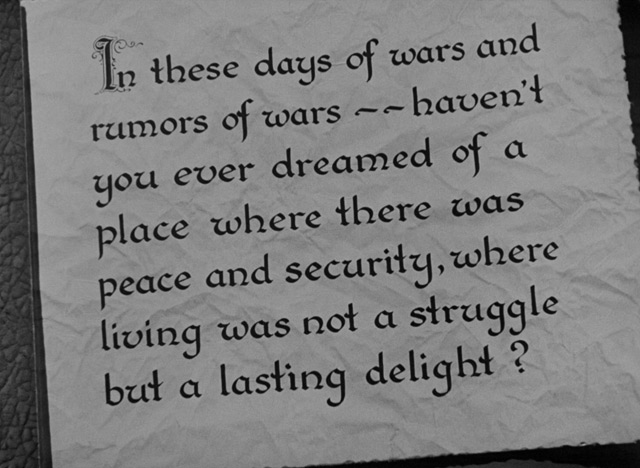
Frame of mystical book
From Frank Capra’s “Lost Horizon” (1937)

This Western book adaptation of the myth is Orientalism at its finest. Shangri-la is depicted as an idyllic, exotic, mystic place where everything is in harmony and people live young forever, hidden among the Himalayan mountains where only those who are lost can find it. But what makes Shangri-la so invaluable in the book and film is not even the indigenous knowledge of the indigenous people, but that a Belgian Catholic missionary had gathered the pinnacles of European culture (books, art, music) and that a brotherhood of foreigners were protecting them from impending world conflagration. What was precious was not Tibet itself but what it represented, and the treasures that were preserved (Lopez, 5). The imagery of Tibet and of Shangri-la is only useful to the extent that the Occident’s superiority is preserved and unquestioned. Although it would be inappropriate to paint all Occidental people who were interested in Tibet with the same brush stroke, it would be fair to say that a significant amount of early scholarship or discourse about Tibet and Shangri-la was indeed Orientalist.

Even long before Hilton’s work, Tibet was already known by European powers with colonial interests in the 19th Century. Because Tibet was always just out of reach of colonization, seen as closed and isolated but never conquered, “many of Europe’s fantasies about India and China, dispelled by colonialism, made their way across the mountains to an idealized Tibet” (Lopez, 6). Lopez points out that many myths were of Tibetan making though, from the guidebooks that they wrote to idyllic hidden valleys (sbas yul) (6). Later, China’s takeover of Tibet was represented as “godless Communists overrunning overrunning a peaceful land devoted only to ethereal pursuits” (Lopez, 7). Orientalism was split between a benign and englightened Orient, the latter of which would be hailed as a salve for the Western spirit. One such group that believed this was the Theosophists, who heavily influenced Nicholas Roerich. Roerich’s book Shambhala (1930) showed that he even looked forward to the apocalyptic reckoning of the world, and a mysterious expedition to Inner Mongolia in 1934-35 that was unaccounted for was also rumoured to have been made in search of Shambhala (Boyd, 258). This interest even inspired him to create the Roerich Pact and Banner of Peace, a treaty about respecting and preserving cultural/scientific treasures with the vision of enlightenment in mind. This connection can be seen at a speech given at the Third International Roerich Peace Banner Convention in 1933: “The East has said that when the Banner of Shambhala would encircle the world, verily the New Dawn would follow. Borrowing this Legend of Asia, let us determine that the Banner of Peace shall encircle the world, carrying its word of Light, and presaging a New Morning of human brotherhood” (Bernbaum, 21). This strikingly reminds one of the way the Chinese used the messianic image of Shambhala for their own political agendas.

Even currently, popular books, songs (see below), media, and franchises (think of the luxury hotel chain) continue to employ the imagery of Shangri-la. There is the continuing sense that it is an eternaly pure mystery, but also that there is a need to seek out the “real” and pure Shangri-la, seen even in book titles such as “Shambhala: The Fascinating Truth behind the Myth of Shangri-la”, published by Victoria LePage in 2014 (the book is a continued attempt to argue that Shambhala is “real” and “may be becoming more so as human beings as a species learn increasingly to perceive dimensions of reality that have been concealed for millennia”). Although possibilities of reading into Western representations of Shambhala are endless and there is much more to be said than cannot be covered in this website, what is worth taking away is also that Tibetans and Tibetan myths were not simply passively objectified – although many Western representations of Shangri-la are out of the hands of Tibetans, it is important to acknowledge that they were also part of the process of myth-making in many ways. This section delves further into this last point.


Lyrics:

Your kisses take me to Shangri-La

Each kiss is magic that makes my little world a Shangri-La

A land of bluebirds and fountains and nothing to do

But cling to an angel that looks like you

And when you hold me, how warm you are

Be mine, my darling, and spend your life with me in Shangri-La

For anywhere you are is Shangri-La

Your kisses take me to Shangri-La

Each kiss is magic that makes my little world a Shangri-La

A land of bluebirds and fountains and nothing to do

But cling to an angel that looks like you

And when you hold me, how warm you are

Be mine, my darling, and spend your life with me in Shangri-La

For anywhere you are is Shangri-La

Chinese Literary Imaginations

For this section, I looked at and personally translated excerpts from two books in Mandarin that were about Shangri-la in Yunnan but also have deployed Shambala imagery: Forever Shangri-la by Hainan (2009), and In Tibet: Essays on Teaching in Shangri-la by Suyang (2011).

Forever Shangri-la (永远的香格里拉) was written by Hainan (海男) in collaboration with a Tibetan photographer Qi Zhala (齐扎拉). With chapters such as “Shangri-la’s lakes”, “Shangri-la’s snow mountains”, and “Shangri-la’s clouds, dance, and wine”, it is a personal account of the writer’s visit to Shangri-la in Yunnan, weaving in histories and facts, but still bracketed by the tropes and stereotypes of the mythical kingdom. The following is an excerpt from the first section, a conversation about a “Spiritual Thoughts about the Kingdom of Shangri-la”.

Hainan: What does Shangri-la mean to you? I wanted to begin with this topic, because today we are going to talk about the great questions about spiritual thoughts regarding the Kingdom of Shangri-la.

Qi Zhala: At the hearts of the Diqing people, Shangri-la is an ideal realm of life. The “Shangri-la” of classical Tibetan Buddhism refers to a beautiful realm that man and god share and where man and nature live in harmony. Some of its symbols: surrounded from all sides by snow, snow-capped peaks towering in the clouds, vast forests beneath the peaks, with 108 of man’s rarest animals and plants in the forest, the snow mountains embracing vast grassy plains, the plains divided into eight pieces by the river, symbolizing eight lotus ponds. In this peaceful and prosperous place, simple people have their own spirituality, splendid temples, and the beautiful Sunlight City and Moonlight City. There is peace and harmony between people and between man and nature.

海男:香格里拉对你来说,意味着什么呢?我想用此话题开场,因为今天意味着我们要谈的是关天香格里拉王国心灵漫记的美好问题。

齐扎拉:在迪庆人民的心目中,香格里拉是一种理想的生活境界。藏传佛教的经典中“香格里拉”是指一种人神共有,人与自然和谐共生的美好境界,其象征和意味是:西周雪环绕,白雪皑皑的雪峰高耸入云,雪峰下是苍莽的原始森林,林中有人间最为珍贵的108种动植物,雪山怀抱着广阔的草原,草原被清澈的江河分为八块,象征着八瓣莲花铺池;在这宁静、富庶的地方,纯朴的人们有自己的神位,有辉煌的寺庙,有祥和美丽的日光城、月光城,人与人之间、人与自然之间和谐而宁静。

From this brief excerpt, we can already see the mysticization and ethnicization of Shangri-la, even in an interview conducted with a Tibetan, for the purposes of the book – to further continue and perpetuate stereotypes of purity and “peace and harmony” and a mystic timelessness of “forever”, with oblique references to “classical Tibetan Buddhism” to lend itself legitimacy. It is interesting to note how they have transplanted the Orientalization of a mythical, non-material space onto an actual community of people living in Yunnan, and the effects that this has.

In Tibet: Essays on Teaching in Shangri-la (在藏地:香格里拉支教随笔) was written by Suyang (苏羊), after she had spent a year volunteering and teaching children in Shangri-la. Although the bulk of this book does not refer to the original mythology of Shangri-la, being mostly about her experience as a volunteer teacher in the actual county, I found that the preface written by Ding Xiaocun (丁小村) could not resist toying with the imagery, as follows.

Suyang’s descriptions. Far and deep in Shangri-la’s plateaus, in Deqin county’s Tibetan school. The Tibetan children there. Their daily learning and their daily lives. The classrooms and dorms. Happy and unhappy things. The four seasons of the plateau. Snow mountains and wind. Lakes and flowers. The harsh living environment and poor standard of living. The plateau’s beauty and the peace of the soul…I cannot describe these one by one, but I have remembered these, they are as simple and pure as the plateau itself, having lodged in my heart as a poetically serene inner harmony.

This is Suyang’s Shangri-la, one person’s sacred place.

Suyang did this, she possessed Shangri-la, her own sacred place.

苏羊的讲述。远在香格里拉高原深处,德钦县山中德普利藏文学校。那里的藏族孩子们。他们的日常学习和生活。课堂和宿舍。开心和不开心的事。高原的四季。雪山和风。湖泊和花草。恶劣的生存环境和贫困的物质生活。高原的大美和心灵的安然……我无法一一描述,但是我记住了这些,它们就像高原本身一样质朴纯净,在我的心里铺展成一片静谧如诗的安详。

这是苏羊的香格里拉,一个人的圣地。

……

苏羊是这么做的,她拥有了香格里拉,她的圣地。

Once again, common descriptions such as “simple”, “pure”, “happy” are used along with the traditional imagery of natural features such as snow mountains and lakes. While these are indeed features of the region, the widespread repetition of these stereotypes risk locking the notion of Shangri-la (both the county and the myth) in essentialized tropes which can continue to be used to reinforce existing power structures. It also is interesting how it is referred to as “one person’s sacred place”, only belonging to Suyang, bringing up the idea of a personal sacrality, or sacredness as something inherently personal. The collective myth of Shangri-la is therefore appropriated to convey a personal meaning of individual sacrality. This is an alternative to common notions of sacred space as communally sacralized via collective ritual and practice. Still, is Shangri-la really something that an individual can “possess”, with its long history and conceptualization in the popular imagination? While the language of possession (拥有) seems somewhat self-centric and possibly violent, perhaps it is precisely because of the broad and expansive collective meaning of Shangri-la that it can be interpreted on such an individual and sentimental level without drawing from the collective imagination.

China

China has had a long history of imagining and appropriating Tibet and images from Tibet. However, the focus of this page will be on Chinese interactions with the myth of Shambhala specifically, especially in modern times. An example of this would be in the 1930s, when the ninth Panchen Lama propagated the Kalachakra tantra in China. Due to the prophetic and messianic vision that came with the myth of Shambhala, as well as the fact that the Panchen Lama himself was meant to be reborn as the apocalyptic king of Shambhala, his presence in China “offered the hope of a future rebirth in a place and time which promised to mark the triumph of good over evil” during a time of political instability (Tuttle, 304). Chinese Buddhists and politicians interpreted the traditions and practices that the Panchen lama brought to China in their own way to their own ends. They saw him as a representative of hope from the West, and saw Shambhala as a symbol of Tibet on the whole (both being north of India). They connected the Kalachakra tantra to its Hindu origins, legitimizing it as a valid Buddhist scripture to Chinese Buddhists, and saw the ninth Panchen Lama’s activities as a salvic power to be applied to China. Shambhala, and by political extension Tibet, thus became central in the Chinese imagination of its own salvation (even though the Panchen Lama’s purpose was radically different), bringing about hope that the Panchen Lama would bring Tibet under the Nationalist Chinese state (Tuttle, 326). Although this hope was frustrated by the lama’s death, this is a prominent modern example of Chinese appropriation of the potent imagery and narrative of Shambhala, romanticizing it as an ultimate salve for their troubles and interpreting it within their own context for their own ends.

The most manifest and recent example of Chinese appropriation of Shambhala imagery is the county itself in Northwestern Yunnan. In 2001, the PRC renamed Zhongdian County (中甸县) as Shangri-la (香格里拉), explicitly named after the land of Shangri-la from the 1933 James Hilton novel Lost Horizon. This was intentionally crafted to promote tourism in the area, though it erased the original Tibetan name for the area, Gyalthang. This recognition was granted because it “coincides with several goals of the Chinese government, including economically developing interior China, promoting harmony, and portraying its minorities as tranquil and happy” (Llamas and Belk, 257). Shangri-la has therefore become a brand name for tourism, compared to “McDonaldization” (Llamas and Belk, 258). Meanwhile, there is an ongoing process of Orientalization even within the so-called “Orient” (which is meant to include both Tibet and China). Orientalization, coined by Said, refers to the way that the Western bourgeoisie divide the world between East and West, or self and other, and this division engenders “theories, epics, novels, social descriptions, and political accounts concerning the Orient, its people, customs, ‘mind,’ destiny, and so on” (3). China, in its tourism efforts, has similarly used and fed the flames of the stereotypes of Tibet and Shambhala, and not only to international tourists but mostly to domestic tourists. Kolås states that this fantasy is based on the three pillars of sacralization (mysticism, spirituality, and Tibetan Buddhism), ethnitization (ethnic minorities, culture, and harmony), and exoticization (natural and artificial spectacles in this land of lakes, rivers, and snowcapped mountains in the Himalayas). The original meaning of Shambhala, reappropriated into Shangri-la, is therefore mostly lost on both locals and tourists, between whom there exists a great economic divide as well.

The Tibetan poet and activist Woeser has also written an essay criticizing the CCTV six-part documentary “The Third Pole”, which is meant to positively positively depict the Tibetan Plateau as a Shangri-la, as well as the 1963 Chinese film “Serf”. “Serf” was meant to unmask “the most reactionary, darkest, cruelest, and most barbarous” “Old Tibet”, demonizing Tibetan civilization and justifying China’s role as a ‘liberator’ of Tibet. Now, “The Third Pole” is one of many examples of Chinese media which strips the same civilization of its barbarism and instead beautifies it as a land of purity. The documentary depicts the harmony between nature and people through almost forty stories, seeming to celebrate life and beauty. Woeser points out that one cannot solely be focused on the West’s Orientalist tendencies of the East; Chinese media, too, orientalizes Tibet to the point of making it “even more ‘Shangri-la’ than ‘Shangri-la’”. It is now depicted as a “heaven on earth” instead of a primitive, backward place because of Chinese state policies. She deems that the “Shangri-la-isation” of Tibet through “The Third Pole” and the demonization in “Serf” are mere continuations from one another which stem from the same source – Chinese colonialism and control in Tibet.

Overall, in various social, political, and historical contexts, the myth of Shambhala/Shangri-la has been employed by China. When used, it has been romanticized and fetishized often quite far beyond its original context of the Kalachakra tantra and has taken on a life of its own, and is only one out of many images used to depict Tibet (especially the “new” Tibet under China) according to the context. The fact that Shangri-la has become a brand name and that Shangri-la-isation has become a perjorative term speaks to its commodification and thus drips with irony when considering its meaning in the Kalachakra tantra.

The following song called Shangri-la (香格里拉) is sung by Ouyang Feiying (欧阳飞莺), a Chinese singer who became famous in Shanghai in the 1940s, in no small part due to this very song. Written by Cheng Dieyi (陳蝶衣) and composed by Jin Gang (金鋼), it was part of the movie soundtrack for a musical drama (莺飞人间, 1946) that Ouyang Feiying starred in herself as a talented singer who fell in love with a musician. Although more specific details about the conditions of writing the song are difficult to find, its extreme popularity among people at the time (and the fact that it has been canonized by some as one of the most classic Shanghai oldies) speaks of the popular imaginations and the popular sacralization of the sacred space.


Lyrics (translated from Mandarin to English by Wan Yii Lee):

This beautiful Shangri-La, this adorable Shangri-la,

I deeply fell in love with it, I fell in love with it.

Look at these mountains, coves, riversides,

Look at this red wall and green tiles,

As if ornamenting a myth,

Look at these uneven strands of willow.

Look at these flowers blossoming,

Distinctly like a colorfull painting,

Ah, and that warm spring breeze, even more like a light cloth,

We are just under its shroud, singing and laughing,

La la la, ha ha ha, this beautiful Shangri-la,

This adorable Shangri-la, I deeply fell in love with it,

It is my ideal home, Shangri-la.

这美丽的香格里拉 这可爱的香格里拉

我深深地爱上了它 我爱上了它

你看这山隈水涯 你看这红墙绿瓦

仿佛是妆点着神话 你看这柳丝参差

你看这花枝低桠 分明是一幅彩色的画

啊 还有那温暖的春风 更像是一袭轻纱

我们就在它的笼罩下 我们歌唱 我们欢笑

啦啦啦 哈哈哈 这美丽的香格里拉

这可爱的香格里拉 我深深地爱上了它

是我理想的家 香格里拉