Visualizations

Although there have been few corroborated eyewitness accounts of Shambhala and what it looks like, thus lending it its mysticism, there have been attempts to describe it in detail and even depict the kingdom visually based on religious textual descriptions.
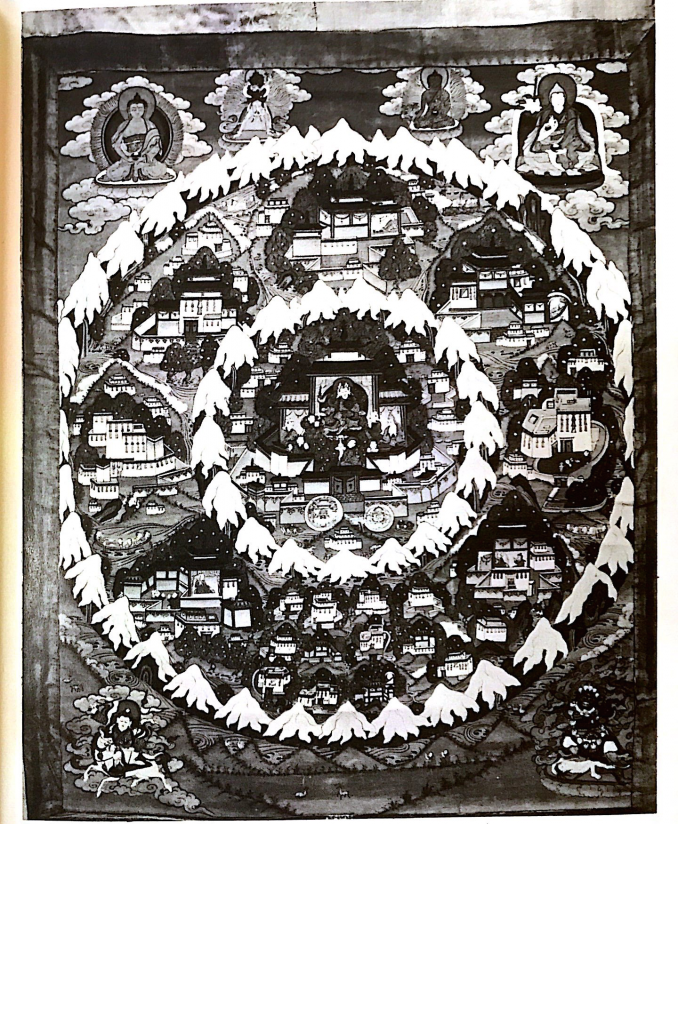
The Kingdom of Shambhala. Rudra Cakrin sits in the middle, surrounded by eight petal-shaped regions with their towns and principalities. Figures along the top from elft to right are: Amitabha Buddha, the Kalacakra Deity and consort, the Medicine Buddha, and the Third Panchen Lama. (Tibetan painting, Musée Guimet, Paris. Photograph from Musées Nationaux-Paris).
Taken from Edwin Berbaum’s The Way to Shambhala
Shambhala (Buddhist Pureland). At the center, shaped like an eight-petaled lotus and surrounded by snow mountains, is the capital city of Kalapa, where King Manjukirti sits. Lama Tsongkapa sits at the top center.
Taken from Himalayan Art

Above are two examples of attempts to visually depict the mythical kingdom, in accordance with the structure detailed in early religious textual descriptions of Shambhala but also in accordance with the shape of the mandala, as seen below.
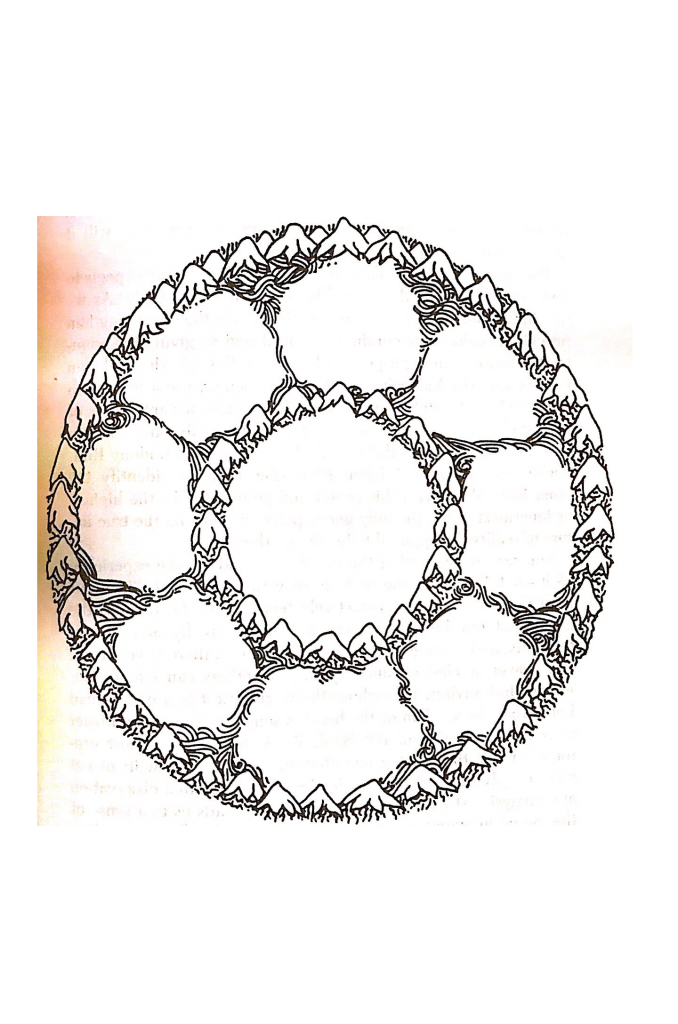
The eight-petaled lotus shape of Shambhala.
Taken from Edwin Berbaum’s The Way to Shambhala


The shape of Shambhala as a representation of deeper levels of the mind, the deepest being the dark circle at the center.
Taken from Edwin Berbaum’s The Way to Shambhala

Indeed, it was written that Shambhala is shaped like a giant lotus having eight petals (Fig 5), with a circle of great snow mountains around the outer perimeter and the perimeter of the pericarp. The interstices of the lotus petals are formed by rivers and snow mountains, and the entire land is covered with beautiful natural features such as lakes, meadows, and forests (Newman, “Brief History”, p. 54). By following the structure of the mandala, with its sacred center and symmetrically concentric circles, it is also implied that the kingdom of Shambhala embodies a structure to be applied to the cosmos, the body, and the mind (Brauen, 11). For example, in Fig 6, we see a visual representation of how the petal-shaped mandala resembles the levels of the mind, and that the deepest level is at the center, i.e. the place of enlightenment. The eight petals symbolize eight kinds of consciousness, which are shallow but merge into one profound awareness that experiences the truest form of reality without disruption. It is particularly apt for the kingdom of Shambhala to be depicted as such, for the myth and prophecy limits access to the kingdom only to those who are sufficiently spiritually enriched and enlightened. Visualizations of Shambhala, therefore, allow us to tap into our understanding of mandalas, whose most striking feature is their spatiality, to see Shambhala also as a spatio-spiritual metaphor for one’s inner kingdom. (Close readings of the Kalachakra texts will also yield this insight, but that is beyond the scope/capacity of this website’s project.) The strong parallels between the narrative of Shambhala and one’s spiritual journey could also be what lends Shambhala its religious potency.

These are only some of countless attempts to visually illustrate the imagination of Shambhala. Further research into the visualization of myth, the attempt to visually capture something formless, would be welcome, to open up discussions about the interaction between myths and visual representations.

The Kalachakra Tantra

If one were to define an “original” source for the mythology of Buddhist Shambhala, it would be the Sanskrit Kalachakra texts (or the Hindu Kalki of Shambhala myths), which came into being around the beginning of the 11th century. (The Sanskrit spelling was “Sambhala”, which Tibetans transliterated as “sham bha la”; for consistency’s sake, we follow “Shambhala” throughout the text of the website.)

Shambhala first appeared in the Hindu prophetic myth of Kalki in the Mahābhārata and the Purāṇas. In Hindu texts, the village of Shambhala was to be the birthplace of Kalki, the future messianic incarnation of Viṣṇu. Viṣṇu would incarnate as the pious Brahman warrior Kalki at the end of the current age of degeneration, and he would rid the earth of the impure while restoring social order (in terms of caste) and righteousness. This mythic prophecy was adapted into the Indian Buddhist Kalachakra Tantra literature; instead of a village, Shambhala would be a “mighty kingdom at the center of a vast empire consisting of ninety-six great lands and more than a billion villages” (Newman, “Itineraries”, p. 486). Similarly, the prophecy stated that, when the time comes, the last Buddhist chief, Raudra Cakrin, would lead Shambhala’s army in a great holy war to destroy the barbarians (in this case, the forces of Islam, as the myth was devised partly to respond to Muslim invasions into northwestern India at the time).


A depiction of Kalki, the future incarnation of Vishnu, the Hindu equivalent of the future King of Shambhala (Indian painting, National Museum, New Delhi) Taken from Edwin Berbaum’s The Way to Shambala

Some assume that, because the Buddhist myth of Shambhala is derived from the Hindu myth, it means that the Buddhist Shambhala must not exist. However, Newman notes that if we assume a Buddhist Shambhala existed at the time of the Sanskrit Kalachakra literature, one would be able to determine the historical entity it corresponded to (“A Brief History”, p. 83). From the Vimalaprabha we know that Shambhala is north of Tibet, Khotan, and China, and also that it is north of the Sita River (i.e. the Tarim River in Eastern Turkistan). He posits therefore that “Sambhala” could have been a special name for a Uighur kingdom in Khocho that flourished around 850-1250 (“A Brief History”, p. 84). Although this is still a speculation, it is important to dispel dismissive doubts that arise due to the complicated “origin” story of Shambhala.

The Kalacakra mandala (Tibetan painting, Namgyal Monastery, Dharamsala) Taken from Edwin Berbaum’s The Way to Shambhala

Explanation and in color.

What is worth noting is that Tibetan Buddhism had appropriated the myth and image of Shambhala from Hindu texts for their own religious and political purposes. The Kalachakra “countered the Muslim raids on northwest India with an apocolyptic vision of a holy war to be carried out by a bodhisattva messiah from Central Asia” (Newman, “Itineraries”, p. 487). At the “origin” of myth, therefore, was an act of appropriation, which is fitting as a way of making us question whether there can be a true singular “origin” for the myth of Shambhala or a pure and “original” Shambhala, which many have sought.

In her reframing of appropriation theory, Sponsler proposes focusing on “shifting processes of appropriation that produced those results now apparently fixed in ink or paint or stone,” “rather than on the finished product or source material where attention is more often directed” (21). Similarly, understanding how the myth of Shambhala has been appropriated as a cultural process, instead of focusing on the elusiveness of its source and its product, might be said to characterize the project of this website. This is especially given that there is no material space/product of Shambhala that we can analyze at the present moment, and, as we can see, even its “origins” appear culturally complex and non-singular. Thus, by looking at various representations, we are continuously focusing on the processes of its re-presentations and its re-appropriations, both of which may actually be the main methods of sacralization for a non-material space.

Itineraries

Itineraries, or lam yig, are a useful way of mentally visualizing space. This is especially so in the Tibetan context where space, place, person, and pilgrimage are conceptualized in ways that defy Anglophone categorizations (Huber, 83). It is therefore important to look at the earliest written itineraries to Shambhala, a supposedly non-material space, as these itineraries lend it both materiality in this world and abstract meanings in Buddhist theory.

John Newman identified three main itineraries to Shambhala: the rMi lam rdzun bshad sgyu ma’i sgra dbyangs chen mo (MLDS), the Kalāpāvatāra (KA), and the Shambha la’i lam yig of the third Paṇ chen Lama.

The MLDS is characterized by its matter-of-fact manner of describing the route to Shambhala, as if anyone could accomplish it by following the cartographical instructions. Meanwhile, the Kalāpāvatāra (KA) is much less straightforward than the MLDS, telling a convoluted story about with Avalokiteśvara as a central character, and Amoghāṅkuśa who describes the route to Kalāpa, the capital of Shambhala. The itinerary is therefore conveyed through narrative, with the itinerary itself being a journey through a spiritual realm. The descriptions of physical geography are hyperbolic and unrealistic, only meant to be obstacles to test the faith of those who search for Shambhala. In Newman’s words, “Any traveller can follow the path described by Man lung Guru; only an adept of tantric magic can hope to reach Kalāpa via the route described in the Kalāpāvatāra” (“Itineraries”, p. 490).

The most famous itinerary of Shambhala is the Shambha la’i lam yig written by the third Paṇ chen Lama (1738-1780), as it was the first to be translated into European languages. Still, most of the Pan chen Lama’s description is a restatement of the KA, thus it offers little new information on the itinerary. What is of interest is that the Pan chen Lama chose to opt for the “spiritual” account (in the spirit of the KA) rather than the “realist” one (in the spirit of the MLDS). He specifically notes that the MLDS is too easy to follow, and contradicts too much with the “authoritative” itinerary, the KA. Here, the spiritual was chosen over the real, the metaphysical over the physical. In order to protect Shambhala’s sanctity from non-Buddhists and barbarians, a spiritual barrier was lifted up in the Shambhala narrative itinerary (Newman, “Itineraries”, p. 491).

While this conclusion risks cutting along cultural lines too neatly, it was observed that Indian itineraries in Tibetan translation leaned on the side of the “spiritual”, foregoing the accuracy of physical geography; indigenous Tibetan lam yigs still favored “realism” and pragmatic guidebooks that were meant to be followed in reality (Newman, “Itineraries”, p. 493). This duality is still useful for understanding the ambivalence that Shambhala straddles and how that adds to its potency as a sacred space, being both accessible and inaccessible, worldly and unworldly, all at once. Its non-materiality gives it an additional spiritual leverage over material sacred spaces.

Even today, the 14th Dalai Lama continues this straddling by saying: “Although Shambhala is a place located somewhere on this planet, it is a place that can be seen only by those whose minds and karmic propensities are pure.” (His Holiness the 14th Dalai Lama, p. xvii) In one sentence, he reinforces both its material and spiritual reality, where the material reinforces its accessibility and the spiritual reinforces its exclusivity. As an abstract space, the possibilities of rhetoric surrounding it are endless.