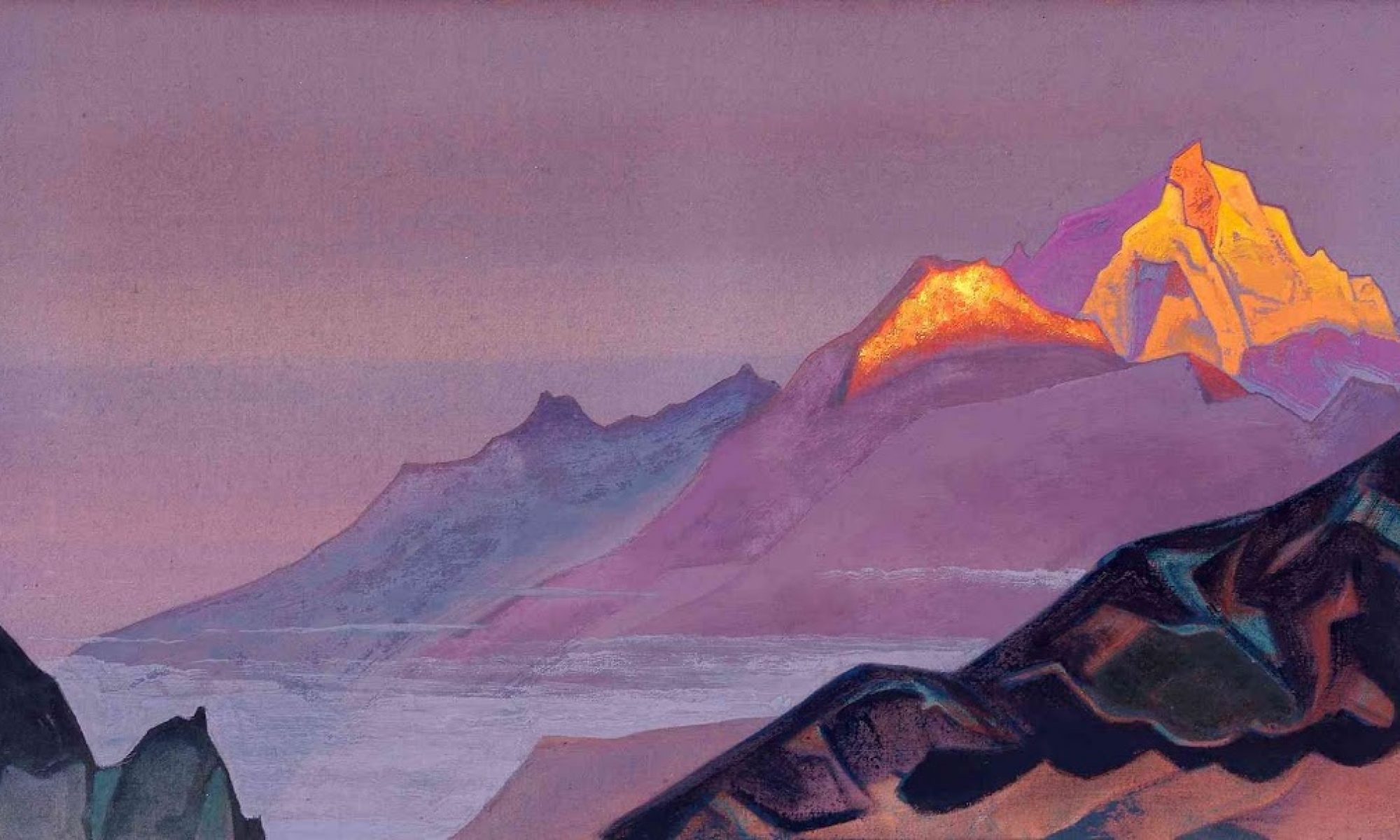
If one were to define an “original” source for the mythology of Buddhist Shambhala, it would be the Sanskrit Kalachakra texts (or the Hindu Kalki of Shambhala myths), which came into being around the beginning of the 11th century. (The Sanskrit spelling was “Sambhala”, which Tibetans transliterated as “sham bha la”; for consistency’s sake, we follow “Shambhala” throughout the text of the website.)
Shambhala first appeared in the Hindu prophetic myth of Kalki in the Mahābhārata and the Purāṇas. In Hindu texts, the village of Shambhala was to be the birthplace of Kalki, the future messianic incarnation of Viṣṇu. Viṣṇu would incarnate as the pious Brahman warrior Kalki at the end of the current age of degeneration, and he would rid the earth of the impure while restoring social order (in terms of caste) and righteousness. This mythic prophecy was adapted into the Indian Buddhist Kalachakra Tantra literature; instead of a village, Shambhala would be a “mighty kingdom at the center of a vast empire consisting of ninety-six great lands and more than a billion villages” (Newman, “Itineraries”, p. 486). Similarly, the prophecy stated that, when the time comes, the last Buddhist chief, Raudra Cakrin, would lead Shambhala’s army in a great holy war to destroy the barbarians (in this case, the forces of Islam, as the myth was devised partly to respond to Muslim invasions into northwestern India at the time).

Some assume that, because the Buddhist myth of Shambhala is derived from the Hindu myth, it means that the Buddhist Shambhala must not exist. However, Newman notes that if we assume a Buddhist Shambhala existed at the time of the Sanskrit Kalachakra literature, one would be able to determine the historical entity it corresponded to (“A Brief History”, p. 83). From the Vimalaprabha we know that Shambhala is north of Tibet, Khotan, and China, and also that it is north of the Sita River (i.e. the Tarim River in Eastern Turkistan). He posits therefore that “Sambhala” could have been a special name for a Uighur kingdom in Khocho that flourished around 850-1250 (“A Brief History”, p. 84). Although this is still a speculation, it is important to dispel dismissive doubts that arise due to the complicated “origin” story of Shambhala.

What is worth noting is that Tibetan Buddhism had appropriated the myth and image of Shambhala from Hindu texts for their own religious and political purposes. The Kalachakra “countered the Muslim raids on northwest India with an apocolyptic vision of a holy war to be carried out by a bodhisattva messiah from Central Asia” (Newman, “Itineraries”, p. 487). At the “origin” of myth, therefore, was an act of appropriation, which is fitting as a way of making us question whether there can be a true singular “origin” for the myth of Shambhala or a pure and “original” Shambhala, which many have sought.
In her reframing of appropriation theory, Sponsler proposes focusing on “shifting processes of appropriation that produced those results now apparently fixed in ink or paint or stone,” “rather than on the finished product or source material where attention is more often directed” (21). Similarly, understanding how the myth of Shambhala has been appropriated as a cultural process, instead of focusing on the elusiveness of its source and its product, might be said to characterize the project of this website. This is especially given that there is no material space/product of Shambhala that we can analyze at the present moment, and, as we can see, even its “origins” appear culturally complex and non-singular. Thus, by looking at various representations, we are continuously focusing on the processes of its re-presentations and its re-appropriations, both of which may actually be the main methods of sacralization for a non-material space.