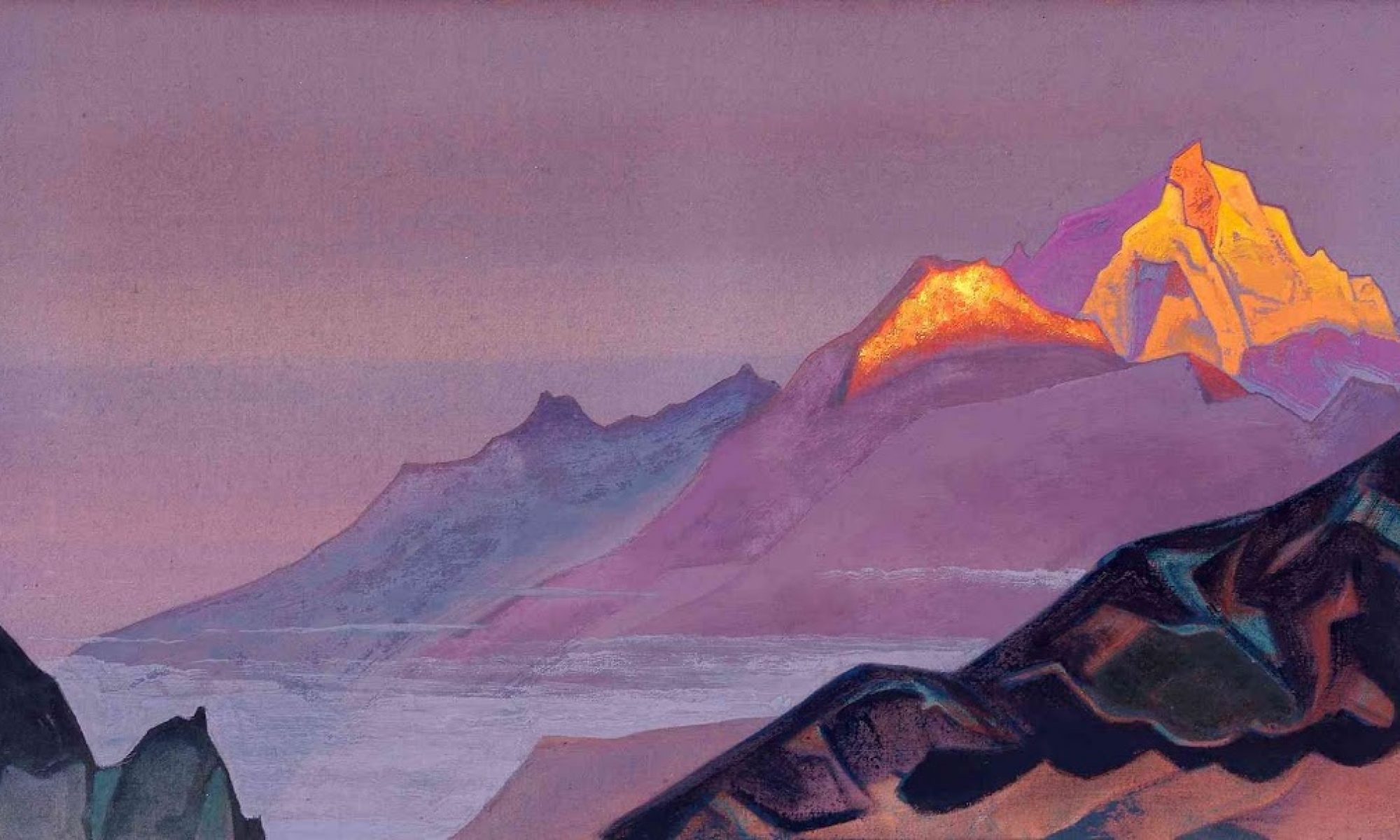
As can be seen from a very preliminary exposition and analysis of various representations of Shambhala/Shangri-la, imagination, and by extension appropriation, has a very crucial role in the sacralization and conceptualization of this sacred space. Although appropriation often bears a negative connotation in today’s discourses as something that the powerful exercise on minorities, this exposition has shown that it lies at the very “origin” of the Shambhala myth as well, as a Buddhist appropriation of a Hindu text. This came into play when foreign scholars were more interested in Tibet for its “deep freeze” of Sanskrit texts, seen as the authentic documents of Mahayana Buddhism while “indigenous” Tibetan religion was even seen as a debased practice (Lopez, 4). And even in the contemporary moment, Tibetans (in Tibet and in exile) are re-appropriating the imagery that has taken a life of its own outside of Tibet itself. It may thus be unfruitful to continue an elusive search for a point of origin or a true Shambhala (at least in the way it is often searched for). I would instead love to see more knowledgeable and established scholars investigate Shambhala at the level of representations and imageries without needing to pin it down to a single origin or even reality, especially in post-modern representations.
Still, it would be irresponsible to totally shirk off the problematic issue of rigid stereotypes and their perpetuation. As Lopez puts: “We are captives of confines of our own making, we are all prisoners of Shangri-La” (13). What he means by this is that we are all complicit in perpetuating the exoticization and imagery of Shangri-la and by so doing have locked ourselves in only being able to see it through such a lens. Tsering Shakya, one of the most prominent historians of modern Tibetan history, stated that, given the current political status of Tibet, the issue of representation of Tibet itself should not be taken so lightly given its political weight, in the following quote:
Once the myth has been sealed, it has an appearance of permanence and takes on a reality of its own. The danger is that Tibetans are also beginning to be seduced by the myth. The tendency is to promote the Tibetan political struggle in terms of the populism of the West, rather than the daily concerns of people in the streets of Lhasa, or of the nomads living in the high plateaus of the Himalayas. This is precisely the reason why the Tibetan issue is totally unknown outside the West. Tibet has not made any significant impact in Asia, South America or Africa. Even our closest neighbours, Nepal, Bhutan, Burma and India, remain oblivious to events in Tibet. The majority of Third World countries see Tibet as merely an instrument of Western political interest. As long as Tibet is considered to be merely an issue concerning sentiments of white people, then inevitably the Tibetan issue will never progress and will remain at the periphery of international concern.
Overall, at this point, Shambhala’s wide-ranging narratives and representations may have more to say about Tibet and our world than the elusive Shambhala itself. As a sacred space that deploys the potency of both the material and the imaginary, the concrete and the abstract, the fact and the mediated representation, and the religious and the secular, it has been uniquely appropriated, sacralized, and interacted with in ways that are on a different scale and plane from material sacred spaces in the world. Future scholarship into its various representations (literary, musical, textual, etc.) and their interpretations and effects (especially in the primary source language) would be highly anticipated.