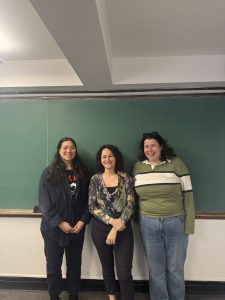
Julia Sherman and Sarah Bryden with Professor Hannah Farber. Photo courtesy of Julia and Sarah.
Research can be a lonely endeavor. Many of the crucial steps—reading, writing, mulling things over—are best executed individually. Spending excessive time pondering a niche, strange question can have an isolating effect. And long hours in the lab, library, or archive can eat into your social life.
But to our surprise, the authors of this blog post (Julia and Sarah) have found our senior thesis experience to be intensely collaborative. Both of us are students in Professor Hannah Farber’s seminar, where we meet weekly to workshop our history theses-in-progress. The class consists of twelve students working on a vast array of topics, from Americanization to cholera to the Orange Juice Boycott. Despite this range, our seminar is structured around peer feedback: as students, we all read one another’s drafts and offer constructive comments, in both written and verbal form. In addition, the seminar provides a learning experience through other topics. We have all enjoyed learning about our classmates’ research!
From our own experiences in this cohort, we can attest to the value of an approach like this. In receiving feedback, we’ve been able to troubleshoot issues as small as word choice and as overarching as chapter structure. By giving feedback, we’ve also learned to articulate our experiences as readers of historical writing– where an argument doesn’t make sense, where more context may be needed, where the writing has confused us, etc.. In turn, this has improved our own writing. Sometimes, it’s easier to learn how to refine a research question or structure historiography through the lens of your peers’ work. Editing each other allows us to look at our own work with a more critical lens,
One of the most helpful parts of roundtable peer feedback is the ability to step out of the myopic world of one’s thesis and look at it from classmates’ perspectives. I (Julia), am using a few different definitions of liberalism and conservatism throughout my paper. Although I use the same words to describe different movements and ideologies from varying perspectives, the political connotations are not always clear. Peer feedback from Professor Farber and the class has hugely helped me to define my terms more clearly, both in my historiography section and the body of the paper.
Similarly, I (Sarah) have had a lot of trouble with jargon and technical terms in my research; my peers have been a huge help in identifying where my writing becomes abstruse, and forcing me to explain what I mean in more concrete terms. Also, I can use my classmates’ reactions to gauge the overall coherence, persuasiveness, and importance of what I am writing. For example, when my peers tell me that a claim surprises them, I know I should present it more persuasively, and with some additional context.
In this series of blog posts, Sarah and Julia examine the role of collaboration in research, both as beneficiaries and researchers. To begin, we spoke with our seminar instructor, Professor Hannah Farber. Having supervised many thesis writers (and once been one herself!), she explained how she has seen students benefit from a collaborative approach to research and how students can best support each other through the thesis process.
Sarah Bryden and Julia Sherman: How would you classify your style as an adviser and professor of the seminar?
Hannah Farber: My core belief is that each student, with his or her unique academic background, mode of thinking, and psychology, has the capacity to be truly original. I encourage students to focus on dilemmas, paradoxes, dissatisfactions with existing research, and historical phenomena that confuse or amuse them. Humans are curious by nature. Let’s forget “finding the correct answer” for a while, and find a great problem!
In terms of the course itself: what I would say is that history writing involves a lot of very specific skills. My goal in the fall is to teach and talk about a bunch of these skills separately, like: reading scholarly works for their arguments, coming up with great paper titles, keeping a research journal, planning a workable writing schedule, locating primary sources, sending polite emails to archivists. By the time the students are immersed in thesis writing in the spring, they are, I hope, combining all of these skills together.
SB and JS: What do you see as the role for students in peer feedback as opposed to your role?
HF: History appears to be much more of a solitary discipline than it actually is. There is a reason that the history department structures its senior thesis as a course with a lot of peer support — you are learning to be historians, and historians depend on each other. Our works are mostly individually authored, but along the way, we get a lot of help. We are motivated by topics that we read about in books that others write. We seek to participate in a scholarly conversation with others who are interested in the same topic. We borrow methods from one another, and from scholars outside the discipline of history as well. We improve our work by receiving feedback from our own peers. As you write your senior thesis, you are moving out of a realm in which you seek to receive an “A” grade from one single instructor, and into a realm where you have to persuade a field that your discoveries, insights, and approaches are significant and valuable. You experience some of this when you assimilate peer feedback. I should also add that giving feedback also makes you a better writer. You often discover flaws in your own work by articulating what you feel is missing from the work of others, and you discover things in others’ work that you want to imitate, as well.
As the instructor for the course, I try to model modes of engagement, and to provide insight into disciplinary conventions and expectations that you simply are not yet in a position to know. Also, I give you your “A” grades, because somebody has to.
SB and JS: What does the thesis experience teach that no other experience in undergraduate does?
HF: Nothing compares to working with an unbounded set of archival materials for the first time. You have to find your own path. Your questions are your questions, and the entire world is the archive in which you will have to seek answers. You’re not cooking from a set of prepped ingredients, so to speak — you’ve got some cash to buy groceries, you’ve got memories of meals you have eaten in the past, and you’ve got a bare workspace. The senior thesis seminar is where you get the cooking tools.
SB and JS: How do you find your role as an undergraduate thesis adviser differ from that of a professor in a class or as a graduate dissertation adviser?
HF: Even in a lecture class, I try to present scholarship as a set of arguments — my own, and those of the scholars whose works I synthesize in my lectures. I try to talk through scholarly problems, because in my opinion, problems are more interesting and enlightening than answers. I myself had no interest in the discipline of history until I learned how much remained unknown and unanswered. That said, a lecture is fundamentally me telling stories to you, while the senior thesis requires you to come up with your own story that answers your own question. Graduate students are supposed to already be able to employ some of these skills, but the wonderful thing about a senior thesis class is that we get to teach them to you! A senior thesis class is also a much more contained situation than a graduate dissertation. I tell students that a senior thesis is defined as the research paper you can complete by the end of the spring term. The best thing I can do is to show them a few senior theses and tell them “look! Here is what students like you were able to do!” Sometimes it’s just mind-blowing.
SB and JS: What are the best ways you have found for students to support each other, both structured via the class or outside of the classroom?
Inside the classroom, I model how to engage with rough drafts: how do we ask certain kinds of questions, how do we formulate certain kinds of critiques. I try to create an atmosphere of trust, because presenting your research is very vulnerable. I try to express to students that I am like their doctor — I don’t bring up problems in drafts to judge them, or to evaluate the work as “good” or “bad,” only to try to improve it from where it is at. I have had only good experiences with Columbia students in doing this. You all really rise to the occasion. Outside of the classroom, there are always some happy loners (introverts thrive as history majors!), but I have found that most students like feeling solidarity via Whatsapp groups or late at night in Butler. Grumbling and whining in a group chat is an important part of writing. Be as dramatic as you want, get it all out, and then bring your best attitude to class in the morning.
SB and JS: What type of dynamic within the classroom or within the cohort works best to produce the best theses and the best process, and why?
HF: As I said above, we all just have to be brave, just like professional scholars do when they present their own works in progress. Most of the scholarship you all do is outside of my area of expertise. I admit when I don’t know something. I sometimes articulate my critiques poorly, and ask the students to serve as my own peers and help me figure out what I’m trying to say. I also try to offer positive encouragement, because it’s not just that students can’t always see where their papers are going wrong. They also can’t always see where their papers are going right! It’s great to be able to say “this is an incredible finding” or “you articulated this really well.” And it feels even better when you all say those kinds of things to each other.
SB and JS: Are there any common mistakes you see students make at different points in the process?
HF: History writing is slow, and the most important mistake I see students making is underestimating the time that it takes to produce a good prospectus. A good prospectus lays out a significant, specific, answerable research question, and you have to have done a lot of research already to produce a question like that. Each year I implore students to start investing time in this preliminary research as soon as possible, but sometimes people just have to experience that “oh, ****” feeling for themselves.
SB and JS: When you were in undergrad, and later doing your PhD, how did collaboration with peers help your research process?
HF: My senior thesis in history at Yale was what inspired me to seek out graduate study in history. At that time, what I thrived on was autonomy rather than collaboration. I fell in love with the feeling of being a lonely detective, solving tiny forgotten mysteries, and going to places I had never been before. I ended up in Portland, Maine, in the middle of winter, being driven around the city’s icy cliffs at unsettling speed by an enthusiastic octogenarian genealogist.
During my Ph.D., by contrast, a great cohort of scholars at UC-Berkeley served as peer mentors and interlocutors for me as I advanced through the degree. My peers and I traded book recommendations and suggested methodologies to one another, provided emotional support to each other, read one another’s rough drafts, and helped one another understand complicated scholarly arguments. Many of us are still in touch. It was an unforgettable experience.
Sarah Bryden, CC’26 and Julia Sherman, CC’26